1994 BUICK CENTURY air condition
[x] Cancel search: air conditionPage 232 of 308
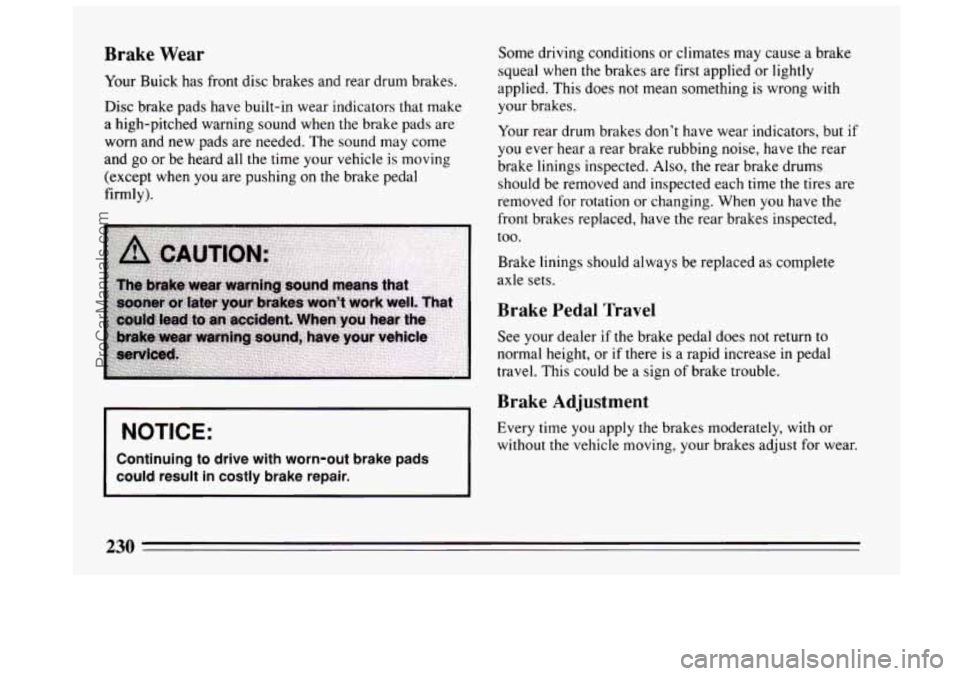
Brake Wear
Your Buick has front disc brakes and rear drum brakes.
Disc brake pads have built-in wear indicators that make
a high-pitched warning sound when the brake pads are
worn and new pads are needed. The sound may come
and
go or be heard all the time your vehicle is moving
(except when
you are pushing on the brake pedal
firmly).
Continuing to drive with worn-out brake pads
could result in costly brake repair.
Some driving conditions or climates may cause a brake
squeal when the brakes are first applied or lightly
applied. This does not mean something
is wrong with
your brakes.
Your rear drum brakes don’t have wear indicators, but if
you ever hear a rear brake rubbing noise, have the rear
brake linings inspected. Also, the rear brake drums
should be removed and inspected each time the tires are
removed for rotation or changing. When you have the
front brakes replaced, have the rear brakes inspected,
too.
Brake linings should always be replaced as complete
axle sets.
Brake Pedal Travel
See your dealer if the brake pedal does not return to
normal height, or
if there is a rapid increase in pedal
travel. This could be a sign of brake trouble.
Brake Adjustment
Every time you apply the brakes moderately, with or
without the vehicle moving, your brakes adjust for wear.
230
ProCarManuals.com
Page 245 of 308

Temperature - A, B, C
The temperature grades are A (the highest), B, and C,
representing the tire’s resistance to the generation of
heat and its ability to dissipate heat when tested under
controlled conditions
on a specified indoor laboratory
test wheel. Sustained high temperature can cause the
material of
the tire to degenerate and reduce tire life, and
excessive temperature can lead
to sudden tire failure.
The grade
C corresponds to a level of performance
which all passenger car tires must meet under the
Federal Motor Vehicle Safety Standard
No. 109. Grades
B and A represent higher levels of performance on the
laboratory test wheel than the minimum required by law.
Warning: The temperature grade for
this tire is
established for a tire that is properly inflated and not
overloaded. Excessive speed, underinflation, or
excessive loading, either separately or in combination,
can cause heat buildup and possible tire failure.
These grades are molded
on the sidewalls of passenger
car tires.
While the tires available as standard or optional
equipment
on General Motors vehicles may vary with
respect to these grades, all such tires meet General
Motors performance standards and have been approved
for use
on General Motors vehicles. All passenger type
(P Metric) tires must conform to Federal safety
requirements in addition to these grades.
Wheel Alignment and Tire Balance
The wheels on your vehicle were aligned and balanced
carefully
at the factory to give you the longest tire life
and best overall performance.
In most cases, you will not need to have your wheels
aligned again. However, if
you notice unusual tire wear
or your vehicle pulling one way or the other, the
alignment may need
to be reset. If you notice your
vehicle vibrating when driving on a smooth road, your
wheels may need to be rebalanced.
Wheel Replacement
Replace any wheel that is bent, cracked or badly rusted.
If wheel nuts keep coming loose, the wheel, wheel bolts,
and wheel nuts should be replaced. If the wheel leaks
air, replace it (except some aluminum wheels, which can
sometimes be repaired). See your Buick dealer if any of
these conditions
exist.
Your dealer will know the kind of wheel you need.
Each new wheel should have the same load carrying
capacity, diameter, width, offset, and be mounted the same way as
the one it replaces.
243
ProCarManuals.com
Page 253 of 308

Finish Damage
Any stone chips, fractures or deep scratches in the finish
should be repaired right away. Bare metal will corrode
quickly and may develop into a major repair expense.
Minor chips and scratches can be repaired with touch-up
materials available from your dealer or other service
outlets. Larger areas
of finish damage can be corrected
in your dealer’s body and paint shop.
Underbody Maintenance
Chemicals used for ice and snow removal and dust
control can collect on the underbody. If these are not
removed, accelerated corrosion (rust) can occur
on the
underbody parts such as fuel lines, frame, floor pan, and
exhaust system even though they have corrosion
protection.
At least every spring, flush these materials from the
underbody with plain water. Clean any areas where mud and other debris can collect.
Dirt packed in closed areas
of the frame should be loosened before being flushed.
Your dealer or an underbody vehicle washing system
can do this for you.
Chemical Paint Spotting
Some weather and atmospheric conditions can create a
chemical fallout. Airborne pollutants can fall upon and
attack painted surfaces on your vehicle. This damage
can take two forms: blotchy, ringlet-shaped
discolorations, and small irregular dark spots etched into
the paint surface.
Although no defect in the paint job causes this, Buick
will repair, at no charge to the owner, the surfaces of
new vehicles damaged by this fallout condition within
12 months or 12,000 miles (20
000 km) of purchase,
whichever comes first.
251
ProCarManuals.com
Page 257 of 308

r Fuse Usage
I
Fuse Amp Circuitry
1 15 ECM, MAF Sensor (3 100 Engine only)
2 20 ECM Injectors/Coil
3
4
5
6
7
8
9
10
11
12
13
14
15
I 16
5
15
10
20
20
10
20 20
30"
5
10
30"
25
20
Automatic Door LockAJnlock
Turn Signal Flasher, Back-up Lights, Trunkbiftgate Release
Supplemental Inflatable Restraint (Air Bag)
Tail, Park, Side Marker, License Plate, Stop/Turn Signal Heater/Air Conditioner
Gages, Warning Indicators, Torque Convert Clutch, Audible Warning\
System, Computer Command
Control, Trunk Release, Brake Warning Indicator, Rear Defog Swit\
ch, Speedometer
Stop Lights, Hazard Flashers
Interior, Underhood, Courtesy,
I/P, Trunk Lights, Door Locks, Horn Relay, Passive Restraint System, \
Deck
Lid Release, Power Antenna
Liftgate Release, Power Windows
Illumination for:
I/P, Radio, Pod Lights, Ashtray, Console Light, Heater-A/C Control, D\
efog Switch,
Headlight Switch
Radio, Cruise Control
Seats, Door Locks, Rear Defog
Windshield WipefWash
Cigarette Lighter
255
ProCarManuals.com
Page 260 of 308

~ ~~~ Replaceable Light Bulbs
Application Number
Exterior
Back-up Lamps ........................ 1156
Center High-Mounted Stoplamp Except Luggage Carrier Mounted
........ 1 141
Front Parking/Tum Signal Lamps
.......... 2057
Headlamps Low-Beam
.......................... 9006
High-Beam
.......................... 9005
License Plate Lamps
..................... 194
Rear Tail/Stop/Turn Signal Lamps
......... 2057
Tail Lamp Only
....................... 194
Tail/Stop Only
........................ 194
Front
................................ 194
Rear
................................. 24
Underhood Lamp
....................... 56 1
Luggage Carrier Mounted ............... 577
Sidemarker Lamps
Application Number
Interior
Air Conditioner/Heater Controls .......... T- 1 . 0
Ashtray ............................... 194
Cluster Lighting
........................ 161
Courtesy Lamps
........................ 561
Dome
............................... 2 1 1-2
Dome Courtesy
....................... 214-2
Domemeading Lamps
.................... 906
Gear Selector Indicator
................. 194G
GloveBox
............................. 174
Indicator Lamps
........................ 194
Indicator Lamp
. SRS .................... 195
Rear Compartment Lid Lamp
............. 1003
Rear Dome
. Wagon ................... 211-2
Turn Signal Indicators
.................... 194
Vanity Mirror
.......................... 124
Headlamp High-Beam
Indicator
............ 194
Map
.................................. 168
258
ProCarManuals.com
Page 261 of 308

Capacities and Specifications
Engine Code 3100 MFI V6 Code M (L82)
Belt Tensions - Fuel Tank Capacity -
Automatically controlled by a self-tensioning idler 16.5 gallons/62.6 liters
pulley. Tension adjustment should never be
Automatic Transaxle Capacity -
(4T60-E) 4-Speed
necessary.
Complete System
- 1 1.6 quarts/l0.9 1
Cooling System Capacity -
Crankcase Capacity (Less Filter) -
4 quarts/3.8 liters iters
Air
Conditioning Refrigerant Capacity (R-134a) -
2.0 lbs. (0.90 kilograms)
Not all air conditioning refrigerants are the same.
If the air conditioning system
in your vehicle
needs refrigerant, be sure
the proper refrigerant
is used.
If you’re not sure ask your Buick dealer.
For additional information, see your “Warranty
and Owner Assistance Information’’ booklet. Pan
Removal and Replacement
-
6 quarts/5.7 liters
8 quarts/7.6 liters
After
Complete Overhaul
-
Maintenance Item Part Numbers -
Air Filter - A1233C
Fuel Filter
- GF580A
Oil Filter
- PF47
PCV Valve
- CV892C
Spark Plug
- R44LTSM6, GAP 0.60” (1 SOmm)
3 rn
ProCarManuals.com
Page 262 of 308

Capacities and Specifications
I
I Engine Code 4 (LN2) 2.2L L4 PFI
Belt Tensions -
Automatically controlled by an idler pulley.
Tension adjustment should never be necessary.
Cooling System Capacity -
Complete System - 8.74 quarts/8.27 liters
Crankcase Capacity (Less Filter) -
4 quarts/3.8 liters
Air Conditioning Refrigerant Capacity (R-134a) -
1.75 lbs. (.79 kilograms)
Not all air conditioning refrigerants are
the same.
If the air conditioning system in your vehicle
needs refrigerant, be sure the proper refrigerant
is used.
If you’re not sure ask your Buick dealer.
For additional information, see your “Warranty
and Owner Assistance Information” booklet.
Fuel Tank Capacity -
Automatic Transaxle Capacity -
16.5 gallons/62.6 liters
(3T40) 3-Speed
Pan Removal and Replacement
-
After Complete Overhaul - 7 quarts/6.6 liters
4 quarts/3.8 liters
Maintenance Item Part Numbers -
Air Filter - A905C
Oil Filter - PF47
PCV Valve - CV9OOC
Spark Plug
- 41-908, GAP 0.06” (1.502mm)
260
ProCarManuals.com
Page 265 of 308

Your Vehicle and the Environment
Proper vehicle maintenance not only helps to keep your
vehicle in good working condition, but also helps the
environment. All recommended maintenance procedures
are important. Improper vehicle maintenance
or the
removal of important components can significantly
affect the quality of the air
we breathe. Improper fluid
levels or even the wrong tire inflation can increase the
level of emissions from your vehicle.
To help protect
our environment, and to help keep your vehicle in good
condition, please maintain your vehicle properly.
How This Part is Organized
The remainder of this part is divided into five sections:
“Section
A: Scheduled Maintenance Services” shows
what to have done and how often. Some of these
services can be complex,
so unless you are technically
qualified and have the necessary equipment,
you should
let your dealer’s service department or another qualified
service center do these jobs. If you
are skilled enough to do some work on your
vehicle, you will probably want to get the service
information
GM publishes. You will find a list of
publications and how
to get them in this manual. See
“Service Publications’’
in the Index.
“Section
B: Owner Checks and Services” tells you what
should be checked whenever
you stop for fuel. It also
explains what you can easily do to help keep
your
vehicle in good condition.
263
ProCarManuals.com