1993 PONTIAC GRAND-AM change wheel
[x] Cancel search: change wheelPage 71 of 306

Features & Controls
Turn Signal and Lane Change
Indicator
(CONT.)
To signal a lane change, just raise or
lower the lever until the green arrow
starts to flash. Hold it there until you
complete your lane change. The lever
will return by itself when you release
it.
As you signal a turn or a lane change, if
the arrows don’t flash but just stay on, a
signal bulb may be burned out and other
drivers won’t see your turn signal.
If a bulb is burned out, replace
it to help
avoid an accident. If the green arrows
don’t
go on at all when you signal a
turn, check the fuse (see the Index under
Fuses & Circuit Breakers) and for
burned-out bulbs.
70
Cruise Control (OPTION)
With cruise control, you can maintain a.
speed
of about 25 mph (40 km/h) or
more without keeping your foot
on the
accelerator. This can really help on long
trips. Cruise control does
not work at
speeds below about
25 mph (40 km/h).
When
you apply your brake or the
clutch pedal, the cruise control
shuts
off. I
I CAUTION
IL
A 0 Cruise control can be
dangerous where you can’t
drive safely
at a steady speed.
So, don’t use your cruise control ‘
on winding roads ofin heavy
traff1C.
I
0 Cruise control can be dangerous
on slippery roads. On such
roads, fast changes
in tire
traction can cause needless wheel
1 spinnin&and you could lose
control.
Don’t use cruise control
on slippery roads.
I
ProCarManuals.com
Page 133 of 306
...
Your Driving and the Road
Anti-Lock Brakes (CONT.)
After an ABS stop, you may also hear a
clicking noise the next time the vehicle
reaches about
4 mph (6 km/h).
If there’s a problem with the anti-lock
brake system, the anti-lock brake system
warning light will stay
on or flash.
See the
Index under Anti-Lock Brake
System Warning Light.
132
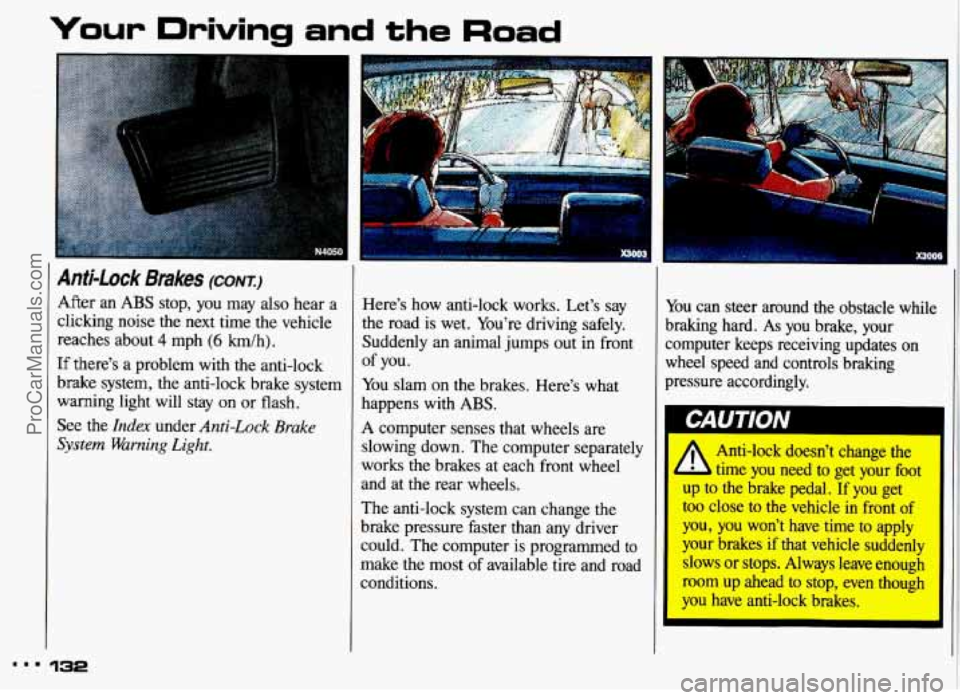
Here’s how anti-lock works. Let’s say
the road is wet. You’re driving safely.
Suddenly an animal jumps out in front
You slam on the brakes. Here’s what
happens with ABS.
A computer senses that wheels are
slowing down. The computer separately
works the brakes at each front wheel
and at the rear wheels.
The anti-lock system can change the
of you.
brake pressure faster than any driver
could. The computer
is programmed to
make the most
of available tire and road
conditions. You
can steer around the obstacle while
braking hard.
As you brake, your
computer keeps receiving updates on
wheel speed and controls braking
pressure accordingly.
Anti-lock doesn’t change the
time you need
to get your foot
the brake pedal. If you get
too close to the vehicle in front
of
I you, you won’t have time to apply
your brakes
if that vehicle suddenly
slows or stops. Always leave enough
room up ahead to stop, even though
you have anti-lock brakes.
ProCarManuals.com
Page 137 of 306
Your Driving and the Road
Variable Effort Steering (omoN)
This steering system provides lighter
steering effort for parking and at low
vehicle speeds. Steering effort will
increase at higher
speeds for improved
road feel.
Steering Tips-Driving on Curves
It’s important to take curves at a
reasonable speed.
A lot of the “driver lost control”
accidents mentioned on the
news happen
on curves. Here’s why:
Experienced driver or beginner, each
of
us is subject to the same laws of physics
when driving on curves. The traction of
the tires against the road surface makes
it possible for the vehicle to change its
path when you
turn the front wheels. If
there’s no traction, inertia will keep the
vehicle going in the same direction. If
you’ve ever tried to steer a vehicle on
wet ice, you’ll understand this. The traction
you
can get in a curve
depends on the condition of your tires
and the road surface, the angle at which
the curve is banked, and your speed.
While you’re
in a curve, speed is the
one factor you can control.
Suppose you’re steering through
a sharp
curve. Then you suddenly accelerate. Those
two control systems-steering
and acceleration-can overwhelm those
places where the tires meet the road and make you lose control.
What should you do if this ever
happens? Let up on the accelerator
pedal, steer the vehicle the way you
want it to go, and slow down.
8.8 136
ProCarManuals.com
Page 142 of 306
Skidding
In a skid, a driver can lose control of
the vehicle. Defensive drivers avoid
most skids by taking reasonable care
suited to existing conditions, and by not
“overdriving” those conditions. But
skids are always possible.
The three types of skids correspond to
your Pontiac’s three control systems.
In
the braking skid your wheels aren’t
rolling.
In the steering or cornering
skid, too much speed or steering in a
curve causes tires to slip and lose cornering force. And in the acceleration
skid too much throttle causes the driving
wheels to spin. A
cornering skid and an acceleration
skid are best handled by easing your
foot
off the accelerator pedal. If your
vehicle starts to slide (as when you turn
a corner on a wet, snow- or ice-covered
road), ease your foot off the accelerator
pedal as soon as you feel the vehicle
start to slide. Quickly steer the way you
want the vehicle to go.
If you start
steering quickly enough, your vehicle
will straighten out. As it does, straighten
the front wheels.
Of course, traction is reduced when
water, snow, ice, gravel, or other
material is on the road. For safety, you’ll
want to slow down and adjust your
driving to these conditions. It is
important to slow down on slippery surfaces because stopping distance will
be longer and vehicle control more
limited. While driving on
a surface with reduced
traction, try your best to avoid sudden
steering, acceleration, or braking
(including engine braking by shifting to
a lower gear). Any sudden change could
cause the tires to slide.
You may not
realize the surface is slippery until your
vehicle is skidding. Learn to recognize
warning clues-such as enough water,
ice or packed snow
on the road to make
a “mirrored surface”-and slow down
when you have any doubt.
Remember: Any anti-lock braking
system
(ABS) helps avoid only the
braking skid.
141
ProCarManuals.com
Page 152 of 306
Here are some things you can check
before a trip:
Windshield Washer Fluid: Is the
reservoir full? Are all windows clean
inside and outside?
shape?
Have you checked all levels?
lenses clean?
safe, trouble-free trip.
Is the tread
good enough for long-distance
driving? Are the tires all inflated to
the recommended pressure?
weather outlook along your route? Should you delay your trip a short
time to avoid a major storm system?
Maps: Do you have up-to-date maps?
Wiper Blades: Are they in good
Fuel, Engine Oil, Other Fluids:
Lights: Are they all working? Are the
Tires: They are vitally important to a
Weather Forecasts: What’s the
On the Road
Unless you are the only driver, it is
good to share the driving task with
others. Limit
turns behind the wheel to
about
100 miles (160 km) or two hours
at a sitting. Then, either change drivers
or stop for some refreshment like coffee,
tea or
soft drinks and some. limbering
up. But do stop and move around. Eat
lightly along the way. Heavier meals
tend to make some people sleepy.
On two-lane highways or undivided
multilane highways that do not have
controlled access, you’ll want to watch
for some situations not usually found on
freeways. Examples are: stop signs and
signals, shopping centers with direct
access to the highway, no passing zones
and school zones, vehicles turning left
and right off the road, pedestrians,
cyclists, parked vehicles, and even
animals.
Highway Hypnosis
Is there actually such a condition as
“highway hypnosis”? Or is it just plain
falling asleep at the wheel?
Call it
highway hypnosis, lack of awareness, or
whatever.
There is something about an easy stretch
of road with the same scenery, along
with the hum of the tires on the road,
the drone of the engine, and the rush
of
the wind against the vehicle that can
make you sleepy. Don’t let it happen
to
you! If it does, your vehicle can leave
the road
in less than a second, and you
could crash and be injured.
What can you do about highway
hypnosis? First, be aware that it can
happen.
Then here are some tips:
Make sure your vehicle is well
ventilated, with a comfortably cool
interior.
151 ...
ProCarManuals.com
Page 161 of 306
Your Driving and the Road
Towing a mailer (CONTJ
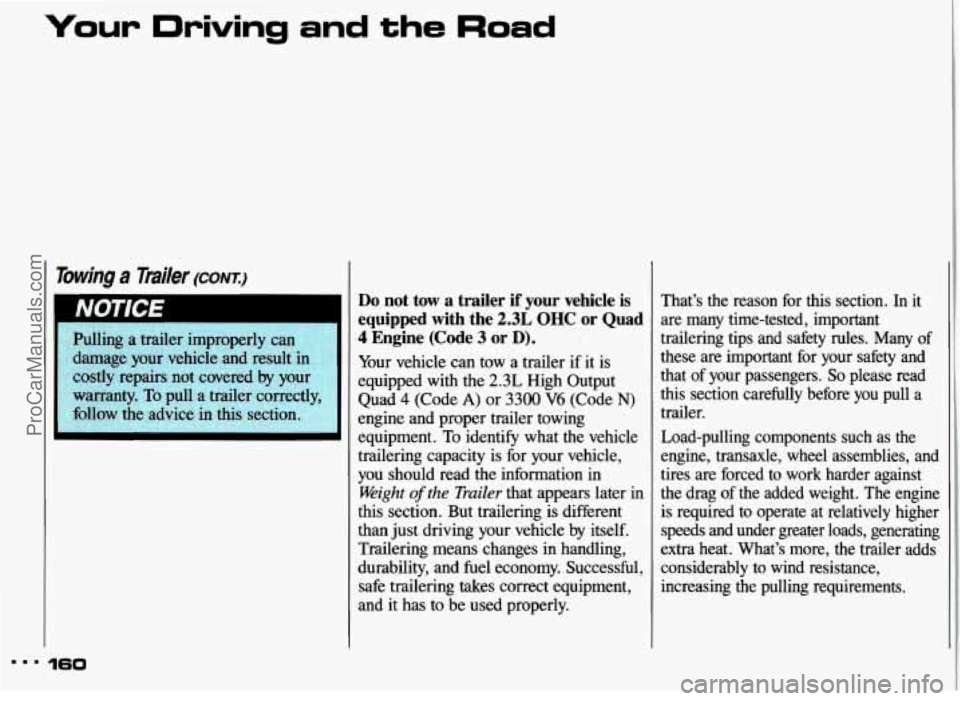
Pulling a trailer improperly can :i+-a .,, >
damage your vehicle and result inf. i,$i
costly repairs not covered by you$.<; .:
warranty. To pull a trailer correct&$; ’:
follow the advice in this section. ,,
’ ,,, . .
, , :i!
Do not tow a trailer if your vehicle is
equipped with the
2.3L OHC or Quad
4 Engine (Code 3 or D).
Your vehicle can tow a trailer if it is
equipped with the
2.3L High Output
Quad
4 (Code A) or 3300 V6 (Code N)
engine and proper trailer towing
equipment. To identify what the vehicle
trailering capacity is for your vehicle,
you should read the information
in
Weight of the Trailer that appears later in
this section. But trailering is different
than just driving your vehicle by itself.
Trailering means changes in handling,
durability, and fuel economy. Successful, safe trailering
takes correct equipment,
and it has to be used properly. That’s the reason for this section.
In it
are many time-tested, important
trailering tips and safety rules. Many
of
these are important for your safety and
that of your passengers.
So please read
this section carefully before you pull a
trailer.
Load-pulling components such as the
engine, transaxle, wheel assemblies, and
tires are forced to work harder against
the drag
of the added weight. The engine
is required to operate at relatively higher
speeds and under greater loads, generating
extra heat. What’s more, the trailer adds
considerably to wind resistance,
increasing the pulling requirements.
... 160
ProCarManuals.com
Page 166 of 306

Turn Signals When Towing a ’Railer
When you tow a trailer, your vehicle has
to have a different turn signal flasher
and extra wiring. The green arrows on
your instrument panel will flash
whenever you signal a
turn or lane
change. Properly hooked up, the trailer
lights will also flash, telling other drivers you’re about to turn, change
lanes or stop.
When towing a trailer, the green arrows
on your instrument panel will flash for
turns even if the bulbs on the trailer are
burned out. Thus, you may think drivers
behind you are seeing your signal when
they are not. It’s important to check occasionally to be sure the trailer bulbs
are still working.
Driving On Grades
Reduce speed and shift to a lower gear
before you start down a long or steep
downgrade. If you don’t shift down, you
might have to use your brakes
so much
that they would get hot and no longer work well.
On a long uphill grade, use the highest
gear possible. If you cannot maintain
posted speeds, driving at a lower speed
may help avoid overheating your engine
and transaxle.
If you have a manual transaxle with
fifth
gear, it’s better not to use fifth gear. Just
drive in fourth gear (or, as you need to,
a lower gear).
Parking on Hills
You really should not park your vehicle,
with a trailer attached,
on a hill. If
something goes wrong, your rig could
start to move. People can be injured,
and both your vehicle and the trailer can
be damaged.
But if you ever have to park your rig on
a hill, here’s how to do it:
1. Apply your regular brakes, but don’t
shift into
P (Park) yet, or into gear
for a manual transaxle.
2. Have someone place chocks under
the trailer wheels.
3. When the wheel chocks are in place,
release the regular brakes until the chocks absorb the load.
165 DDD
ProCarManuals.com
Page 176 of 306

12. Remove the cables in reverse order
to prevent electrical shorting. Take
care that they don't touch each other
or any other metal.
lowing %ur Pontiac
Try to have a GM dealer or a
professional towing service tow your
Pontiac. The usual towing equipment is:
(A) Sling-type tow truck
(B) Wheel-lift tow truck
(C) Car carrier
If your vehicle has been changed or
modified since it was hctory-new
by
adding aftermarket items like fog lamps,
aero
skirting, or special tires and
wheels, these instructions and illustrations may not be correct.
Before you do anything,
turn on the
hazard warning flashers. When
you call,
tell the towing service:
That your vehicle cannot be towed
fram the front or rear with sling-type
equipment, as described later
in this
section.
drive. vehicle.
lever. damaged.
That your vehicle has front-wheel
The make, model, and year of your
Whether you can still move the shift
If there was an accident, what was
When the towing service arrives, let the
tow operator know that
this manual
contains detailed towing instructions and
illustrations.
The operator may want to
see them.
175 I..
ProCarManuals.com