1993 PONTIAC BONNEVILLE lane
[x] Cancel search: lanePage 74 of 322
Tilt Steering Wheel
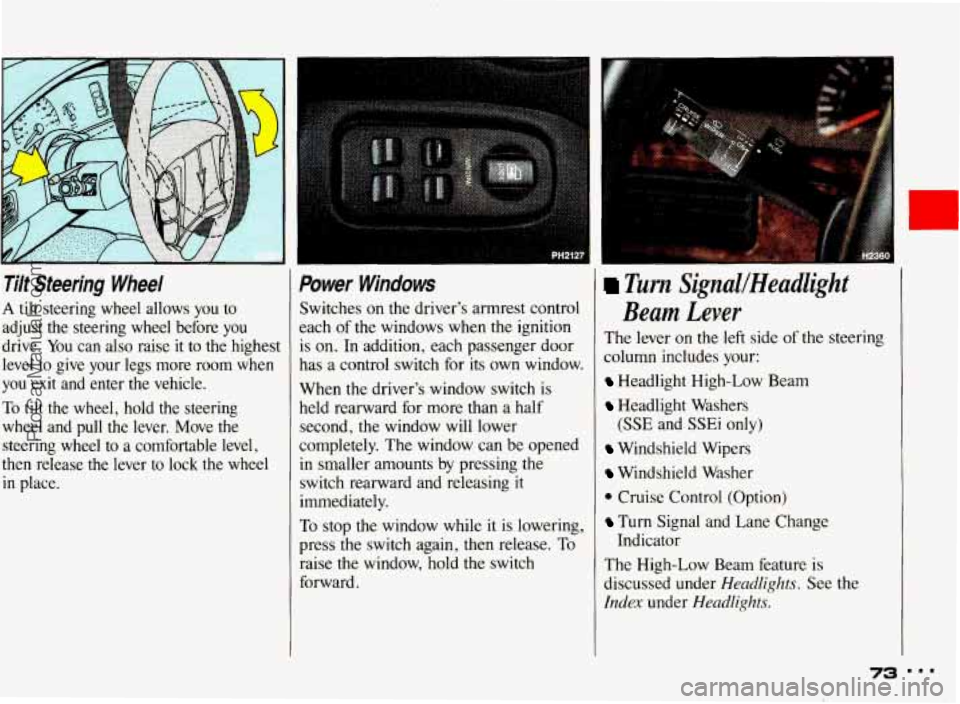
A tilt steering wheel allows you to
adjust the steering wheel before you
drive. You can
also raise it to the highest
level to give your legs more room when
you
exit and enter the vehicle.
To tilt the wheel, hold the steering
wheel and
pull the lever. Move the
steering wheel to a comfortable level,
then release the lever
to lock the wheel
in place.
Power Windows
Switches on the driver’s armrest control
each
of the windows when the ignition
is
on. In addition, each passenger door
has a control switch for its own window.
When the driver’s window switch is
held rearward for more than a half
second, the window will lower
completely. The window can be opened
in smaller amounts by pressing the
switch rearward and releasing it
immediately.
To stop the window while it is lowering,
press the switch again, then release.
To
raise the window, hold the switch
forward.
r
Turn SignallHeadlight
Beam Lever
The lever on the left side of the steering
column includes your:
Headlight High-Low Beam
Headlight Washers
Windshield Wipers
Windshield Washer
0 Cruise Control (Option)
Turn Signal and Lane Change
The High-Low Beam feature is
discussed under
Headlights. See the
Index under Headlights.
(SSE and SSEi only)
Indicator
73 ==.
t ProCarManuals.com
Page 75 of 322
Features & Controls
Turn Signal and Lane Change
Indicator
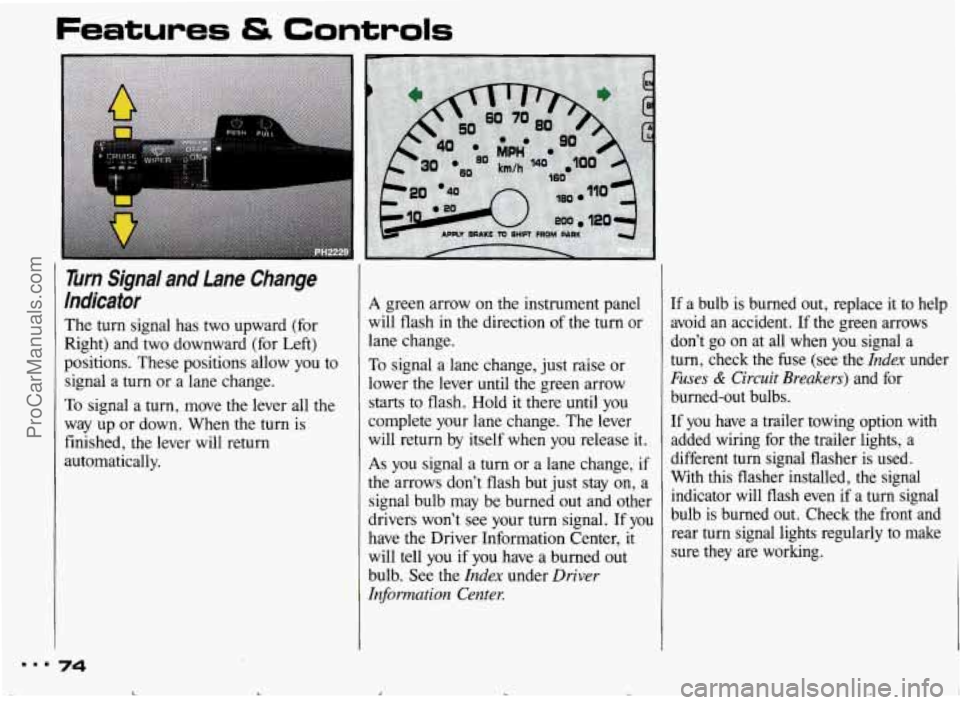
The turn signal has two upward (for
Right) and two downward (for Left)
positions. These positions allow you to
signal a turn or a lane change.
To signal a turn, move the lever all the
way up or down. When the turn is
finished, the lever will return
automatically.
A green arrow on the instrument panel
will flash in the direction of the turn or
lane change.
To signal a lane change, just raise or
lower the lever until the green arrow
starts to flash. Hold it there until you
complete your lane change. The lever
will return by itself when you release
it.
As you signal a turn or a lane change, if
the arrows don’t flash but just stay
on, a
signal bulb may be burned out and other
drivers won’t see your turn signal.
If you
have the Driver Information Center, it
will tell you if you have a burned out
bulb. See the
Index under Driver
Information
Center.
If a bulb is burned out, replace it to help
avoid an accident.
If the green arrows
don’t go on at all when you signal a
turn, check the fuse (see the
Index under
Fuses & Circuit Breakers) and for
burned-out bulbs.
If you have a trailer towing option with
added wiring for the trailer lights, a
different
turn signal flasher is used.
With this flasher installed, the signal
indicator will flash even if a
turn signal
bulb is burned out. Check the front and
rear turn signal lights regularly to make
sure they are working.
... 74
.. c L ProCarManuals.com
Page 88 of 322
El 030 I
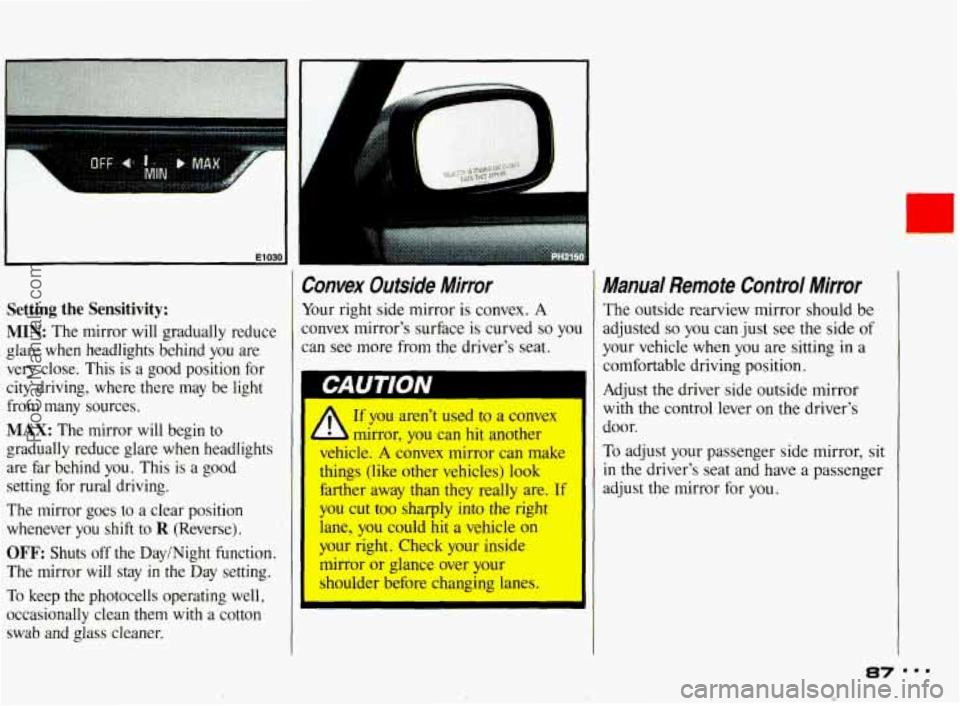
Setting the Sensitivity:
MIN: The mirror will gradually reduce
glare when headlights behind you are
very close. This is a good position for
city driving, where there may be light
from many sources.
MAX: The mirror will begin to
gradually reduce glare when headlights
are far behind you. This is
a good
setting for rural driving.
The mirror goes to a clear position whenever you shift to
R (Reverse).
OFF: Shuts off the Day/Night function.
The mirror will stay
in the Day setting.
To keep the photocells operating well,
occasionally clean them with
a cotton
swab and glass cleaner.
Convex Outside Mirror
Your right side mirror is convex. A
convex mirror’s surface is curved so you
can see more from the driver’s seat.
r
- If you aren’t used to a convex I
- mirror, you can hit another
vehicle.
A convex mirror can make
things (like other vehicles)
look
farther away than they really are. If
you cut too sharply into the right
lane,
you could hit a vehicle on
your right. Check your inside
mirror or glance over your
shoulder before changing lanes.
I
Manual Remote Control Mirror
The outside rearview mirror should be
adjusted
so you can just see the side of
your vehicle when you are sitting in a
comfortable driving position.
Adjust the driver side outside mirror
with the control lever
on the driver’s
door.
To adjust your passenger side mirror, sit
in the driver’s seat and have a passenger
adjust the mirror for you.
I D ProCarManuals.com
Page 148 of 322
STOPII
LOW WORKERS FLAGGER
SHOULDER AHEAD AHEAD
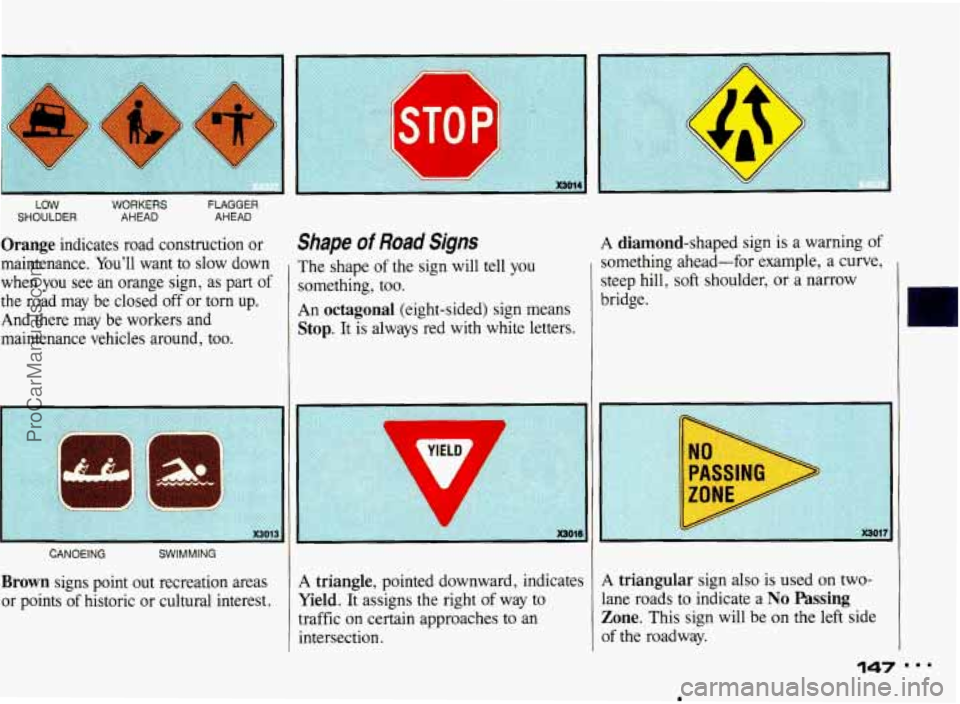
Orange indicates road construction or Shape Of Road S@S
rnaincnance. You’ll want to slow down
when you see an orange sign, as part of
the road may be closed off or torn up.
And there may be workers and
maintenance vehicles around,
too.
CANOEING SWIMMING
Brown signs point out recreation areas
or points of historic or cultural interest. The shape
of the
sign will tell you
something, too.
An octagonal (eight-sided) sign means
Stop. It is always red with white letters.
A
triangle, pointed downward, indicates
Yield. It assigns the right of way to
traffic
on certain approaches to an
intersection. A
diamond-shaped sign is a warning
of
something ahead-for example, a curve,
steep hill,
soft shoulder, or a narrow
bridge.
A triangular sign also is used on two-
lane roads to indicate a
No Passing
Zone. This sign will be on the left side
of the roadway.
147
ProCarManuals.com
Page 149 of 322
Your Uriving and the Road
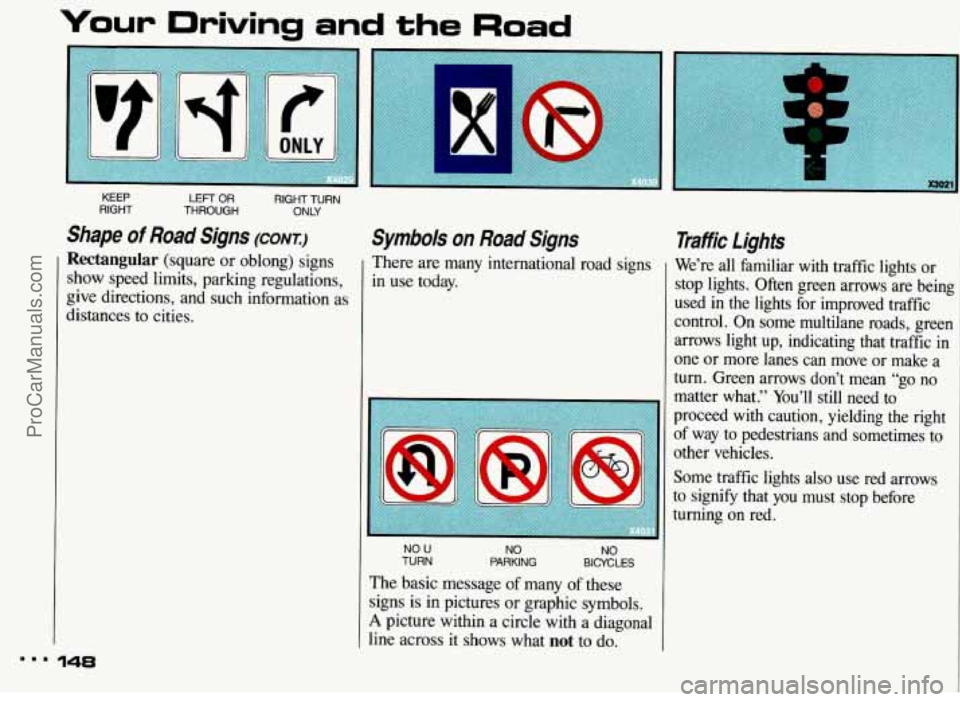
KEEP LEFT OR RIGHT TURN
RIGHT THROUGH ONLY
Shape of Road Signs (CONI:)
Rectangular (square or oblong) signs
show speed limits, parking regulations,
give directions, and such information as
distances to cities.
I
Symbols on Road Signs
There are many international road signs
in use today.
NO U NO TURN
PARKING BICYCLES NO
The basic message of many of these
signs is in pictures or graphic symbols.
A picture within a circle with a diagonal
line across it shows what
not to do.
Traffic Lights
We’re all familiar with traffic lights or
stop lights. Often green arrows are being
used in the lights for improved traffic
control. On some multilane roads, green
arrows light up, indicating that traffic
in
one or more lanes can move or make a
turn. Green arrows don’t mean “go no
matter what.” You’ll still need to
proceed with caution, yielding
the right
of way to pedestrians and sometimes to
other vehicles.
Some traffic lights also use red arrows
to signify that you must stop before
turning on red.
m.. 148
ProCarManuals.com
Page 150 of 322
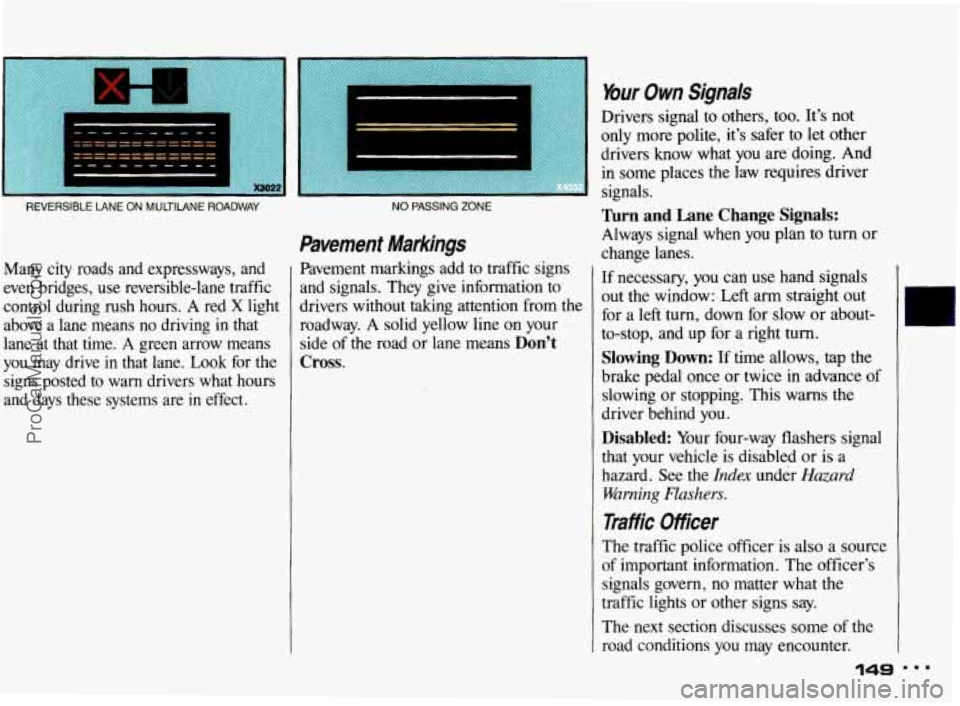
REVERSIBLE LANE ON MULTllANE ROADWAY
Many city roads and expressways, and
even bridges,
use reversible-lane traffic
control during rush hours.
A red X light
above a lane means
no driving in that
lane at that time.
A green arrow means
you may drive in that lane. Look for the
signs posted to warn drivers what hours
and days these systems are in effect.
bur Own Signals
Drivers signal to others, too. It’s not
only more polite, it’s safer to let other
drivers know what
you are doing. And
NO PASSING ZONE
Pavement Markings
Pavement markings add to traffic signs
and signals. They give information
to
drivers without taking attention from the
roadway. A solid yellow line on your
side
of the road or lane means Don’t
Cross.
in some places the iaw requires driver
signals.
“urn and Lane Change Signals:
Always signal when you plan to turn or
change lanes.
If necessary, you can use hand signals
out the window: Left arm straight out
for a
left turn, down for slow or about-
to-stop, and up for a right
turn.
Slowing Down: If time allows, tap the
brake pedal once
or twice in advance of
slowing or stopping. This warns the
driver behind you.
Disabled: Your four-way flashers signal
that your vehicle is disabled or is a
hazard. See the
Index under Hazard
Warning Flashers.
Tm#k Officer
The traffic police officer is also a source
of important information. The officer’s
signals govern, no matter what the
traffic lights or other signs say.
The next section discusses some of the
road conditions
you may encounter.
149
ProCarManuals.com
Page 151 of 322
Your Driving and the Road
Defensive Driving
The best advice anyone can give about
driving is: Drive defensively.
Please
start with a very important safety
device in your Pontiac: Buckle up. (See
the
Index under Safev Belts.)
Defensive driving really means “be
ready for anything.” On city streets,
rural roads, or freeways, it means
“always expect the unexpected.”
Assume that pedestrians or other drivers
are going to be careless and make
mistakes. Anticipate what they might
do. Be ready for their mistakes.
Expect children to dash out from behind
parked cars, often followed by other
children. Expect occupants in parked
cars to open doors into traffic. Watch for
movement in parked cars-someone
may be about to open a door. Expect other
drivers to
run stop signs
when you are on a through street. Be
ready to brake if necessary as you go
through intersections. You may not have
to use the brake, but if you do, you will
be ready.
If you’re driving through a shopping
center parking lot where there are well-
marked lanes, directional arrows, and
designated parking areas, expect some
drivers to ignore all these markings and
dash straight toward one part of the lot.
Pedestrians can be careless. Watch for
them. In general, you must give way to
pedestrians even if you know you have
the right of way.
Rear-end collisions are about the most
preventable of accidents. Yet they are
common. Allow enough following distance. It’s the best defensive driving
maneuver, in both city and rural
driving. You never
know when the
vehicle in front of you is going to brake
or turn suddenly.
Here’s a final bit of information about
defensive driving. The most dangerous
time for driving in the
U.S. is very early
on Sunday morning.
In fact, GM
Research studies show that the most and
the least dangerous times for driving, every week, fall on the same day. That
day is Sunday. The most dangerous time
is Sunday from 3 a.m. to 4 a.m. The
safest time is Sunday from
10 a.m. to
11 a.m. Driving the same distance on a
Sunday at
3 a.m. isn’t just a little more
dangerous than it is at
10 a.m. It’s about
134 times more dangerous!
That leads to the next section.
ProCarManuals.com
Page 162 of 322
The traction you can get in a curve
depends on the condition of your tires
and the road surface,
the angle at which
the curve is banked, and your speed.
While you’re
in a curve, speed is the
one factor you can control.
Suppose you’re steering through a sharp
curve. Then you suddenly accelerate.
Those two control systems-steering
and acceleration-can overwhelm those
places where the tires meet the road and make you lose control.
What should you do if this ever
happens? Let up on
the brake or
accelerator pedal, steer the vehicle the
way you want it to go, and slow down. Speed limit signs near
curves warn that
you should adjust your speed. Of
course, the posted speeds are based on
good weather and road conditions.
Under less favorable conditions you’ll
want to go slower.
If you need to reduce your speed as you
approach a curve, do
it before you enter
the curve, while your front wheels are
straight ahead.
Try to adjust your speed
so you can
“drive” through the curve. Maintain a
reasonable, steady speed. Wait to
accelerate until you are out of the curve,
and then accelerate gently into the
straightaway.
When you drive into a curve at night,
it’s harder to see the road ahead of you
because it bends away from the straight
beams of your lights. This
is one good
reason to drive slower.
Steering in Emergencies
There are times when steering can be
more effective than braking. For
example, you come over a hill and find a
truck stopped in your lane, or a car
suddenly pulls out from nowhere, or a
child darts
out from between parked
cars and stops right in front of you. You
can avoid these problems by braking-if
you can stop
in time. But sometimes you
can’t; there isn’t room. That’s the time
for evasive action-steering around the
problem.
Your Pontiac can perform very well in
emergencies like these. First apply your
brakes.
It is better to remove as much
speed as you can from a possible
collision. Then steer around the
problem, to the left or right depending
on the space available.
161
ProCarManuals.com