Page 86 of 436

CAUTION
Plugging the cord into an ungrounded outlet could cause an ele\
ctrical
shock.
Also, the wrong kind of extension cord could overheat and
cause a fire. You could be seriously injured. Plug the cord into a
properly grounded three-prong
11 0-volt outlet. If the cord won’t reach,
use a heavy-duty three-prong extension cord rated for at least \
15
amps.
1 NOTICE
1 After you’ve used the block heater, be sure to store the cord in th~~~~
manner it was, to help keep it away from moving engine parts.\
If YOU
don’t, it could be torn and damaged.
~p@&%?yl~
How long should you keep tne MOCK neater plugged in? The answer depends
on the weather, the kind
of oil ,you have, and some other things. Follow this-
chart.
,.
ENGINE BLOCK HEATER USAGE”
Viscosity . 32’ $0 0°F ’ 0’ to -10°F ‘Belaw -1 0°F
Grade Oil (0” to &I S‘C) ’ ’ (-18’ to. -23°C) (B&w -23°C)
SAE Not Two Eight Hours
I OW-30 Required Hours or Overnight
SAE . Nit ’ . Two Eight Hours
15W-40 f3equired Hours or Overnight
..
* The times listed are minimum. times. It will not harm &her
the block heater
TO1 57
or the vehicle to leave it plugged in longer than the times stated. 3
For best results in cold weather, use Number I-D diesel fuel or a “winterized”
Number
2-D fuel.
If Your Diesel Engine Won’t- Start
If you’ve run out of fuel, look -at “Running Out Of Fuel” (see ‘‘Diesel Fuel
Requirements and Fuel System”
m the Index).
If you’re not out of fuel, and your engine won’t start, do this:
Turn y6ur ignition key
to Run. .Make sure that the GLOW PLUGS light is out.
Then turn
the ignition key to Stkrt while you ‘push the accelerator pedal
down.
2-1 8
ProCarManuals.com
Page 99 of 436
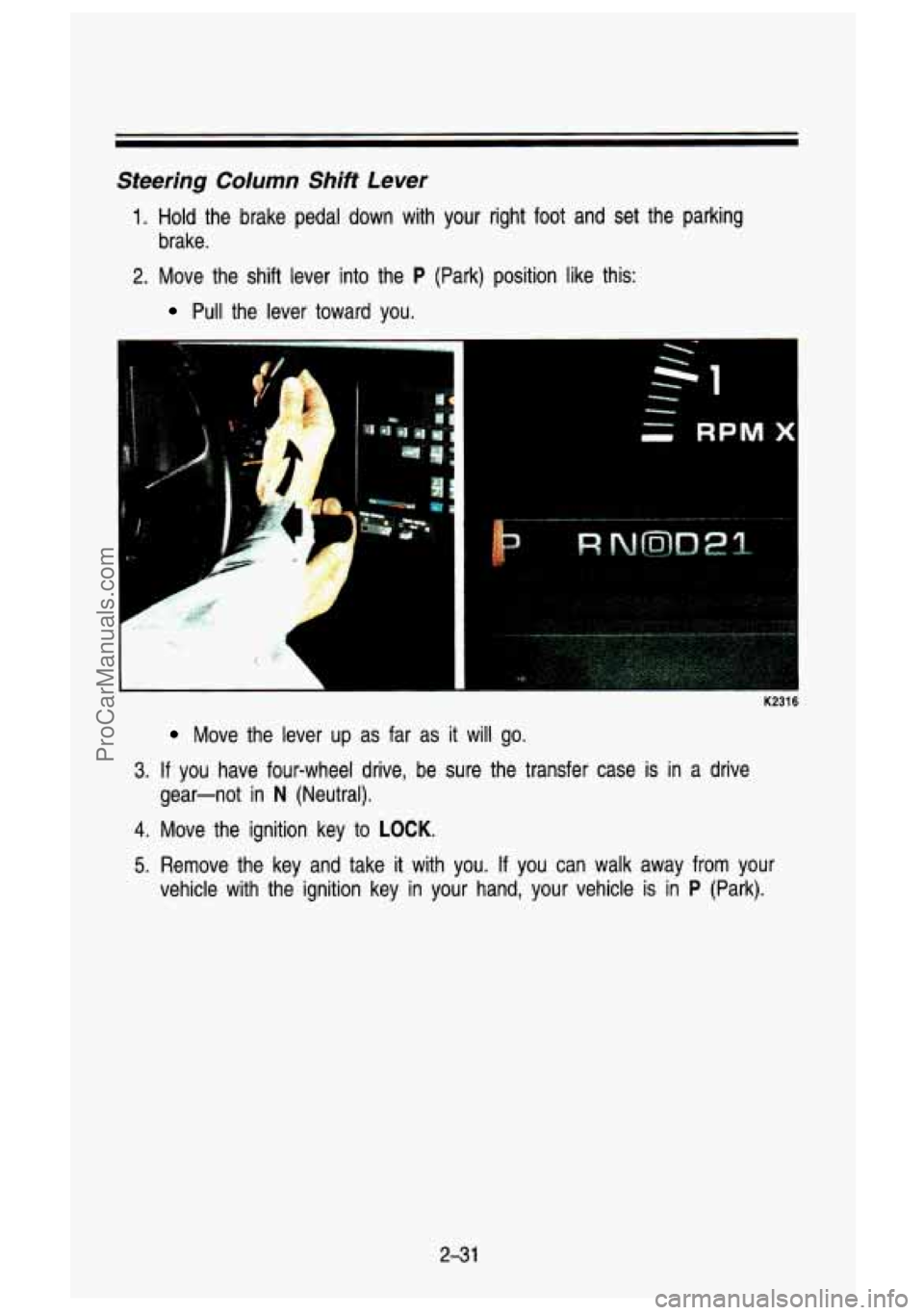
Steering Column Shift Lever
1. Hold the brake pedal down with your right foot and set the parking
brake.
2. Move the shift lever into the P (Park) position like this:
Pull the lever toward you.
~- - --
w KL" I"
Move the lever up as far as it will go.
3. If you have four-wheel drive, be sure the transfer case is in a drive
4. Move the ignition key to LOCK.
5. Remove the key and take it with you. If you can walk away from your
vehicle with the ignition key
in your hand, your vehicle is in P (Park).
gear-not
in N (Neutral).
2-31
ProCarManuals.com
Page 132 of 436
Features & Controls
Center Floor Console
K2229
Your vehicle may have a console compartment between the bucket seats\
. To
open it, just squeeze the buttons on both sides of the keyhole, and pull up.
Use your round key to lock this compartment. Your console also includes a
handy place to hold cups.
PO192
Your console also has a cup holder that slides out, for the back seat
passengers
to use.
2-64
ProCarManuals.com
Page 146 of 436
.
If you have the Sport Performance Model (RPO B4U), your")
Features & Controls
Tachometer
If you have a tachometer, it displays the engine speed in revolut\
ions per
minute (rpm).
If you have the Sport Performance Model (RPO B4U), your tachometer
reading will go
to 6,000 RPM.
'I I Do not operate the engine with the tachometer in the red area, your
engine
or other parts could be damagec' I
Damage to your engine or vehicle caused by operating the engine in 1
red area isn't covered by your vehicle warranty.
Warning and lndicator Lights
This section describes the warning lights and gages that are o\
n your vehicle.
The pictures
will help you locate them.
Warning lights and gages can signal that something is wrong be\
fore
it
becomes serious enough to cause expensive repair or replacement. Paying
attention
to your warning lights and gages could also save you or others from
injury.
Warning lights go on when there may be or
is a problem with one of your
vehicle's functions.
As you will see in the details on the next few pages,
some warning lights come on briefly when you turn the ignition\
key just
to let
2-78
ProCarManuals.com
Page 190 of 436

Your Driving and the Road
Ir
-
, ..-
I
AM407001
According to the American Medical Association, a 180-pound (82 kg) person
who drinks three 12-ounce
(355 ml) bottles of beer in an hour will end up
with a BAC of about 0.06 percent. The person would reach the same BAC
by drinking three 4-ounce (120 ml) glasses of wine or three mixed drinks
if
each had 1-112 ounces (45 ml) of a liquor like whiskey, gin or vodka.
It’s the amount of alcohol that counts. For example, if the same person drank
three double martinis
(3 ounces or 90 ml of liquor each) within an hour, the
person’s BAC would be close
to 0.12 percent. A person who consumes food
just before or during drinking
will have a slightly lower BAC level.
DRINKING THAT WILL 8
RESULT IN A BAC
OF ABOUT .05% IN
~ THE TlME SHOWN 6
7
OF DRINKS
NUMBER ’
(as in picture) 4
3
t --
2 1
1 i I
100 120 140 160 180 200 220 240
BODY WEIGHT
IN POUNDS
I 3 HOURS
I
YOUR
AM407002
The law in most U.S. states sets the legal limit at a BAC of 0.10 percent. In
Canada the limit is 0.08 percent, and in some other countries it’s lower than
4-1 2
ProCarManuals.com
Page 194 of 436
If you keep pace with the traffic and alllow realieti~ following dbtances, ‘you
will eliminate a lot .of unnecessary braking.. That means - better brakin’g . and
longer brake life;
,* If your engine ever stops while- you’re driving, brake normally but don’t
pump your brakes. If you do, tht$ pedal may get harder to. .push down. If
your- engine stops, you will still have some power $rake, assist But you
will use it when you brake. Once the power assist =is used ‘up, it may
take longer to stop and the brake pedal will be harder to push.
Anti-lock Brakes (ABS)
Your vehicl’e has an ‘advanced electronic braking system that can help keep it
under Control.
When you turn your key on you m.ay .hear a momentary clicking ngise. , ,.
Here’s I how anti-lock .works. Let’s say the road is wet. You’re d.rivilng. sifely.
Suddenly an animal jumps out In frqnt of you.
ProCarManuals.com
Page 205 of 436

Tune your senses to different kinds of signals. -Your eyes, for example, meed
to constantly sweep the terrain for unexpected obstacles. Your .ears need
to
listen for unusual tire or engine sounds. With your arms, hands, feet, and
body you’ll need to respond
to vibrations and vehicle bounce.
Controlling your vehicle is the key
to successful off-road driving. One of the
best ways
to control your vehicle is to control your speed. Here .are some
things
to keep in mind. At higher speeds:
e you approach things fastar and you have less time to scan the terrain
for obstacles.
you have less time
to react. ‘I , ’C _. ’.
you have more vehicle bounce when you drive over obstacles.
you’ll need more distance for braking, especially since you’\
re on an unpaved surface.
CAUTION
When you’re driving off road, bouncing and quick changes in
direction can easily throw you out of position. This could cause you
to lose control and crash. So, whether you’re driving on or off the
road, you and your passengers should wear safety belts.
Scanning the Terrain
Off-road driving can take you over many different kinds of terrain. You need
to be familiar with the terrain and its many different features. Here are some
things
to consider.
Surface Conditions
Off-roading can ta.ke you. over hard-packed dirt, gravel, rocks,\
grass, sand, mud, snow or ice. Each of these sutfaces affects the steering, acceleration,
and braking of your vehicle in different ways. Depending upon the kind of
. surface you are on, you may experience slipping, sliding, wheel\
spinning,
delayed acceleration, poor traction, and longer braking distances\
.
Surface Obstacles
Unseen or hidden obstacles can be hazardous. A rock, log, hole, rut, or
bump can startle you if you’re not prepared for them. Often these obstacles
are hidden by grass, bushes, snow or even the rise and fall of the terrain
itself. -.Here are some things
to consider:
Is the path ahead clear?
Will the surface texture change abruptly up ahead?
4-27
ProCarManuals.com
Page 244 of 436
Hazard Warning Flashers U
I
I
. .' ~.
AM505004
Your hazard warning flashers let you warn others. They also let pol\
ice know
you have a problem. Your front and rear turn signal lights will flash
on and
off. But they won't flash if you are braking.
L'
I K2503
I
r 1
Press the button in to make your front and rear turn signal lights flash on
and off.
Your hazard warning flashers work no matter what position your key is in,
and even if the key isn't in.
5-2
ProCarManuals.com