Page 12 of 339
How to Use this Manual
These symbols are used on warning and
indicator lights:
Engine Coolant
Temperature
Battery Charging System
Fuel
I.. 10
E3
Brake
w
Here are some other symbols you may
see:
Hood Release
Lighter
Horn
ProCarManuals.com
Page 55 of 339
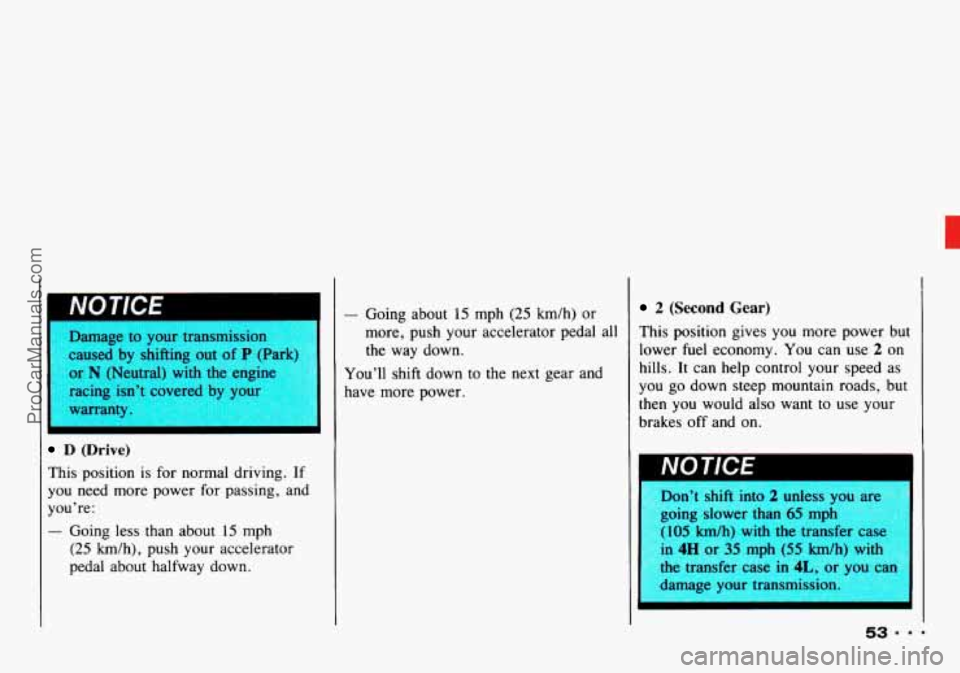
Damage to your transmission
caused by shifting out
of P Park)
or N (Neutral) with the engi
racing isn’t covered by your
warranty.
D (Drive)
This position is for normal driving. If
you need more power for passing, and
you’re:
- Going less than about 15 mph
(25 km/h), push your accelerator
pedal about halfway down.
- Going about 15 mph (25 h/h) or
more, push your accelerator pedal all
the way down.
You’ll shift down to
the next gear and
have more power.
2 (Second Gear)
This position gives you more power but
lower fuel economy. You can
use 2 on
hills.
It can help control your speed as
you go down steep mountain roads, but
then
you would also want to use your
brakes
off and on.
going slower than
65 mph
(105 km/h) with the transfer
in 4H or 35 mph (55 h/h) wit1
the transfer case
in 4L, or you can
damage
your transmission
53.m.
ProCarManuals.com
Page 56 of 339
Features & Controls
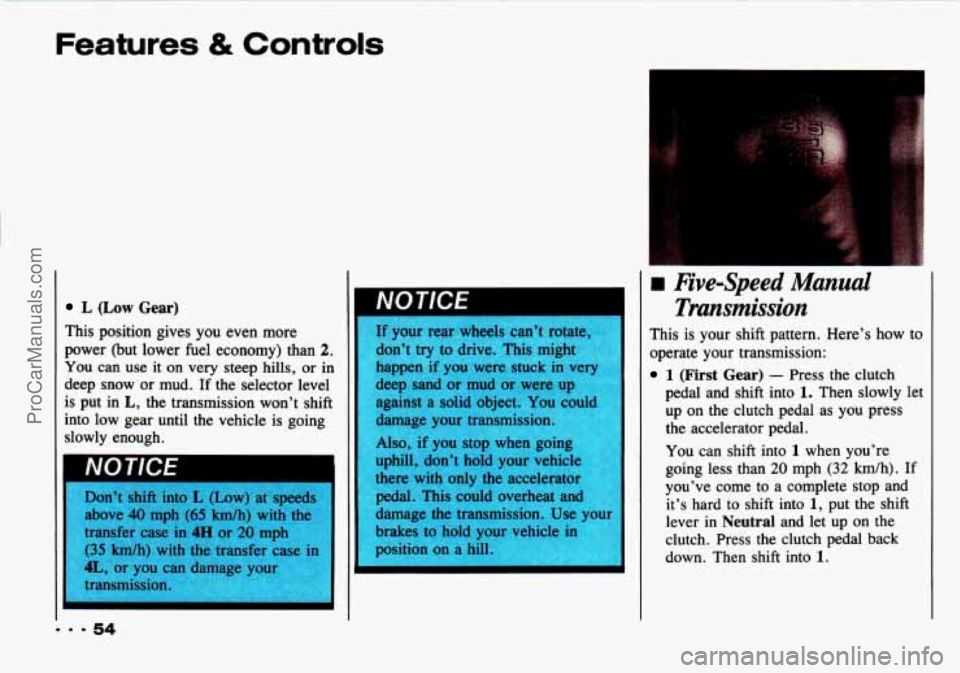
L (Low Gear)
This position gives you even more
power (but lower fuel economy)
than 2.
You can use it on very steep hills, or in
deep snow or mud.
If the selector level
is put in
L, the transmission won’t shift
into low gear until the vehicle is going
slowly enough.
I NOTICE
above 40 mph (65 km/h) with the
transfer case
in 4H or 20 mph
(35 km/h) with the transfer case in
4L, or you can damage your
IVU I IbC Transmission
This is your shift pattern. Here’s how to
operate your transmission:
1 (Fist Gear) - Press the clutch
pedal and shift into
1. Then slowly let
up on the clutch pedal as you press
the accelerator pedal.
You can shift into 1 when you’re
going less than
20 mph (32 km/h). If
you’ve come to a complete stop and
it’s hard
to shift into 1, put the shift
lever in
Neutral and let up on the
clutch. Press the clutch pedal back
down. Then shift into
1.
I Five-Sveed Manual
... 54
ProCarManuals.com
Page 58 of 339
Features & Controls
shifi Speeds (MANUAL TRANSMISSION)
MANUAL TRANSMISSION RECOMMENDED SHIFT SPEEDS IN MPH (km/h)
Engine
1.6L L4 47 11
21 29 41
34
27
15 Acceleration Shift Speed Cruise Shift Speed
1to2 4to5 1to2 2to3 3to4 4to5 3to4
2to3
(24) (76)
(18) (34) (47) (66) (55) (43)
This chart shows when
to shift to the
next higher gear for best fuel economy.
If your speed drops below 20 mph
(32 km/h), or if the engine is not
running smoothly, you should downshift
to the next lower gear. You may have to
downshift two or more gears to keep the
engine running smoothly or for good
performance.
. . 56
A
LAU I IUlV
If you skip more than one
could lose control
of your vehicle.
And
you could injure yourself or
others. Don’t shift from
5 to 2 or
4 to 1.
L gear when you downshift, you
If you skip more than one gea~
when you downshift, or if 1
race the engine when you
downshift, you can damr-- thc
clutch
or transmission
ProCarManuals.com
Page 61 of 339

To unlock the hubs:
1. Stop your vehicle.
2. Drive seven feet (two meters) in the
direction opposite to the direction
you were driving before you stopped.
3. Then, press the clutch if you have a
manual transmission, and shift the
transfer
case to 2H. The hubs will
unlock.
Transfer Case
The transfer case shift lever is on the
floor to the right of the driver. Use this
lever to shift into and out of four-wheel
drive. An indicator light comes on when
the transfer case is in
4H or 4L.
2H: This setting is for driving in most
street and highway situations. Your front
axle
is not engaged in two-wheel drive.
4H: This setting engages your front axle
to help drive your vehicle. Use
4H
when you need extra traction, such as
on wet or icy roads,
or in most off-road
situations.
N (Neutral): Shift to this setting only
when your vehicle needs
to be towed.
4L: This setting also engages your front
axle to give you extra traction, but
should be used only for driving downhill
or on slippery surfaces when you’re
driving slower than
35 mph (55 km/h).
Remember that driving in 4H or 4L may
reduce fuel economy. Also, driving
in
four-wheel drive on dry pavement could
cause your tires to wear faster and make
your transfer case harder to shift.
You can shift from
2H to 4H or from
4H to 2H at any speed if your hubs are
locked and your wheels are straight
ahead. Your front
axle will engage
faster if you take your foot off the
accelerator pedal for a
few seconds as
you shift.
ProCarManuals.com
Page 82 of 339
Features & Controls
rn Instrument Panel and
Clusters
Your instrument cluster is designed to
let you know at a glance how your
vehicle is running. You’ll know how
fast you’re going, about how much fuel
you have left, and many other things you’ll need
to know to drive safely and
economically. Optional Cluster
If you have the optional cluster, your
instrument panel gives you additional
information. The cluster includes
a
tachometer.
US. shown; Canada similar
Speedometer and Odometer
Your speedometer lets you see your
speed in both miles per hour (mph) and
kilometers per hour (km/h). Your
odometer shows how far your vehicle
has been driven,
in either miles (used in
ProCarManuals.com
Page 85 of 339

c
When one of the warning lights comes
on and stays on
when you are driving,
or when one of the gages shows there
may be a problem, check the section
that tells you what to do about
it. Please
follow the manual’s advice. Waiting to
do repairs can
be costly - and even
dangerous. So please get to know your
warning lights and gages. They’re a big
help.
Fuel Gage
Your fuel gage shows about how much
fuel
is in your tank. When the gage first
indicates
E, you still have a little fuel
left (about one
or two gallons), but you
need to get more right away.
Here are four concerns some owners
have had about the fuel gage. All these
situations are normal and do not indicate
that anything is wrong
with the fuel
gage.
At the gas station, the gas pump shuts
It takes more (or less) gas to fill up
off before the
gage reads
F.
than the gage reads. For example, the
gage reads
1/2 full, but it took more
(or less) than half of the tank’s
capacity to fill it.
The gage moves a little when you
turn, stop or speed up.
When you turn the engine off, the
gage doesn’t
go back to E.
83. 9
ProCarManuals.com
Page 87 of 339

Engine Coolant Temperature Gage
This gage shows the engine coolant
temperature. If the gage pointer moves
to the “H” (red) side, your engine is
too hot! It means that your engine
coolant has overheated and you should
stop your vehicle and turn off the engine
as soon as possible.
HOT
COOLANT CAN BURN YOU
BADLY!
In “Problems on the Road, ” this
manual shows what to do. See “Engine
Overheating’’
in the Index.
-I
I L
Charging System Light
This light will come on briefly when
you turn on
the ignition, but the engine
is not running, as a check to show you it
is working. Then it should go out when
the engine starts. If it stays on, or
comes on while you are driving, you
may
have a problem with the electrical
charging system. It could indicate that
you have a loose generator drive belt, or
another electrical problem. Have
it
checked right away. Driving while this
light
is on could drain your battery.
If you must drive a short distance with
the light
on, be certain to turn off
all your accessories, such as the radio
and air conditioner.
Malfunction Indicator Lamp (Check
Engine Light)
A computer monitors operation of your
fuel, ignition and emission control
systems. The light should come on when
the ignition is on, but the engine is not
running, as a check to show you
it is
working. If
it does not come on at all,
have it fixed right away. If it stays
on,
or comes on while you are driving, the
computer is indicating that you have
a
problem. You should take your vehicle
in for service soon.
85.9.
ProCarManuals.com