1993 CHEVROLET TRACKER wheel
[x] Cancel search: wheelPage 60 of 339
Features & Controls
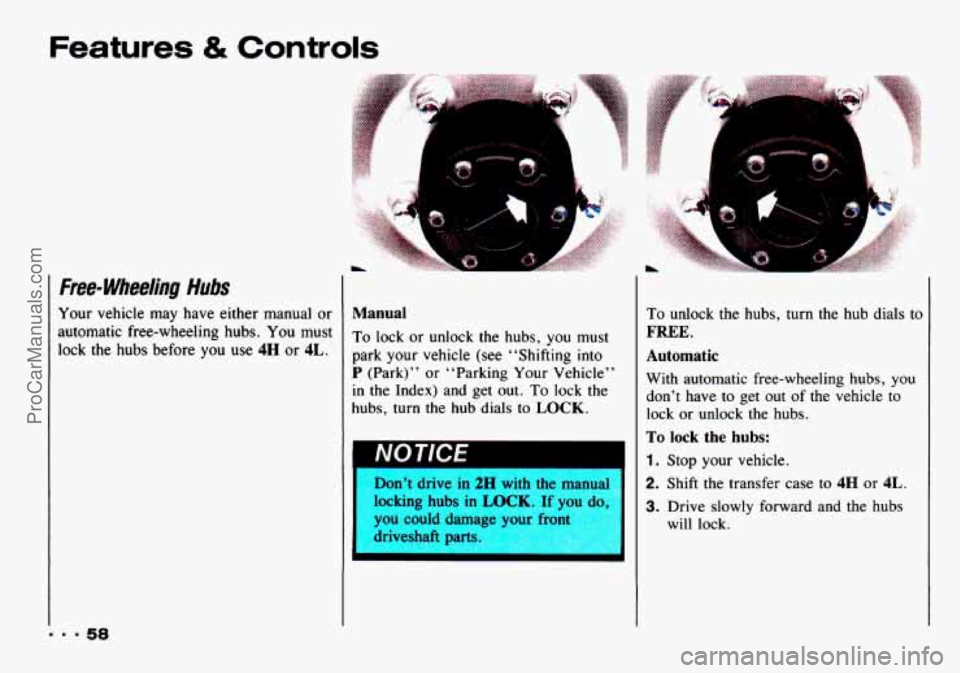
Free- Wheeling Hubs
Your vehicle may have either manual or
automatic free-wheeling hubs. You must
lock
the hubs before you use 4H or 4L.
Manual
To lock or unlock the hubs, you must
park your vehicle (see “Shifting into
P (Park)” or “Parking Your Vehicle”
in the Index) and get out. To lock the
hubs, turn
the hub dials to LOCK.
Don’t drive in 2H with the manual
locking hubs in
LOCK. If yo1
you could damage your front 7
driveshaft parts. I
To unlock the hubs, turn the hub dials to
FREE.
Automatic
With automatic free-wheeling hubs, you
don’t have to get out of the vehicle to
lock
or unlock the hubs.
To lock the hubs:
1. Stop your vehicle.
2. Shift the transfer case to 4H or 4L.
3. Drive slowly forward and the hubs
will lock.
ProCarManuals.com
Page 61 of 339

To unlock the hubs:
1. Stop your vehicle.
2. Drive seven feet (two meters) in the
direction opposite to the direction
you were driving before you stopped.
3. Then, press the clutch if you have a
manual transmission, and shift the
transfer
case to 2H. The hubs will
unlock.
Transfer Case
The transfer case shift lever is on the
floor to the right of the driver. Use this
lever to shift into and out of four-wheel
drive. An indicator light comes on when
the transfer case is in
4H or 4L.
2H: This setting is for driving in most
street and highway situations. Your front
axle
is not engaged in two-wheel drive.
4H: This setting engages your front axle
to help drive your vehicle. Use
4H
when you need extra traction, such as
on wet or icy roads,
or in most off-road
situations.
N (Neutral): Shift to this setting only
when your vehicle needs
to be towed.
4L: This setting also engages your front
axle to give you extra traction, but
should be used only for driving downhill
or on slippery surfaces when you’re
driving slower than
35 mph (55 km/h).
Remember that driving in 4H or 4L may
reduce fuel economy. Also, driving
in
four-wheel drive on dry pavement could
cause your tires to wear faster and make
your transfer case harder to shift.
You can shift from
2H to 4H or from
4H to 2H at any speed if your hubs are
locked and your wheels are straight
ahead. Your front
axle will engage
faster if you take your foot off the
accelerator pedal for a
few seconds as
you shift.
ProCarManuals.com
Page 63 of 339

To release the parking brake: Hold the
brake pedal down. Pull the parking
brake lever up
until you can push in the
release button. Hold the release button
in as you move the brake lever all the
way down.
I NOTICE
Driving with the parking brake on
can cause your rear brakes to
overheat.
You may have to replac=
them, and
you could also dvwe
other parts
of your vehicle.
If you are on a hill: See “Parking on
Hills” in
the Index. That section shows
how to turn your front wheels.
If you are towing a trailer and are
parking on any hill:
See “Towing a
Trailer”
in the Index. That section
shows what to
do first to keep the trailer
from moving.
Shifiing into P (Park)
(AUTOMATIC TRANSMlSS/ON)
It can be dangerous to get out
of your vehicle if
the shift
lever is not fully in
P (Park) with
the parking brake firmly set. Your
vehicle can roll,
If you have left the engine
running, the vehicle can move
suddenly. You or others could be
injured. To be sure your vehicle
won’t move, when you’re on fairly
level ground, use the steps that
follow.
If you have four-wheel drive and
your transfer case
is in
N (Neutral), your vehicle will be
free
to roll even if your shift lever
is in
P (Park). So, be sure the
transfer case
is in a drive gear -
not in N (Neutral).
If
you are parking on a hill, or if
you’re pulling a trailer, also see
‘‘Parking on Hills”
or ‘‘Towing a
Trailer” in the Index.
ProCarManuals.com
Page 64 of 339

Features & Controls
1. Hold the brake pedal down with your
right foot and set the parking brake.
2. Move the shift lever into the P (Park)
position like this:
Hold in the button on the lever,
and push the lever all the way
toward the front of your vehicle.
3. If you have four-wheel drive, be sure
the transfer case is in a drive gear
-
not in N (Neutral).
4. Move the ignition key to LOCK.
5. Remove the key and take it with you.
If you can walk away from your
vehicle with the ignition key in your
hand, your vehicle is
in P (Park).
Leaving Your Vehide with the
Engine Running
(AUTOMATIC TRANSMISSION)
A It can be dangerous to leave
your vehicle with the engine
running. Your vehicle could move
suddenly if the &ifl lever is not
fully in P (Park) with the parking
brake firmly set.
If you have f0.w-wheel drive and
your -fer we is. in
N (Neutral), your vehicle will be
free to roll, even if your shift lever
is in P (Park). So be sure the
transfer case is in a drive gear -
not in N (Neutral).
And, if you leave the vehicle with
the
engine running, it could
overheat and even catch fire. You
or others could be injured. Don't
leave your vehicle with the engine
running unless you have to.
If you have to leave your vehicle with
the engine running, be sure your vehicle
is in
P (Park) and your parking brake is
firmly set before you leave
it. If you
have four-wheel drive, be sure that the
transfer case is in a drive gear
- not in
N (Neutral). After you've moved the
shift lever into the
P (Park) position,
hold the regular brake pedal down.
Then, see if you can move the shift
lever away from
P (Park) without first
pushing the button. If you can, it means
that the shift lever wasn't fully locked
into
P (Park).
ProCarManuals.com
Page 65 of 339
Shifling out of P (Park)
(AUTOMATIC TRANSMISSION)
Your Geo has a brake-transmission shift
interlock. You have to fully
apply your
regular brake
before you can shift from
P (Park) when the ignition is in the ON
position. See “Automatic Transmission”
in the Index.
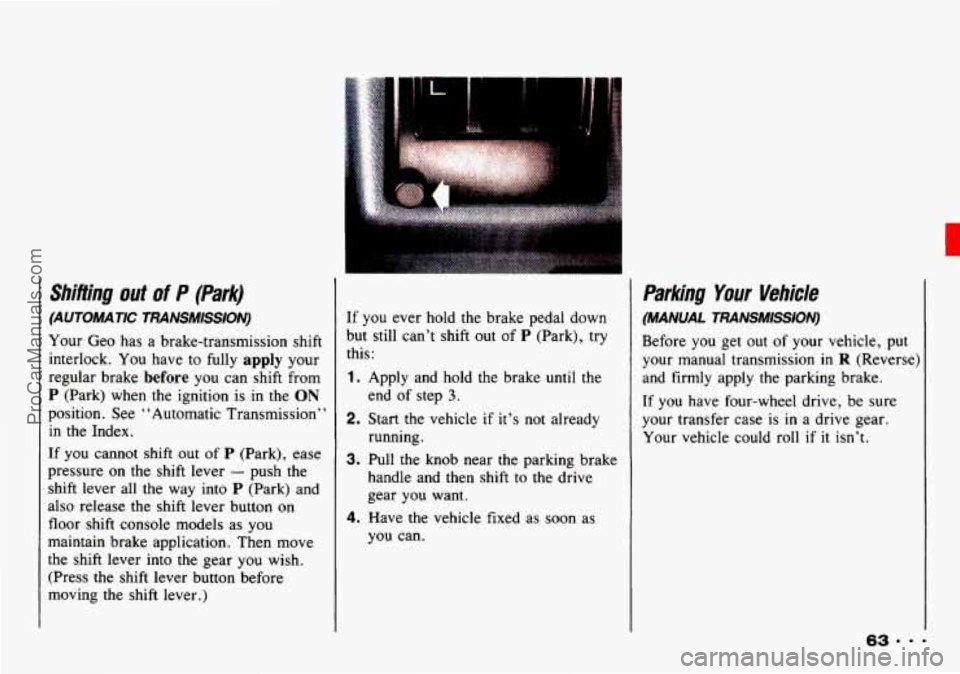
If you cannot shift out of P (Park), ease
pressure on the shift lever
- push the
shift lever all the way into P (Park) and
also release
the shift lever button on
floor shift console models as you
maintain brake application. Then move
the shift lever into the gear you wish.
(Press
the shift lever button before
moving
the shift lever.)
I
If you ever hold the brake pedal down
but still can’t shift out of
P (Park), try
this:
1. Apply and hold the brake until the
end
of step 3.
2. Start the vehicle if it’s not already
running.
3. Pull the knob near the parking brakc
handle and then shift
to the drive
gear you want.
4. Have the vehicle fixed as soon as
you can.
Parking Your Vehicle
(MANUAL TRANSMISSION)
Before you get out of your vehicle, put
your manual transmission in
R (Reverse)
and firmly apply the parking brake.
If you have four-wheel drive, be sure
your transfer case is in a drive gear.
Your vehicle could roll
if it isn’t.
ProCarManuals.com
Page 67 of 339

Running Your Engine While
You’re Parked
(AUTOMATIC TRANSMISSION)
It’s better not to park with the engine
running. But if
you ever have to, here
are some things to
know.
CAUTION
A
Idling the engine with the air system control off could allow dangerous
exhaust into your vehicle (see
the earlier Caution under “Engine
Exhaust’
’).
Also, idling in a closed-in place can let deadly carbon monoxide (CO) into
your vehicle even if
the fan switch is at the highest setting. One place this
can happen is a garage. Exhaust - with CO - can come in easily. NEVER
park in a garage with
the engine running.
Another closed-in place can be a blizzard. (See “Blizzard”
in the Index.)
It can be dangerous to get out of your vehicle if the shift lever is not
fully in
P (Park) with the parking brake firmly set. Your vehicle can roll. Don’t
leave your vehicle when
the engine is running unless you have to. If you’ve
left the engine running, the vehicle can move suddenly. You or others could
be injured.
To be sure your vehicle won’t move, even when you’re on fairly
level ground, always set your parking brake and move the shift lever
to P
(Park).
If you have four-wheel drive and your transfer case
is in N (Neutral), your
vehicle will be free to roll, even
if your shift lever is in P (Park). So, be sure
the transfer case
is in a drive gear - not in N (Neutral). Follow the proper
steps to be sure your vehicle won’t move. See “Shifting into
P (Park)” in
the Index.
If you are parking on a hill, or if you’re pulling a trailer, also see “Parking
on Hills” or “Towing a Trailer” in the Index.
c
ProCarManuals.com
Page 69 of 339

H Horn
To sound the horn, press the horn
symbol on your steering wheel.
I Tilt meel (OPTION)
1 tilt steerng wheel allows you to adjust
he steering wheel before you drive.
lou can also raise it to the highest level
o give your legs more room when you
:xit and enter the vehicle.
?o tilt the wheel, hold the steering
vheel and lower the lever. Move the
teering wheel
to a comfortable level,
hen raise the lever to its highest
losition to lock the wheel in place.
H I;he Turn SignaULights
CoPttrolHeadlight Beam
Lever
The lever on the left side of the steering
column includes your:
Turn Signal and Lane Change
Headlight High/Low Beam and
Indicator
Passing Signal
Lighting Operation
67
c
ProCarManuals.com
Page 86 of 339

Features & Controls
. . .a4
Brake System Warning Light
Your Geo’s hydraulic brake system is
divided into two parts.
If one part isn’t
working, the other part can still work
and stop you.
For good braking, though,
you need both parts working well.
Your vehicle also has rear wheel
anti-lock brakes. If the warning light
goes on, there could be a brake problem
with either your regular or rear wheel
anti-lock brakes,
or both. Have your
brake system inspected right away.
This light should come
on as you start
the vehicle. If it doesn’t come on then,
have
it fixed so it will be ready to warn
you if there’s a problem. This light will
also come on when you
set your parking brake, and it
will stay
on if your parking brake doesn’t release
fully. If it stays on after your parking
brake is fully released, it means you
may have a brake problem.
If the light comes on while driving, pull
off the road and stop carefully. You
may notice that the pedal is harder to
push.
Or, the pedal may go closer to the
floor. It may take longer to stop. If the
light is still on, have the vehicle towed
for service. (See “Towing
Your
Vehicle” in the Index.)
$ Your brake system may not
be working properly if the
brake warning light
is on. Driving
with the brake warning light on
can lead to an accident.
If the light
is still on after you’ve pulled off
the road and stopped carefully,
have the vehicle towed for service.
I
ProCarManuals.com