1993 CHEVROLET SUBURBAN check engine
[x] Cancel search: check enginePage 213 of 386

Your Driving and the Road
Highway Hypnosis
Is there actually such a condition as “highway hypnosis?” Or \
is it just plain
falling asleep at the wheel? Call
it highway hypnosis, lack of awareness, or
whatever.
There is something about an easy stretch of road with the sam\
e scenery, along with the hum of the tires on the road, the drone of the engine, and the
rush
of the wind against the vehicle that can make you sleepy. Don’\
t let it
happen to you! If it does, your vehicle can leave the road in less than a
second,
and you could crash and be injured.
What can you do about highway hypnosis? First, be aware that
it can
happen.
Then here are some tips:
Make sure your vehicle is well ventilated, with a comfortably \
cool interior.
Keep your eyes moving. Scan the road ahead and to the sides. Check
your rearview mirrors frequently and your instruments from time \
to time.
This can help you avoid a fixed stare.
Wear good sunglasses in bright light. Glare can cause drowsiness. But
don’t wear sunglasses at night. They will drastically reduce your overall
vision at the very time you need all the seeing power you have.
If you get sleepy, pull off the road into a rest, service, or parking area
and take a nap, get some exercise, or both. For safety, treat\
drowsiness
on the highway as an emergency.
As in any driving situation, keep pace with traffic and allow ade\
quate
following distances.
4-46
ProCarManuals.com
Page 214 of 386
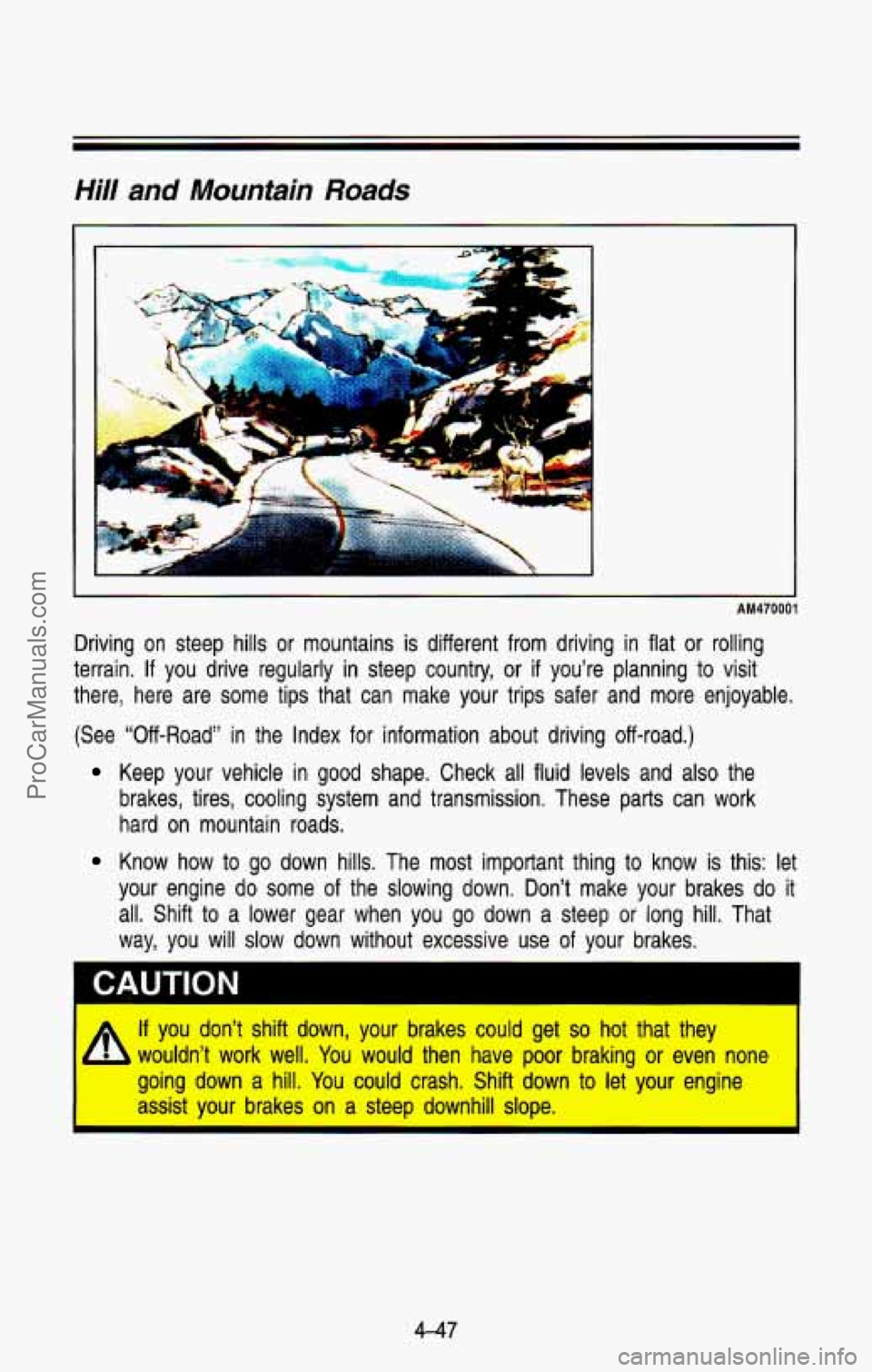
Hill and Mountain Roads
:.-. . , , . .;. . . . . . - ,. ..
AM470001
Driving on steep hills or mountains is different from driving in flat or rolling
terrain.
If you drive regularly in steep country, or if you’re planning to visit
there, here are some tips that can make your trips safer and more enjoyable.
(See “Off-Road” in the Index
for information about driving off-road.)
Keep your vehicle in good shape. Check all fluid levels and also the
brakes, tires, cooling system and transmission. These parts can work
hard on mountain roads.
Know how to go down hills. The most important thing to know is this: let
your engine do some
of the slowing down. Don’t make your brakes do it
all. Shift
to a lower gear when you go down a steep or long hill. That
way, you will slow down without excessive use of your brakes.
I
CAUT’oN
A If you don’t shift down, your brakes could get so hot that they
v- wouldn’t work well. You would then have poor braking or even none
going down a hill.
You could crash. Shift down to let your engine
assist
your brakes on a steep downhill slope.
4-47
ProCarManuals.com
Page 222 of 386
t
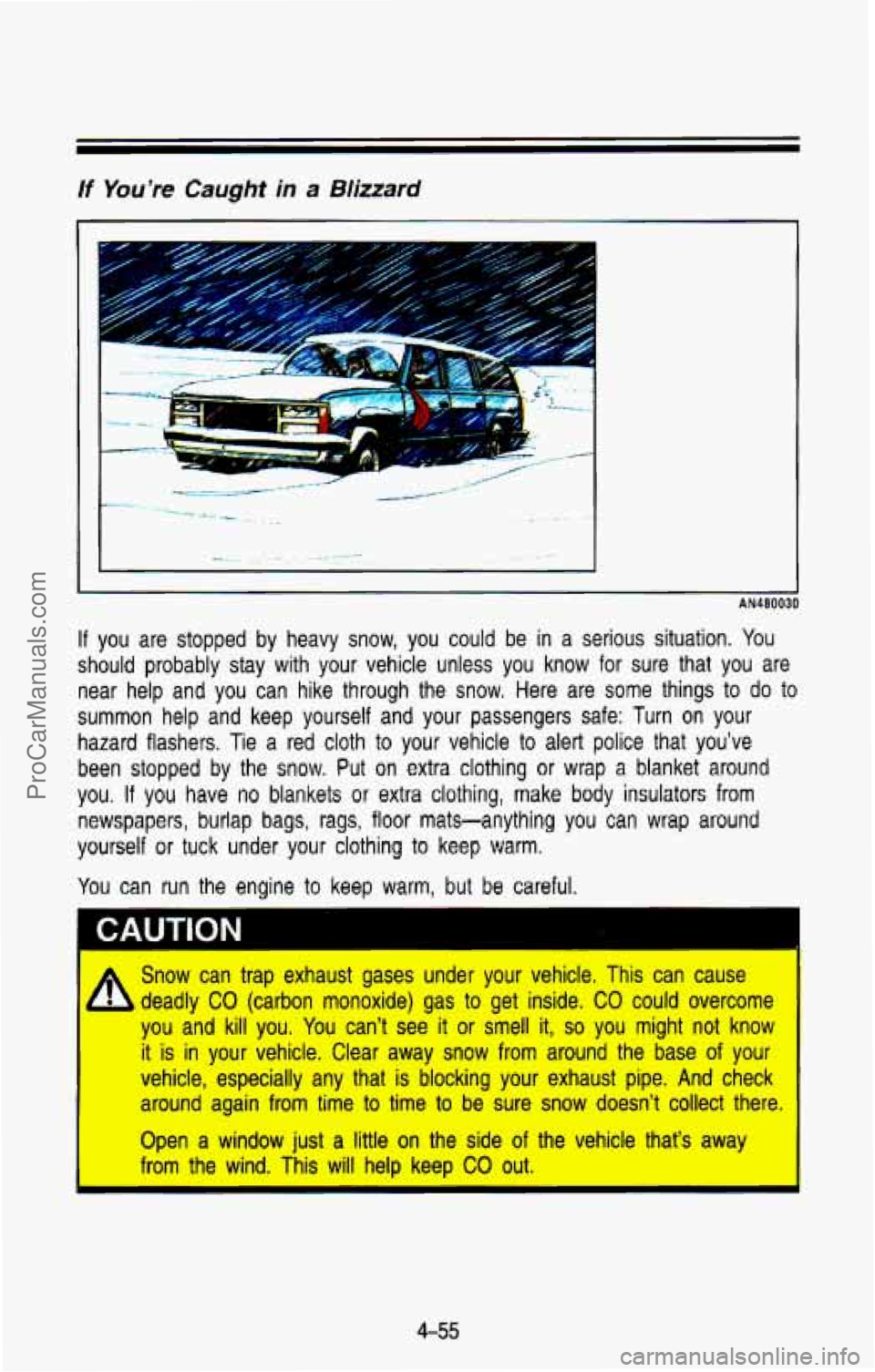
If You’re Caught in a Blizzard
I-
.
If you are stopped by heavy snow, you could be in a serious situation. You
should probably stay with your vehicle unless you know for sure that you are
near help and you can hike through the snow, Here are
some things to do to
summon help and keep yourself and your passengers safe: Turn o\
n your
hazard flashers. Tie a red cloth to your vehicle
to alert police that you’ve
been stopped by the snow. Put on extra clothing or wrap
a blanket around
you.
If you have no blankets or extra clothing, make body insulators from
newspapers, burlap bags, rags, floor mats-anything you
can wrap around
yourself
or tuck under your clothing to keep warm.
You
can run the engine to keep warm, but be careful.
Snow can trap exhaust gases under your vehicle. This can cause\
deadly
CO (carbon monoxide) gas to get inside. CO could overcome
you and kill you. You can’t see
it or smell it, so you might not know
it is in your vehicle. Clear away
snow from around the base of your
vehicle, especially any that is blocking your exhaust pipe. And check
around again from time to time
to be sure snow doesn’t collect there.
Open
a window just a little on the side of the vehicle that’s away
I from the wind. This will help keep CO out.
4-55
ProCarManuals.com
Page 228 of 386

I
If you have a rear-most window open and you pull a trailer with \
your
can’t see or smell
CO. It can cause unconsciousness or death (See
“Engine Exhaust” in the Index).
To maximize your safety when towing
a trailer:
- vehicle, carbon monoxide (CO) could come into your vehicle. You
Have the exhaust system inspected for leaks and make
Keep the rear-most windows closed.
If exhaust does come into your vehicle through a window in the
rear or another opening, drive with your front, main heating or
cooling system
on and with the fan on any speed. This will
bring fresh, outside air into your vehicle.
Do not use RECIR
because it only recirculates the air inside your vehicle. See
“Comfort Controls” in the Index.
necessary repairs before starting on your trip.
During your trip, check occasionally to be sure that the load is secure, and
that the lights and any trailer brakes are still working.
Following Distance
Stay at least twice as far behind the vehicle ahead as you would when
driving your vehicle without a trailer. This can help you avoid situations that
require heavy braking and sudden turns.
Passing
You’ll need more passing distance up ahead when you’re towing a tr\
ailer.
And, because you’re
a good deal longer, you’ll need to go much farther
beyond the passed vehicle before you can return to your lane.
Backing Up
Hold the bottom of the steering wheel with one hand. Then, to move the
trailer left, just move your hand to the left.
To move the trailer to the right,
move your hand to the right. Always back up slowly and,
if possible, have
someone guide you.
Making Turns
When you’re turning with a trailer, make wider turns than n\
ormal. Do this so
your trailer wheels won’t strike soft shoulders, curbs, road signs, trees, or
other objects. Avoid jerky or sudden maneuvers. Signal well in advance.
4-61
ProCarManuals.com
Page 229 of 386
Your Driving and the Road
Turn Signals When Towing a Trailer
When you tow a trailer, your vehicle has to have a different turn signal
flasher and extra wiring. The green arrows on your instrument \
panel will flash
whenever you signal a turn
or lane change. Properly hooked up, the trailer
lights will also flash, telling other drivers you’re about
to turn, change lanes,
or stop.
When towing a trailer, the green arrows on your instrument pan\
el will flash for
turns even
if the bulbs on the trailer are burned out. Thus, you may think \
drivers behind you are seeing your signal when they are not.
It’s important to
check occasionally to be sure the trailer bulbs are still working.
Driving on Grades
Reduce speed and shift to a lower gear before you start down a long or
steep downgrade. If you don’t shift down, you might have to use your brakes
so much that they would get hot and no longer work well.
On
a long uphill grade, shift down and reduce your speed to 45 mph (70
kmlh) or less to reduce the possibility of engine and transmission overheating.
If you have an automatic transmission, you should use D (or, as you need to,
a lower gear) when towing a trailer. Operating your vehicle in D when towing
a trailer will minimize heat buildup and extend the
life of your transmission.
Or,
if you have a manual transmission with fifth gear and you are to\
wing a
trailer, it’s better not
to use fifth gear, just drive in fourth gear (or, as you
need to, a lower gear).
Parking on Hilk
You really should not park your rig on a hill. If something goes wrong, your
rig could start
to move. People can be injured and both your vehicle and the
trailer can be damaged.
But
if you ever have to park your rig on a hill, here’s how to do it:
1. Apply your regular brakes, but don’t shift into P (Park) yet, or into gear
for a manual transmission.
2. Have someone place chocks under the trailer wheels.
3, When the wheel chocks are in place, release the regular brakes\
until the
4. Reapply the regular brakes. Then apply your parking brake, and \
then
chocks absorb the load.
shift
to P (Park), or R (Reverse) for a manual transmission.
5. If you have a four-wheel-drive vehicle, be sure the transfer case \
is in
a
drive gear-not in
N (Neutral).
4-62
ProCarManuals.com
Page 230 of 386
. .
6. Release the regular brakes.
CAUTION
It can be dangerous to get out of your vehicle if the shift lever is no
fully in
P (Park) wi-. the parking brake firmly set. Your vehicle can
roll.
If you have left the engine running, the vehicle can move suddenl\
y.
You or others could be injured.
To be sure your vehicle won’t move,
when you’re on fairly level ground, use the steps that foll\
ow.
If you have four-wheel drive and your transfer case is in N (Neutral),
your vehicle will be free to
roll, even if your shift lever is in P (Park)
So, be sure the transfer case is in a drive gear-not in N (Neutral).
If you are parking on a hill, or if you’re pulling a trailer, also see
I “Parking On Hills” in the Index. I
When You Are Ready to Leave After Parking on a Hill
1. Apply your regular brakes and hold the pedal down while you:
Start your engine.
Shift into a gear; and
Release the parking brake.
2. Let up on the brake pedal.
3. Drive slowly until the trailer is clear of the chocks.
4. Stop and have someone pick up and stow the chocks.
Maintenance When Trailer Towing
Your vehicle will need service more often when you’re pulling a \
trailer. .See
the Maintenance Schedule for more on this. Things that are especially
important in trailer operation are automatic transmission fluid (don’t overfill),
engine oil, axle lubricant, belts, cooling system, and brake ad\
justment. Each
of these is covered in this manual, and the Index will help you find them
quickly.
If you’re trailering, it’s a good idea to review these sections before
you start your trip.
Check periodically to see that all hitch nuts and bolts are tight.
4-63
ProCarManuals.com
Page 242 of 386
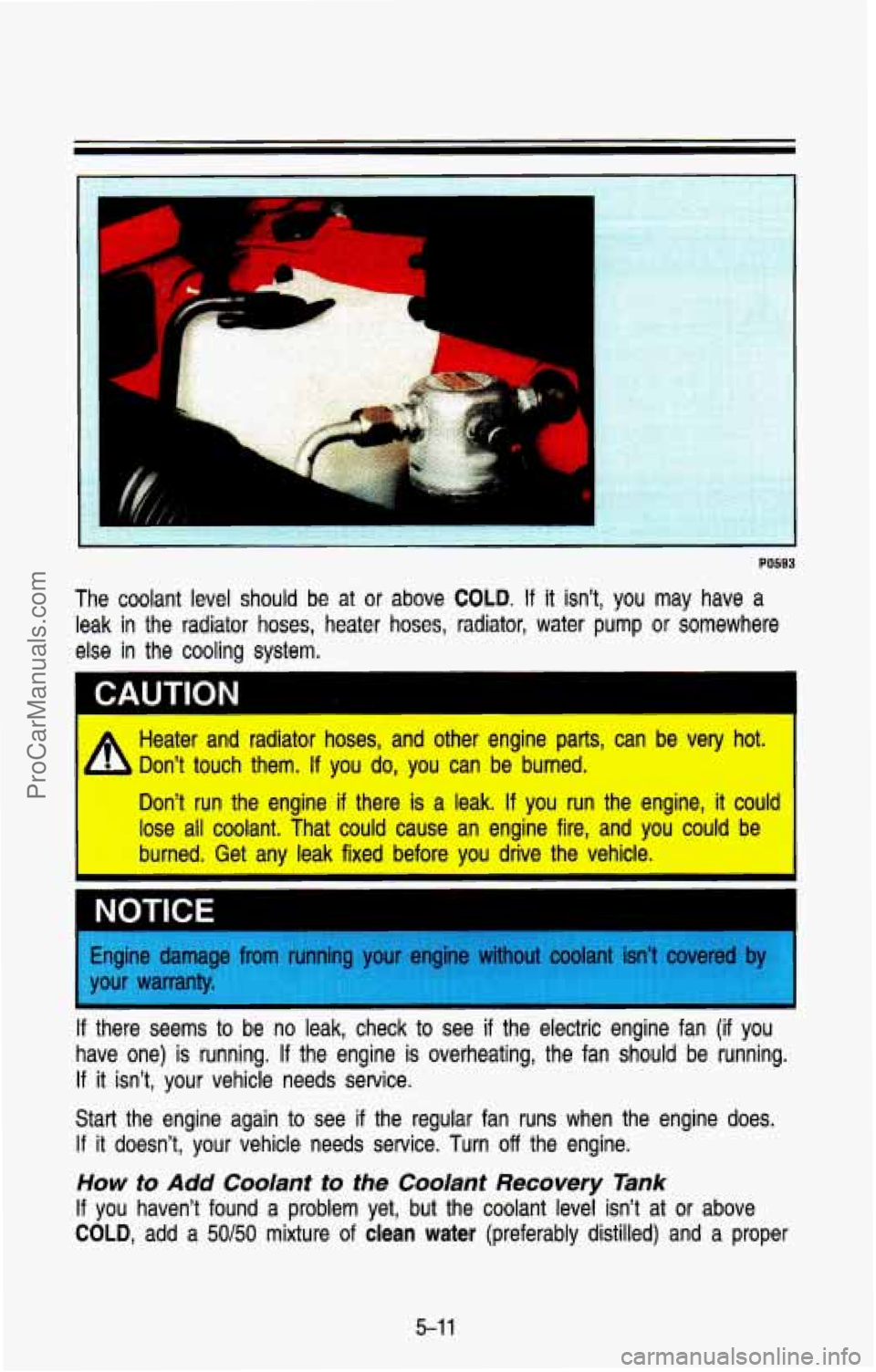
The coolant level should be at or above COLD. If it isn’t, you may have a
leak in the radiator hoses, heater hoses, radiator, water pump or somewhere
else in the cooling system.
CAUTION
A
Heater and radiator hoses, and other engine parts, can be very\
hot.
Don’t touch them. If you
do, you can be burned.
Don’t run the engine
if there is a leak. If you run the engine, 1‘ it coulc
lose all coolant. That could cause an engine fire, and you could
be
I burned. Get any leak fixed before you drive the vehicle.
I
If there seems to be no leak, check to see if the electric engine fan (if you
have one) is running. If the engine is overheating, the fan \
should be running.
If
it isn’t, your vehicle needs service.
Start the engine again to see
if the regular fan runs when the engine does.
If
it doesn’t, your vehicle needs service. Turn off the engine.
How to Add Coolant to the Coolant Recovery Tank
If you haven’t found a problem yet, but the coolant level \
isn’t at or above
COLD, add a 50150 mixture of clean water (preferably distilled) and a proper
5-1 1
ProCarManuals.com
Page 266 of 386
Service & Appearance Care
.
Here you will find information about the care of your vehicle . This section
begins with service and fuel information. and then it shows
how to check
important fluid and lubricant levels
. There is also technical information about
your vehicle. and a section devoted to its appearance care
.
Service ........................................................................\
........................................... 6-3
Fuel ........................................................................\
................................................ 6-4
Checking Things Under the Hood
....................................................................... \
6-8
Hood Release
........................................................................\
............................ 6-8
Engine Oil ........................................................................\
.................................. 6-9
Air Cleaner
........................................................................\
............................... 6-16
Automatic Transmission Fluid
........................................................................\
. 6-17
Manual Transmission Fluid ........................................................................\
..... 6-20
Hydraulic Clutch
........................................................................\
....................... 6-21
Transfer Case
........................................................................\
.......................... 6-23
Front
Axle ........................................................................\
................................. 6-24
Rear Axle
........................................................................\
................................. 6-24
Engine Coolant
........................................................................\
........................ 6-25
Power Steering Fluid
........................................................................\
............... 6-29
Windshield Washer Fluid
........................................................................\
......... 6-31
Brake Master Cylinder
........................................................................\
............. 6-32
6-1
ProCarManuals.com