1993 CHEVROLET S10 brake
[x] Cancel search: brakePage 277 of 356
Downloaded from www.Manualslib.com manuals search engine Brake Master Cylinder
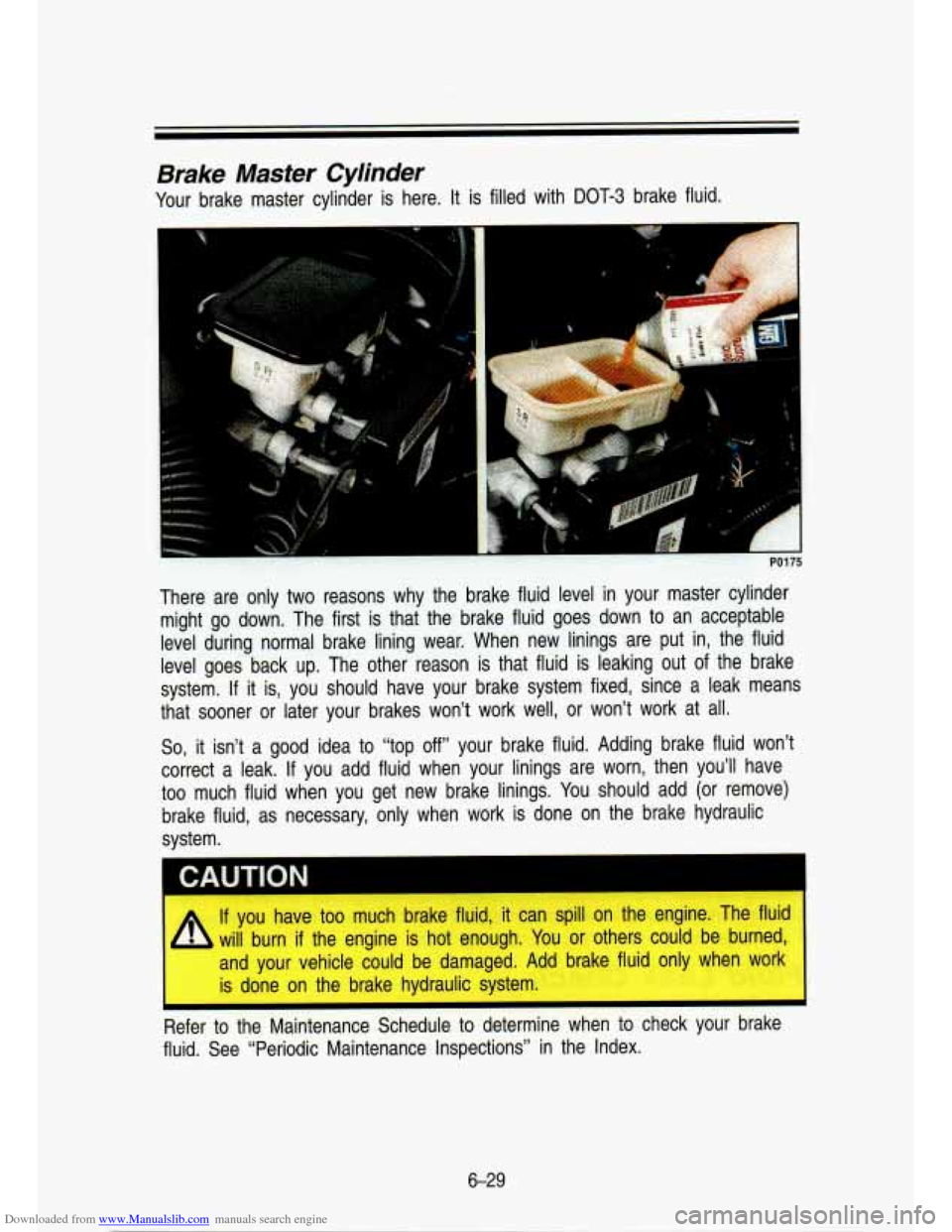
Your brake master cylinder is here. It is filled with DOT-3 brake fluid.
PO775
So, it isn’t a good idea to “top off” your brake fluid. Adding brake fluid won’t
correct a leak.
If you add fluid when your linings are worn, then you’ll have \
too much fluid when you get new brake linings. You should add (or remove)
brake fluid, as necessary, only when work is done on the brake hydraulic
system.
If you have too much brake fluid,
it can spill on the engine. The fluid
will burn if the engine is hot enough. You or others could be burned,
and your vehicle could be damaged. Add brake fluid only when work
is done on the brake hydraulic system. I
Refer to the Maintenance Schedule to determine when to check your brake
fluid. See “Periodic Maintenance Inspections” in the Index.
6-29
Page 278 of 356
Downloaded from www.Manualslib.com manuals search engine . ..
Service & Appearance Care
To Check Brake Fluid:
You can check the brake fluid without taking off the cap. Just look at the
windows on the brake fluid reservoir. The fluid levels should be above
MIN. If
they aren’t, have your brake system checked to see if there is a leak.
After work is done on the brake hydraulic system, make sure t\
he levels are above
MIN and below the top of each window.
What To Add
When you do need brake fluid, use only DOT-3 brake fluid-such as Delco
Supreme
11 @ (GM Part No. 1052535). Use new brake fluid from a sealed
container only.
Replacing Brake System Parts
The braking system on a modern vehicle is complex. Its many parts have to
be of top quality and work well together if the vehicle is to have really good
braking. Vehicles we design and test have top-quality GM brake parts in
them, as your vehicle does when
it is new. When you replace parts of your
braking system-for example, when your brake linings wear down and you
have to have new ones put in-be sure you get new genuine GM
replacement parts.
If you don’t, your brakes may no longer work properly. For
example,
if someone puts in brake linings that are wrong for your vehicle, the
balance between your front and rear brakes can change, for the\
worse. The braking performance you’ve come
to expect can change in many other ways
if someone puts in the wrong replacement brake parts.
Fluid Leak Check
After the vehicle has been parked for a while, inspect the su\
rface under the
vehicle for water, oil, fuel or other fluids. Water dripping from the air
conditioning system after
it has been used is normal. If you notice fuel leaks
or fumes, the causes should be found and corrected at once.
6-30
Page 315 of 356
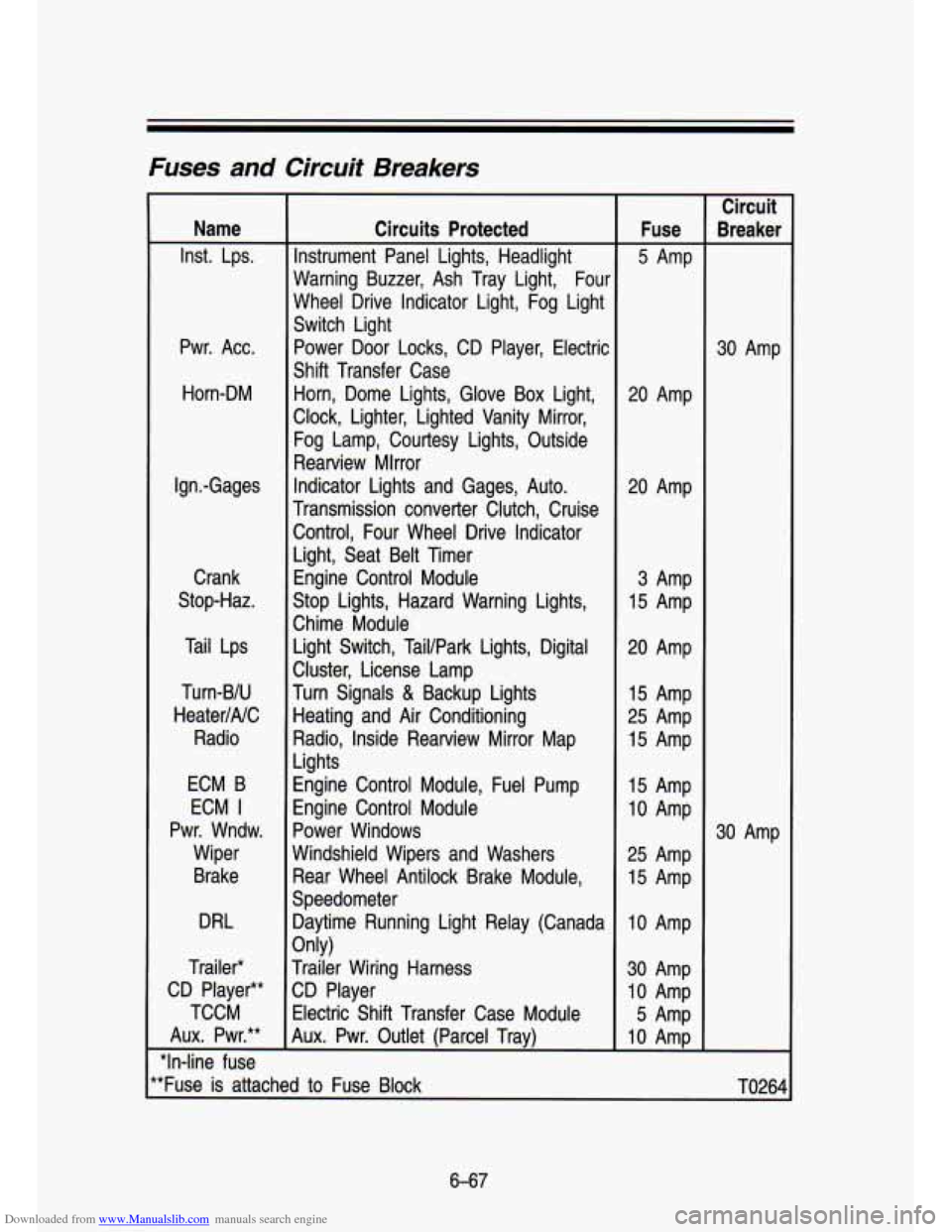
Downloaded from www.Manualslib.com manuals search engine Fuses and Circuit Breakers
Name
Inst. Lps.
Pwr. Acc. Horn-DM
Ign.-Gages Crank
Stop-Haz.
Tail Lps
Turn-BIU
HeaterINC Radio
ECM B
ECM
I
Pwr. Wndw. Wiper
Brake
DRL
Trailer*
CD Player**
TCCM
Aux. Pwr.**
"In-line fuse Circuits Protected
Instrument Panel Lights, Headlight
Warning Buzzer, Ash Tray Light, Four
Wheel Drive Indicator Light, Fog Light
Switch Light Power Door Locks, CD Player, Electric
Shift Transfer Case Horn, Dome Lights, Glove Box Light,
Clock, Lighter, Lighted Vanity Mirror,
Fog Lamp, Courtesy Lights, Outside
Rearview Mlrror
Indicator Lights and Gages, Auto.
Transmission converter Clutch, Cruise Control, Four Wheel Drive Indicator
Light, Seat Belt Timer Engine Control Module
Stop Lights, Hazard Warning Lights,
Chime Module Light Switch, Tail/Park Lights, Digital
Cluster, License Lamp
Turn Signals
& Backup Lights
Heating and Air Conditioning
Radio, Inside Rearview Mirror Map
Lights
Engine Control Module, Fuel Pump
Engine Control Module
Power Windows
Windshield Wipers and Washers Rear Wheel Antilock Brake Module,
Speedometer Daytime Running Light Relay (Canada
Trailer Wiring Harness
CD Player
Electric Shift Transfer Case Module
Aux. Pwr. Outlet (Parcel Trav)
Only) Fuse
5 Amp
20 Amp
20 Amp
3 Amp
15 Amp
20 Amp 15 Amp
25 Amp
15 Amp
15 Amp
10 Amp
25 Amp
15 Amp
10 Amp
30 Amp
10 Amp
5 Amp
10 AmD Circuit
kea ker
30 Amp
30 Amp
'*Fuse is attached to Fuse Block
TO264
6-67
Page 320 of 356

Downloaded from www.Manualslib.com manuals search engine Scheduled Maintenance Services
SCHEDULED MAINTENANCE SERVICES FOR
I
If your driving conditions meet those specified i
Services” in this Section (or see Index), use
M
Item I I Miles (000) I 3 I 6
No. Service Kilometers (000) 5 10
1 Engine Oil Change*
I -Even/ 3 Months, or
Oil Filter Change*
-Every 3 Months, or
tt
2 Chassis Lubrication-Every 12 Months,
,, Clutch Fork Ball Stud Lubrication (4.3L or J I engines only) I
4 Cooling System Service*-Every 24
1 Months or
5 I Air Cleaner Filter Replacement* I I
6 Front Wheel Bearing Repack (2WD
Only)
7 Transmission Service**
8 Fuel Filter Replacement*
9 Spark Plugs Replacement*
10 Spark Plug Wire Inspection*
11 Engine Timing Check*
12 Fuel Tank, Cap and Lines Inspection*
13 Engine Accessory Drive Belt Inspection*
14 Tire and Wheel Rotation
t
15 Drive Axle Service tt
16 Brake Systems Inspection**
FOOTNOTES:
*An Emission Control Service
**See “Explanation
of Scheduled Maintenapce Services” i n the Index
TO283
7-4
Page 322 of 356

Downloaded from www.Manualslib.com manuals search engine scheduled Maintenance Services
I
SCHEDU--D MAIM 4ANCE SEf -7s FOR
If your driving conditions meet those I
Services” in this Section (or see lnde
Item Miles
(000)
No. Service Kilometers (000)
1 Engine Oil Change*
Oil Filter Change* -Every 12 Months,
or
-Every
12 Months, or
2 Chassis Lubrication-Every 12 Months, or
Clutch Fork Ball Stud Lubrication (4.3L
engines only)
Months or
3
4 Cooling System Service*-Every 24
5 Air Cleaner Filter Replacement*
6 Front Wheel Bearing Repack (2WD
7 Transmission Service**
8 Fuel Filter Replacement*
9 Spark Plugs Replacement*
10 Spark Plug Wire Inspection* 11 Engine Timing Check*
12 Fuel Tank, Cap and Lines Inspection*
13 Engine Accessory Drive Belt Inspection*
14 Tire and Wheel Rotation
15 Drive Axle Service
16 Brake Systems Inspection**
Only)
FOOTNOTES:
*An Emission Control Service
36
5 10
**See “Explanation of Scheduled Maintenance Services” in the Index
TO287
7-6
Page 324 of 356
Downloaded from www.Manualslib.com manuals search engine Scheduled Maintenance Services
Explanation Of Scheduled Maintenance Services
Below are explanations of the services listed in the maintenance charts.
The proper fluids and lubricants to use are listed in this se\
ction. Make sure whoever services your vehicle uses these. All parts should be \
replaced and all necessary repairs done before you or anyone else drives th\
e vehicle.
1. ENGINE OIL AND OIL FILTER CHANGE* -ALWAYS USE SG OR SG/CE QUALITY, ENERGY CONSERVING
II OILS OF THE PROPER
VISCOSITY. To determine the preferred viscosity oil for your vehicle’s
engine (e.g. SAE 5W-30). See “Engine Oil” in the Index.\
2. CHASSIS LUBRICATION -Lubricate the front suspension, ball joint,
steering linkage, clutch, and transfer case shift linkage, parki\
ng brake
cable guides, propshaft splines, universal joints, brake pedal s\
prings, and
clutch pedal springs at the intervals specified on the proper \
maintenance
schedule, or at every engine oil change, whichever comes first.\
On
vehicles without hydraulic clutches, lubricate the clutch cross \
shaft every
30,000 miles
(50 000 km).
Ball joints should not be lubricated unless their temperature i\
s 10°F
(-12°C) or higher. When the weather is cold, let them war\
m up before
lubricating them or they could be damaged.
Also, be sure to check all the vehicle fluid levels at this \
time.
3. CLUTCH FORK BALL STUD LUBRICATION (4.3L ENGINES ONLY)
-Lubricate the clutch fork ball stud through the fitting on th\
e clutch housing. Lubricant must be added “sparingly” to the fittin\
g, as only
.0066
Ib. (.003 kg) is required to lubricate the ball stud surface\
. Do not add
lubricant more often than the intervals recommended in the Main\
tenance
Schedules. Too much lubricant
will damage the clutch assembly.
4. COOLING SYSTEM SERVICE* -Drain, flush and refill the system wit\
h
new coolant. See “Engine Coolant’’ in the Index for th\
e proper coolant
and mixture to use in your vehicle.
Also inspect the hoses and replace them
if they are cracked, swollen, or
deteriorated. Tighten all hose clamps. Clean the outside of the radiator
and air conditioning condenser. Wash the radiator neck. To ensure proper
operation, pressure test the radiator and cap.
* An Emission Control Service
7-8
Page 325 of 356

Downloaded from www.Manualslib.com manuals search engine 5. AIR CLEANER FILTER REPLACEMENT* -Replace at specified
intervals. Ask your dealer for the proper replacement intervals for your
driving conditions.
6. FRONT WHEEL BEARING REP1 -;< (2-WHEEL DRIVE ONLY) -Clean
and repack the front wheel bearings at each brake relining, or at the
specified interval, whichever comes first.
7. TRANSMISSION SERVICE:
Automatic Transmission -Change the transmission fluid and filter \
every 15,000 miles (25
000 km) if the vehicle is mainly driven under one or
more of these conditions:
In heavy city traffic.
Where the outside temperature regularly reaches 90°F (32°C) or
In hilly or mountainous terrain.
Frequent trailer pulling.
higher.
0 Uses such as taxi, police, delivery or other commercial service\
.
If the vehicle is not used mainly under any
of these conditions, change
the fluid and filter every 30,000 miles
(50 000 km). See “Automatic
Transmission Fluid” in the Index for more information.
Manual Transmission -Transmission fluid does not require periodic\
changing.
8. FUEL FILTER REPLACEMENT* -Replace the fuel filter at the specified
9. SPARK PLUGS REPLACEMENT* -Replace spark plugs with the type
interval
or sooner
if clogged.
listed in Section
6. See “Specification Charts” in the Index.
10. SPARK PLUG WIRE INSPECTION* -Clean wires and inspect for b\
urns, cracks or other damage. Check the wire boot fit at the distributor and \
at
the spark plugs. Replace wires as needed.
11. ENGINE TIMING CHECK AND DISTRIBUTOR CHECK* -Adjust timing to underhood label specifications. Inspect the inside and outsid\
e of the
distributor cap and rotor for cracks, carbon tracking and corro\
sion. Clean or replace as needed.
12. FUEL TANK, CAP AND LINES INSPECTION* -Inspect the fuel tan\
k, cap and lines for damage or leaks. Remove fuel cap, inspect g\
asket for
an even filler neck imprint, and any damage. Replace parts as \
needed.
* An Emission Control Service
7-9
Page 326 of 356
Downloaded from www.Manualslib.com manuals search engine Scheduled Maintenance Services
13. ENGINE ACCESSORY DRIVE BELT INSPECTION*-Inspect belt. Look
for cracks, fraying, wear, and proper tension. Adjust or replac\
e as needed.
14. TIRE AND WHEEL ROTATION AND INSPECTION -For proper wear and maximum tire life, rotate tires at the first
6,000 miles (10 000
kilometers) for Schedule I or 7,500 miles (12 500 kilometers) for
Schedule
II and then every 15,000 miles (25 000 kilometers) thereafter.
Follow the instructions and patterns shown in Section
6. Check tires for
uneven wear or damage.
If irregular or premature wear is apparent,
check wheel alignment. Also, check for damaged wheels. See “\
Tires” in
the Index for more information.
15. DRIVE AXLE SERVICE -Check rear/front axle fluid level and add \
as
needed. Check constant velocity joints and axle seals for leaki\
ng.
Locking differential -Drain fluid at first oil change and refill. Check
fluid level and add as needed at subsequent oil changes. In d\
usty areas
or trailer towing applications, drain fluid at every 15,000 miles
(24
135 kilometers) and refi1l.t
Standard differential -Check fluid level and add as needed at
every oil change. In dusty areas or trailer towing applications\
, drain
fluid every
15,000 miles (24 135 kilometers) and refil1.t
More frequent lubrication may be required for off-road use.
16. BRAKE SYSTEM INSPECTION -When the engine oil is changed,
inspect the lines and hoses for proper hookup, binding, leaks, \
cracks,
chafing, etc. Check the parking brake adjustment, and the fluid\
level in
the master cylinder. A low fluid level can indicate worn disc \
brake pads
which may need to be serviced.t
When the wheels are removed for rotation, inspect disc brake p\
ads for
wear and rotors for surface condition. Also inspect drum brake \
linings for
wear and cracks. Inspect other brake parts, including drums, wh\
eel cylinders, parking brake, etc., at the same time.
Inspect brakes more often if driving habits or conditions resul\
t
in
frequent braking.
tA fluid
loss in these systems may indicate a problem. Have them inspected
and repaired at once.
7-1 0