1993 CHEVROLET LUMINA ESP
[x] Cancel search: ESPPage 139 of 324
Downloaded from www.Manualslib.com manuals search engine -.,.. -
could cause the tires to slide. You may
not realize the surface is slippery until
your vehicle is skidding. Learn to
recognize warning clues-such as
enough water, ice or packed snow on
the road to make a “mirrored
surface”-and slow down when you
have any doubt.
If you have the anti-lock braking
system, remember: It helps avoid only
the braking
skid. If you do not have
anti-lock, then
in a braking skid (where
the wheels are no longer rohg),
release enough pressure on the brakes
to get the wheels rolling again.
This
restores steering control. Push the
brake pedal down steadily when
you
have to stop suddenly. As long as the
wheels are rolling, you will have steering
control. Steer the way you want to
go.
-
X3030 , , -;. - ., ,
Driving. at Might
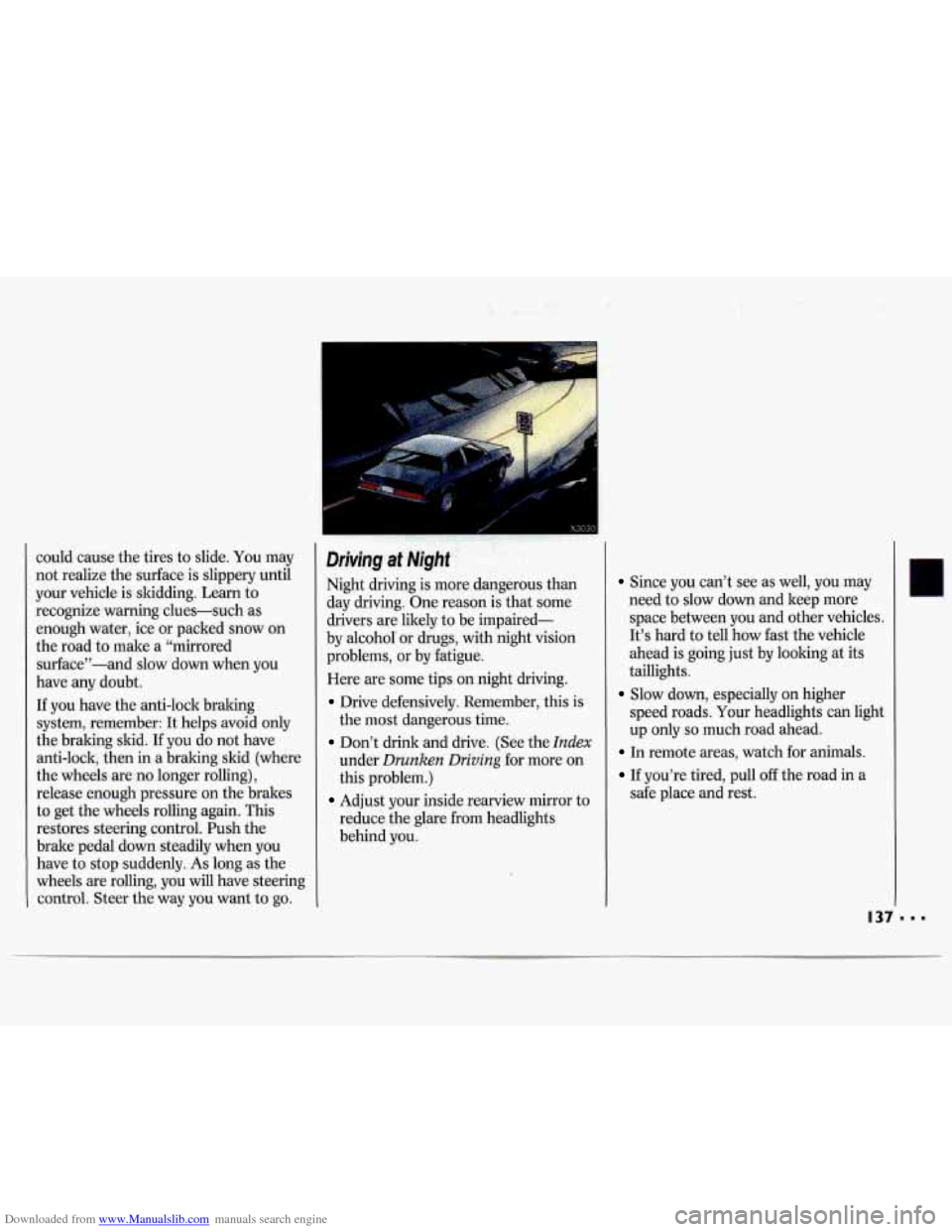
Night driving is more dangerous than
day driving. One reason is that some
drivers are likely to be impaired-
by alcohol or drugs, with night vision
problems,
or by fatigue.
Here are some tips on night driving.
Drive defensively. Remember, this is
the most dangerous time.
Don’t drink and drive. (See the Index
under Drunken Driving for more on
this problem.)
Adjust your inside rearview mirror to
reduce the glare from headlights
behind you.
Since you can’t see as well, you may
need to slow
down and keep more
space between you
and other vehicles.
It’s hard to tell how fast the vehicle
ahead’is going just by looking at its
taillights.
Slow down, esp.ecially on higher
speed roads. Your headlights can light
up only so much road ahead.
In remote areas, watch for animals.
If you’re tired, pull off the road in a
safe place and rest.
Page 142 of 324
Downloaded from www.Manualslib.com manuals search engine ..I
Your Driving and the Road
Driving in the Rain (cow.)
walking. Road spray can often be worse for vision than rain, especially
if it
comes from
a dirty road.
So it is wise to keep your wiping
equipment in good shape and keep your
windshield washer tank filled. Replace
your windshield wiper inserts when
they show signs of streaking or missing
areas on the windshield, or when strips
of rubber start to separate from the
inserts.
I40
CAUTION
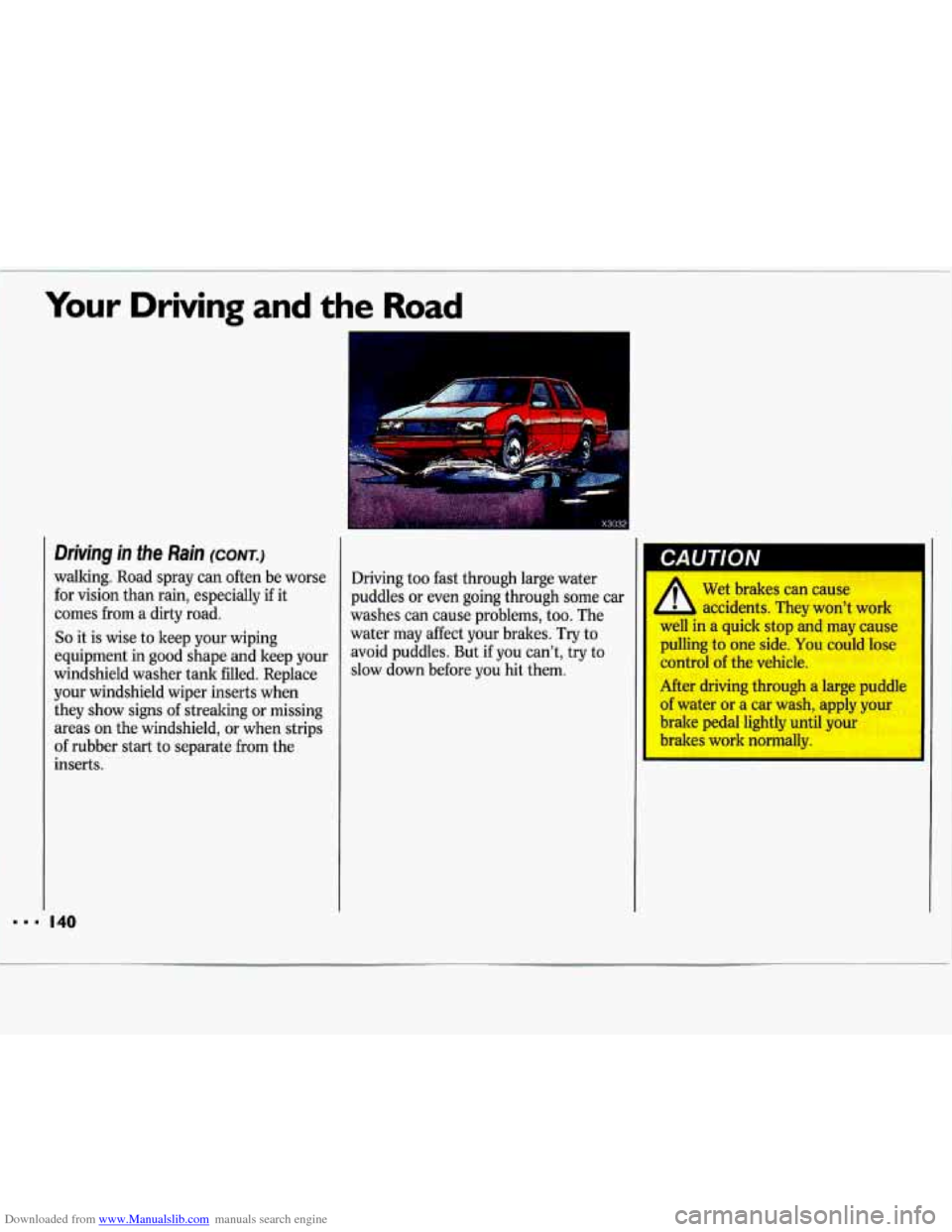
Driving too fast through large water
puddles or even going through some car
washes can cause problems, too. The
water may affect your brakes.
Try to
avoid puddles. But
if you can’t, try to
slow down before
you hit them.
A Wet brakes can cause
,- accidents. They won’t work
well in
a quick stop and may cause
pulling to one side.
You could lose
control
of the vehicle.
After driving through a large puddle of water or a car wash, apply your
brake pedal lightly until your
brakes work normally.
I
Page 143 of 324
Downloaded from www.Manualslib.com manuals search engine Hydroplaning
Hydroplaning is dangerous. So much
water can build up under your tires that
they can actually ride on the water. This
can happen if the road is wet enough
and you’re going fast enough. When
your vehicle is hydroplaning, it has little
or no contact with the road.
You might not be aware of
hydroplaning.
You could drive along for
some time without realizing your tires
aren’t in constant contact with the road.
You could find out the hard way: when
you have to slow, turn, move out to
pass--or if you get hit by
a gust of wind.
You could suddenly find yourself out of
control. Hydroplaning doesn’t happen often.
But
it can
if your tires haven’t much
tread or if the pressure in one or more is
low. It can happen if a lot of water is
standing on the road. If you can see
reflections from trees, telephone poles, or other vehicles, and raindrops
“dimple” the water’s surface, there
could be hydroplaning.
Hydroplaning usually happens at higher
speeds. There just isn’t a hard and fast
rule about hydroplaning. The best
advice is to slow down when it
is
raining, and be careful.
Some Other Rainy Weather Tips
Turn on your headlights-not just
your parking lights-to help make you
more visible to others.
Look for hard-to-see vehicles coming
from behind.
You may want to use
your headlights even in daytime if it’s
raining hard.
Besides slowing down, allow some
extra following distance. And be
especially careful when you pass
another vehicle. Allow yourself more
clear room ahead, and be prepared to
have your view restricted by road
spray. If the road spray is
so heavy
you are actually blinded, drop back.
Don’t pass until conditions improve.
Going more slowly is better than
having an accident.
Use your defogger if it helps.
Have good tires with proper tread
depth. (See the
Index under Tires.)
Page 144 of 324
Downloaded from www.Manualslib.com manuals search engine Your Drivi r 2 the
A I
3 m
Driving in Fog, Mist and Haze
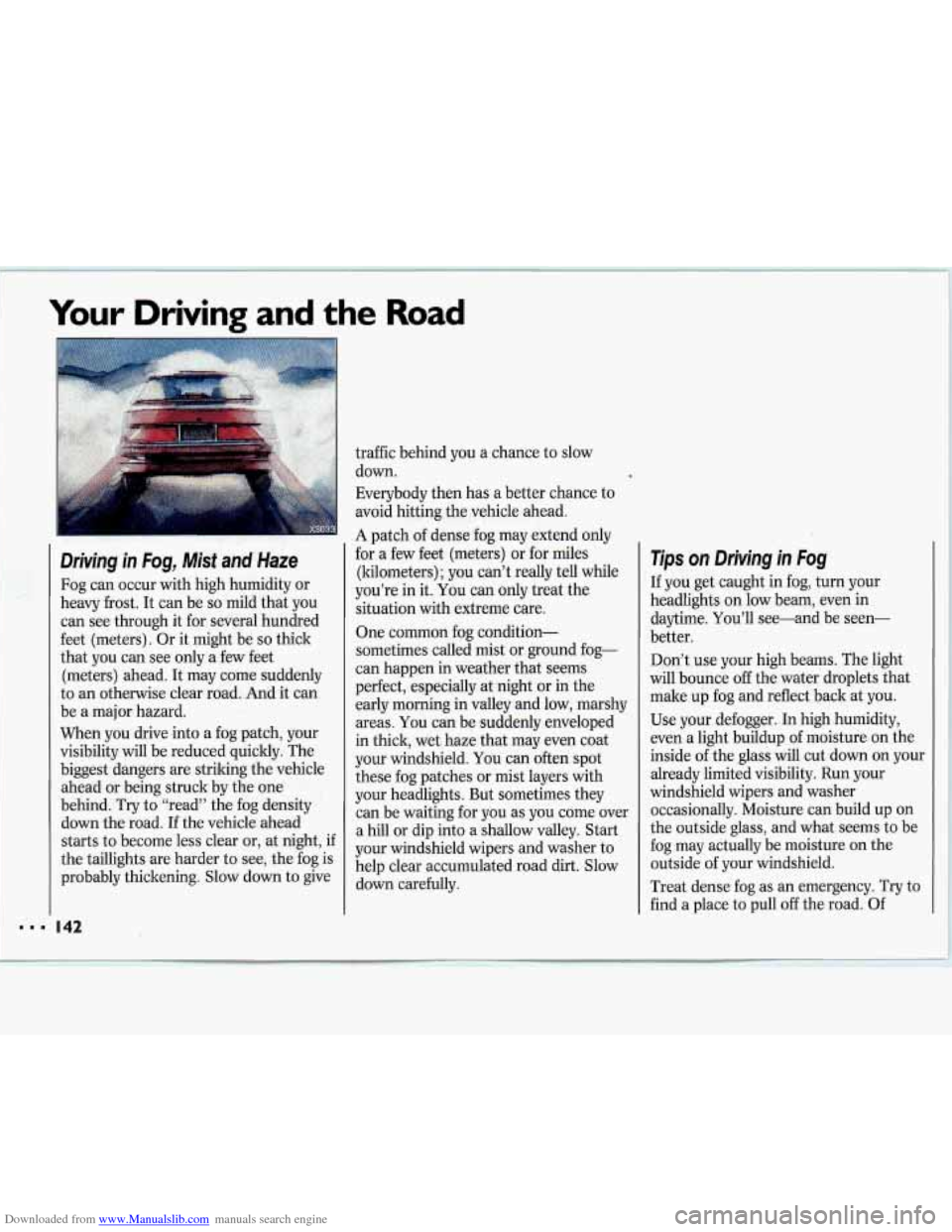
Fog can occur with high humidity or
heavy frost. It can be
so mild that you
can see through it for several hundred
feet (meters). Or it might be
so thick
that you can see only a few feet
(meters) ahead. It may come suddenly
to an otherwise clear road. And
it can
be
a major hazard.
When you drive into a fog patch, your
visibility will be reduced quickly. The biggest dangers are striking the vehicle
ahead or being struck by the one
behind.
Try to “read” the fog density
down the road. If the vehicle ahead
starts to become less clear or, at night, if
the taillights are harder to see, the fog is
probably thickening. Slow down to give traffic behind you
a chance
to slow
down.
Everybody then has a better chance to
avoid hitting the vehicle ahead.
A patch of dense fog may extend only
for a few feet (meters) or for miles (kilometers);
you can’t really tell while
you’re in it.
You can only treat the
situation with extreme care.
One common fog condition-
sometimes called mist or ground fog-
can happen in weather that seems
perfect, especially at night or in the
early morning in valley and low, marshy
areas.
You can be suddenly enveloped
in thick, wet haze that may even coat
your windshield.
You can often spot
these fog patches or mist layers with
your headlights. But sometimes they can be waiting for you as you come over
a hill or dip into a shallow valley. Start
your windshield wipers and washer to
help clear accumulated road dirt. Slow
down carefully.
Tips on Driving in Fog
If you get caught in fog, turn your
headlights on low beam, even in
daytime. You’ll see-and be seen-
better.
Don’t use your high beams. The light
will bounce
off the water droplets that
make up fog and reflect back at you.
Use your defogger. In high humidity,
even a light buildup of moisture on the
inside of the glass will cut down on your
already limited visibility. Run your
windshield wipers and washer
occasionally. Moisture can build up on
the outside glass, and what seems to be
fog may actually be moisture on the
outside of your windshield.
Treat dense fog as an emergency. Try to
find a place to pull off the road. Of
Page 145 of 324

Downloaded from www.Manualslib.com manuals search engine course you want to respect another’s
property, but you might need to put
something between you and moving
vehicles-space, trees, telephone poles,
a private driveway, anything that
removes you from other traffic.
If visibility
is near zero and you must
stop but are unsure whether you are
away from the road, turn your hghts on,
start your hazard warning flashers, and
sound your horn at intervals or when
you hear approaching traffic.
Pass other vehicles in fog only if you
can see far enough ahead to pass safely.
Even then, be prepared to delay your
pass if you suspect the fog
is worse up
ahead.
If other vehicles try to pass you,
make it easy for them.
Cify Driving
One of the biggest problems with city
streets is the amount of traffic on them.
You’ll want to watch
out for what the
other drivers are doing and pay
attention to traf€ic signals.
Here are ways to increase your safety in
city driving:
Know the best way to get to where
you are going.
Try not to drive around
trying to pick out a familiar street or
landmark. Get
a city map and plan
your trip into an unlmown part of the
city
just as you would for a cross-
country trip.
Try to use the freeways that rim and
crisscross most large cities. You’ll
save time and energy. (See the next
section,
Freway Driving.)
Treat a green light as a warning
signal.
A traffic light is there because
the corner is busy enough to need
it.
When a light turns green, and just
before you start to move, check both
ways for vehicles that have not
cleared the intersection or may be
running the red light.
Obey all posted speed limits. But
remember that they are for ideal road,
weather and visibility conditions.
You
may need to drive below the posted
limit in bad weather or when visibility
is especially poor.
Pull to the right (with care) and stop
clear of intersections when you see or
hear emergency vehicles.
Page 155 of 324
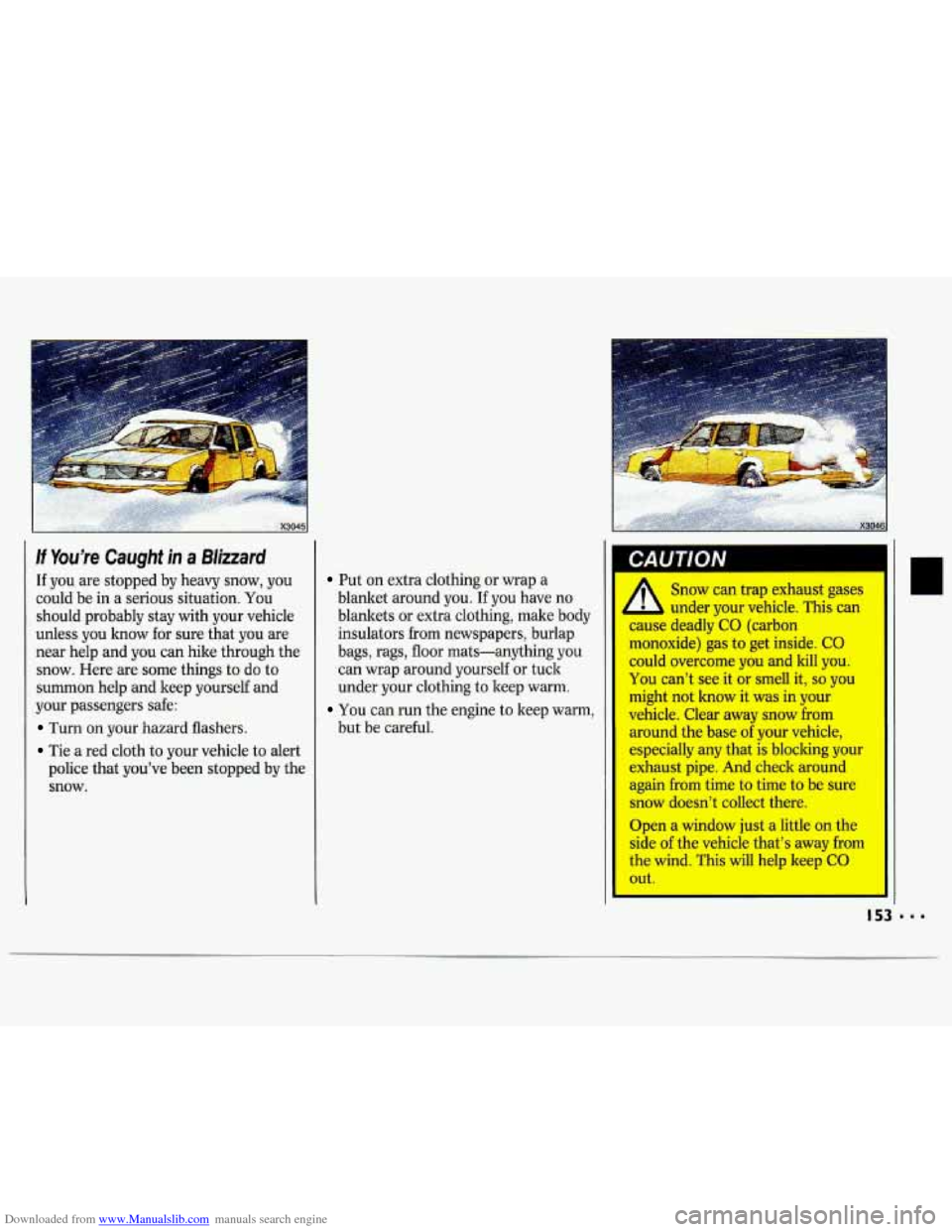
Downloaded from www.Manualslib.com manuals search engine If You’re Caught in a Blizzard
If you are stopped by heavy snow, you
could be in a serious situation. You
should probably stay with your vehicle
unless you know for sure that you are
near help and you can hike through the
snow. Here are some things to do to
summon help and keep yourself and
your passengers safe:
Turn on your hazard flashers.
Tie a red cloth to your vehicle to alert
police that you’ve been stopped by the
snow.
Put on extra clothing or wrap a
blanket around you.
If you have no
blankets or extra clothing, make body
insulators from newspapers, burlap
bags, rags, floor mats-anything you can wrap around yourself
or tuck
under your clothing to keep warm.
but be careful.
You can run the engine to keep warr~,
111 CAUT’olv Snow can trap exhaust gases
under your vehicle. This can
cause deadly
CO (carbon
monoxide) gas to get inside. CO
could overcome you and kill you.
You can’t see it or smell it,
so you
might not know it was in your
vehicle. Clear away snow
from
around the base of your vehicle,
especially any that is blocking your
exhaust pipe. And check around
again from time to time to be sure
snow doesn’t collect there.
Open a window just a little on the
side
of the vehicle that’s away from
the wind. This will help keep
CO
out.
153
Page 161 of 324

Downloaded from www.Manualslib.com manuals search engine Driving with a Trailer
Towing a trailer requires a certain
amount of experience. Before setting out for the open road, you’ll want to get
to know your rig. Acquaint yourself
with the feel of handling and braking
with the added weight of the trailer.
And always keep in mind that the
vehicle you are driving is now
a good
deal longer and not nearly
so responsive
as your vehicle is by itself.
Before you start, check the trailer hitch
and platform, safety chains, electrical connector, lights, tires and mirror
adjustment. If the trailer has electric
brakes, start your vehicle and trailer
moving and then apply the trailer brake
controller by hand to be sure the brakes
are worling. This lets you check your
electrical connection at the same time. During your
trip, check occasionally to
be sure that the load is secure, and that
the lights and any trailer brakes are still
working.
Following Distance
Stay at least twice as far behind the
vehicle ahead
as you would when
driving your vehicle without a trailer.
This can help you avoid situations that
require heavy braking and sudden
turns.
Passing
You’ll need more passing distance up
ahead when you’re towing a trailer.
And, because you’re a good deal longer,
you’ll need to go much farther beyond
the passed vehicle before you can return
to your lane.
Backing Up
Hold the bottom of the steering wheel
with one hand. Then, to move the
trailer to the left, just move that hand
to
the left. To move the trailer to the right,
move your hand to the right. Always
back up slowly and, if possible, have
someone guide you.
Page 163 of 324

Downloaded from www.Manualslib.com manuals search engine Parking on Hills
You really should not park your vehicle,
with a trailer attached,
on a hill. If
something goes wrong, your rig could
start to move. People can be injured,
and both your vehicle and the trailer
can be damaged.
But if you ever have to park your rig
on
a hill, here’s how to do it:
1. Apply your regular brakes, but don’t
shift into
P (Park) yet.
2. Have someone place chocks under
the trailer wheels.
3. When the wheel chocks are in place,
release the regular brakes until the
chocks absorb the load.
4. Reapply the regular brakes. Then
apply your parking brake, and then
shift to
P (Park).
5. Release the regular brakes.
When You are Ready to Leave After
Parking on a
Hill
1. Apply your regular brakes and hold
the pedal down while you:
Start your engine;
Shift into a gear; and
Release the parking brake.
2. Let up on the brake pedal.
3. Drive slowly until the trailer is clear
4. Stop and have someone pick up and
of
the chocks.
store the chocks.
Maintenance When Trailer Towing
Your vehicle will need service more
often when you’re pulling a trailer. See
the Maintenance Schedule for more
on
this. Things that are especially
important in trailer operation are
automatic transaxle fluid (don’t
overfill), engine oil, belts, cooling
system, and brake adjustment. Each
of
these is covered in this manual, and the
Index will help you find them quickly. If
you’re trailering, it’s a good idea to
review these sections before you start
your trip.
Check periodically to see that all hitch
nuts and bolts are tight.