1993 CHEVROLET DYNASTY seats
[x] Cancel search: seatsPage 710 of 2438
(3) Remove motor mounting screws.
(4) Carefully disconnect housing and cables from
motor assembly.
INSTALLATION
(1) Place motor assembly into position.
(2) Carefully connect cables and housings to motor
assembly. (3) Install mounting screws.
(4) Install bolt holding motor assembly to adjuster. (5) Install seat following procedure outlined under
Seat Assembly Installation.
ENTHUSIAST SEAT
AG and AJ body vehicles have, as an option, a spe-
cial enthusiast seat package. The seat includes not
only the normal six-way power seat adjuster, but also
special lumbar air filled support bag and adjustable
seat back side wings (Fig. 12). These mechanisms are
adjusted by a switch located on the right side seat
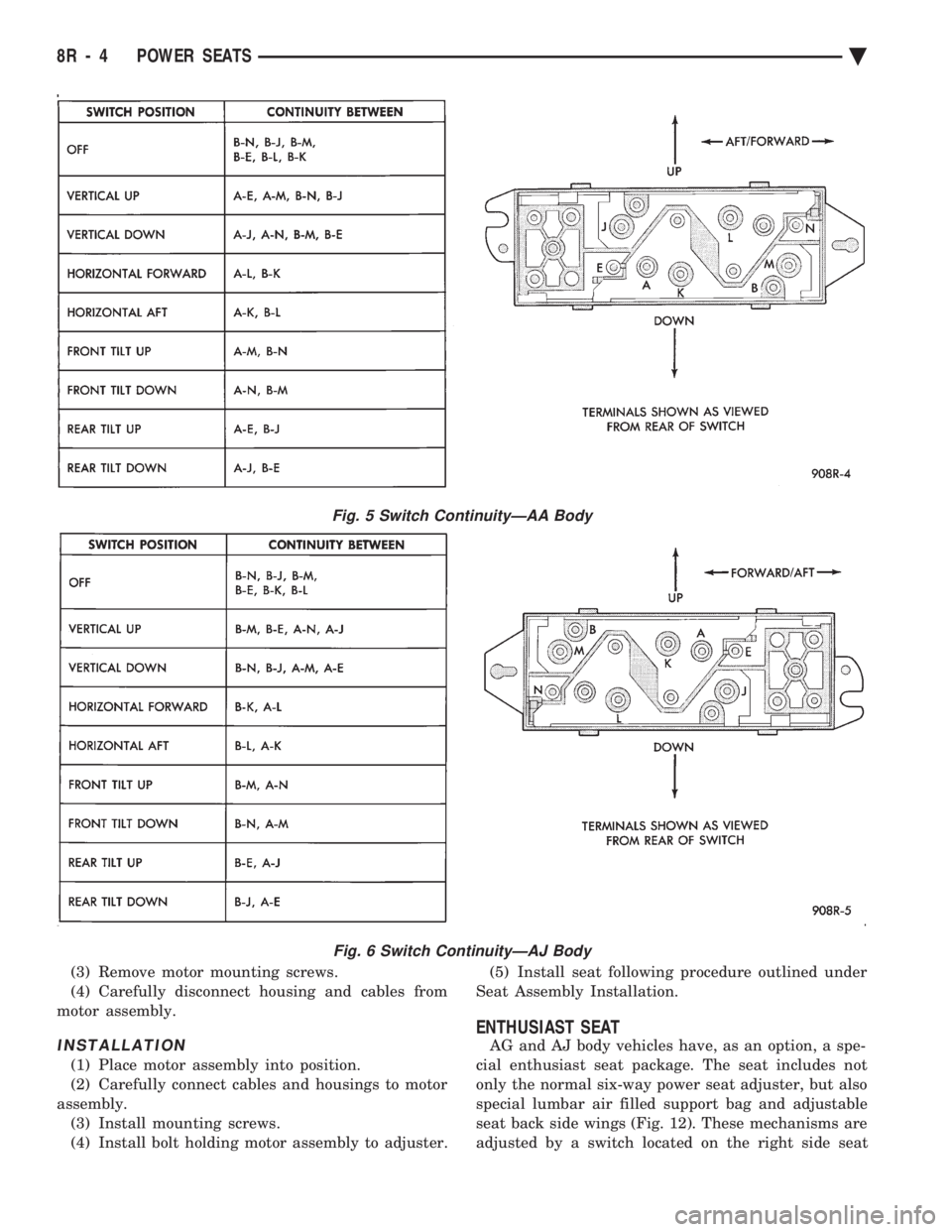
Fig. 5 Switch ContinuityÐAA Body
Fig. 6 Switch ContinuityÐAJ Body
8R - 4 POWER SEATS Ä
Page 711 of 2438

wing. Refer to Owner Manual supplied with vehicle
for complete instructions for seat operation.
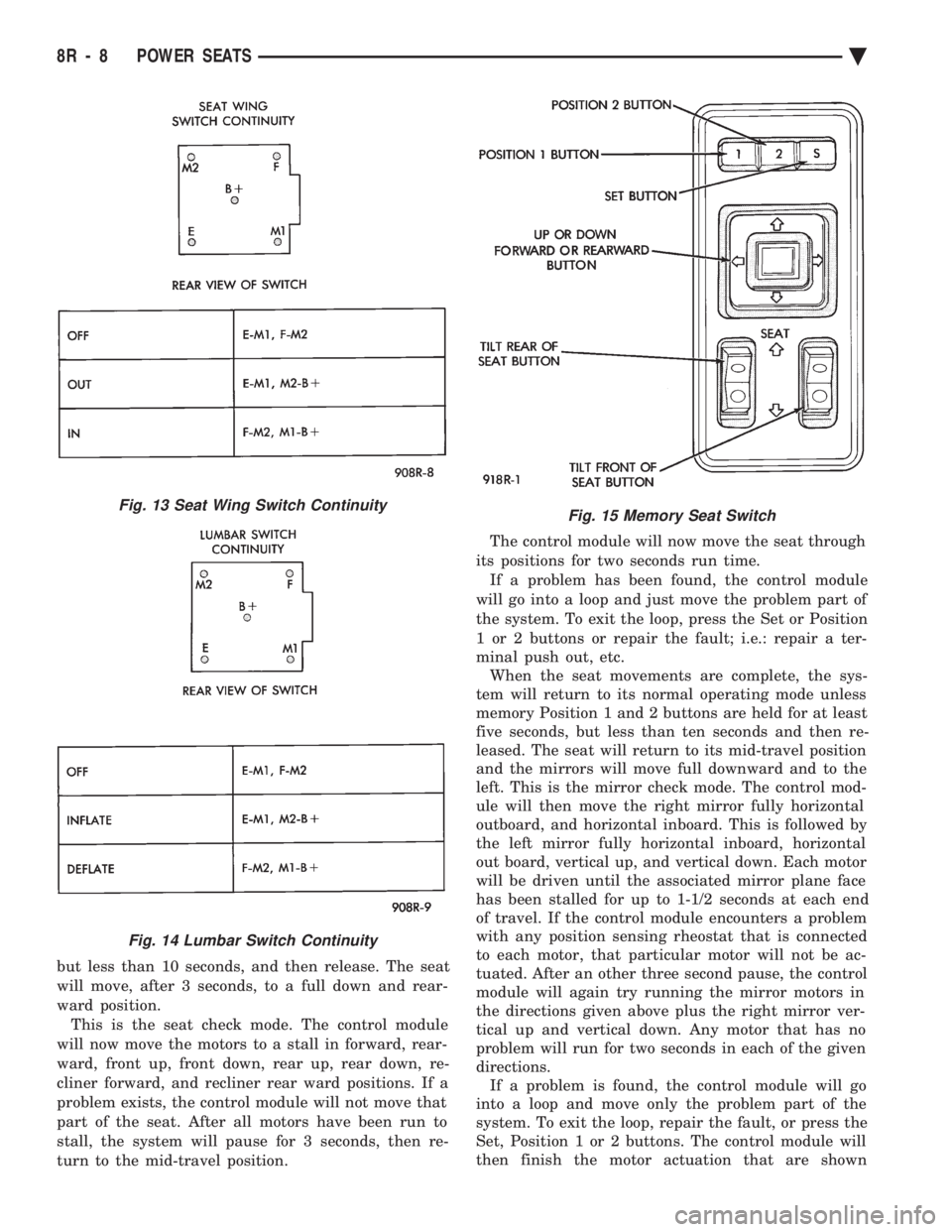
SWITCH TEST
For switch testing, remove switch from its mount-
ing location. Using an ohmmeter, refer to Figures 13
and 14 to determine if continuity is correct. If these
results are not obtained, replace the switch.
SWITCH REPLACEMENT REMOVAL
(1) Remove left cushion side shield.
(2) Disconnect wiring from switch.
(3) Depress bezel retainers and push switch from
bezel. (4) For installation, reverse above procedure.
POWER MEMORY SEAT, RECLINER AND
MIRRORS
AC & AY Body vehicles have, as an option, a spe-
cial 2 position memory power seat, recliner and
memory power outside rear view mirror system.
Each of the components can be moved to a desired
position by operating switches (Fig. 15). The seat and
recliner use potentiometers as position sensors and
the mirrors use rheostats to send their positioning
information back to the control module in the driv-
er's seat. After the desired seat and mirror position is
set. The seat, recliner, and mirror position can be
memorized at any time by pressing and release the
Set button. Followed by pressing the Position 1 or 2
button, for the specific position desired. DO NOT
press any other seat related switch for at least 5 sec-
onds. However, for the driver to recall a position, the
vehicle must not be moving and the seat belt must
NOT be buckled. Refer to the Owners Manual sup-
plied with the vehicle for complete instructions on
system operation.
Fig. 7 Switch ContinuityÐAG & AJ Bodies (8-Way)
Fig. 8 Seat AdjusterÐAC and AJ Bodies
Ä POWER SEATS 8R - 5
Page 712 of 2438
SYSTEM SOFT LIMITS
This portion of the system becomes activated when
the control module must shut off a specific seat, re-
cliner or mirror motor because it has reached the end
of its travel. When a mechanical stall condition is de-
tected, the control module will set a soft limit in its
memory and will not allow the motor to be driven
past that point. To override the soft limits, activate the seat or re-
cliner switch twice in the desired direction holding
the switch activated until the end of travel has been
reached. Reactivate and hold the switch once more
for three seconds. This will cause new soft limits to
be set in the control module.
SETTING SYSTEM SOFT LIMITS
If the control module or motor assemblies have
been replaced, the control module must learn its new
soft limits. To do this, perform the memory seat di-
agnostic self-test. After the tests are completed, the
control module will have learned and memorized its
new soft limits.
TEST PROCEDURES
Before any testing is attempted, the battery should
be carefully charged and all connections and termi-
nals cleaned and tightened to insure proper continu-
ity and grounds.
MEMORY SEAT AND MIRROR DIAGNOSTIC
SELF-TESTS
The system has a built-in set of three self-tests
which check all components in the system while giv-
ing a visual feedback. To enter the first self-test mode, switch test, press
memory position 1 and 2 buttons, hold for at least
five seconds and no longer than ten seconds. Follow
this immediately by pressing the Set button and hold
for at least five seconds but less than ten seconds.
Three seconds after the button is released, the seat,
recliner and mirrors will move to a mid-travel posi-
tion. Within ten seconds, press and release a seat
button to activate a seat or recliner motor. All
switches except the mirror switches may now be
tested one at a time. The memory switches, Position
1 and 2 and Set buttons, may also be tested. A good
switch contact actuation will NOD the seat. The seat
nod consists of seat front up and seat track forward
followed by seat front down and seat track rearward.
The nod also includes both outside power rear view
mirrors operating in the vertical plane. The system
will continue NODDING for good switches until 10
seconds pass without any switch actuation. Within 10 seconds of the last seat nod, press mem-
ory position 1 and 2 buttons for at least 5 seconds
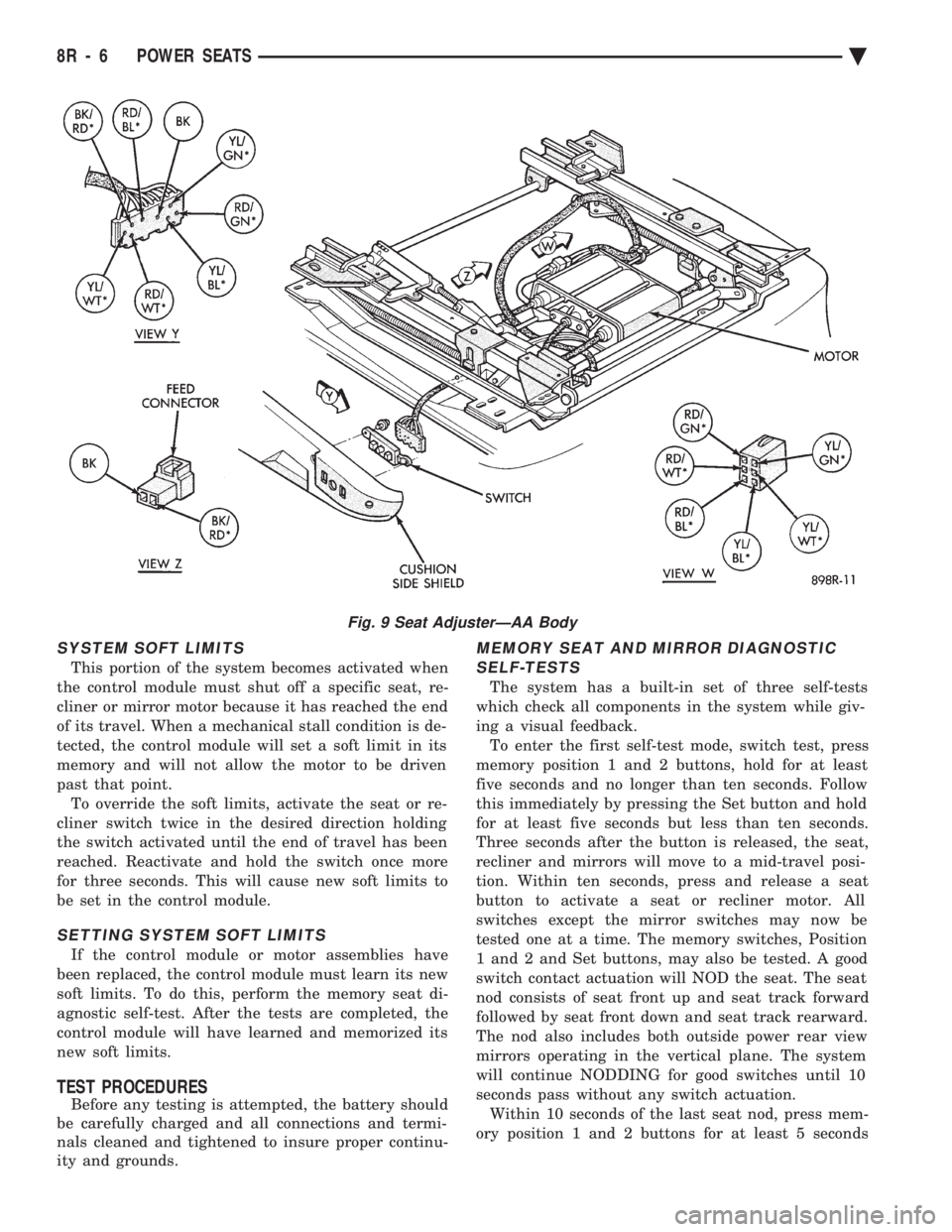
Fig. 9 Seat AdjusterÐAA Body
8R - 6 POWER SEATS Ä
Page 713 of 2438
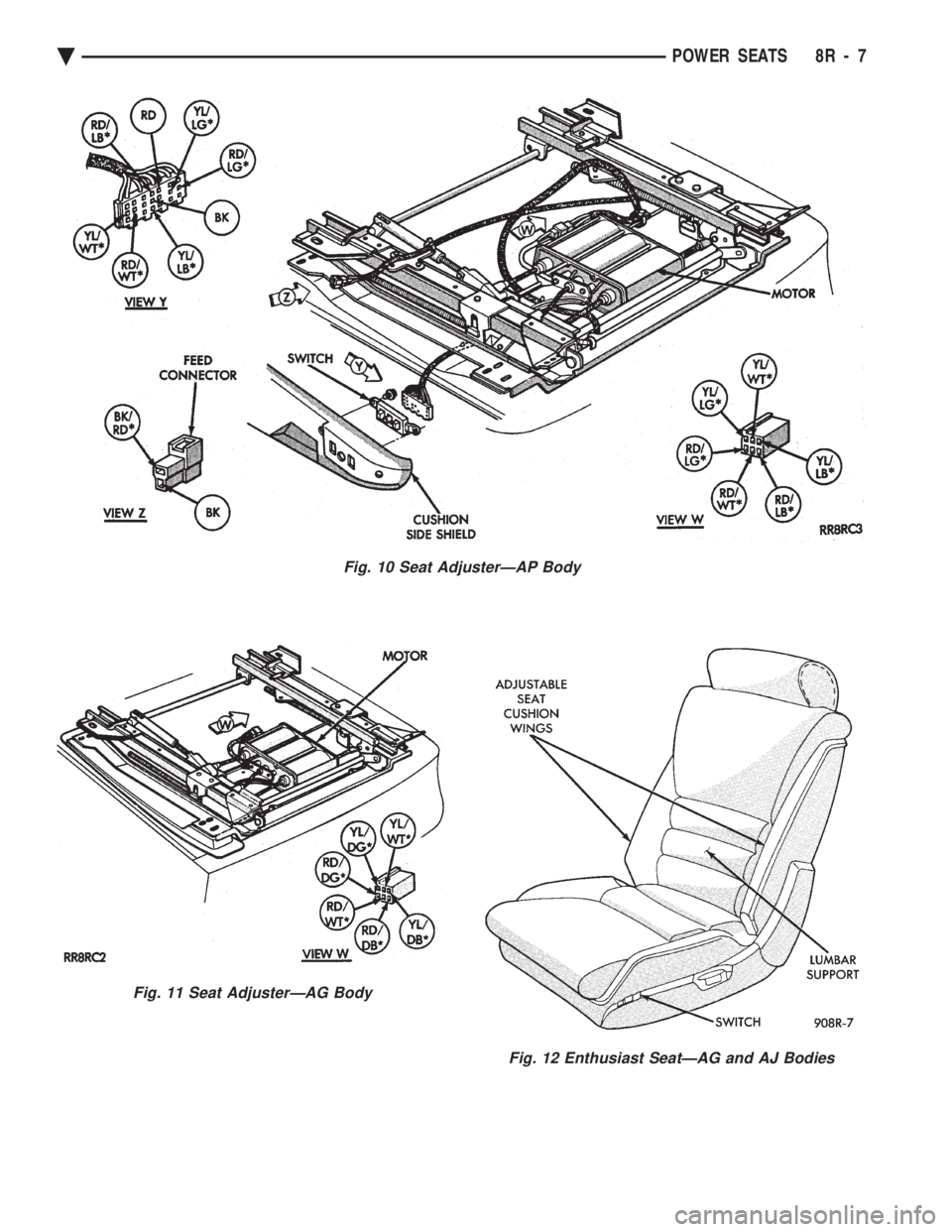
Fig. 10 Seat AdjusterÐAP Body
Fig. 11 Seat AdjusterÐAG Body
Fig. 12 Enthusiast SeatÐAG and AJ Bodies
Ä POWER SEATS 8R - 7
Page 714 of 2438
but less than 10 seconds, and then release. The seat
will move, after 3 seconds, to a full down and rear-
ward position. This is the seat check mode. The control module
will now move the motors to a stall in forward, rear-
ward, front up, front down, rear up, rear down, re-
cliner forward, and recliner rear ward positions. If a
problem exists, the control module will not move that
part of the seat. After all motors have been run to
stall, the system will pause for 3 seconds, then re-
turn to the mid-travel position. The control module will now move the seat through
its positions for two seconds run time. If a problem has been found, the control module
will go into a loop and just move the problem part of
the system. To exit the loop, press the Set or Position
1 or 2 buttons or repair the fault; i.e.: repair a ter-
minal push out, etc. When the seat movements are complete, the sys-
tem will return to its normal operating mode unless
memory Position 1 and 2 buttons are held for at least
five seconds, but less than ten seconds and then re-
leased. The seat will return to its mid-travel position
and the mirrors will move full downward and to the
left. This is the mirror check mode. The control mod-
ule will then move the right mirror fully horizontal
outboard, and horizontal inboard. This is followed by
the left mirror fully horizontal inboard, horizontal
out board, vertical up, and vertical down. Each motor
will be driven until the associated mirror plane face
has been stalled for up to 1-1/2 seconds at each end
of travel. If the control module encounters a problem
with any position sensing rheostat that is connected
to each motor, that particular motor will not be ac-
tuated. After an other three second pause, the control
module will again try running the mirror motors in
the directions given above plus the right mirror ver-
tical up and vertical down. Any motor that has no
problem will run for two seconds in each of the given
directions. If a problem is found, the control module will go
into a loop and move only the problem part of the
system. To exit the loop, repair the fault, or press the
Set, Position 1 or 2 buttons. The control module will
then finish the motor actuation that are shown
Fig. 13 Seat Wing Switch Continuity
Fig. 14 Lumbar Switch Continuity
Fig. 15 Memory Seat Switch
8R - 8 POWER SEATS Ä
Page 715 of 2438
above. When the control module has finished, it will
return to the normal operating mode after ten sec-
onds if no further switches are activated.The control module will also return to normal op-
erating mode if any manual seat or recliner move-
ment switch is actuated during the ten second
timeout. If the system has found a problem, refer to the ap-
propriate diagnosis condition.
POWER MEMORY SEAT, RECLINER AND
MIRRORS DIAGNOSIS
Before any diagnosis is done on the system, move
the seat switches and listen for relays clicking in the
control module under the seat. If relays can be heard,
the main battery and ground circuits to the control
module as well as the battery circuit to the switches
in the driver's door are good. When checking for voltage or continuity, always
use a volt/ohm meter to get accurate readings. The
seat and recliner switches must be activated to check
for voltage at the seat and recliner motors or at the
input to the control module from the switches. The control module creates a special voltage supply
for the position sensing functions. It also shuts down
after five seconds, in order to check this or any other
voltage being fed back to the control module. A
switch may have to be activated more than once to
verify a voltage reading. The voltage from the con-
trol module that feeds the seat and recliner position
sensing potentiometer, will be between 4.5 to 5 volts.
For simplicity in the diagnosis section, the feed volt-
age will be called 5 volts. On the position sensing
wires, these voltages will always be less than 5 volts
but more than 0 volts. Typically the high level is at
a maximum of about 4.25 volts and the low level can
be as little as 0.1 volts. If any seat or recliner potentiometer or mirror
rheostat position sense wires are crossed, the control
module will not move that part of the system. The
seat or mirror will be in a fault diagnostic mode.
CONDITION: SYSTEM WILL NOT OPERATE.
PROCEDURE
(1) Check for forward/rearward operation of re-
cliner. If not operable, check for an open or loose cir-
cuit breaker mounted in board on the relay bank in
cavity 15. (2) Check for continuity between 2-way connector
under driver's seat and pin 1 at control module 10-
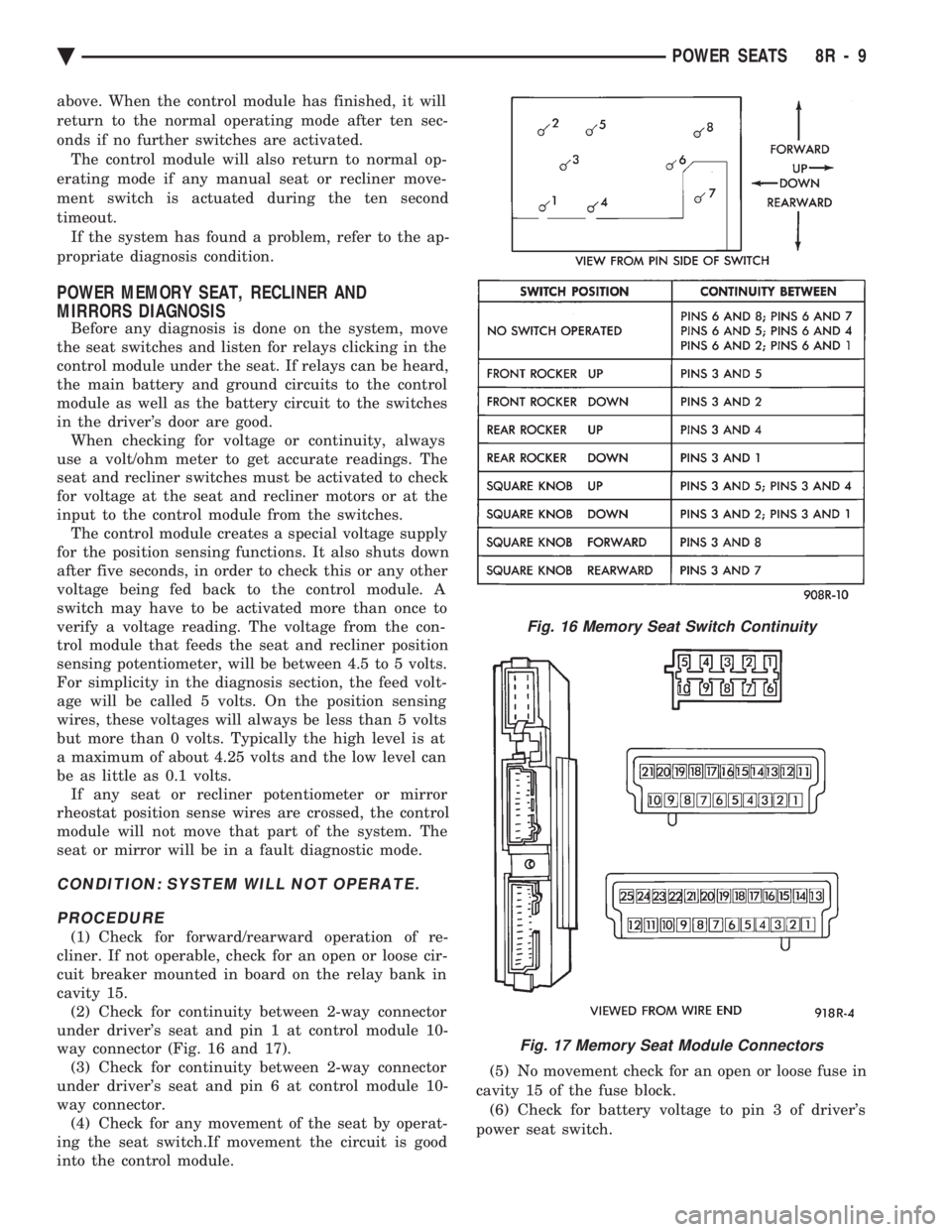
way connector (Fig. 16 and 17). (3) Check for continuity between 2-way connector
under driver's seat and pin 6 at control module 10-
way connector. (4) Check for any movement of the seat by operat-
ing the seat switch.If movement the circuit is good
into the control module. (5) No movement check for an open or loose fuse in
cavity 15 of the fuse block. (6) Check for battery voltage to pin 3 of driver's
power seat switch.
Fig. 16 Memory Seat Switch Continuity
Fig. 17 Memory Seat Module Connectors
Ä POWER SEATS 8R - 9
Page 716 of 2438
(7) If battery is good, check for continuity of driv-
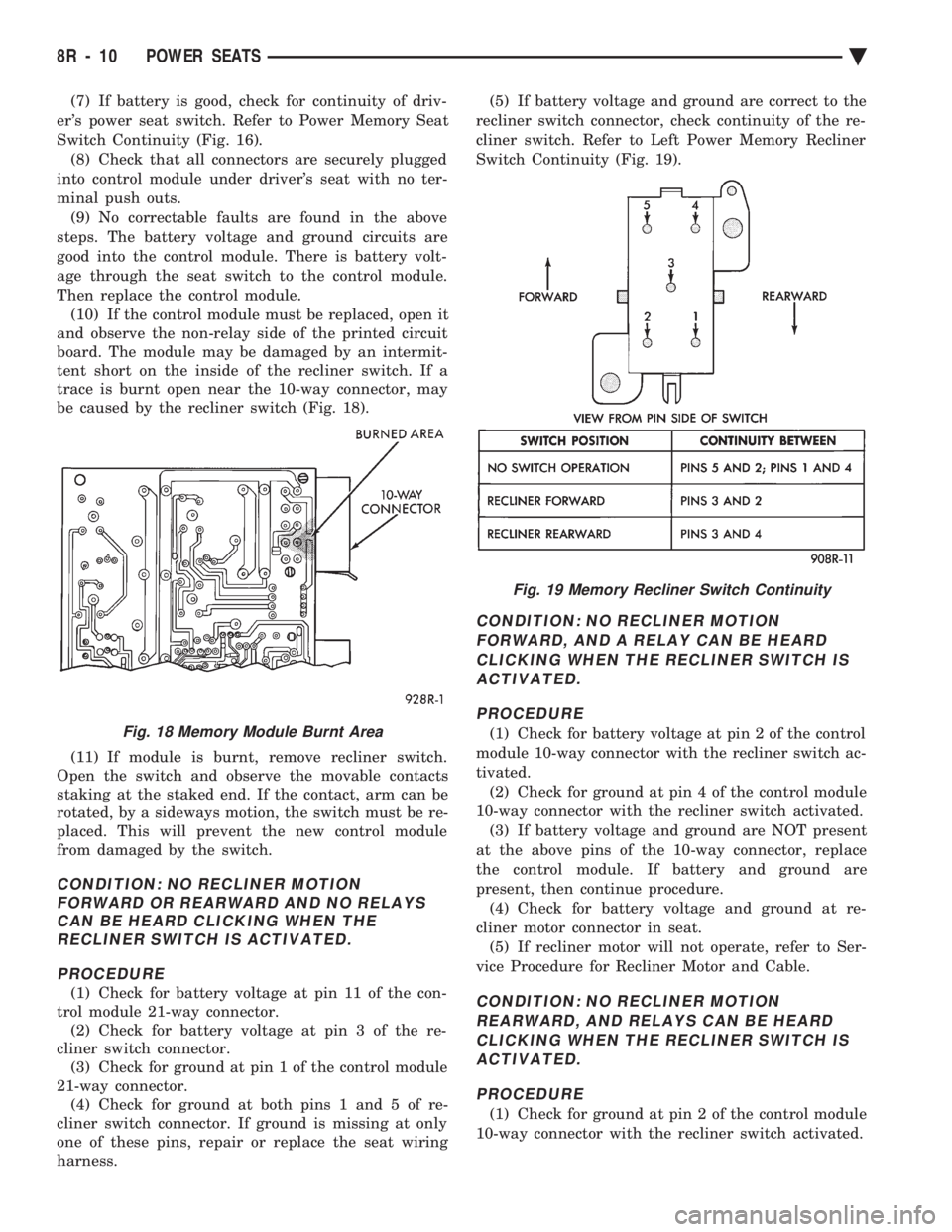
er's power seat switch. Refer to Power Memory Seat
Switch Continuity (Fig. 16). (8) Check that all connectors are securely plugged
into control module under driver's seat with no ter-
minal push outs. (9) No correctable faults are found in the above
steps. The battery voltage and ground circuits are
good into the control module. There is battery volt-
age through the seat switch to the control module.
Then replace the control module. (10) If the control module must be replaced, open it
and observe the non-relay side of the printed circuit
board. The module may be damaged by an intermit-
tent short on the inside of the recliner switch. If a
trace is burnt open near the 10-way connector, may
be caused by the recliner switch (Fig. 18).
(11) If module is burnt, remove recliner switch.
Open the switch and observe the movable contacts
staking at the staked end. If the contact, arm can be
rotated, by a sideways motion, the switch must be re-
placed. This will prevent the new control module
from damaged by the switch.
CONDITION: NO RECLINER MOTION FORWARD OR REARWARD AND NO RELAYSCAN BE HEARD CLICKING WHEN THERECLINER SWITCH IS ACTIVATED.
PROCEDURE
(1) Check for battery voltage at pin 11 of the con-
trol module 21-way connector. (2) Check for battery voltage at pin 3 of the re-
cliner switch connector. (3) Check for ground at pin 1 of the control module
21-way connector. (4) Check for ground at both pins 1 and 5 of re-
cliner switch connector. If ground is missing at only
one of these pins, repair or replace the seat wiring
harness. (5) If battery voltage and ground are correct to the
recliner switch connector, check continuity of the re-
cliner switch. Refer to Left Power Memory Recliner
Switch Continuity (Fig. 19).
CONDITION: NO RECLINER MOTION FORWARD, AND A RELAY CAN BE HEARDCLICKING WHEN THE RECLINER SWITCH ISACTIVATED.
PROCEDURE
(1) Check for battery voltage at pin 2 of the control
module 10-way connector with the recliner switch ac-
tivated. (2) Check for ground at pin 4 of the control module
10-way connector with the recliner switch activated. (3) If battery voltage and ground are NOT present
at the above pins of the 10-way connector, replace
the control module. If battery and ground are
present, then continue procedure. (4) Check for battery voltage and ground at re-
cliner motor connector in seat. (5) If recliner motor will not operate, refer to Ser-
vice Procedure for Recliner Motor and Cable.
CONDITION: NO RECLINER MOTION REARWARD, AND RELAYS CAN BE HEARDCLICKING WHEN THE RECLINER SWITCH ISACTIVATED.
PROCEDURE
(1) Check for ground at pin 2 of the control module
10-way connector with the recliner switch activated.
Fig. 18 Memory Module Burnt Area
Fig. 19 Memory Recliner Switch Continuity
8R - 10 POWER SEATS Ä
Page 717 of 2438
(2) Check for battery voltage at pin 4 of the control
module 10-way connector with the recliner switch ac-
tivated. (3) If battery voltage and ground are NOT present
at the above pins of the 10-way connector, replace
the control module. If battery and ground are
present, then continue procedure. (4) Check for battery voltage and ground at re-
cliner motor connector in seat. (5) If recliner motor will not operate, refer to Ser-
vice Procedure for Recliner Motor and Cable.
CONDITION: NO RECLINER MANUAL MOVEMENT FORWARD OR REARWARD,RECLINER MOVES IN RECALL MODE ONLY.
PROCEDURE
(1) Check wiring harness in seat between control
module and recliner switch for shorted wires to
ground or crossed wires. If the ground pins 1 and 5
are in the wrong cavities of the recliner switch con-
nector, the control module may be damaged. Deter-
mine the cause and replace the control module after
repairing the wiring if necessary. (2) The recliner moves forward in the recall mode
only. Press the recliner switch in the forward direc-
tion and check for battery voltage at pin 2 of the re-
cliner switch connector and at pin 5 of the 21-way
control module connector. (3) The recliner moves rearward in the recall mode
only. Press the recliner switch in the rearward direc-
tion and check for battery voltage at pin 4 of the re-
cliner switch connector and at pin 6 of the 21-way
control module connector.
CONDITION: NO RECLINER MOVEMENT IN THE RECALL MODE, RECLINER WILL MOVEMANUALLY WITHOUT STALL DETECTION.
PROCEDURE
(1) Check for 5 volts at pin 9 of the control module
21-way connector (This is the 5 volt feed from the
control module to the recliner position sensing resis-
tor. (2) Check for ground at pin 7 of the 21-way control
module connector. To test for ground, one lead of the
voltmeter must be connected to the 5 volt supply for
the control module. If the sense voltage and ground
are NOT present, at the above pins of the 21-way
control module connector when the recliner switch is
pressed. Replace the control module since an in ad-
vertent application of battery voltage to the circuit
could damaged the control module. If the circuits are
present then continue this procedure. (3) Check for 5 volts at pin 2 of the black 5-way
connector plugged into the recliner motor end-bell. (4) Check for ground at pin 4 of the black 5-way
connector plugged into the recliner motor end-bell. (5) Unplug the black 5-way connector and observe
the male pins for deformation. If deformed, carefully
straighten to mate properly with the connector. Care-
fully reconnect 5-way connector. (6) Check for a voltage at pin 3 of the black 5-way
connector plugged into the recliner motor end-bell
with the recliner switch activated. Less than 5 volts
when fully forward and more than 0 volts when fully
reclined that is variable when the recliner is moving.
This is the position sense voltage the control module
must have or it will not move the recliner in recall
since it has no reference for movement. To test for
this voltage, one lead of the voltmeter must be con-
nected to either pin 4 of the black 5-way connector or
pin 7 of the 21-way connector. If the above steps
have been followed and the voltage is 0, check for a
seat wiring harness short to ground of this circuit,
repair as necessary, before continuing with this pro-
cedure. (7) Check for the position sense voltage at pin 3 of
the control module 21-way connector. If the voltage
appears correct, and varies as indicated in step (6)
above and there is continuity back to the 5-way con-
nector, then replace the control module.
CONDITION: NO SEAT OR RECLINER MOVEMENT FROM THE MANUAL SWITCHES.SEAT AND RECLINER WILL MOVE IN THERECALL MODE ONLY.
PROCEDURE
(1) Check for a stuck switch contact in the recliner
switch mounted in the driver's left seat side shield.
Refer to the Memory Recliner Switch Continuity
(Fig. 19). (2) Check for a stuck switch contact in the driver's
power seat switch. Refer to Memory Seat Switch
Continuity (Fig. 16).
CONDITION: NO MEMORY RECALL OF SEAT, RECLINER, OR MIRRORS. SEAT, RECLINER,AND MIRRORS WILL MOVE BY MANUALSWITCH ACTUATION ONLY.
PROCEDURE
(1) Check for a stuck switch contact in the memory
switch. Refer to the Memory Switch Continuity (Fig.
20). (2) Check for battery voltage pin 1 of the memory
switch (Fig. 20).
Ä POWER SEATS 8R - 11