Page 174 of 358
Your Driving and the Road
Winter Driving
Here are some tips for winter driving:
Have your Chevrolet in good shape
for winter. Be sure your engine
coolant mix is correct.
Snow tires can help in loose snow, but
they may give
you less traction on ice
than regular tires.
If you do not expect
to be driving in deep snow, but may
have to travel over ice, you may not
want to switch
to snow tires at all.
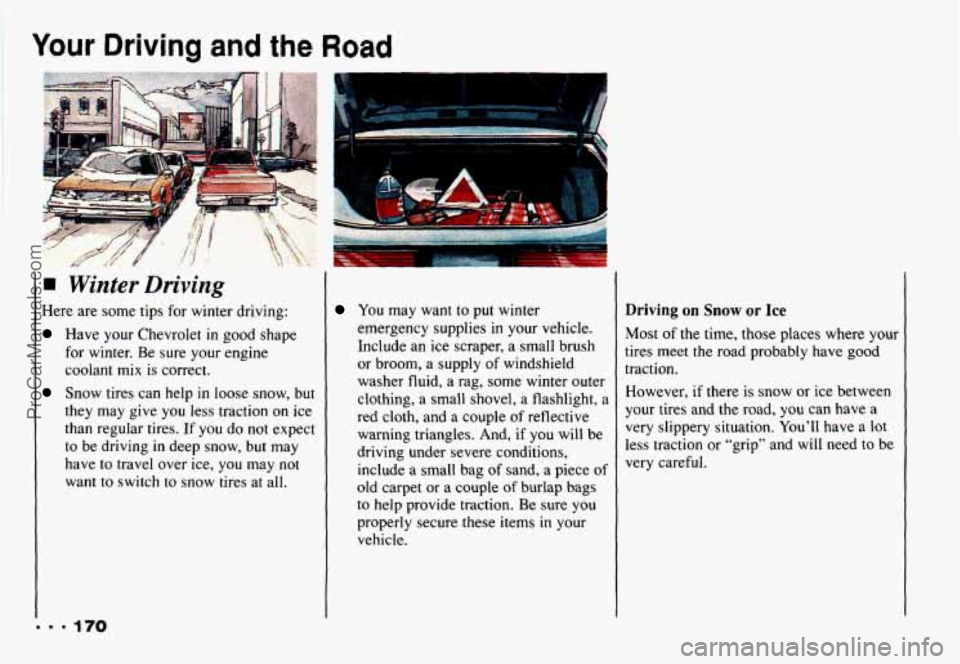
You may want to put winter
emergency supplies in your vehicle.
Include an ice scraper, a small brush
or broom, a supply
of windshield
washer fluid, a rag, some winter outer
clothing, a small shovel, a flashlight, a
red cloth, and a couple
of reflective
warning triangles. And, if you will be
driving under severe conditions,
include a small bag of sand, a piece of
old carpet or
a couple of burlap bags
to help provide traction. Be sure you
properly secure these items in your
vehicle.
Driving on Snow or Ice
Most of the time, those places where your
tires meet
the road probably have good
traction.
However, if
there is snow or ice between
your tires and the road, you can have a
very slippery situation. You’ll have a lot
less traction or “grip” and will need to
be
very careful.
ProCarManuals.com
Page 187 of 358
Part 5
P
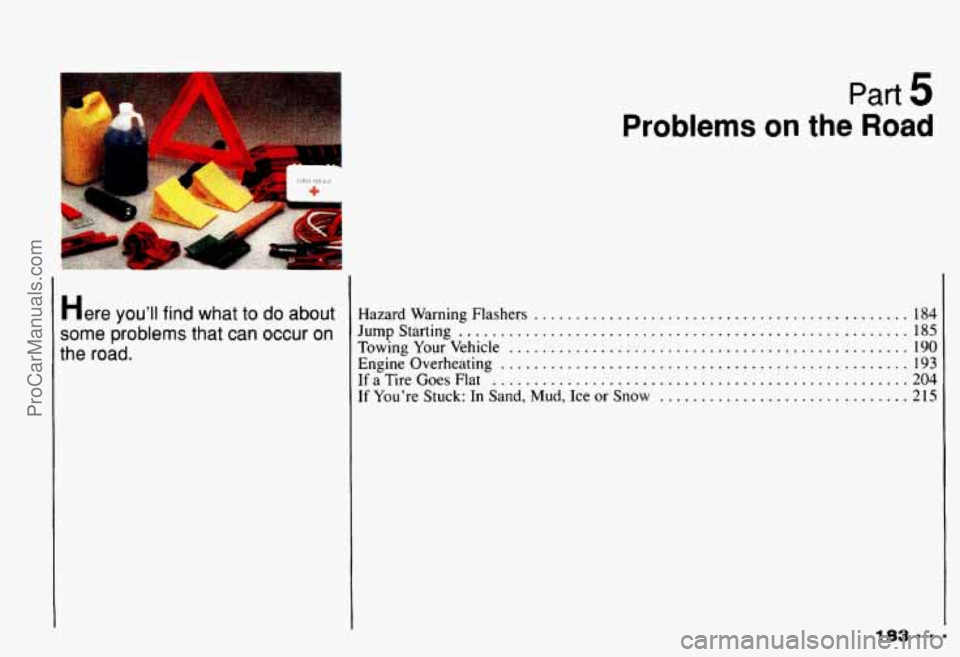
Here you’ll find what to do about
some problems that can occur on
the road.
rroblems on the Road
Hazard Warning Flashers ............................................. 184
Jump Starting ...................................................... 185
Towing Your Vehicle ................................................ 190
Engine Overheating ................................................. 193
If a Tire Goes Flat .................................................. 204
If You’re Stuck: In Sand, Mud, Ice or Snow .............................. 215
ProCarManuals.com
Page 188 of 358
Problems on the Road
1
A
... 184
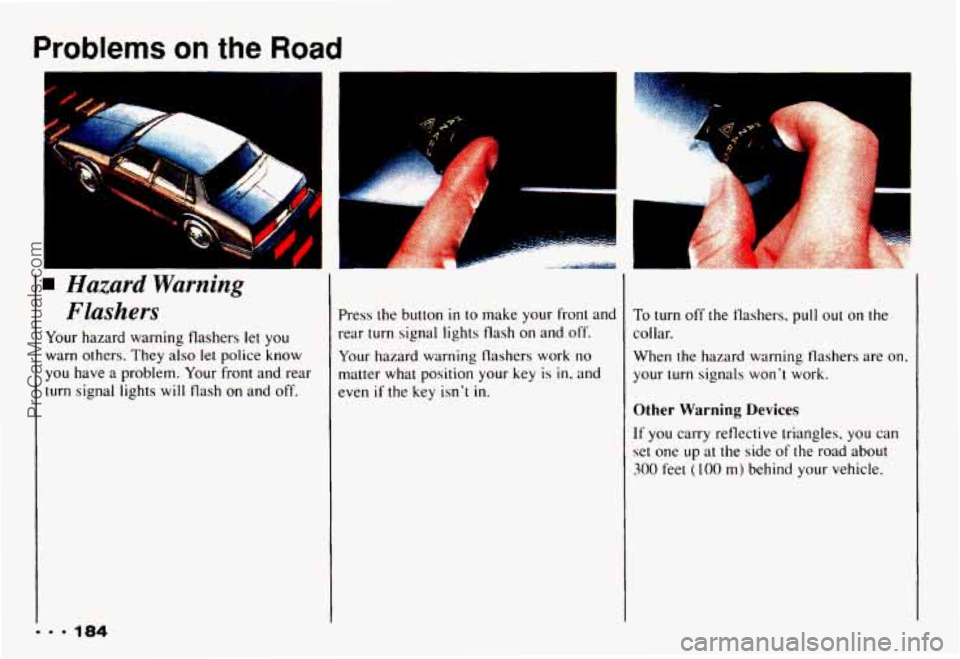
Hazard Warning
Flashers
Your hazard warning flashers let you
warn others. They also let police know
you have a problem. Your front and rear
turn signal lights
will flash on and off.
Press the button in to make your fronl and
rear
turn signal lights flash on and off.
Your hazard warning flashers work no
matter what position your key
is in, and
even
if the key isn‘t in.
To turn off the flashers. pull out on the
collar.
When the hazard warning tlashers are on,
your turn signals won’t work.
Other Warning Devices
If you carry retlective triangles, you can
set one
up at the side of the road about
300 feet (100 m> behind your vehicle.
ProCarManuals.com
Page 194 of 358
Problems on the Road
A
le
=Towing Your Vehicle
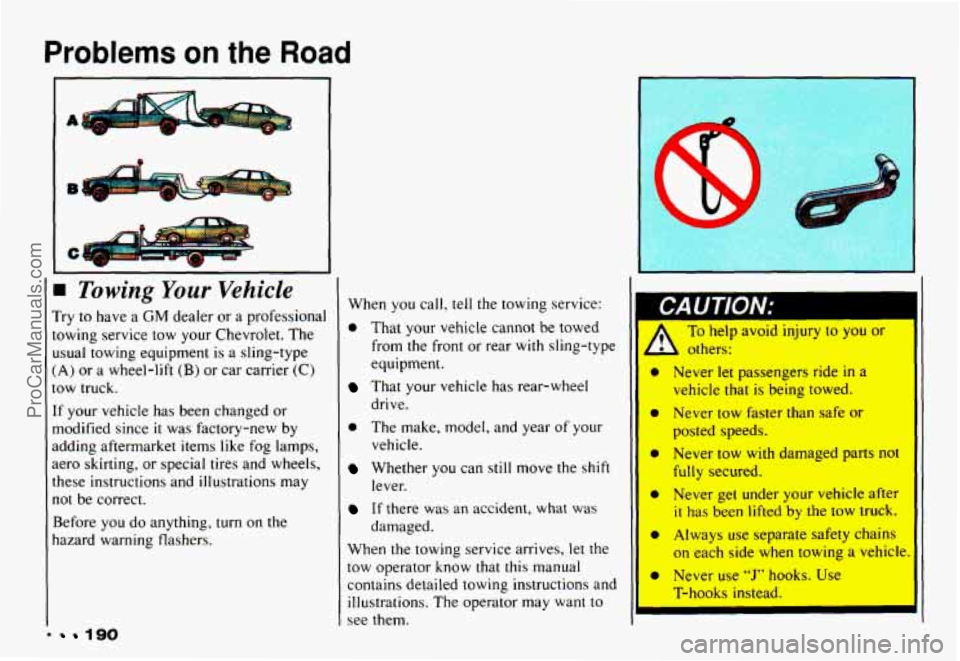
Try to have a CM dealer or a professional
towing service tow your Chevrolet. The
usual towing equipment is a sling-type
(A) or a wheel-lift (B) or car carrier (C)
tow truck.
If your vehicle has been changed or
modified since
it was factory-new by
adding aftermarket items like fog lamps,
aero skirting, or special tires and wheels,
these instructions and illustrations may
not be correct.
Before you do anything,
turn on the
hazard warning flashers.
190
When you call, tell the towing service:
0 That your vehicle cannot be towed
from the front or rear
with sling-type
equipment.
drive.
That your vehicle has rear-wheel
0 The make, model, and year of your
Whether you can still move the shift
If there was an accident, what was
When the towing service arrives, let the
tow operator know
that this manual
contains detailed towing instructions and
illustrations. The operator may want
to
see them.
vehicle.
lever.
damaged.
1
TO help avoid injury to you or
0
0
0
e
a
0
b others:
Never let passengers ride in a
vehicle that is being towed.
Never tow faster than safe
or
posted speeds.
Never
tow with damaged parts not
fully secured.
Never
get under your vehicle after
it has been lifted by the tow truck.
Always use separate safety chains
on each side when towing a vehicle,
Never use “J” hooks. Use
T-hooks instead.
ProCarManuals.com
Page 197 of 358
I
c
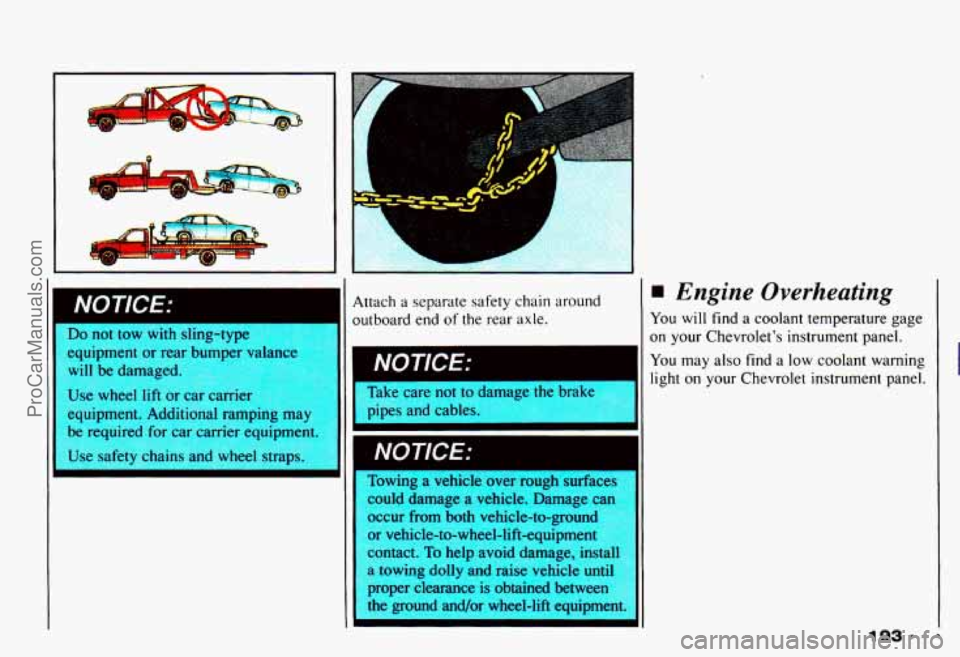
Do not tow with sling-type
eauipment or rear bumDer valance
equipment. Additional ramping may
be required for car carrier equipment.
Use safety chains and wheel straps. Attach
a separate
safety chain around
outboard end
of the rear axle.
NOTICE: I
could damage a vehicle. Damage can
occur from both vehicle-to-ground
or vehicle-to-wheel-lift-equipment
To help avoid damage, install
g dolly and raise vehicle until
er clearance is obtained between
the ground and/or wheel-lift equipment.
Engine Overheating
You will find a coolant temperature gage
on your Chevrolet's instrument panel.
You may also find a low coolant warning
light on your Chevrolet instrument panel.
193 9
ProCarManuals.com
Page 198 of 358
Problems on the Road
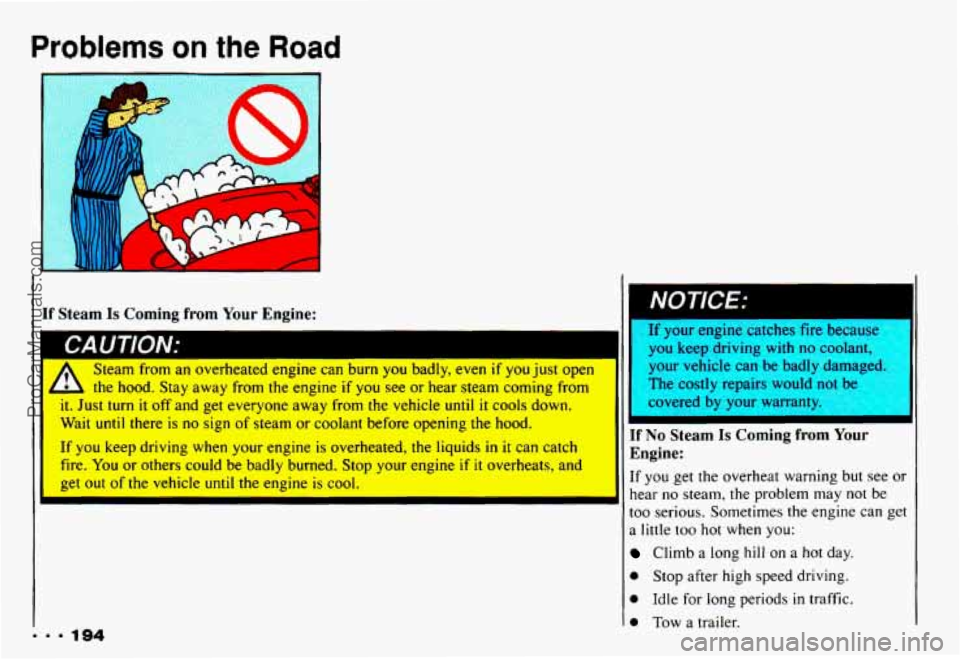
If Steam Is Coming from Your Engine:
W1Ldr-W II LUU I ILJN.'
Steam from an overheated engine can bum you badly, even if you just open
k the hood. Stay away from the engine if you see or hear steam coming from
x. Just turn it off and get everyone away from the vehicle until it cools down.
Wait
until there is no sign of steam or coolant before opening the hood.
If you keep driving when your engine is overheated, the liquids in it can catch
fire. You or others could be badly burned. Stop your engine if it overheats, and
get out of the vehicle until the engine is cool,
... 194
11 your engine catches fire because
I you keep driving with no coolant,
I1
E
I1
h
tC
a
0
a
a
your vehicle can be badly damaged
The
costly repairs would not be
covered by your warranty.
F No Steam Is Coming from Your
hgine:
'you get the overheat warning but see or
ear
no steam, the problem may not be
)o serious. Sometimes the engine can get
little too
hot when you:
Climb a long hill on a hot day.
Stop after high speed driving.
1 Idle for long periods in traffic.
1 Tow a trailer.
ProCarManuals.com
Page 199 of 358
If you get the overheat warning with no
sign of steam,
try this for a minute or so:
1. If you have an air conditioner, turn it
2. Turn on your heater to full hot at the
off.
highest fan speed and open
the
window
as necessary.
3. Try to keep your engine under load (in
a drive gear where the engine runs
slower).
If you no longer have the overheat
warning, you can drive. Just
to be safe,
drive slower for about
ten minutes. If the
warning doesn’t come back on,
you can
drive normally. If
the warning
continues, pull over, stop,
and park your vehicle right away.
If there’s
still no sign of steam, you can
idle
the engine for two or three minutes
while you’re parked, to see
if the warning
stops.
But then, if you still have the
warning, TURN
OFF THE ENGINE
AND GET EVERYONE OUT
OF THE
VEHICLE
until it cools down.
You may decide not to
lift the hood but to
get service help right away.
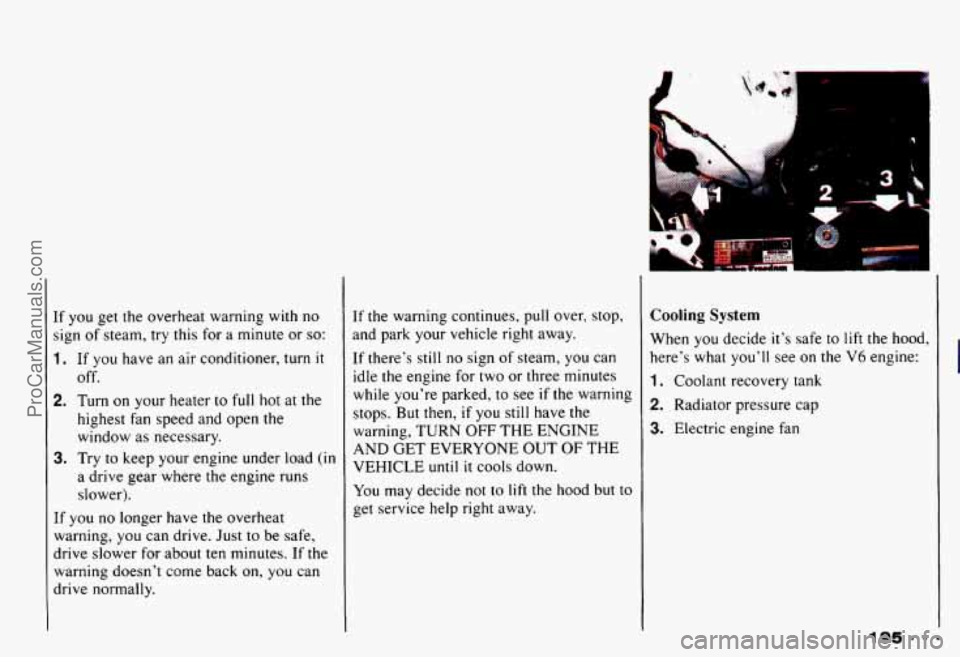
Cooling System
When you decide it’s safe to lift the hood,
here’s what you’ll see on the V6 engine:
1.
2.
3.
Coolant recovery tank
Radiator pressure cap
Electric engine
fan
ProCarManuals.com
Page 201 of 358
eng~ witho
r
u -.. .
tolar .-
[f there seems to be no leak, check to see
f the electric engine fan is running. If the
:ngine is overheating, the fan should be
-unning.
If it isn’t, your vehicle needs
iervice.
I I
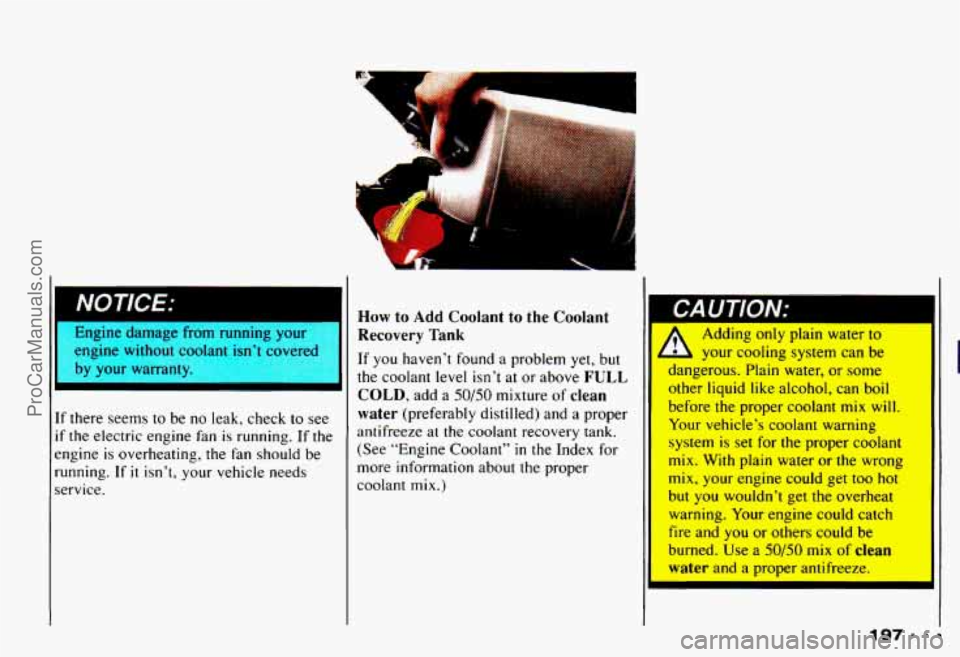
How to Add Coolant to the Coolant
Recovery Tank
If you haven’t found a problem yet, but
the coolant level isn’t
at or above FULL
COLD,
add a 50/50 mixture of clean
water
(preferably distilled) and a proper
antifreeze at the coolant recovery tank.
(See “Engine Coolant”
in the Index for
more information about the proper
coolant
mix.)
A Adding only plain water to
L your cooling system can be
dangerous. Plain water, or some
I
other liquid like alcohol, can boil
before the proper coolant
mix will.
Your vehicle’s coolant warning
system
is set for the proper coolant
mix. With plain water or the wrong
mix, your engine could get too hot
but you wouldn’t get the overheat
warning. Your engine could catch
fire and you or others could
be
burned. Use a 50/50 mix of clean
water
and a proper antifreeze.
197-
ProCarManuals.com