1993 CHEVROLET CAMARO stop start
[x] Cancel search: stop startPage 106 of 358

Features 8t Controls
f
I
I
. ’ 102
If the light stays on or comes on when
you’re driving, stop
as soon as possible
and turn the key off. Then start the engine
to reset the system. If the light still stays
on, or comes on again while you’re
driving, your Chevrolet needs service.
Unless the regular brake system warning
light is also on, you
will still have brakes,
but not anti-lock brakes. If the regular
brake system warning
light is also on, see
“Brake System Warning Light” earlier
in
this part. When your anti-lock system is working,
the message
LOW TRAC will appear on
your instrument cluster. This means that
slippery road conditions may exist. Adjust
your driving accordingly. The light
will
stay on for about four seconds after the
ABS stops working. The
LOW TRAC
light also comes on during engine starting
as
a bulb check.
Engine Coolant Temperature Gage
This gage shows the engine coolant
temperature.
If the gage pointer moves
into the red area, your engine is
too hot!
It means that your engine coolant has
overheated. If you have been operating
your vehicle under normal driving
conditions, you should
pull off the road,
stop your vehicle and
turn off the engine
as soon as possible.
HOT COOLANT CAN BURN YOU
BADLY!
In ”Problerns on the Road,” this manual
shows
what to do. See “Engine
Overheating”
in the Index.
ProCarManuals.com
Page 123 of 358
I
Adjusting the Speakers To Play a Cassette Tape
Balance:
Turn the balance control behind
tapes that are
30 to 45 minutes long on
the upper knob to move the sound Your
tape player
is built to work best with
thin they may not work well in this player. do not have the Delco/Bose system. With each side. Tapes longer than that
are so
between the right and left speakers
if you
in first. If you hear nothing or hear just a
electronically
balanced. The
longer side
with the tape visible goes
the
Delco/Bose system, Your speakers are
Fade: Turn the fade control behind the garbled
sound, it may not be in squarely.
lower knob to move the sound between Press
STOP-EJECT to remove
the tape
the front and rear speakers. and start over.
Once the tape
is playing, use the upper
and lower knobs for volume and balance,
just as you do for radio. The arrows show
which side
of the tape is playing. Press
4 or
to rapidly rewind or
advance the tape. Press
STOP-EJECT
to stop the tape.
I
119
ProCarManuals.com
Page 128 of 358

Comfort Controls & Audio Systems
To Stop the Disc Player
0
0
Turn the power off or turn the ignition
key off. The disc stays in the player
and will resume playing at the point
where
it stopped.
Press
ST-PL to stop playing the disc
and switch to radio. Press ST-PL to
restart the disc at the point where
it
stopped.
Press
EJCT to eject the disc and the
radio will play. The disc
will start
playing at track
1 when you reinsert it.
Theft-Deterrent Feature
Delco-Loc I1 is a security feature for the
compact disc player. It can be used or
ignored. If ignored, the system functions
normally.
If it is used, your system won’t
be usable
if it’s ever stolen.
Setting Your Security Code
The instructions below tell you how to
enter a security
code into the system. If
your vehicle loses battery power for any
reason,
you must enter the security code
again before the system
will turn on.
1. Write down any six digit number and
2. Turn the ignition switch to the Acc
3. Turn the audio system off.
4. Press and hold 1 and 4 together until
keep it in a safe place.
or
Run position.
“---” shows on the display.
I. 9 124
ProCarManuals.com
Page 140 of 358
Your Driving and the Road
136
Slowing down: If time allows, tap the
brake pedal once or twice
in advance of
slowing or stopping. This warns the driver
behind you.
Disabled: Your four-way flashers signal
that your vehicle
is disabled or is a
hazard. See “Hazard Warning Flashers”
in
the Index.
Traffic Officer
The traffic police officer is also a source
of important information. The officer’s
signals govern, no matter what the traffic
lights or other signs say.
The next section discusses some of the
road conditions you may encounter.
Defensive Driving
The best advice anyone can give about
driving
is: Drive defensively.
Please start
with a very important safety
device
in your Chevrolet: Buckle up. (See
“Safety Belts”
in the Index.)
Defensive driving really means “be ready for anything.“ On city streets,
rural roads,
or freeways, it means “always expect the
unexpected.”
Assume that pedestrians or other drivers
are going
to be careless and make
mistakes. Anticipate what they
might do.
Be ready for their mistakes.
Expect children
to dash out from behind
parked cars, often followed
by other
children. Expect occupants
in parked cars
to open doors into traffic. Watch for movement
in parked cars - someone
may be about
to open a door.
Expect other drivers
to run stop signs
when you are
on a through street. Be
ready
to brake if necessary as you go
:hrough intersections.
You may not have
:o use the brake, but if you do, you will be
-eady.
If you’re driving through a shopping
center parking
lot where there are
well-marked lanes, directional arrows,
and designated parking areas, expect
some drivers to ignore all these markings
and dash straight toward one part of the
lot.
ProCarManuals.com
Page 154 of 358

Your Driving and the Road
So here are some tips for passing:
0
0
“Drive ahead.” Look down the road,
to the sides, and
to crossroads for
situations that might affect your
passing patterns. If you have
any
doubt whatsoever about making a
successful pass, wait for a better time.
Watch for traffic signs, pavement
markings, and lines. If you can see a
sign up ahead that might indicate a
turn or an intersection, delay your
pass.
A broken center line usually
indicates
it’s all right to pass
(providing the road ahead is clear).
0
0
Never cross a solid line on your side
of the lane or
a double solid line, even
if the road seems empty of
approaching traffic.
If you suspect that the driver of the
vehicle you want to pass isn’t aware
of your presence, tap the horn a
couple of times before passing.
Do not get too close to the vehicle you
want to pass while you’re awaiting an
opportunity. For one thing, following
too closely reduces your area
of
vision, especially if you’re following a
larger vehicle. Also, you won’t have
adequate space
if the vehicle ahead
suddenly slows
or stops. Keep back a
reasonable distance.
0 When it looks like a chance to pass is
coming up, start to accelerate but stay
in the right lane and don’t get too
close. Time your move so you will be
increasing speed as the time comes
to
move into the other lane. If the way is
clear to pass, you
will have a “running
start” that more than makes up for the
distance you would lose
by dropping
back. And
if something happens to
cause you to cancel your pass, you
need only slow down and drop back
again and wait for another
opportunity.
.. = 150
ProCarManuals.com
Page 156 of 358

Your Driving and the Road
The three types of skids correspond to
your Chevrolet’s three control systems. In
the braking skid your wheels aren’t
rolling. In the steering or cornering skid,
too much speed or steering in a curve
causes tires to slip and lose cornering
force. And
in the acceleration skid too
much throttle causes the driving wheels to
spin.
A cornering skid and an acceleration skid
are best handled by easing your foot off
the accelerator pedal. If your vehicle
starts to slide (as when you turn a corner
on a wet, snow- or ice-covered road),
ease your
foot off the accelerator pedal as
soon as you feel the vehicle start to slide.
Quickly steer the way
you want the vehicle to
go. If you
start steering quickly
enough, your vehicle will straighten out.
As it does, straighten the front wheels.
Of course, traction
is reduced when water,
snow, ice, gravel, or other material is on
the road. For safety, you’ll want to
slow
down and adjust your driving to these
conditions. It is important to slow down
on slippery surfaces because stopping
distance will be longer and vehicle control more limited. While
driving on a surface
with reduced
traction,
try your best to avoid sudden
steering, acceleration, or braking
(including engine braking by shifting to a
lower gear). Any sudden changes could
cause the tires to slide.
You may not
realize the surface is slippery until your
vehicle is skidding. Learn to recognize
warning clues
- such as enough
water, ice or packed snow on the road to
make
a “mirrored surface” - and slow
down when you have any doubt.
Remember:
Any anti-lock braking system
(ABS) helps avoid only the braking skid.
Steer the way you want to go.
ProCarManuals.com
Page 159 of 358
When you follow another vehicle on a
freeway or highway, use low beams. True,
most vehicles now have day/night mirrors
that enable the driver to reduce glare. But
outside mirrors are not of this type and
high beams from behind can bother the
driver ahead.
A Few More Night Driving Suggestions
Keep your windshield and all the glass on
your vehicle clean
- inside and out.
Glare at night is made much worse by dirt
on the glass. Even the inside of the glass
can build
up a film caused by dust.
Tobacco smoke also makes inside glass
surfaces very filmy and can be a vision
hazard
if it’s left there. Dirty
glass makes lights dazzle and flash
more than clean glass would, making the
pupils of your eyes contract repeatedly.
You might even want to keep a cloth and
some glass cleaner
in your vehicle if you
need to clean your glass frequently.
Remember that your headlights light
up
far less of a roadway when you are in a
turn or curve.
Keep your eyes moving; that
way, it’s
easier to pick
out dimly lighted objects.
Just as your headlights should be checked
regularly for proper aim,
so should your
eyes be examined regularly. Some drivers
suffer from
night blindness - the
inability to see
in dim light - and aren’t
even aware of
it.
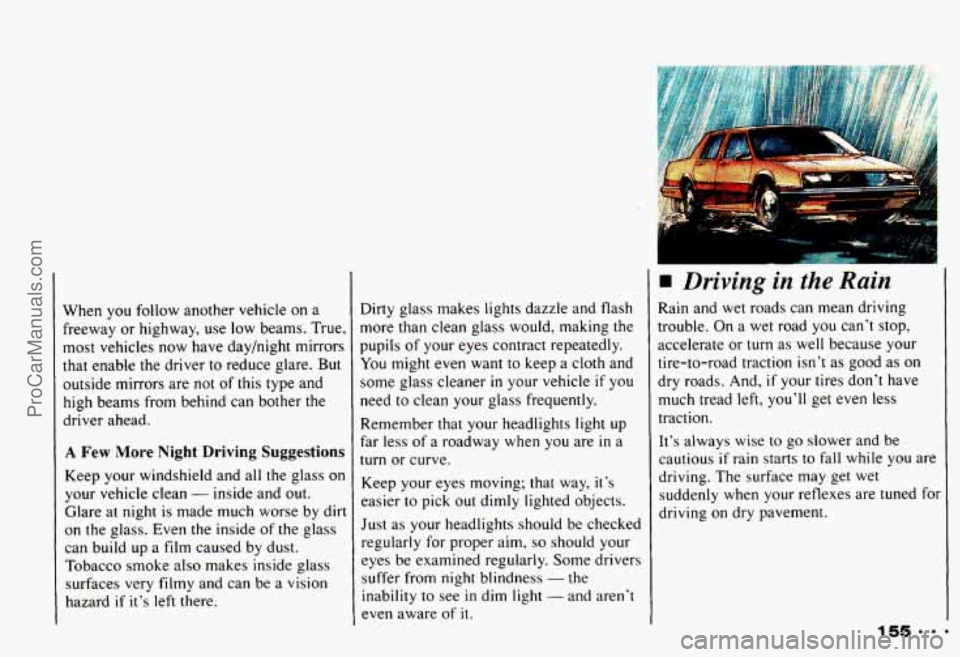
Driving in the Rain
Rain and wet roads can mean driving
trouble. On a wet road you can’t stop,
accelerate or
turn as well because your
tire-to-road traction isn’t as good as on
dry roads. And,
if your tires don’t have
much tread left,
you’ll get even less
traction.
It’s always wise to go slower and be
cautious
if rain starts to fall while you are
driving. The surface may get wet
suddenly when your reflexes are tuned for
driving on
dry pavement.
ProCarManuals.com
Page 160 of 358
Your Driving and the Road
.I. 156
The heavier the rain, the harder it is to
see. Even if your windshield wiper blades
are
in good shape, a heavy rain can make
it harder to see road signs and traffic
signals, pavement markings, the edge of
the road, and even people walking. Road
spray can often be worse for vision than
rain, especially
if it comes from a dirty
road.
So it is wise to keep your wiping
equipment
in good shape and keep your
windshield washer tank filled. Replace
your windshield wiper inserts when they
show signs of streaking
or missing areas
on the windshield, or when strips of
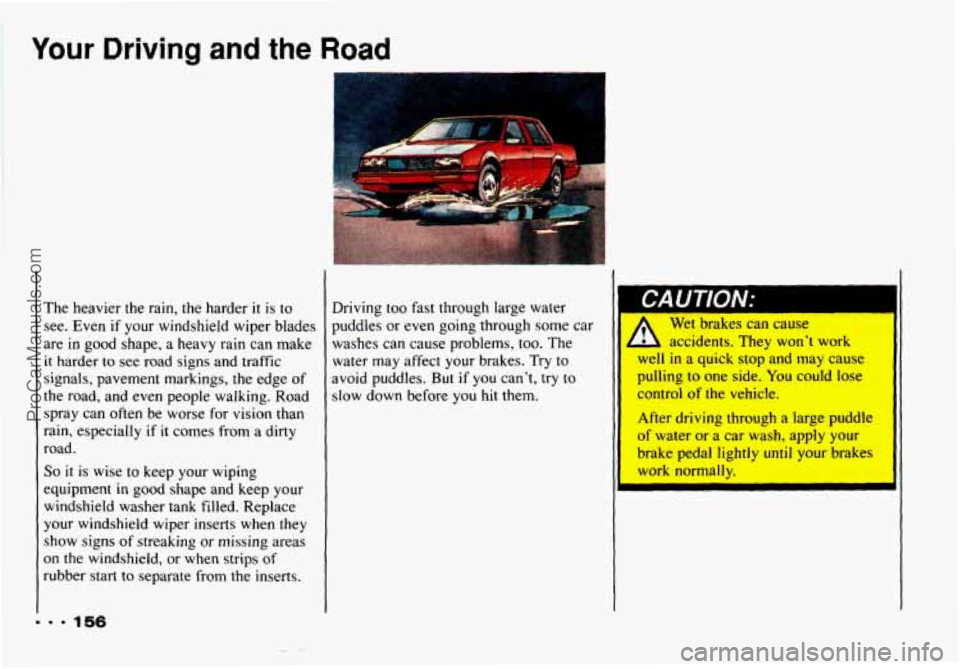
rubber start to separate from the inserts. Driving too fast through large water
puddles or even going through some car
I I
washes can cause problems, too. The
water may affect your brakes. Try to
avoid puddles. But
if you can’t, try to
slow down before
you hit them. Wet
brakes can cause
- L accidents. They won’t work
I
well in a quick stop and may cause
pulling to one side.
You could lose
control of the vehicle.
After driving through a large puddle
of water or a car wash, apply your
brake pedal lightly
until your brakes
work normally.
ProCarManuals.com