1993 CHEVROLET BLAZER oil level
[x] Cancel search: oil levelPage 285 of 386

Service & Appearance Cam
Manual Transmission Fluid
When to Check:
A good time to have it checked is when the engine oil is changed. However,
the fluid in your manual transmission doesn’t require changing.
How to Check:
Because this operation can be a little difficult, you may choose to have this
done at your dealership Service Department.
If you do it yourself, be sure to follow all the instructions here, or you could
get a false reading.
IYW I ILL
1 Too much or too little fluid can damage your transmission. Too much can 1
mean that some of the fluid could come out and fall on hot engine parts,
starting a fire. Be sure to get an accurate reading if you check your
transmission fluid,
I I
Check the fluld level only when your engine is off, the vehicle is parked on a
level place and the transmission is cool enough for you to rest your fingers
on the transmission case.
Then, follow these steps:
~~~~ K24
1. Remove the filler plug.
2. Check that the lubricant level is up to the bottom of the filler plug hole.
3. If the fluid level is good, install the plug and be sure it is fully seated. If
the fluid level is low, add more fluid as described in the next steps.
6-20
Page 291 of 386

Service & Appearance Care
The following explains your cooling system and how to add cool\
ant when it is
low.
If you have a problem with engine overheating, see “Engine
Overheating” in the Index.
The proper coolant for your vehicle
will:
Give freezing protection down to -34°F (-37°C).
Give boiling protection up to 258°F (125°C).
Protect against rust and corrosion.
Help keep the proper engine temperature.
Let the warning lights and gages work as they should.
What to Use:
Use a mixture of clean water (preferably distilled), and antifreeze that meets
“GM Specification
6038-M,” which won’t damage aluminum parts. Also use
GM Engine Coolant Supplement (sealer) with a complete coolant change.
If
you use these, you don’t need to add anything else.
Adding only plain water to your cooling system can be dangerous.
I
Plain water, or some other liquid like alcohol, can boil before the \
proper coolant mix will. Your vehicle’s coolant warning system is set
for the proper coolant mix. With plain water or the wrong mix, your
engine could get too hot but you wouldn’t get the overheat \
warning. Your engine could catch fire and you or others could be burned. Us\
e
a 50/50 mix of clean water and a proper antifreeze.
jIi ,yo.w use an improper coolant mix, your engine .coutd overheat andi
badly damaged. The repair cost wouldn’t be covered by your warranty.’ TP~
much water in ;the mix can freeze and crack the engine, radiator, .heater
wre-ad -.other parts.
Some conditions, such as air trapped in the cooling system, can affect the
coolant level in the radiator. Check the coolant level when th\
e engine is cold
and follow the steps under “Adding Coolant” for the prope\
r way to
add
coolant.
.. .. ..
If you have to add coolant mdre than four times a year, have your dealer
check
your cooling system.
6-26
Page 298 of 386

After work is done on the brake hydraulic system, make sure t\
he levels are
above
MIN and below the top of each window.
What To Add:
When you do need brake fluid, use only DOT-3 brake fluid-such \
as Delco
Supreme 11
@ (GM Part No. 1052535). Use new brake fluid from a sealed
container only.
NOTICE
DOT-5 silicone brake fluid can damage your vehicle. Don’t use it.
Don’t let someone put in the wrong kind of fluid. For example, just a
few drops
of mineral-based oil, such as engine oil, in your brake
-]stem can damaae brake svstem parts
so badlv that 1 fll have to
be replaced.
Brake fluid can damage paint, so be careful nor IO spit1 Drake fluid on
your vehicle.
Hydro-Boost Brake System (Hydraulic Pump)
The power steering pump is also used as the Hydro-boost pump. \
Refer to “Power Steering System” in this section when checking flui\
d level
or adding fluid.
Replacing Brake System Parts
The braking system on a modern vehicle is complex. Its many parts have to
be of top quality and work well together
if the vehicle is to have really good
braking. Vehicles we design and test have top-quality
GM brake parts in
them, as your vehicle does when
it is new. When you replace parts of your
braking system-for example, when your brake linings wear down and you
have to have new ones put in-be sure you get new genuine
GM
replacement parts. If you don’t, your brakes may no longer work properly. For
example,
if someone puts in brake linings that are wrong for your vehicle, the
balance between your front and rear brakes can change, for the\
worse. The
braking performance you’ve come to expect can change in many other ways
if someone puts in the wrong replacement brake parts.
6-33
Page 334 of 386
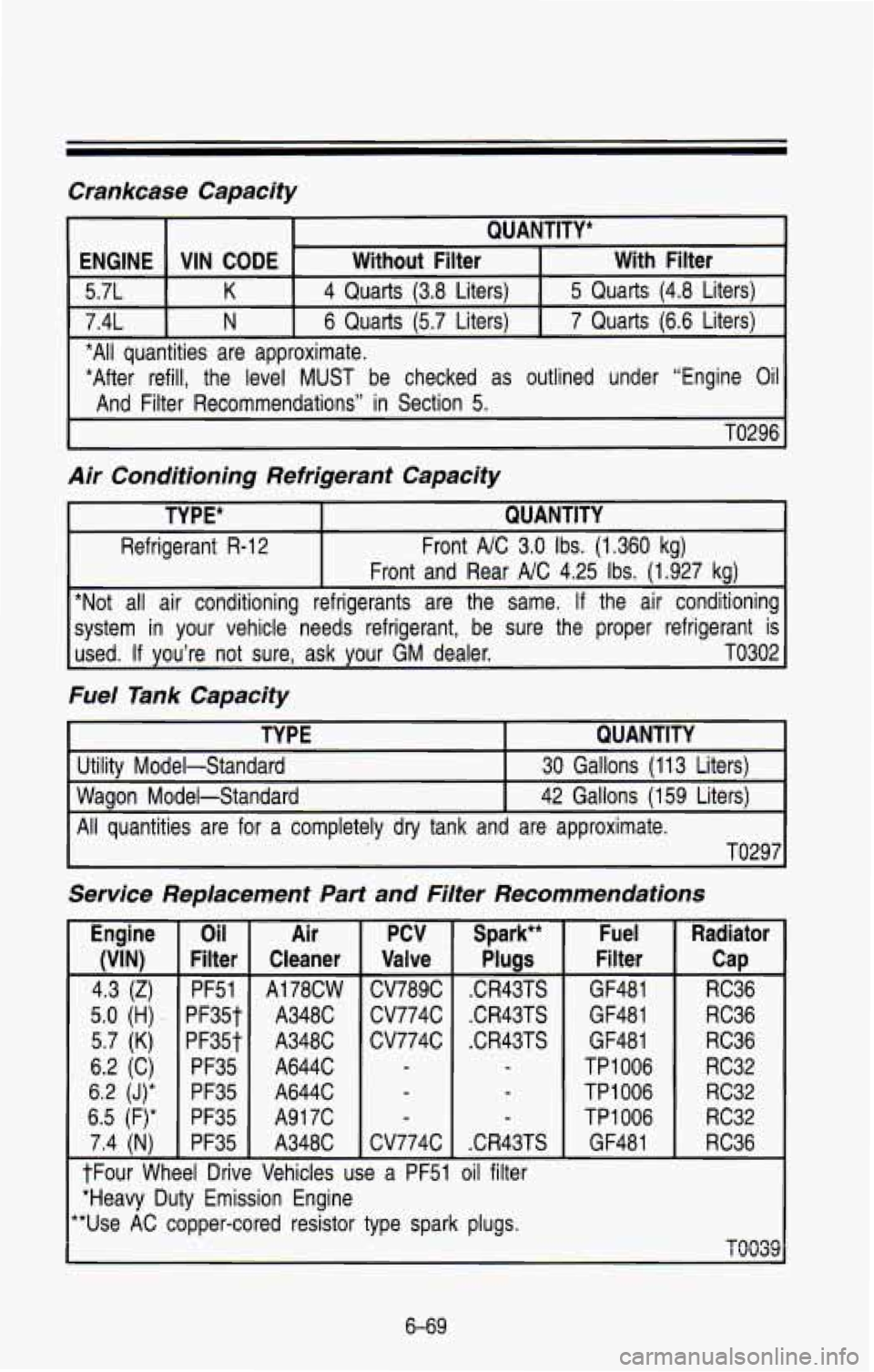
Crankcase Capacify
QUANTITY*
ENGINE VIN CODE Without Filter With Filter
5.7L K 4 Quarts (3.8 Liters) 5 Quarts (4.8 Liters)
7.4L N 6 Quarts (5.7 Liters) 7 Quarts (6.6 Liters)
*All quantities are approximate.
*After refill, the level MUST be checked as outlined under “\
Engine Oil
TO296
And Filter Recommendations” in Section
5.
Air Condifioning Refrigeranf Capacify
TYPE* QUANTITY
Refrigerant R-12 Front
AJC 3.0 Ibs. (1.360 kg)
Front and Rear AJC 4.25 Ibs. (1.927 kg)
*Not all air conditioning refrigerants are the same.
If the air conditioning
system in your vehicle needs refrigerant, be sure the proper r\
efrigerant is
used. If you’re not sure, ask your GM dealer. TO302
Fuel Tank Capacify
I -1
Utility Model-Standard 30 Gallons (113 Liters)
Wagon Model-Standard 42 Gallons (159 Liters)
All quantities are for a completely dry tank and are approxima\
te. TO2971
Service Replacemenf Part and Filfer Recommendations
5.7 (K)
6.2 (C)
6.2
(J)*
6.5 (F)*
-
Oil
Filter
PF5 1
PF35t PF35t
PF35
PF35
PF35
PF35
-
1
Air PCV
Cleaner Valve
A348C
cv774c
A348C cv774c
A644C
A644C
A91 7C
A348C cv774c
AI 7acw cv7agc
Spark**
Plugs
.CR43TS
.CR43TS
.CR43TS
-
.CR43TS i
use a PF51 oil filter
*Heavy Duty Emission Engine
**Use
AC copper-cored resistor type spark plugs.
Fuel
Filter
GF481
GF481
GF481
TP
1 006
TP 1 006
TP 1 006 G F48 1
Radiator
RC36
RC36
RC36
RC32
RC32
RC32
RC36
Cap
6-69
Page 355 of 386
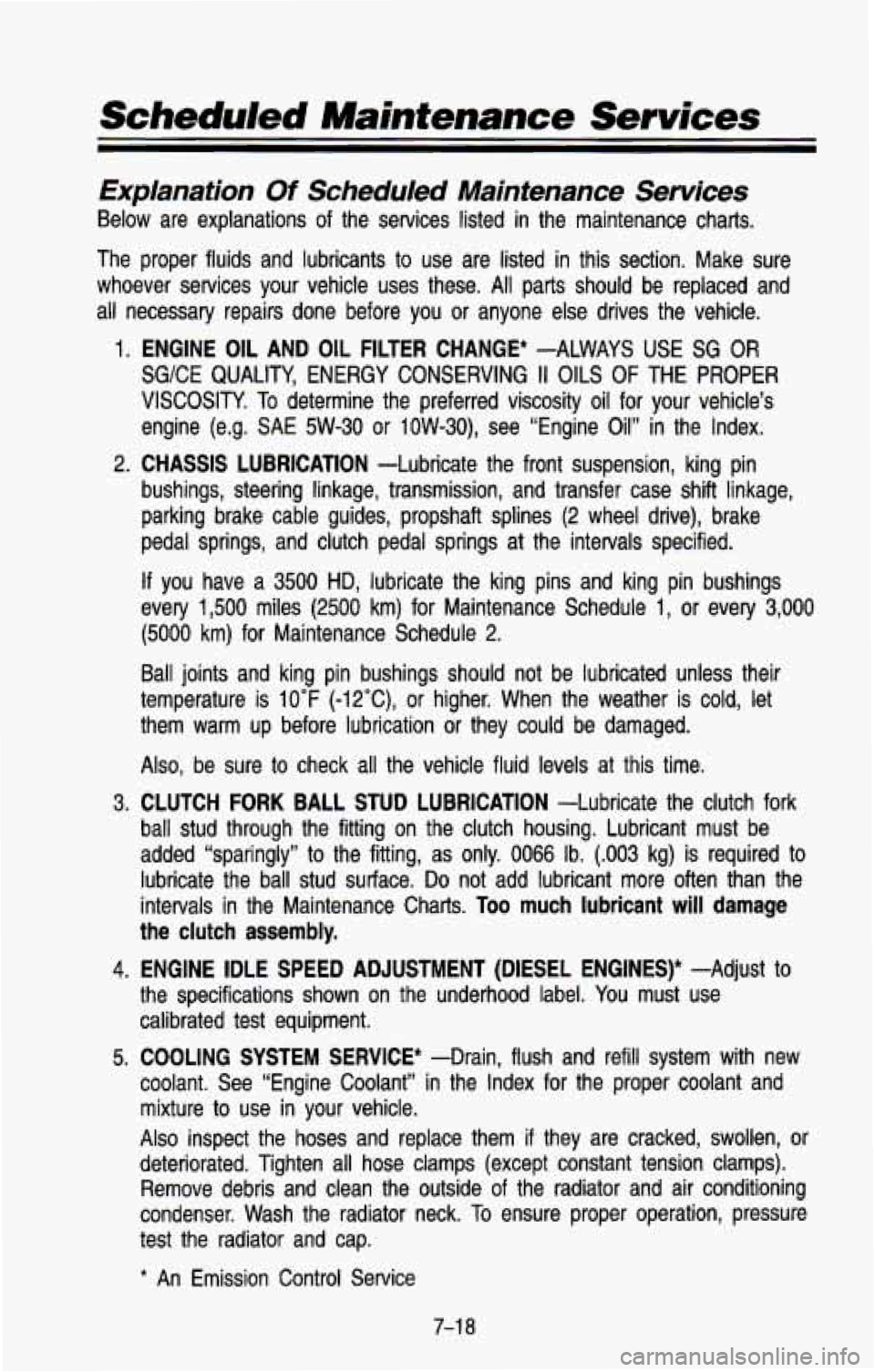
Scheduled Maintenance Services
Explanation Of Scheduled Maintenance Services
Below are explanations of the services listed in the maintenance charts.
The proper fluids and lubricants to use are listed in this section. Make sure
whoever services your vehicle uses these.
All parts should be replaced and
all necessary repairs done before you or anyone else drives the ve\
hicle.
1. ENGINE OIL AND OIL FILTER CHANGE* -ALWAYS USE SG OR
SG/CE QUALITY, ENERGY CONSERVING II OILS OF THE PROPER
VISCOSITY. To determine the preferred viscosity oil for your vehicle’s
engine (e.g. SAE 5W-30 or
10W-30), see “Engine Oil” in the Index.
2. CHASSIS LUBRICATION -Lubricate the front suspension, king pin
bushings, steering linkage, transmission, and transfer case shift\
linkage,
parking brake cable guides, propshaft splines
(2 wheel drive), brake
pedal springs, and clutch pedal springs at the intervals specif\
ied.
If you have a 3500 HD, lubricate the king pins and king pin bushings
every
1,500 miles (2500 km) for Maintenance Schedule 1, or every 3,000
(5000 km) for Maintenance Schedule 2.
Ball joints and king pin bushings should not be lubricated unl\
ess their
temperature is
10°F (-12”C), or higher. When the weather is cold, let
them warm up before lubrication
or they could be damaged.
Also, be sure to check all the vehicle fluid levels at this time.
3.
CLUTCH FORK BALL STUD LUBRICATION -Lubricate the clutch fork
ball stud through the fitting on the clutch housing. Lubricant \
must be
added “sparingly” to the fitting, as only.
0066 Ib. (.003 kg) is required to
lubricate the ball stud surface. Do not add lubricant more often than the
intervals in the Maintenance Charts.
Too much lubricant will damage
the clutch
assembly.
4. ENGINE IDLE SPEED ADJUSTMENT (DIESEL ENGINES)* -Adjust to
the specifications shown on the underhood label. You must use
calibrated test equipment.
5. COOLING SYSTEM SERVICE* -Drain, flush and refill system with new
coolant. See “Engine Coolant” in the Index for the proper\
coolant and
mixture
to use in your vehicle.
Also inspect the hoses and replace them if they i cracked, swollen, or
deteriorated. Tighten all hose clamps (except consrant tension clamps).
Remove debris and clean the outside of the radiator and air c\
onditioning
condenser. Wash the radiator neck.
To ensure proper operation, pressure
test the radiator and cap.
* An Emission Control Service
7-1 8
Page 358 of 386

23. EXHAUST PRESSURE EGULATOR VALVE INSPECTION* -Check that
the valve works properly. Correct any binding. Inspect hoses fo\
r cracks,
chafing or decay. Replace parts
as needed.
24. TIRE AND WHEEL ROTATION AND INSPECTION -For proper wear
and maximum tire life, rotate tires
at the first 6,000 miles (10 000
kilometers) for Schedule I (t) or 7,500 miles (12 500 kilometers) for
Schedule
II (.) and then every 15,000 miles (25 000 kilometers)
thereafter.
Follow the instructions and patterns shown in Section 6.
Check tires for uneven wear or damage. If irregular or premature wear is
apparent, check wheel alignment.
Also, check for damaged wheels. See
“Tires” in the Index for more information.
For dual wheels, whenever the vehicle, wheels, or fasteners are new\
,
have the wheel fastener torque set at the first 100,
1,000 and 6,000
miles
(160, 1600 and 10 000 km).
For
3500 H.D. Models, block the tires opposite those being removed to
keep the vehicle from rolling.
25.
DRIVE AXLE SERVICE -Check readfront axle fluid level and add as
needed. Check constant velocity joints and axle seals for leaki\
ng.
Locking differential-Drain fluid at first oil change and refill. Check
fluid level and add as needed at subsequent oil changes. In dusty
areas, or trailer towing applications drain fluid at every
15,000 miles
(24 135 kilometers) and refill$
every oil change. In dusty areas,
or trailer towing applications, drain
fluid every 15,000 miles
(24 135 kilometers) and refi1l.t
Standard differential -Check fluid level and add as needed at
More frequent lubrication may be required on heavy-duty or off-road
use.
26. BRAKE SYSTEM INSPECTION -When the engine oil is changed,
inspect the lines
and hoses for proper hookup, binding, leaks, cracks,
chafing, etc. Check the parking brake adjustment, and the fluid level in
the master cylinder.
A low fluid level can indicate worn disc brake pads
which may need to be serviced$
*An Emission Control Service
tA fluid loss in these systems may indicate a problem. Have them
inspected and repaired
at once.
7-2 1
Page 359 of 386

Scheduled Maintenance Services
When the wheels are removed for rotation, inspect disc brake p\
ads for wear
and rotors for surface condition.
Also inspect drum brake linings for wear and
cracks. Inspect other brake parts, including drums, wheel cylind\
ers, parking
brake, etc., at the same time. Remove any rust
or dirt from the wheel and
mounting surfaces before mounting the wheel.
Inspect brakes more often if driving habits or conditions result in
frequent braking.
Owner Checks and Services
Listed below are owner checks and services which should be made at the
time period specified to help ensure proper safety, emission pe\
rformance, and
dependability of your vehicle.
Be sure any necessary repairs are completed at once. Whenever \
any fluids
or lubricants are added to your vehicle, make sure they are the proper ones,
as shown in this Section.
At Least Once a Month
Tire inflation pressure check --Check the tires for proper inflation. If they
are low, inflate them to the level specified on the certification label
or on the
tire inflation charts. See “Loading Your Vehicle” or “Inflation-Tire Pressure” in
the Index.
At Least Once a Year
Key lock cylinder lubrication --Lubricate key lock cylinders with engine oil.
See the “Recommended Fluid and Lubricants” chart in this section.
Transmission neutral or clutch start switch operation
4 When you are doing this check, the vehicle could move suddenly. If
it does, you or others could be injured. Follow the steps below. I
1. Before you start, be sure you have enough room around the veh\
icle.
2. Firmly apply both the manual parking brake and the regular bra\
ke. See
“Brakes” and “Parking Brake” in the Index.
Do not use the accelerator
pedal.
3. Be ready to turn off the engine immediately if it starts.
4. On automatic transmission vehicles, try to start the engine in each gear.
The starter should work only in
P (Park) or N (Neutral).
7-22
Page 361 of 386
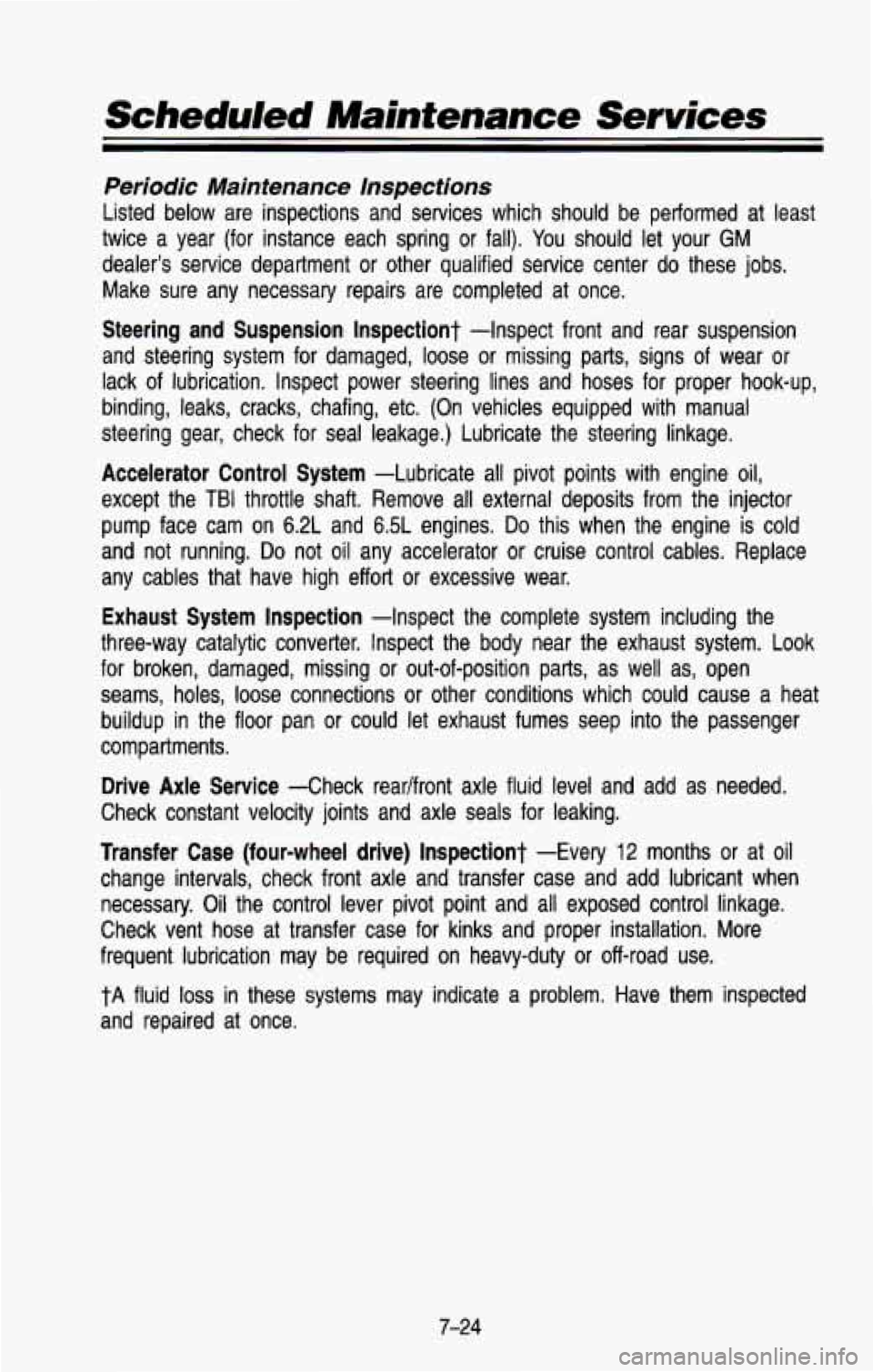
Scheduled Maintenance Services
Periodic Maintenance Inspections
Listed below are inspections and services which should be performed at least
twice a year (for instance each spring or fall). You should let your GM
dealer’s service department or other qualified service center
do these jobs.
Make sure any necessary repairs are completed at once.
Steering and Suspension lnspectiont -Inspect front and rear suspension
and steering system
for damaged, loose or missing parts, signs of wear or
lack of lubrication. Inspect power steering lines and hoses for\
proper hook-up,
binding, leaks, cracks, chafing, etc. (On vehicles equipped wit\
h manual
steering gear, check for seal leakage.) Lubricate the steering linkage.
Accelerator Control System -Lubricate all pivot points with engine oil,
except the
TBI throttle shaft. Remove all external deposits from the injector
pump face cam on 6.2L and 6.5L engines.
Do this when the engine is cold
and not running.
Do not oil any accelerator or cruise control cables. Replace
any cables that have high effort
or excessive wear.
Exhaust System Inspection -Inspect the complete system including the
three-way catalytic converter. Inspect the body near the exhaust system. Look
for broken, damaged, missing
or out-of-position parts, as well as, open
seams, holes, loose connections
or other conditions which could cause a heat
buildup in the
floor pan or could let exhaust fumes seep into the passenger
compartments.
Drive Axle Service -Check readfront axle fluid level and add as needed.
Check constant velocity joints and axle seals for leaking.
Transfer Case (four-wheel drive) lnspectiont -Every 12 months or at oil
change intervals, check front axle and transfer case and add l\
ubricant when
necessary. Oil the control lever pivot point and all exposed control linkage. \
Check vent hose at transfer case for kinks and proper installa\
tion. More
frequent lubrication may be required on heavy-duty
or off-road use.
tA fluid loss in these systems may indicate a problem. Have them inspected
and repaired at once.
7-24