1993 CHEVROLET ASTRO PASSENGER engine overheat
[x] Cancel search: engine overheatPage 73 of 345
Downloaded from www.Manualslib.com manuals search engine CAUTION
Plugging the cord into an ungrounded outlet could cause an electrical
shock.
Also, the wrong kind of extension cord could overheat and
cause a fire. You could be seriously injured. Plug the cord into a
properly grounded three-prong
1 IO-volt outlet. If the cord won't
reach, use a heavy-duty three-prong extension
cord rated for at least
15 amm.
I
After you've used the block heater, be sure to store the cord as it was
before, to
ep it i 9v from vina enaine Parts. If vou don't, it could be I
damaaed.
How long should you keep the block heater plugged in? The answer ,)ends
on the weather, the kind
of oil you have, and some other things. Instead of
trying to list everything here, we ask that you contact a GM dealer in the
area where you'll be parking your vehicle. The dealer can give\
you the best
advice for that particular area.
Automatic Ilansmission
PO472
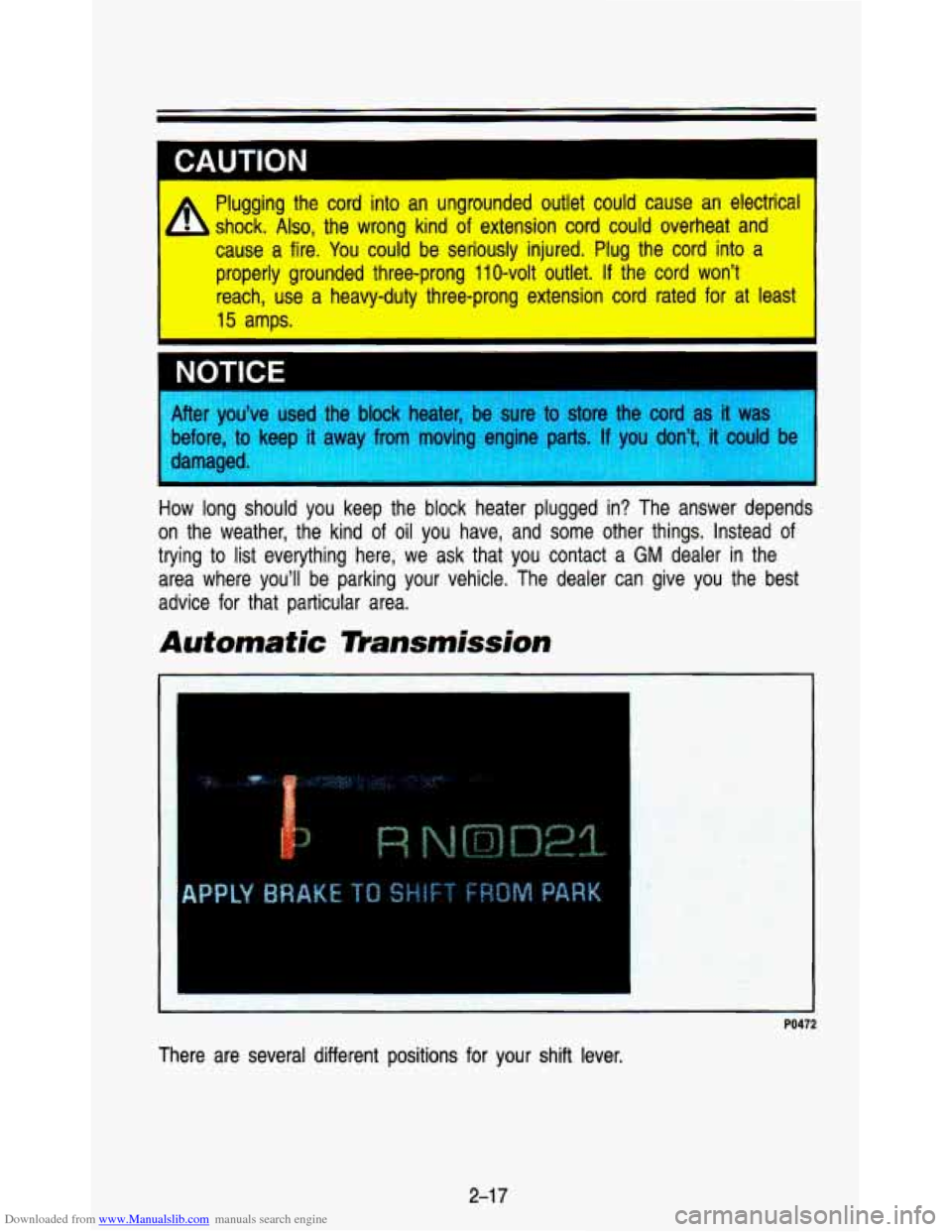
There are several different positions for your shift lever.
2-1 7
Page 76 of 345
Downloaded from www.Manualslib.com manuals search engine Features & Controls
mud. If the selector lever is put in 1 (First Gear), the transmission won't
shift into
1 (First Gear) until the vehicle is going slowly enough.
NOTICE 1
I
If your rear wheels can't rotate, don't try to drive. This might happen
you were stuck in very deep sand
or mud or were up against a soli(
obiect. You could damage your transmission or transfar case, or hoth
Atso, IT u stop when goir uphill, m't hold your vel ~ -e tl 'e with only
the accelerator pedal. This could overheat and damage the transmission.
Use yo1 "--kes or shift into :Park) hold your vehicle in position o
Loc&hg Rear Axle
If you have this feature, your rear axle can give you additional traction on
snow, mud, ice, sand or gravel. It works like a standard axle most of the
time,
but when one of the rear wheels has no traction and the other does,
the locking feature will allow the wheel with traction to move\
the vehicle.
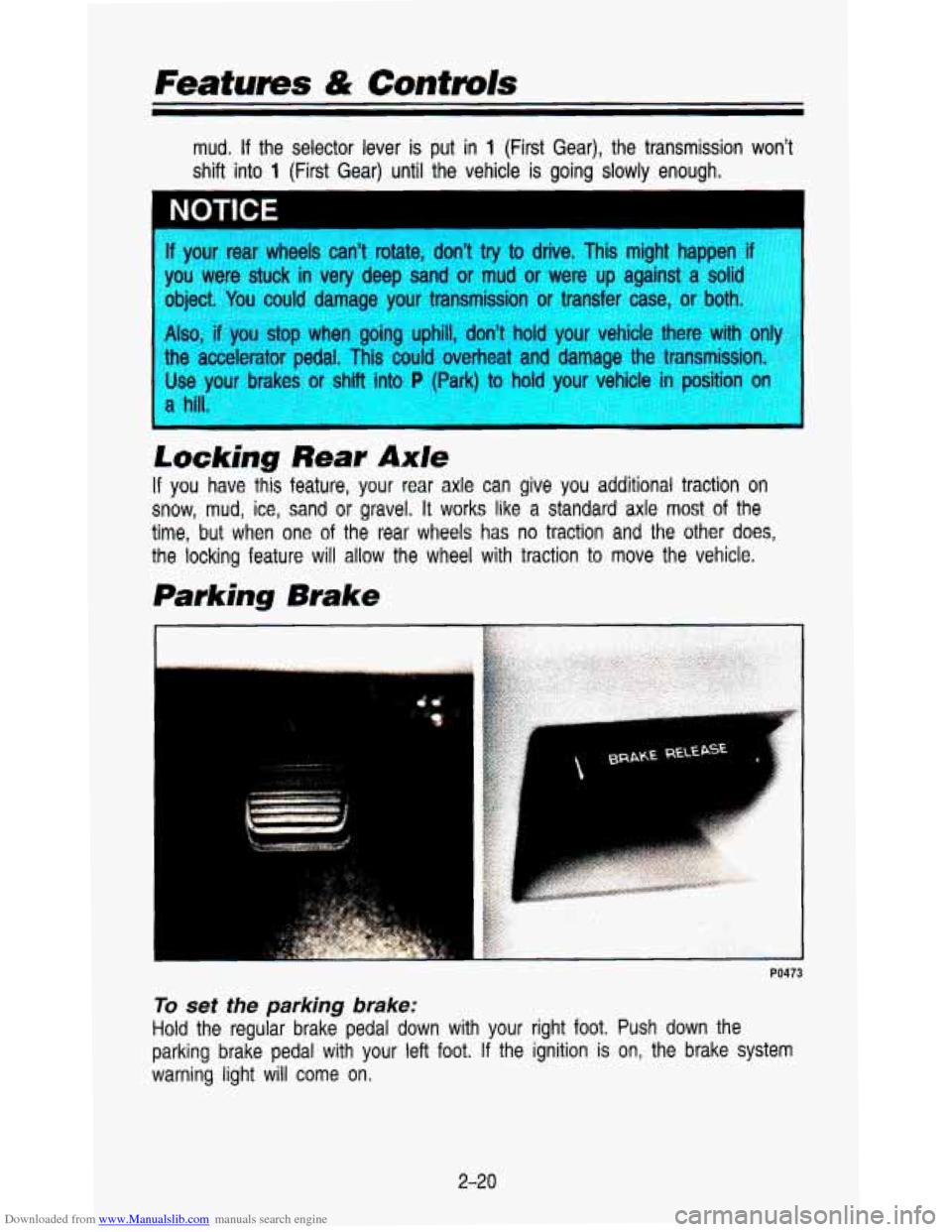
Parking Brake
2-20
Page 78 of 345
Downloaded from www.Manualslib.com manuals search engine Features & Controls
2. Move the shift lever into the P (Park) position like this:
Pull the lever toward you.
Move the lever up as far as it will go.
3. Move the ignition key to LOCK.
4. Remove the key and take it with you. If you can walk away from your
vehicle with the ignition key in your hand, your vehicle is in
P (Park).
Leaving Your Vehicle With the
Engine Running
It can be dangerous to leave your vehicle with the engine running.
‘) Your vehicle could move suddenly if the shift lever is not fully in
P (Park) with the parking brake firmly set. And, if you leave the
vehicle .with the engine running, it could overheat and even catch’
fire, You or others could be injured. Don’t leave your vehicle with the
I engine running unless you have to.
If you have to leave your vehicle with the engine running, be sure your
vehicle is in
P (Park) and your parking brake firmly set before you leave it\
.
After you’ve moved the shift lever into the
P (Park) position, hold the regular
brake pedal down then, see
if you can move the shift lever away from P
{Park) without first pulling it toward you. If you can, it means that the shift
lever wasn’t fully locked into
P (Park).
2-22
Page 106 of 345
Downloaded from www.Manualslib.com manuals search engine Features & Contmls
Cigarette Lighter/Ashtrays
Cigarette Lighter
PO428
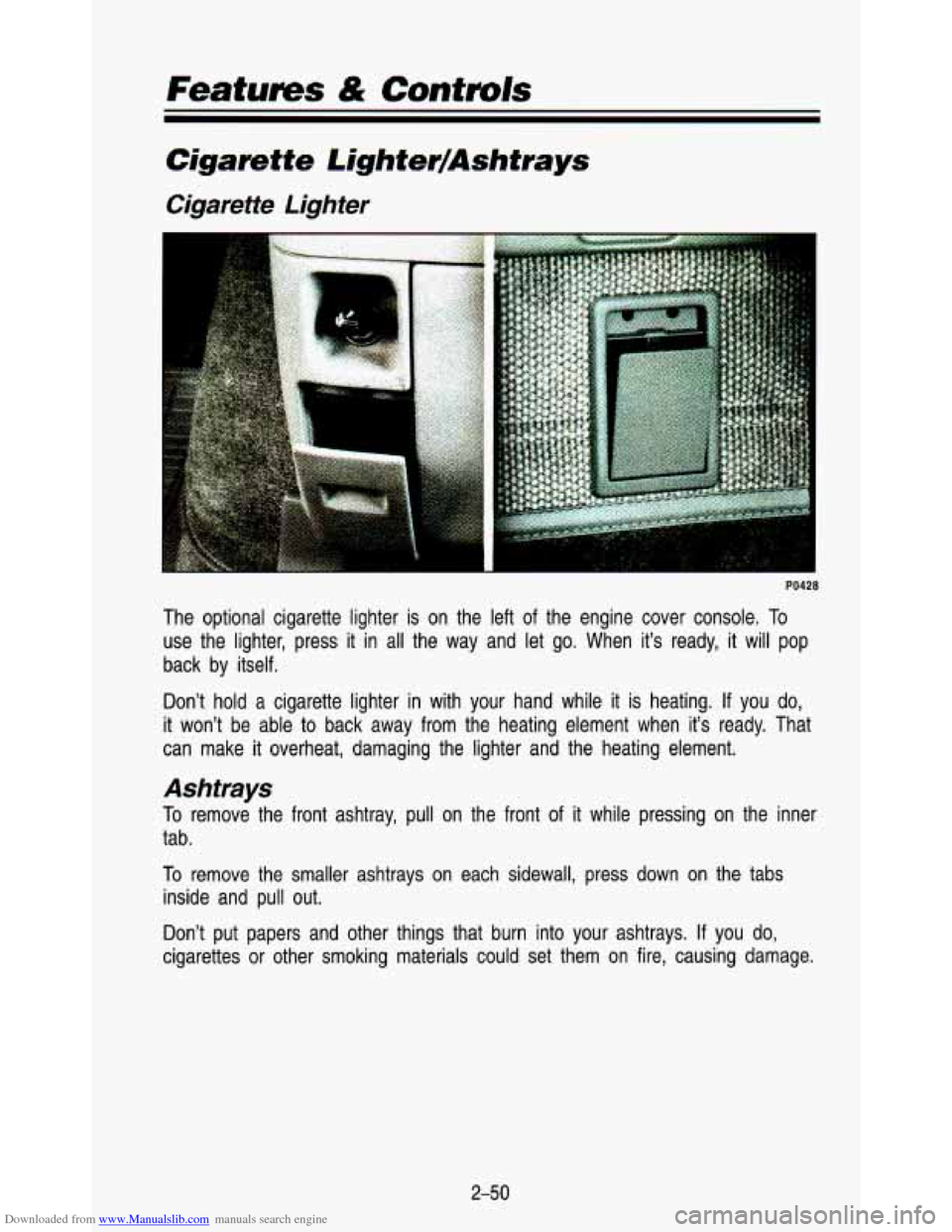
The optional cigarette lighter is on the left of the engine cover console. To
use the lighter, press it in all the way and let go. When it’s ready, it will pop
back by itself.
Don’t hold a cigarette lighter in with your hand while it is heating.
If you do,
it won’t be able to back away from the heating element when it’s ready. That
can make
it overheat, damaging the lighter and the heating element.
Ashtrays
To remove the front ashtray, pull on the front of it while pressing on the inner
tab.
To remove the smaller ashtrays on each sidewall, press down on the tabs
inside and pull out.
Don’t put papers and other things that burn into your ashtr\
ays.
If you do,
cigarettes or other smoking materials could set them on fire, causing dam\
age.
2-50
Page 116 of 345
Downloaded from www.Manualslib.com manuals search engine Features & Controls
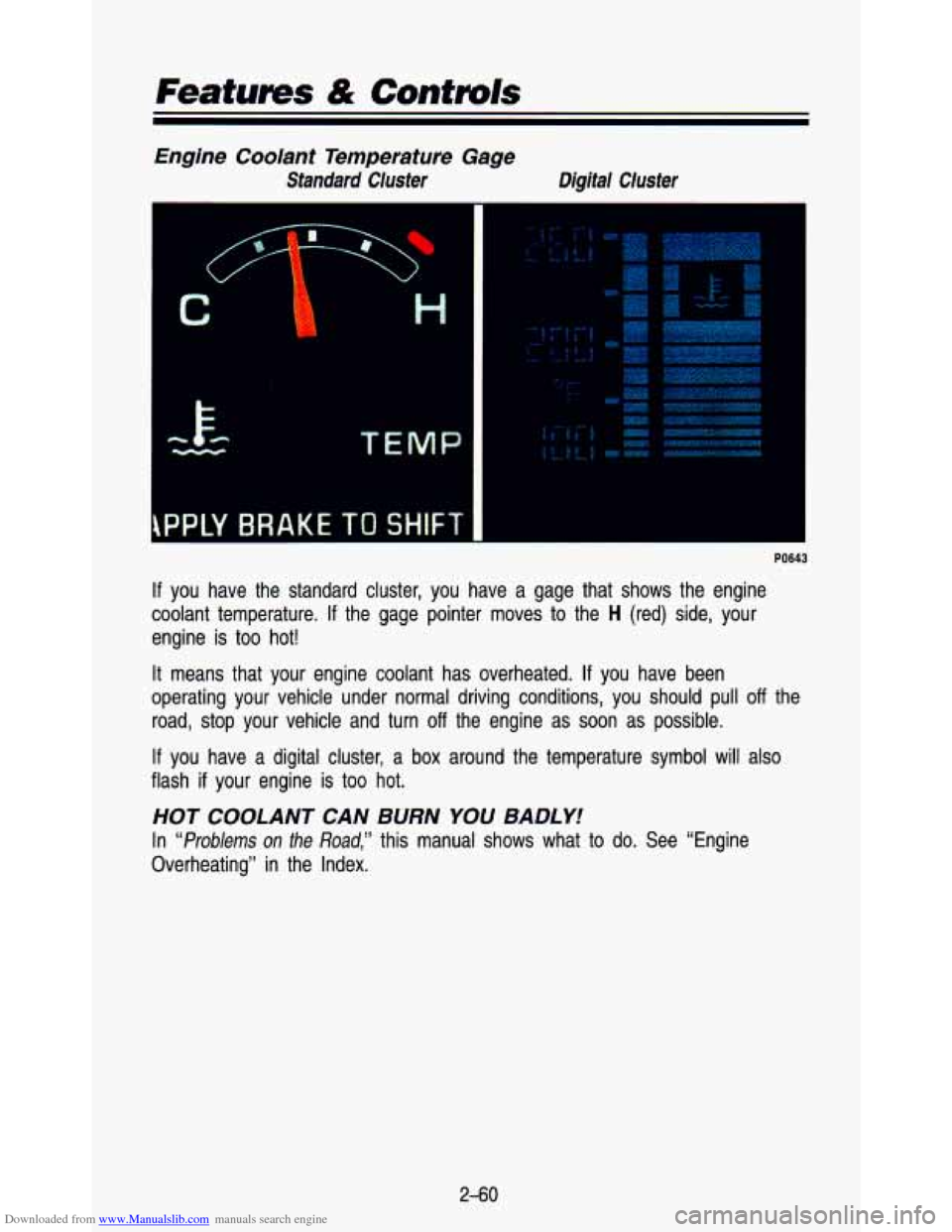
Engine Coolant Temperature Gage
Standard CIuster Digital Cluster
TEMP
PPLY BRAKE TO SHIFT
PO643
If you have the standard cluster, you have a gage that shows the\
engine
coolant temperature.
If the gage pointer moves to the H (red) side, your
engine is too hot!
It means that your engine coolant has overheated.
If you have been
operating your vehicle under normal driving conditions, you shou\
ld pull
off the
road, stop your vehicle and turn
off the engine as soon as possible.
If you have a digital cluster, a
box around the temperature symbol will also
flash
if your engine is too hot.
HOT COOLANT CAN BURN YOU BADLY!
In “Problems on the Road,” this manual shows what to do. See “Engine
Overheating” in the Index.
2-60
Page 167 of 345
Downloaded from www.Manualslib.com manuals search engine Most drivers treat their brakes with care. Some, however, overwork the
braking system with poor driving habits.
Avoid needless heavy braking. Some people drive in spurts-heavy
acceleration followed by heavy braking-rather than keeping pace with
traffic. This
is a mistake. Your brakes may not have time to cool
between hard stops. Your brakes will wear out much faster if you do a
lot of heavy braking.
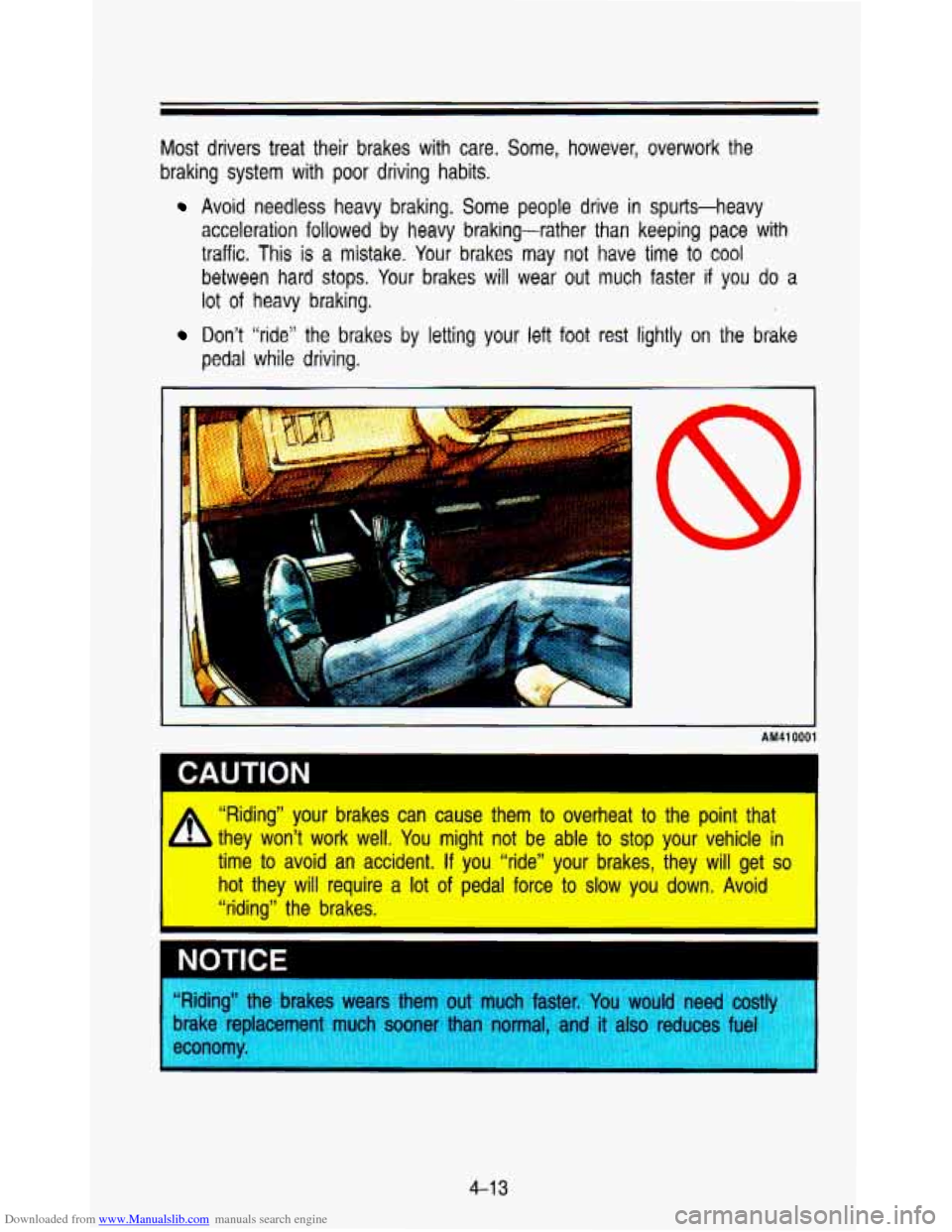
Don’t ”ride” the brakes by letting your left foot rest lightly on the brake
pedal while driving.
II
!
I AM410001
A
“Riding” your brakes can cause them to overheat to the point that
they won’t work well. You might not be able
to stop your vehicle in
time to avoid an accident.
If you “ride” your brakes, they will get so
hot they will require a lot of pedal force to slow you down. Avoid
“riding” the brakes.
1 CAUTION
I
NOTICE
“Riding .he brakes wears them out much faster. You would need costll
brake replacement much
sooner than normal. and it also reduces fuel
4-1 3
Page 202 of 345

Downloaded from www.Manualslib.com manuals search engine Your Driving and the Road
Following Distance
Stay at least twice as far behind the vehicle ahead as you w\
ould when
driving your vehicle without a trailer. This can help you avoi\
d situations that require heavy braking and sudden turns.
Passing
You’ll need more passing distance up ahead when you’re to\
wing a trailer.
And, because you’re a good deal longer, you’ll need
to go much farther
beyond the passed vehicle before you can return
to your lane.
Backing Up
Hold the bottom of the steering wheel with one hand. Then, to move the
trailer to the left, just move your hand to the left.
To move the trailer to the
right, move your hand to the right. Always back up slowly and\
, if possible,
have someone guide you.
Making Turns
When you’re turning with a trailer, make wider turns than n\
ormal. Do this so
your trailer wheels won’t strike soft shoulders, curbs, road \
signs, trees, or
other objects. Avoid jerky or sudden maneuvers. Signal well in advance.
Turn Signals When Towing a Trailer
When you tow a trailer, your vehicle has to have a different turn signal
flasher and extra wiring. The green arrows on your instrument \
panel will flash
whenever you signal a turn or lane change. Properly hooked up,\
the trailer lights will also flash, telling other drivers you’re about to turn, change lanes,
or stop.
When towing a trailer, the green arrows on your instrument pan\
el will flash for
turns even
if the bulbs on the trailer are burned out. Thus, you may think \
drivers behind you are seeing your signal when they are not. \
It’s important to
check occasionally
to be sure the trailer bulbs are still working.
Driving on Grades
Reduce speed and shift to a lower gear before you start down a long or
steep downgrade. If you don’t shift down, you might have to use your brakes
so much that they would get hot and no longer work well.
On a long uphill grade, shift down and reduce your speed to \
around
45 mph
(70 km/h) to reduce the possibility of engine and transmission overheating.
You should use
D (or as you need to, a lower gear) when towing a trailer.
Operating your vehicle in
D when towing a trailer will minimize heat buildup
and extend the life
of your transmission.
4-48
Page 205 of 345
Downloaded from www.Manualslib.com manuals search engine I m Section
Here you’ll find what to do about some problems that can occur on the road .
Hazard Warning Flashers ........................................................................\
........... 5-2
Other Warning Devices ........................................................................\
............... 5-3
Jump Starting ........................................................................\
.............................. 5-3
Towing Your Vehicle ........................................................................\
.................... 5-7
Engine Overheating ........................................................................\
..................... 5-8
Engine Fan Noise ........................................................................\
....................... 5.16
a Tire Goes Flat ........................................................................\
...................... 5-16
Changing a Flat Tire ........................................................................\
............... 5-17
Storing the Jack and Tire ........................................................................\
....... 5-30
You’re Stuck: In Sand, Mud, Ice or Snow ................................................... 5-32
5-1