Page 181 of 398
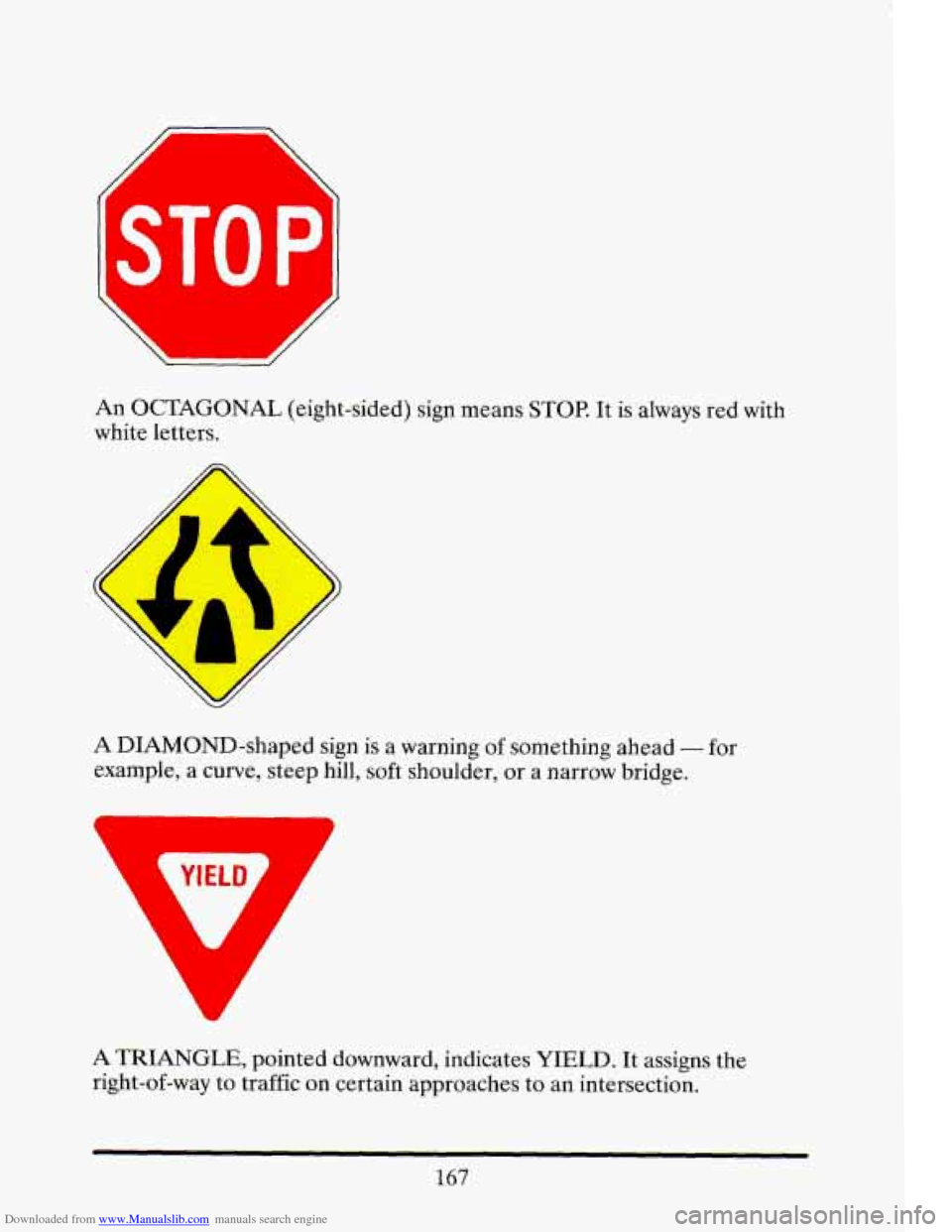
Downloaded from www.Manualslib.com manuals search engine An OCTAGONAL (eight-sided) sign means STOP. It is always red with
white letters.
A DIAMOND-shaped sign is
a warning of something ahead - for
example, a curve, steep hill, soft shoulder, or a narrow bridge.
A TRIANGLE, pointed downward, indicates YIELD. It assigns the
right-of-way to traffic on certain approaches to an intersection.
167
Page 185 of 398

Downloaded from www.Manualslib.com manuals search engine Many city roads and expressways, and even bridges, use reversible-lane
traffic control during rush hours. A red
X light above a lane means no
driving in that lane at that time.
A green arrow means you may drive in
that lane.
Look for the signs posted to warn drivers what hours and days
these systems are in effect.
PAWMENT MmNGS
I NU
PASSING
ZONE
Pavement markings add to traffic signs and signals. They give information
to drivers without taking attention from the roadway. A solid yellow line
on your side of the road or lane means “don’t cross.’’
YOUR OW SIGNALS
Drivers signal to others, too. It’s not only more polite, it’s safer to let
other drivers know what you are doing. And in some places the law
requires driver signals.
Turn and lane change signals. Always signal when
you plan to turn or
change lanes.
If necessary, you can use hand signals out the window: Left arm straight
out for a left turn, down for slow
or about-to-stop, and up for a right turn.
Slowing down.
If time allows, tap the brake pedal once or twice in
advance
of slowing or stopping. This warns the driver behind you.
Disabled. Your four-way flashers signal that your vehicle is disabled or is
a hazard.
See “Hazard Warning Flasher” in the Index.
171
Page 193 of 398

Downloaded from www.Manualslib.com manuals search engine If you keep pace with the traffic and allow realistic following distances,
you
will eliminate a lot of unnecessary braking. That means better
braking and longer brake life.
If your engine ever stops while you’re driving, brake normally but
don’t pump your brakes.
If you do, the pedal may get harder to push
down.
If your engine. stops, you will still have some power brake assist.
But you
will use it when you brake. Once the power assist is used up, it
may take longer to stop and the brake pedal will be harder to push.
Anti-Lock Brakes (ABS)
Your Cadillac has an advanced electronic braking system that will help
prevent skidding.
This light on the
instrument panel
will
go on when you start
your vehicle.
hear a
Once the vehicle speed reaches about
5 mph (8 km/h), you may
momentary motor or c1,icking noise and you may
even notice that your
brake pedal moves a little
while this is going on. This is the ABS system
testing itself.
If there’s a problem with the anti-lock brake system, the
anti-lock brake system warning light will stay on. See “Anti-lock Brake
System Warning Light” in the Index.
179
Page 195 of 398
Downloaded from www.Manualslib.com manuals search engine I
A CAUTION:
Anti-lock doesn’t change the time you need to get your foot up to
the brake pedal. If you get too close
to the vehicle in front of
you, you won’t have time to apply your brakes
if that vehicle
suddenly slows or stops.
Always leave enough room up ahead to
stop, even though you have anti-lock brakes.
I
To Use Anti-Lock:
Don’t pump the brakes. Just hold the brake pedal down and let anti-lock
work for you.
You may hear the anti-lock pump or motor operate. and
feel the brake pedal pulsate, but this is normal.
Disc Brake Wear Indicators
Your Cadillac has four-wheel disc brakes.
Disc brake pads have built-in wear indicators that make a high-pitched
warning sound when the brake pads are worn and new pads are needed.
The sound may come and
go or be heard all the time your vehicle is
moving (except when you
are pushing on the brake pedal firmly).
UJTION:
The brake wear warning sound means that sooner or later YL-,
brakes won’t work well. That could lead to an accident. When
you hear the brake wear warning sound, have your vehicle
serviced.
NOTICE:
181
Page 202 of 398
Downloaded from www.Manualslib.com manuals search engine A cornering skid and an acceleration skid are best handled by easing your
foot
off the accelerator pedal.
If your vehicle starts to slide (as when you turn a corner on a wet, snow-
or ice-covered road), ease your foot off the accelerator pedal as soon as
you
feel the vehicle start to slide. Quickly steer the way you want the
vehicle to go.
If you start steering quickly enough, your vehicle will
straighten out. As it does, straighten the front wheels.
Of course, traction is reduced when water, snow, ice, gravel, or other
material is on the road. For safety, you’ll want to slow down and adjust
your driving to these conditions. It is important to slow down on slippery
surfaces because stopping distance will be longer and vehicle control
more limited.
While driving on a surface with reduced traction, try your best to avoid
sudden steering, acceleration,
or braking (including engine braking by
shifting to
a lower gear). Any sudden changes could cause the tires to
slide. You may not realize the surface is slippery until your vehicle is
skidding. Learn to recognize warning clues
-- such as enough water, ice or
packed snow
on the road to make a “mirrored surface” -- and slow down
when you have any doubt.
Remember: Any anti-lock braking system
(ABS) helps avoid only the
braking skid. Steer the way you want to go.
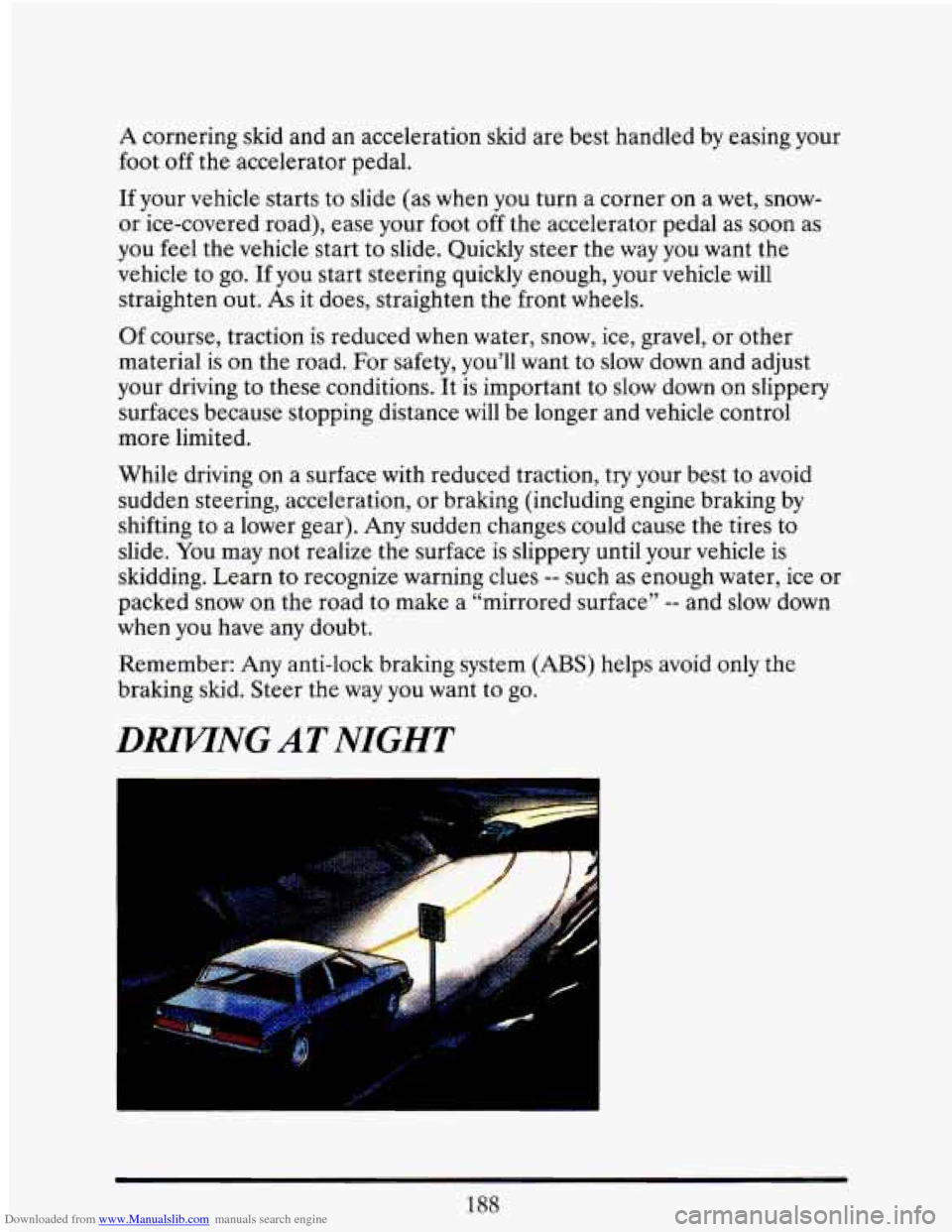
DIWTNG AT NIGHT
188
Page 209 of 398
Downloaded from www.Manualslib.com manuals search engine Start your windshield wipers and washer, to help clear accumulated road
dirt. Slow down carefully.
Tips on Driving in Fog
If you get caught in fog, turn your headlights on low beam: (en In
daytime. You’ll see -- and be seen -- better. Use your fog lignts if your
vehicle has them.
Don’t use your high beams.
The light will bounce off the water droplets
that make up fog and reflect back at
you.
Use your defogger. In high humidity, even a light buildup of moisture on
the inside
of the glass will cut down on your already limited visibility. Run
your windshield wipers and washer occasionally. Moisture can build up
on the outside glass, and what seems to be fog may actually be moisture
on the outside of your windshield.
Treat dense fog as an emergency. Try to find a place to pull off the road,
Of course you want to respect another’s property, but you might need to
put something between you and moving vehicles
-- space, trees, telephone
poles,
a private driveway, anything that removes you from other traffic.
If visibility is near zero and you must stop but are unsure whether you are.
away from the road, turn your lights
on, start your hazard warning
flashers, and sound your horn at intervals or when you hear approaching
traffic.
Pass other vehicles
in fog only if you can see far enough ahead to pass
safely.
Even then, be preparcd to delay your pass if you suspect the fog is
worse up ahead. If other vehicles try to pass you, make it easy for them.
195
Page 210 of 398
Downloaded from www.Manualslib.com manuals search engine CITYDRWTNG
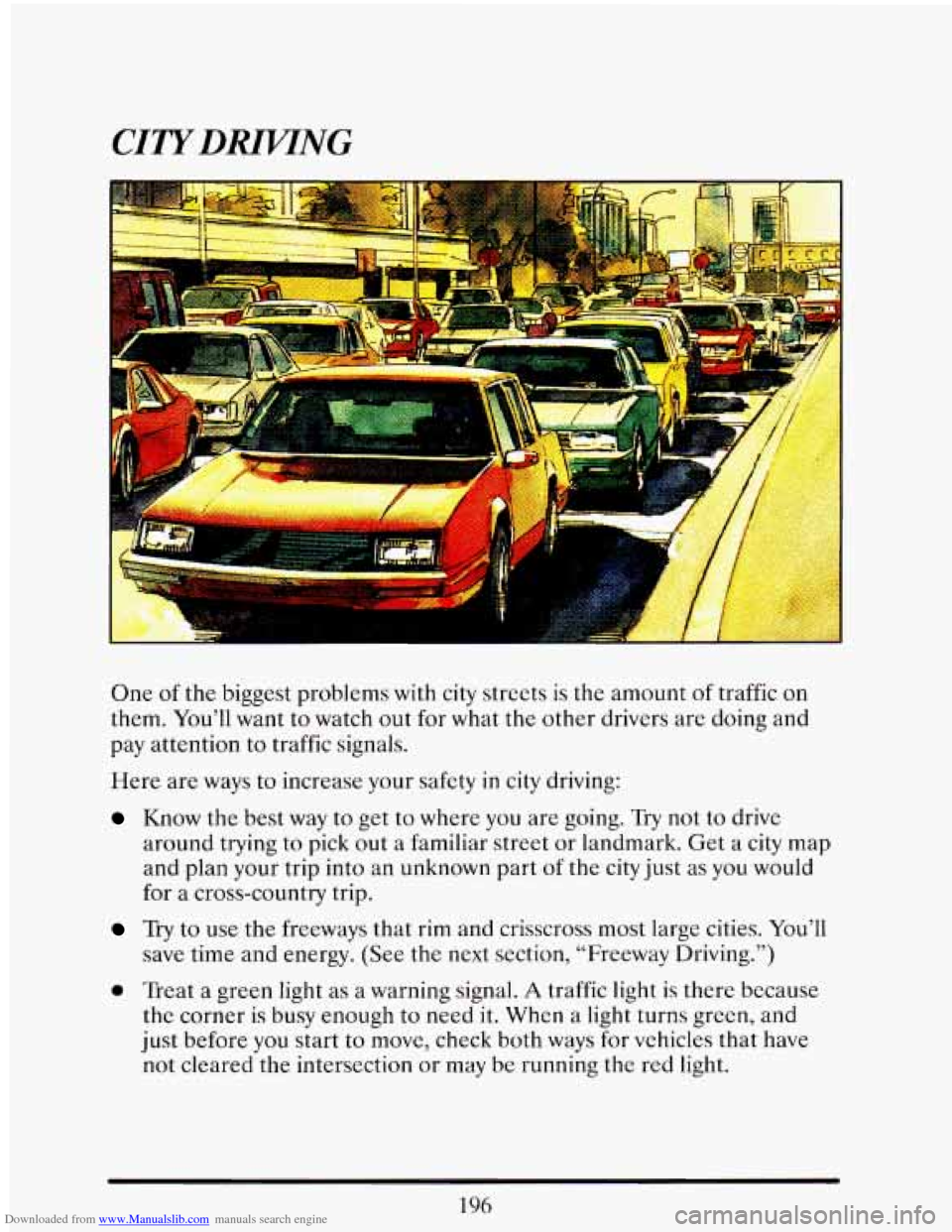
One of the biggest problems with city streets is the amount of traffic on
them. You’ll want to watch out for what the other drivers are doing and
pay attention to traffic signals.
Here are ways to increase your safety in city driving:
Know the best way to get to where you are going. Try not to drive
around trying to pick out a familiar street or landmark. Get a city map
and plan your trip into an unknown part of the city just as you would
for
a cross-country trip.
Try to use the freeways that rim and crisscross most large cities. You’ll
save time and energy. (See the next section, “Freeway Driving.”)
0 Treat a green light as a warning signal. A traffic light is there because
the corner is busy enough to need it. When a light turns green, and
just before you start to move, check both ways for vehicles that have
not cleared the intersection or may
be running the red light.
196
Page 213 of 398
Downloaded from www.Manualslib.com manuals search engine time and flash your brake lights (in addition to your turn signal) as extra
warning that you are about
to slow down and exit.
The exit ramp can be curved, sometimes quite sharply.
The exit speed
is usually posted. Reduce your speed according to your
speedometer, not to your sense of motion. After driving for any distance
at higher speeds, you may tend to think you are going slower than you
actually are. For example,
40 mph (65 km/h) might seem like only 20 mph
(30 kmih). Obviously, this could lead to serious trouble on a ramp
designed for
20 mph (30 kmih)!
DMNG A LONG DISTANCE
Although most long trips today are made on freeways, there are still
many made on regular highways.
Long-distance driving on freeways and regular highways is the same in
some ways.
The trip has to be planned and the vehicle prepared, you
drive at higher-than-city speeds, and there are longer turns behind the
wheel. You’ll enjoy your trip more
if you and your vehicle are in good
shape. Here are some tips for a successful long trip.
BEFORE LEAVTNG ONA LONG TRIP
Make sure you’re ready. Try to be well rested. If you must start when
you’re not fresh
-- such as after a day’s work -- don’t plan to make too
many miles that first part
of the journey. Wear comfortable clothing and
shoes
you can easily drive in.
Is your vehicle ready for a long trip? If you keep it serviced and
maintained, it’s ready
to go. If it needs service, have it done before
starting out.
Of course, you’ll find experienced and able service experts in
Cadillac dealerships all across North America. They’ll be ready and
willing
to help if you need it.
Here are some things you can check before a trip:
Windshield Washer Fluid: Is the reservoir full? Are all windows clean
inside and outside?
Wiper Blades: Are they in good shape?
Fuel. Engine Oil, Other Fluids: Have you checked all levels‘?
199