1993 BUICK SKYLARK steering
[x] Cancel search: steeringPage 205 of 306

.If a Tire Goes Flat Changing a Flat Tire
It’s unusual for a tire to “blow out” while you’re driving,
especially
if you maintain yourtires properly. If air goes
out of a tire, it’s much more likely to leak out slowly.
But if you should ever have a “blowout,” here are a few
tips about what to expect and what to do:
1
If a front tire fails, the flat tire will create a drag that
pulls the vehicle toward that side: Take your foot off the
accelerator pedal and grip the steering wheel firmly. Steer to maintain lane position, then gentlv
I. - to a
stop well out of the traffic lane.
A rear blowout, particularly on a curve, acts much like a
skid and may require the same correction you’d use in a
skid. In any rear blowout, remove your foot from the
accelerator pedal. Get the vehicle under control by steering the way you want the vehicle to go. It may be
very bumpy and noisy, but you can still steer. Gently
brake to
a stop, well off the road if possible.
If your tire goes flat, the next section shows how to use
your jacking equipment to change a flat tire safely.
If a tire goes flat, avoid further tire and wheel damage
by driving slowly
to a level place. Turn on your hazard
warning flashers.
A “-CAUTION:
I Changing a tire can cause an injury. The vehicle
can slip off the jack and roll over you or other
people. You and they could be badly injured. Find
a level place to change your tire.
To help prevent
the vehicle from moving:
1. Set the parking brake K- Ay.
2. Put the shift lever in “P” (Park
3. Turn off the engine.
To be even more certain the vehicle won’t mob
you can put chocks at the front and rear of t
tire farthest away from the one being changed,
I That would be the tire on the oP?r side of the
vehicle, the oppos’-
1 end.
CAUTION: (Continued)
Page 215 of 306
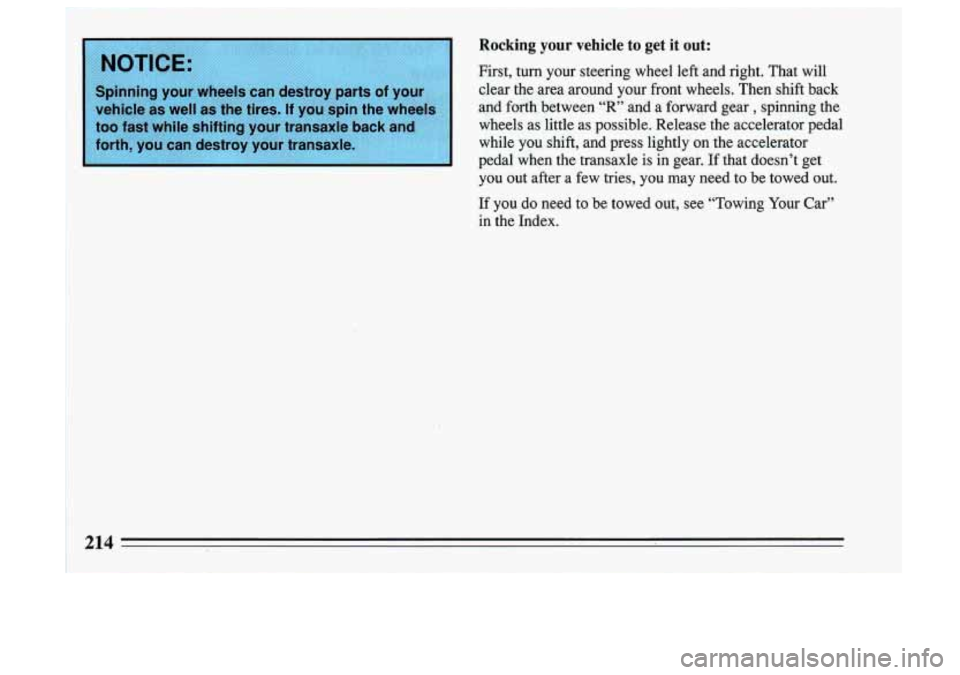
Rocking your vehicle to get it out:
First, turn your steering wheel left and right. That will
clear the area around your front wheels. Then shift back
and forth between “R” and a forward gear
, spinning the
wheels as little as possible. Release the accelerator pedal
while you shift, and press lightly on the accelerator
pedal when the transaxle is in gear. If that doesn’t get
you out after a few tries, you may need
to be towed out.
If you do need to be towed out, see “Towing Your Car”
in the Index.
Page 235 of 306

Power Steering Fluid What to Add:
I
How To Check Power Steering Fluid:
Unscrew the cap and wipe the dipstick with .a clean rag.
Replace the cap and completely tighten it. Then remove
the cap again and look at the fluid level on the dipstick.
When the engine compartment is hot, the level
When the engine compartment is cool, the level
should be at the
“HOT” mark.
should be at the “FULL COLD” mark. Refer
to the Maintenance Schedule
to determine what
kind
of fluid to use. See “Recommended Fluids and
Lubricants”
in the Index.
234
Page 259 of 306

Fuses and Circuit Breakers
The wiring circuits in your car are protected from short
circuits.by a combination of fuses, circuit breakers, and
fusible thermal links in the wiring itself. This greatly
reduces the chance of fires caused by electrical
problems.
Be sure to use the correct fuse. If you ever have a
problem on the road and don’t have a spare fuse, you
I
can “borrow” one of the identical size and rating. Just
pick some feature of your car that you can get along
without
-- like the radio or cigarette lighter -- and use its
fuse, if it is of the value you need. Replace it as soon as
you can.
The fuse panel
is to the left of the steering column, near
the parking brake release lever. Pull the cover down to
access the fus.es.
I
258
Page 264 of 306

. Capacities and Specifications
Engine Code D1 (L40)2 2.3L L-4 (QUAD 4) OHC
Belt Tensions -
Front crankbelt: automatically controlled by an
idler pulley. Tension adjustment should never be
ncessary. Power steering:
450 Newtons
Cooling System Capacity -
10.4 quarts/9.8 liters
Crankcase Capacity -
4 quarts/3.8 liters
Air Conditioning Capaeity(Rl2)4 -
2.63 lbs. (1.19 kilograms)
Fuel Tank Capacity -
15.2 gallons/57.5 liters
Transaxle, Automatic -
Capacity 4 quarts/3.8 liters
Maintenance Item Part Numbers3
Air Filter - AI 172C
Fuel Filter
- GF578
Oil Filter
- PF1225 or PF47
PCV Valve
- CV899C
Spark Plug
- FR3LSK, GAP 0.035”
~~~~
1 8th Character of the Vehicle Identification Number.
z Made in a GM plant in the United States.
3 Part numbers are AC type.
4 Air Conditioning Refrigerant - Not all air conditioning refrigerants are the same. If the air conditioning system in your
vehicle needs refrigerant, be sure the proper refrigerant
is used. If you’re not sure ask your Buick dealer.
263
Page 275 of 306
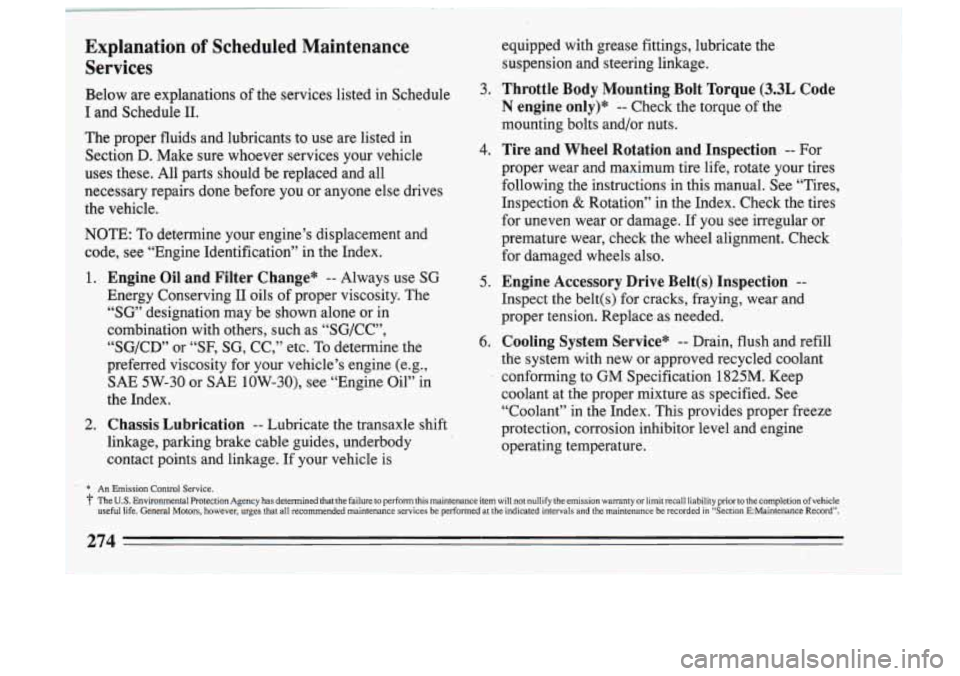
Explanation of Scheduled Maintenance equipped with grease fittings, lubricate the
Services suspension and steering linkage.
Below are explanations
of the services listed in $chediie ‘ ‘ 3. Throttle Body Mounting; Bolt Torque (3.3L Code . , I:
I and Schedule 11.
The proper fluids and lubricants to use are listed in
Section
D. Make sure whoever services your vehicle
uses these. All parts should be replaced and all
necessary repairs done before you or anyone else drives
the vehicle.
NOTE:
To determine your engine’s displacement and
code, see “Engine 1dentific.ation” in the Index.
1. Engine Oil and Filter Change* -- Always use SG
Energy Conserving
I1 oils of proper viscosity. The
“SG, designation may be shown alone or in
combination with others, such as “SG/CC”,
“SG/CD” or “SF,
SG, CC,” etc. To determine the
preferred viscosity for your vehicle’s engine (e.g.,
SAE 5W-30 or SAE 10W-30), see “Engine Oil” in
the Index.
2. Chassis Lubrication -- Lubricate the transaxle shift
linkage, parking brake cable guides, underbody
contact points and linkage. If your vehicle is
An Emission Control Service.
N engine only)* -- Che& the torque of the
mounting bolts and/or nuts.
proper wear and maximum tire life, rotate your tires
following the instructions in this manual. See “Tires,
Inspection
& Rotation” in the Index, Check the tires
for uneven wear or damage. If you see irregular or
premature wear, check
the wheel alignment. Check
for damaged wheels also.
5. Engine Accessory Drive Belt@) Inspection --
Inspect the belt(s) for cracks, fraying, wear and
proper tension. Replace as needed.
6. Cooling System Service* -- Drain, flush and refill
the system with new or approved recycled coolant
conforming to GM Specification 1825M. Keep
coolant at the proper mixture as specified. See
“Coolant” in the Index. This provides proper freeze
protection, corrosion inhibitor level and engine operating temperature.
4. Tire and Wheel Rotation and Inspection -- For
The U.S. Environmental Protection Agency has determined that the failure to perform this maintenance item will not nullify the emission war\
ranty or limit recall liability prior to the completion of vehicle
useful life. General Motors, however, urges that all recommended maintenance services be performed at the indicated i\
ntervals and the maintenance be recorded in “Section EMaintenance Record”.
274
Page 281 of 306
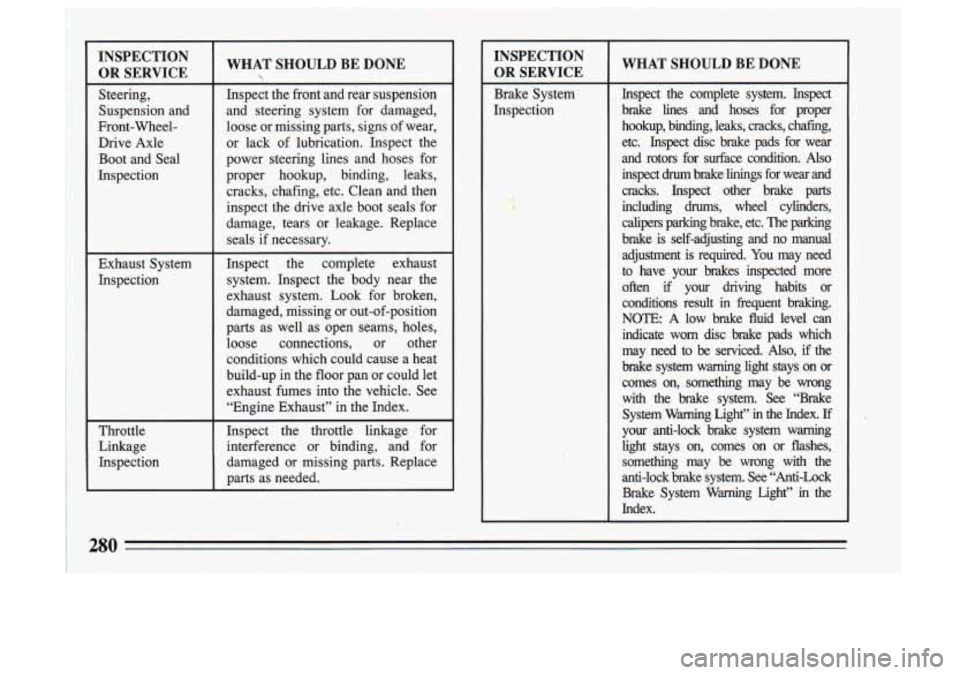
INSPECTION
OR SERVICE
Steering,
Suspension and
Front-Wheel-
Drive Axle
Boot and Seal
Inspection
Exhaust System
Inspection
Throttle
Linkage Inspection
WHAT SHOULD BE DONE
hspect the front and rear suspension
and steering system for damaged,
loose or missing parts, signs of wear,
or lack of lubrication. Inspect the
power steering lines and hoses for
proper hookup, binding, leaks, cracks, chafing, etc. Clean and then
inspect the drive axle boot seals for
damage, tears or leakage. Replace
seals
if necessary.
Inspect the complete exhaust system. Inspect the body near the
exhaust system. Look for broken,
damaged, missing or out-of-position
parts as well as open seams, holes,
loose connections,
or other
conditions which could cause a heat
build-up in the floor pan or could let
exhaust fumes into the vehicle. See
“Engine Exhaust” in the Index.
Inspect the throttle linkage for interference or binding, and for
damaged or missing parts. Replace
parts as needed.
“:
INSPECTION
OR SERVICE
Brake System
Inspection
WHAT SHOULD BE DONE
Inspect the complete system. Inspect
brake
lines and hoses for proper
hookup, binding, leaks, cracks, chafing,
etc.
Inspect disc brake pads for wear
and rotors for swrface condition.
Also
inspect Qwn brake linings for wear and
cracks. Inspect other brake
parts
including drums, wheel cylinders,
calipers parking brake, etc. The parking
brake is self-adjusting and no manual adjustment
is required. You may need
to have your brakes inspected more often
if your driving habits or
conditions result in frequent braking.
NOTE: A low brake fluid level can
indicate worn disc brake pads which
may
need to be serviced. Also, if the
brake system warning light stays on or
comes on, something may
be wrong
with the brake system. See “Brake System
Warning Light” in the Index. If
your anti-lock brake system warning
light stays
on, comes on or flashes,
something may
be wrong with the
anti-lock brake system. See “Anti-Lock
Brake System Warning Light”
in the
Index.
280 .~ . ~
Page 282 of 306
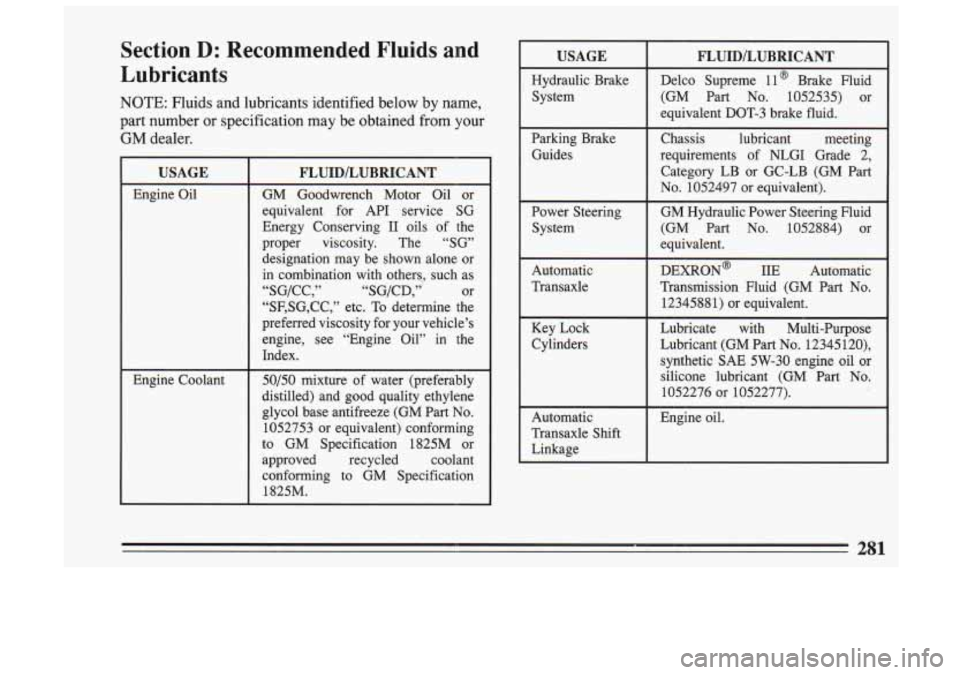
Section D: Recommended Fluids and
Lubricants
NOTE: Fluids and lubricants identified below by name,
part number or specification may be obtained from your
GM dealer.
USAGE
Engine Oil
Engine Coolant
FLUID/LUBRICANT
GM Goodwrench Motor Oil or
equivalent for API service SG
Energy Conserving I1 oils of the
proper viscosity. The
“SG’
designation may be shown alone or
in combination with others, such as
“SGICC,”
66~~/~~,991 or
“SF,SG,CC,” etc. To determine the
preferred viscosity for your vehicle’s
engine, see “Engine Oil” in the
Index.
50/50 mixture of water (preferably
distilled) and good quality ethylene
glycol base antifreeze (GM Part No.
1052753 or equivalent) conforming
to GM Specification 1825M or
approved recycled coolant
conforming to GM Specification
1825M.
USAGE
Hydraulic Brake
System
Parking Brake
Guides
Power Steering
System
Automatic
Transaxle
Key Lock
Cylinders
Automatic
Transaxle Shift
Linkage
FLUIDlLUBRICANT
~~
Delco Supreme 11 @ Brake Fluid
(GM Part No. 1052535) or
equivalent DOT-3 brake fluid.
Chassis lubricant meeting
requirements of NLGI Grade 2,
Category LB or GC-LB (GM Part
No. 1052497 or equivalent).
GM Hydraulic Power Steering Fluid
(GM Part No. 1052884) or
equivalent.
DEXRON@ IIE Automatic
Transmission Fluid (GM Part
No.
12345881) or equivalent.
Lubricate with Multi-Purpose
Lubricant (GM Part
No. 12345120)’
synthetic
SAE 5W-30 engine oil or
silicone lubricant
(GM Part No.
1052276 or 1052277).
Engine oil.
281