1993 BUICK SKYLARK tow
[x] Cancel search: towPage 84 of 306

Leaving Your Vehicle With the Engine
Running
CAUTION:
It can be dangerous,to leave your vehicle with
the engine running. Your vehicle could move
suddenly
if the shift lever is not fully in “P”
(Park) with the parking brake firmly set. And,
il
you leave the vehicle with the engine running, it
could overheat and even catch fire. You or others
I
could be injured. Don’t leave your vehic ’ wi
the engine running unless you have to.
I
If you have to leave your vehicle with the engine
running, be sure your vehicle is in
“P” (Park) and your
parking brake is firmly set before you leave it. After
you’ve moved the shift lever into the
“P” (Park)
position, hold the regular brake pedal down. Then, see if
you can move the shift lever away from “P” (Park)
without first pulling it toward you (or, if you have the
console shift lever, without first pushing the button). If
you can, it means that the shift lever wasn’t fully locked
into
“P” (Park).
Shifting Out of P (Park) 66 99
Your Buick has a brake-transaxle shift interlock. You
have to fully applv your regular brake before
you can
shift
from “P” (Park) when the ignition is in the “Run”
position. See “Automatic Transaxle ” in the Index.
If you cannot shift out of “P” (Park), ease pressure on
the shift lever -- push the shift lever all^ the way into “P”
(Park) and also release the shift lever button on floor
shift console models as you maintain brake application.
Then move the shift lever into the gear you wish. (Press
the shift lever button before moving the
shift lever.) If
you ever hold the brake pedal down but still can’t shift
out of “P” (Park), try this:
1. Turn the key to “Off.”
2. Apply and hold the brake until the end of Step 4.
3. Shift to “N’ (Neutral).
4. Start the vehicle and then shift to the drive gear you
5. Have the vehicle fixed as soon as you can. want.
Page 86 of 306
P
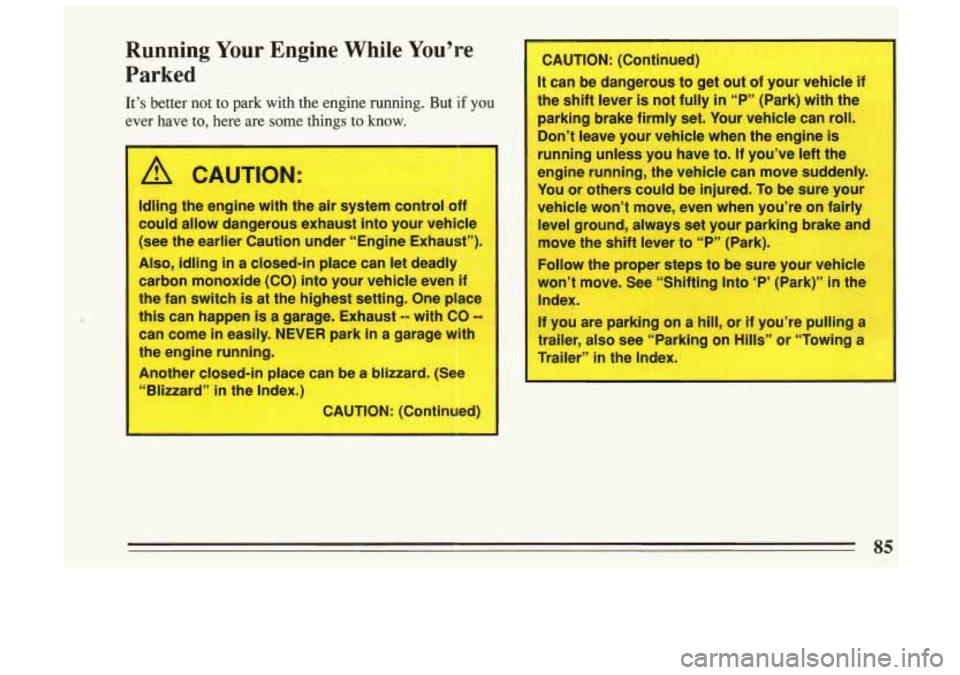
-Running Your Engine While You’re
‘Parked
It’s better n.ot to park with the engine running. But if YOU
ever have to, here are~same things to how.
Idling the engine with tfie air 31 em control off
8could al~low dangerous exhaust into jour vehilcle
(see the earlier Cawtionunder “‘Engine IExhaust”:
Also, idling In a Closed-in> place can let‘ ‘dead.,
‘carbon monoxide
(CO) into yo~ur ve,hicle ewn if
t’he fan switch
is at the highest setting. One placl
this can happen is agarage. Exhaust -- with CO
can came in easily. #NEVER park in a garage with
the engine running.
Another clq3ed8-in;
place can be a blizzard. l(See
in the Index.)
nued:
It can ‘be dangerous ta get ‘olut lof ,your vehicle if
‘the shift lever is not fully
in T’ (Park) witlh trhe
parking brake flirmly set. Your vehicle
can roll.
Dm’t leave yaur vehic;le when the engine
is
running unless you have to. If you’ve lefi the
enlgine running, the vehicle can
move suddenly.
You
or others cou!ld be injured. To be sure yow’r
vehicle wonlpt move, even when
you’re on fair ~
level gramd, always set your parking brake and’
move
the shift lever to “P” (Park).
Follow the prope!r steps
to be sure your vehicle
wm’t move. See “S’hifting
Into ‘PB (Park)”’ in the
Inde?.
If
you are parking on a hill, or if you’lre pulling a
trailer,
atso see “Parking OM Hills”’ or “Towing, a
‘Trailer”
in th’e Index.
85
Page 91 of 306

Ihrn Signal tCONSS Chime
A chime will sound if your turn signal is left on after
having gone
3/4 of a mile, to remind you to turn your
signal
off.
Operation of Lights
Although your vehicle’s lighting system (headlights,
parking lights, fog lamps, side.marker lights and
taillights) meet all applicable federal lighting
requirements, certain states and provinces may apply their own lighting regulations that may require special
attention before you operate these lights. For example,
some jurisdictions may require that you operate your
lower beam lights with fog lamps at all times, or that
headlights be turned on whenever you must use your
windshield wipers. In addition, most jurisdictions
prohibit driving solely with parking lights, especially at
dawn or dusk. It
is recommended that you check with
you own state or provincial highway authority for
applicable lighting regulations.
Headlight High-Low Beam
To change the headlights
from low beam to high or
high to low, pull the turn
signal lever all the way
toward you. Then release it.
When the high beams are
on, this blue light on the
instrument panel also will
be on.
Flash-To-Pass Feature
It lets you use your high beam headlights to signal a driver in front of you that you want to pass. It works
even
if your headlights are off.
To use it, pull the multifunction lever toward you a little
(but not
so far that you hear a click).
If your headlights are off Your high beam headlights
will
turn on. They’ll stay on as long as you hold the
lever there. Release the lever to turn them
off.
90
I
Page 92 of 306

If your headlights are on, but on low beam: The
system works normally. Just pull the lever until it clicks.
Your headlights will shift to high beam and stay there.
To return to low beam, just pull the lever toward you.
Windshield Wipers
You control the windshield wipers by moving the lever
marked
“WIPER.”
For a single wiping cycle, move the lever down to
“MIST.” Hold it down until the wipers start, then let go.
The wipers will stop after one cycle. If you want more
cycles, hold the lever down to “MIST” longer.
i
For steady wiping at low speed, move the lever to the
“LOW’ position. For high speed wiping, move the lever
further, up to “HIGH” To stop the wipers, move the
lever to “OFF.”
Low Speed Delay Wipers (Option)
You can set the wiper speed for a long or short delay
between wipes. This can be very useful in light rain or
snow. Move the lever to DELAY then, turn the band to
choose the amount of delay.
I A CAUTION:
Damaged wiper blades may prevent you from
seeing well enough
in a storm to drive safely. To
avoid damage, be sure to clear ice and snow
from the wiper blades before using them.
If
they’re frozen to the windshield, carefully loosen
or thaw them.
If your blades do become
damaged, get new blades or blade inserts.
Page 112 of 306

This light will also come on when you set your parking
brake, and will stay on
if your parking brake doesn’t
release fully. If it stays on after your parking brake is
fully released, it means you have a brake problem.
If the
light comes on while driving, pull
off the road and stop
carefully, You may notice that the pedal is harder to
push. Or, the pedal may go closer to the floor. It may
take longer to stop. If the light is still on, have the
vehicle towed for service. (See “Towing Your
Car” in
the Index.)
-
1
I A CAUTION:
Your brake system may not be working properly
if the brake warning light is on. Driving with the
brake warning light on can lead to an accident. If
the light is still on after you’ve pulled off the road
and stopped carefl
r, have the vehicle towed for
service.
I
Anti-Lock Brake System Warning Light
ANTI.-
LOCK
With anti-lock, this light will go on unless you start your
engine and it will stay on for three .seconds. If the light
doesn’t come on, have it fixed
so it will be ready to
warn
you if there is a problem.
If the light stays on or comes on when you’re driving,
stop as soon
as possible and turn the key off. Then start
the engine to reset the system. If the light still stays on,
or comes on again while you’re driving, your Buick
needs service. Unless the regular brake system warning
light is also on, you will still have brakes, but not
anti-lock brakes. If the regular brake system warning
111
Page 138 of 306

Part 4 Your Driving and the Road
I
Here you’ll find information about driving on different kinds\
of roads and io varying weather conditions . We’ve also
included many other useful tips
on driving .
Part 4 includes:
RoadSigns
....................................................................... \
DefensiveDriving .................................................................
DrunkenDriving ..................................................................
ControlofaVehicle ................................................................
Braking ......................................................................
Steering .....................................................................
Passing .....................................................................
LossofControl ...............................................................
DrivingatNight ...................................................................
DrivingintheRain .................................................................
Driving in Fog, Mist and Haze ........................................................
CityDriving ......................................................................
FreewayDriving ...................................................................
DrivingonaLongTrip .............................................................
HillandMountainRoads ............................................................
ParkingonHills ...................................................................
WinterDriving ....................................................................
TowingaTrailer ...................................................................
138
144
145
148
149
154
156
158
159
161
164
165
166
168
170
172
175
179
Page 146 of 306
Defensive driving really means “be ready for anything.” On city streets, rural roads, or freeways, it means
“always expect the unexpected.”
Assume that pedestrians or other drivers are going to be
careless and make mistakes. Anticipate what they might
do. Be ready for their mistakes.
Expect children to dash out from behind parked cars,
often followed by other children. Expect occupants in
parked cars to open doors into traffic. Watch for
movement in parked cars
-- someone may be about to
open a door.
Expect other drivers to run stop signs when you are on a
through street. Be ready to brake if necessary as you go
through intersections. You may not have to use the
brake, but if you do, you will be ready. following distance. It’s the best defensive driving
maneuver, in both city and rural driving.
You never
know when the vehicle in front
of you is going to brake
or turn suddenly.
Here’s a final bit
of information about defensive driving.
The most dangerous time for driving in the
U.S. is very
early on Sunday morning. In fact,
GM Research studies
show that the most and the least dangerous times for
driving, every week, fall an the same day. That day is
Sunday. The most dangerous time is Sunday fi-om
3 a.m.
to 4 a.m. The safest time is Sunday from 10 a.m. to
11 a.m. Driving the same distance on a Sunday at 3 a.m.
isn’t just a little more dangerous than it is at 10 a.m. It’s
about 134 times more dangerous!
That leads to the next section.
If you’re driving through a shopping center parking lot
Drunken Driving
where there are well-marked lanes, directional arrows, Death and\
injury associated with drinking and driving is
and designated parking areas, expect some drivers to a national tragedy. It’s the number one contributor to the
ignore all these markings and dash straight toward one highway \
death toll, claiming.thousands of victims every
part
of the lot.
year. Alcohol takes away three things that anyone needs
Pedestrians can be careless. Watch for them. In general,
you must give way to pedestrians even
if you know you
have the right of way.
Rear-end collisions are about the most preventable of
accidents. Yet they are common. Allow enough to drive a vehicle: Judgment
0 Muscular Coordination
0 Vision
145
Page 168 of 306

Entering the Freeway
At the entrance there is usually a ramp that leads to the
freeway. If you have a clear view of the freeway as you
drive along the entrance ramp, you should begin to
check traffic. Try to determine where
you expect to
blend with the flow. If traffic is light, you may have no
problem. But if it is heavy, find a gap as you move along
the entering lane and time your approach. Try to merge
into the gap at close to the prevailing speed. Switch on
your turn signal, check your rearview mirrors as you
move along, and glance over your shoulder as often as
necessary. Try to blend smoothly with the traffic flow.
Driving on the Freeway
Once you are on the freeway, adjust your speed to the
posted limit or to the prevailing rate
if it’s slower. Stay
in the right lane unless you want to pass.
If you are on a
two-lane freeway, treat the right lane as the slow lane
and the left lane as the passing lane.
If you are on a three-lane freeway, treat the right lane as
the slower-speed through lane, the middle lane as the
higher-speed through lane, and the left lane as the
passing lane.
Before changing lanes, check your rearview mirrors.
Then use your turn signal. Just before you leave the lane, glance quickly over your
shoulder to make sure there isn’t another vehicle in your
“blind” spot.
If you are moving from an outside to a center lane on a
freeway having more than two lanes, make sure another vehicle isn’t about to move into the same spot.
Look at
the vehicles two lanes over and watch for telltale signs:
turn signals flashing, an increase in speed, or moving
toward the edge of the lane. Be prepared
to delay your
move.
Once
you are moving on the freeway, make certain you
allow a reasonable following distance. Expect to move slightly slower at night.
Leaving the Freeway
When you want to leave the freeway, move to the proper
lane well in advance. Dashing across lanes at the last
minute is dangerous. If you miss your exit do not, under
any circumstances, stop and back up. Drive on to the
next exit.
At each exit point is a deceleration lane. Ideally it
should be long enough for you to enter it at freeway
speed (after signaling, of course) and then do your
braking before moving onto the exit ramp.
Unfortunately, not all deceleration lanes are long enough
-- some are too short for all the braking. Decide when to
167 2-