Page 78 of 306

Automatic Transaxle
There are several different positions for your shift lever.
P.(Park)
This locks your front wheels. It’s the best position to
use when you start your engine because your vehicle
can’t move easily.
A CAUTION:
It is dangerous to get out of your vehicle if the
shift lever
is not fully in “P” (Park) with the
parking brake firmly set. Your vehicle can
roll.
Don’t leave your vehicle when the engine is
running unless you have to. If you have left the
engine running, the vehicle can move suddenly.
You or others could be injured.
To be sure your
ehicle won’t move, when you’re on fairly level
ound, always set your parking brake and move
e shift lever to
“P” (Park). See “Shifting Into ‘P’
ark)”
in the Index. If you are parking on a hill
, if you’re pulling a trailer, also see “Parking on
11s” or “ Towing a Trailer” in the Index.
Ensure the shift lever is fully in “P” (Park) range before
starting the engine. Your Buick has a brake-transaxle
shift interlock. You have to fully apply your regular
brake before you can shift from “P” (Park) when the
ignition key is in the “Run” position.
If you cannot shift
out of
“P” (Park), ease pressure on the shift lever - push
the shift lever all the way into
“P,’ (Park) and also
release the shift lever button on floor shift console
models
- as you maintain brake application. Then move
77
Page 79 of 306

1 the shift lever into the gear you wish. (Press the shift
lever
button before moving the shift lever on floor shift
3: console models.) See “SI
section,
R (Reverse)
Use this gear to back ifting’ Out
of ‘I?’ (Park)” in this
To rock your vehicle back and forth
to get out of snow,
ice
or sand without damaging your transaxle, see “If
You’re Stuck: In Sand, Mud, Ice or, Snow” in the Index.
N (Neutral)
In this position, your engine doesn’t connect with the
wheels. To restart when you’re already moving,
use
“N” (Neutral) only. Also, use “N’ when your vehicle
is being towed.
I
A CAUTION:
hifting out of ‘‘P” (Park) or “N” (Neutral) while
our engine is “racing” (running at high speed)
s dangerous. Unless your foot is firmly on the
rake pedal, your vehicle could move very
apidly. You could lose control and
hit people or
bjects. Don’t shift out of
“P” (Park) or “N”
[Neutral) while your engine is racing.
Damage to your transaxle caused by shifting out
I
of “P” (Park) or “N” (Neutral) with the engine
racing isn’t covered by your warranty.
I
D (Drive)
This position is for normal driving.
Page 80 of 306
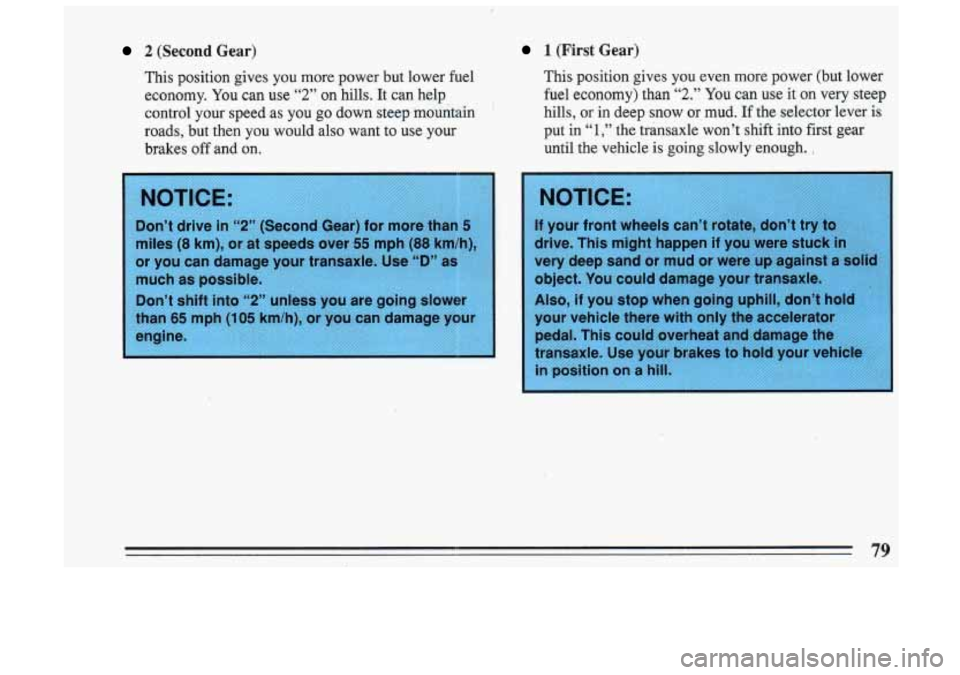
2 (Second Gear)
This position gives you more power but lower fuel
economy. You can use
“2” on hills. It can help
control your speed as you go down steep mountain
’
roads, but then you would also want to use your
brakes
off and on.
1 (First Gear)
This position gives you even more power (but lower
fuel economy) than
“2.” You can use it on very steep
hills, or in deep snow or mud.
If the selector, lever is
put in
“1,” the transaxle won’t shift into first gear
until the vehicle
is going slowly enough. ,
Don’t drive in “2” (Second Gear) for more than 5
miles (8 km), or at speeds over 55 mph (88 km/h),
or you can damag ansaxl
much as possible.
Don’t shift into “2” unless you are going
slower
than 65 mph (105 km/h), or you can damage your
engine.
79
Page 82 of 306

If YOU are on a hill: See “ Parking on Hills” in the Index.
That section shows how to tuk your front wheels.
If you are towing a trailer and are parking on any hill:
See
“ Towing a Trailer” in the Index. That section shows
what to do first to keep the trailer from moving.
Shifting Into 44 P 99 (Park)
I I
A CAUTION:
It can be dangerous to get out of your vehicle if
the shift lever is not fully in “PYy (Park) with the
parking brake firmly set. Your vehicle can roll.
If you have left the engine running, the vehicle
can move suddenly. You or others could be
injured. To be sure your vehicle won’t move,
when you’re on fairly level ground, use the steps
that follow.
If you are parking on a hill, or if
you’re pulling a trailer, also see “Parking On
Hills” or “Towing a Trailer”
in the Index.
Steering Column Shift Lever
1. Hold the brake pedal down with your right fuot and
2. Move the shift lever into “F”’ (Park) position like
set
the parking brake.
this:
0 Pull the lever toward you.
81
Page 84 of 306

Leaving Your Vehicle With the Engine
Running
CAUTION:
It can be dangerous,to leave your vehicle with
the engine running. Your vehicle could move
suddenly
if the shift lever is not fully in “P”
(Park) with the parking brake firmly set. And,
il
you leave the vehicle with the engine running, it
could overheat and even catch fire. You or others
I
could be injured. Don’t leave your vehic ’ wi
the engine running unless you have to.
I
If you have to leave your vehicle with the engine
running, be sure your vehicle is in
“P” (Park) and your
parking brake is firmly set before you leave it. After
you’ve moved the shift lever into the
“P” (Park)
position, hold the regular brake pedal down. Then, see if
you can move the shift lever away from “P” (Park)
without first pulling it toward you (or, if you have the
console shift lever, without first pushing the button). If
you can, it means that the shift lever wasn’t fully locked
into
“P” (Park).
Shifting Out of P (Park) 66 99
Your Buick has a brake-transaxle shift interlock. You
have to fully applv your regular brake before
you can
shift
from “P” (Park) when the ignition is in the “Run”
position. See “Automatic Transaxle ” in the Index.
If you cannot shift out of “P” (Park), ease pressure on
the shift lever -- push the shift lever all^ the way into “P”
(Park) and also release the shift lever button on floor
shift console models as you maintain brake application.
Then move the shift lever into the gear you wish. (Press
the shift lever button before moving the
shift lever.) If
you ever hold the brake pedal down but still can’t shift
out of “P” (Park), try this:
1. Turn the key to “Off.”
2. Apply and hold the brake until the end of Step 4.
3. Shift to “N’ (Neutral).
4. Start the vehicle and then shift to the drive gear you
5. Have the vehicle fixed as soon as you can. want.
Page 85 of 306
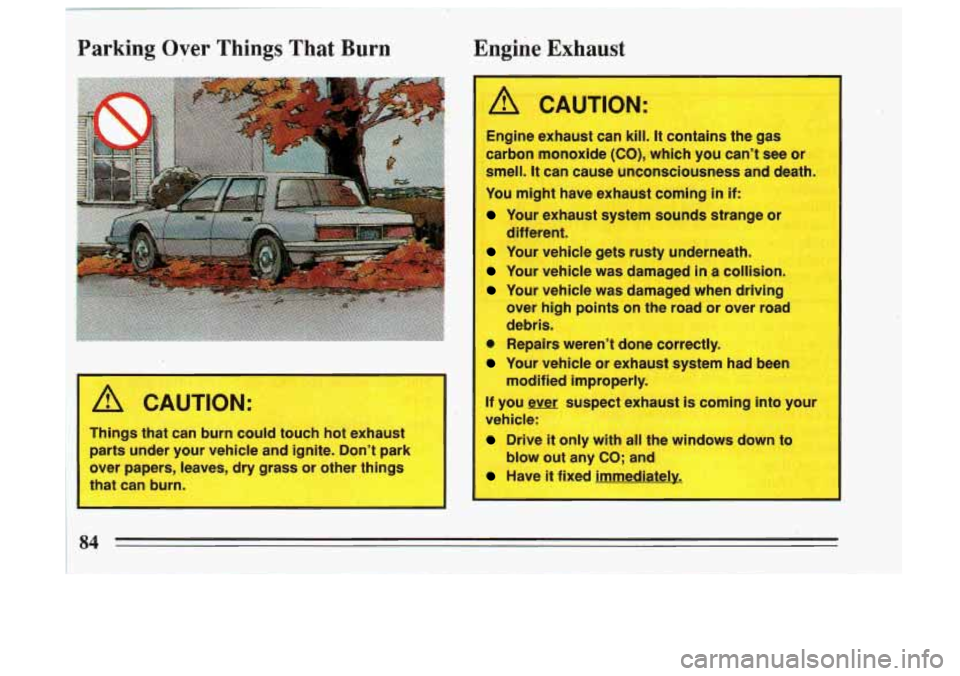
Parking Over Things That Burn
A CAUTION:
Things that can burn could touch hot exhaust
rrts under your vehicle and ignite. Don’t park
over papers, leaves, dry grass or other things
3t can burn.
/1 CAUTION:
Engine exhaust can kill. It contains the gas
carbon monoxide
(CO), which you can’t see or
smell.
It can cause unconsciousness and death.
You might have exhaust coming
in if:
Your exhaust system sounds strange or
Your vehicle gets rusty underneath.
Your vehicle was damaged in a collision.
Your vehicle was damaged when driving
over hinh Doints on the road or over road
different.
debris.
0 Repairs weren’t done
correctly.
I Your vehicle or exha tern had been
modified improperly.
If you ever suspect exhaust is coming into your
I vehicle:
Drive it only with all the windows down to
blow out any
CO; and
Have it fixed immediately.
I
Page 86 of 306
P
-Running Your Engine While You’re
‘Parked
It’s better n.ot to park with the engine running. But if YOU
ever have to, here are~same things to how.
Idling the engine with tfie air 31 em control off
8could al~low dangerous exhaust into jour vehilcle
(see the earlier Cawtionunder “‘Engine IExhaust”:
Also, idling In a Closed-in> place can let‘ ‘dead.,
‘carbon monoxide
(CO) into yo~ur ve,hicle ewn if
t’he fan switch
is at the highest setting. One placl
this can happen is agarage. Exhaust -- with CO
can came in easily. #NEVER park in a garage with
the engine running.
Another clq3ed8-in;
place can be a blizzard. l(See
in the Index.)
nued:
It can ‘be dangerous ta get ‘olut lof ,your vehicle if
‘the shift lever is not fully
in T’ (Park) witlh trhe
parking brake flirmly set. Your vehicle
can roll.
Dm’t leave yaur vehic;le when the engine
is
running unless you have to. If you’ve lefi the
enlgine running, the vehicle can
move suddenly.
You
or others cou!ld be injured. To be sure yow’r
vehicle wonlpt move, even when
you’re on fair ~
level gramd, always set your parking brake and’
move
the shift lever to “P” (Park).
Follow the prope!r steps
to be sure your vehicle
wm’t move. See “S’hifting
Into ‘PB (Park)”’ in the
Inde?.
If
you are parking on a hill, or if you’lre pulling a
trailer,
atso see “Parking OM Hills”’ or “Towing, a
‘Trailer”
in th’e Index.
85
Page 110 of 306

Warning Lights, Gages and
Indicators
This section describes the warning lights and gages that
may be on your vehicle. The pictures will help you
locate them.
Warning lights and gages can signal that something is wrong before it becomes serious enough to cause an
expensive repair or replacement. Paying attention to
your warning lights and gages could also save you or
others from injury.
Warning lights go on when there may be or is a problem with one of your vehicle’s functions.
As you will see in
the details
on the next few pages, some warning lights
come on briefly when you turn the ignition key just to
let you know they’re working. If you are familiar with
this section, you should not be alarmed when this
happens.
Gages can indicate when there may be or is a problem
with one of your vehicle’s functions. Often gages and
warning lights work together to let you know when
there’s a problem with your vehicle. When
one
of the warning lights comes on and stays on
when you are driving, or when one of the gages shows
there may be a problem, check the section that tells you what to do about it. Please follow the manual’s advice.
Waiting to do repairs can be costly
-- and,even
dangerous.
So please get to know your warning lights
and gages. They’re a big help.
Fuel Gage
Your fuel gage shows how much fuel is in your tank. It
works only when the engine is on. When the indicator
nears
“E,” you still have a little fuel left. You need to get
more right away.