1993 BUICK ROADMASTER lights
[x] Cancel search: lightsPage 161 of 340
Your Own Signals Defensive Driving
Drivers signal
to others, too. It’s not only more polite,
it’s safer ‘to let other drivers know what you are doing.
And in some places the law requires driver signals.
Turn and lane change signals. Always signal when you
plan to turn or change lanes.
If necessary, you can
use hand signals out the window:
Left arm straight out for
a left turn, down- for slow or
about-to-stop, and up for a right turn.
Slowing. down. If time allows, tap the brake pedal once
or twice
in advance of slowing or stopping. This warns
the driver behind you.
Disabled. Your -four-way flashers signal that your
vehicle is disabled or is a hazard. See “Hazard Warning
Flasher” in the Index.
Traffic Officer
The traffic police officer is also a source of important
information.
The officer’s signals govern, no matter
what the traffic lights or other signs say.
The next section discusses some of the road conditions
you
may encounter. The
best advice anyone can give about driving is: Drive
i
defensively. !
Please start with a very important safety device in your
Buick: Buckle up. (See “Safety Belts” in the Index.) i
Defensive driving really means “be ready for anything.”
On city streets, rural roads, or freeways, it means
“always expect the unexpected.”
Assume that pedestrians or other drivers are going to be
careless and make mistakes. Anticipate what they might
do. Be ready for their mistakes.
Expect children to dash out from behind parked cas,
often-followed by other children. Expect occupants
in
parked cars to open doors into traffic., Watch for
movement
in parked cars - someone may be about to
open a door.
Expect other drivers to run stop signs when. you are on a
through street. Be ready to brake if necessary
as you go
through intersections. You may not have
to use the
brake, but if you do, you will be ready.
If you’re driving through a shopping center parking lot
where there are well-marked lanes, directional arrows,
and designated parking areas, expect.some drivers to
159
__
Page 172 of 340
Try to adjust‘ your speed so you can “drive” through the
curve. Maintain a reasonable, steady speed. Wait to
accelerate until you are out
of the curve, and then
accelerate gently
into the straightaway.
When you drive into a curve at night, it’s harder to see
the road ahead
of you because it bends away from the
straight beams
of your lights. This is one good reason. to
drive slower.
Steering in Emergencies
There are times when steering can be more effective
than braking. For example, you come over a hill and
find a truck stopped
in your lane, or a car suddenly pulls
out
f-rom nowhere, or a child darts out from between
parked
cars and stops right in front of you. You can
avoid these problems by braking
- if you can stop in
time. But sometimes you can’t; there isn’t room. That’s\
the time for evasive action
- steering around the
problem.
Your Buick can perform very well in emergencies like
these. First apply your brakes. It is better to remove as
much speed as you can
from a possible collision. Then
steer around the problem, to the left
or right depending
on the space available,
Page 177 of 340

vehicle is skidding. Learn to recognize warning clues -
such as enough water, ice or packed snow on the road to
make a “mirrored surface’’
- and slow .down when you
.have any doubt.
Remember: Any anti-lock braking system (ABS) helps
avoid only the braking skid. Steer the way you want
to
go-
Driving at Night
Night driving is more dangerous than day driving. One
reason is that some drivers are likely to be impaired
-
by alcohol or drugs, with night vision prob1ems;or by
fatigue.
Here are some tips on night driving.
0
0
0
0
a
0
0
Drive defensively. Remember, this is the most
dangerous time.
Don’t drink and drive. (See “Drunken Driving.” in
the Index for more on this problem.)
Adjust your inside rearview mirror to reduce the
glare from headlights behind you.
Since’ you can’t see as well,
you may need to slow
down and
keep more space between you and other
vehicles. It’s hard to tell how fast the vehicle ahead
is going just
by looking at its taillights,
Slow down, especially on higher speed roads. Your
headlights can light up only
so much road ahead.
In remote areas, watch for animals.
If you’re tired, pull
off the road in a safe place and
rest.
175
I
.!
I
Page 178 of 340
Night Vision
'No one can see as we11 at night as in the daytime. But as
we get older these differences increase.
A 50-year-old
driver may require .at least twice as much light
to see the
same thing at night as a 20-year-old.
What you do in the daytime can also affect your night
vision.
For example, if you spend the day in bright
sunshine you are wise to wear sunglasses.
Your eyes will
have less trouble adjusting to night.
But'if you're driving, don't wear sunglasses at night.
They.may cut down on glare from headlights, but they
also make a lot
of things invisible that should remain
yisible
- such as parked cars, obstacles, pedestrians, or
even train5 blocking railway crossings. You mzy want to
put on
your sunglasses -after ,you have pulled into a
brightly-lighted service or refreshment area. Eyes shie1ded.from that glare
may adjust.more quickly to
darkne,ss back on the road. But be sure to remove your
sunglasses before
you leave the service area.
When you .follow another vehicle
on a freeway or
highday, use low beams. True, most vehic1e.s now.have,
day-night mirrors that enable the driver to reduce glare.
But outside mirrors are not
of this type and.high beams
from behind can bother the driver ahead.
176
Page 182 of 340
Driving in Fog, Mist and Haze When you drive into a fog patch, your$sibility will be
reduced quickly. The biggest dangers
are striking the
vehicle ahead or being struck by the
one behind. Try to
‘‘read” the fog density down the road.
If the vehicle
ahead starts to become less clear
or, at night; if the
taillights are harder to see,
-the fog is probably
thickening. Slow down to give- traffic behind you. a
chance to slow down. Everybody then has a better chance.to avoid hitting the vehicle ahead.
A patch of derise fog may extend only for a few feet
(meters) or for miles (kilometers); you can’t really tell
while you’re
in it. You can only treat ‘the situation with
extreme tare.
One, common fog condition - sometimes called mist or
ground fog - can happen in weather that seems perfect,
especially at night or in the early
morning in valley and
low, marshy areas. You can be suddenly enveloped
in
thick, wet haze that may even coat ,your windshield. You
can often spot these fog patches .or mist layers with
your
headlights. But sometimes they can be waiting for you
as you come over a hill or dip into a. shallow valley.
Start your windshield wipers and washer, to help clear
accumulated road dirt. Slow down carefully.’
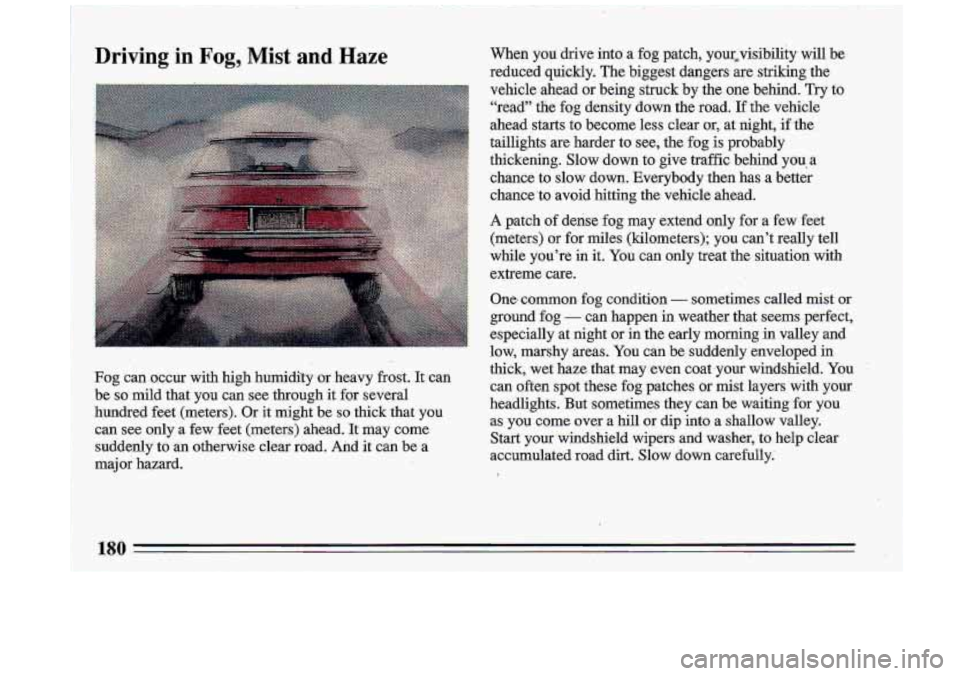
Fog can occur with high humidity or heavy frost. It can
be
so mild that- you can see through it for several
hundred feet (meters). Or-it might
he so thick .that you
can see only
a few feet (meters) ahead. It may come
suddenly
to an otherwise clear road. And it can be a
major hazard.
Page 183 of 340
Tips on Driving in Fog
If you get caught in fog, turn your headlights on low
beam, even in daytime. You’ll see
- and be seen -
better.
Pass other vehicles in fog only if you can see far enough
ahead to pass safely. Even then, be prepared to delay
your pass if you suspect the
fog.is worse up ahead. If
other vehicles try to pass you, make it easy for them.
*
If visibility is near zero and you must stop but are
unsuTe whether you are away
from the road, turn your
lights on, start
your hazard warning flasher, and sound
your
Born at intervals or when you hear approaching
traffic. One
of the
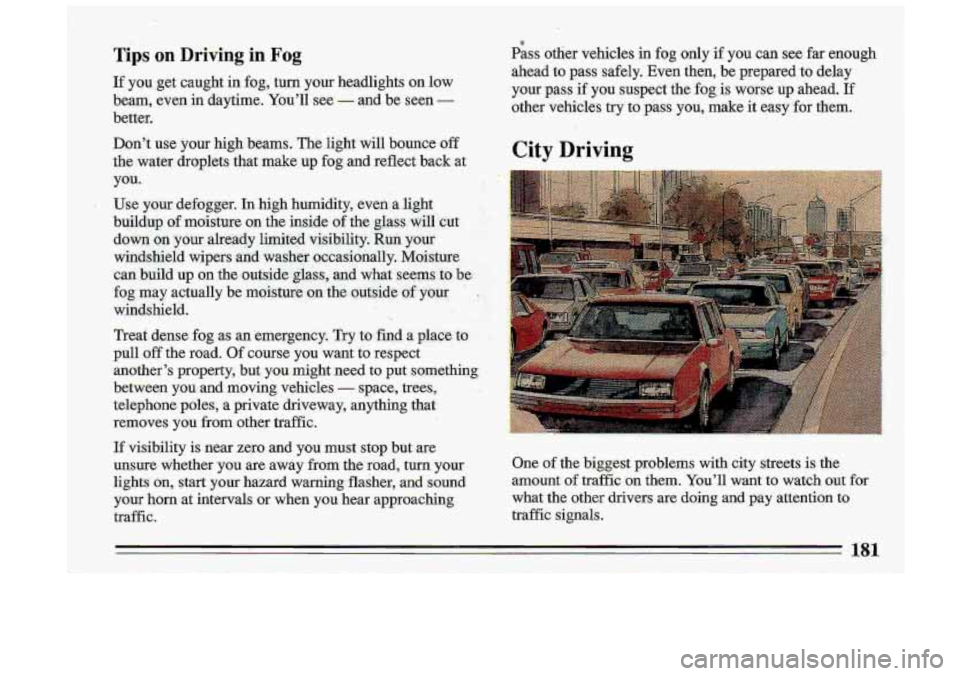
biggest problems with city streets is the
amount of traffic
on them. You’ll want to watch out for
what the other drivers are doing and pay attention
to
traffic signals.
181
Page 197 of 340
Run your engine only as long as you must. This saves
fuel. When you
run the engine, make it go a little faster
than just idle. That is, push the accelerator slightly. This:
uses less fuel for the heat that you get and it keeps the
battery charged.
You will need a well-charged battery to
restart the vehicle, and possibly for signaling later
on
with your headlights. Let the heater run for awhile.
Then, shut the engine
off and close the window almost
all the way to preserve the heat. Start the engine again
and repeat this only when you feel really uncomfortable
from the cold. But do
it as 'little as possible. Preserve the
fuel
as long as you can. To help keep warm, you can get
out of the vehicle and
do some fairly vigorous exercises
every half hour or
so until help comes.
Towing, a Trailer
/! CAUTION-
If you don't use the correct equipment and drive
properly, you can lose control when you
pull a
trailer.
For example, if the trailer is too heavy,
I the brakes may not work well - or even at all,
You and your passengers could be seriously'
injured. Pull
a trailer only if you have followed
I the steps in this section.
Page 201 of 340
Driving with a Trailer
Towing a trailer requires a certain amount of experience. Before setting out for the open road, you’ll want to get
to
know your rig. Acquaint yourself with the feel of
handling and braking. with the added weight of the
trailer. And always keep in mind that the vehicle you are
driving is now
a good deal longer and not nearly so
responsive as your vehicle is by itself.
Before you start, check the trailer hitch and platform,
safety chains, electrical connector, lights, tires and
mirror adjustment.
If the trailer has electric biakes, start
your yehicle and trailer moving and then apply the
trailer brake controller by hand to be sure the- brakes are
working. This lets you check your electrical connection
at the same time.
During your trip, check occasionally to
be sure that the
load
is secure, and that the Lights.and any trailer brakes
are .still working.
Following Distance
Stay at least twice as far behind the vehicle ahead as you
would when driving your vehicle without a trailer. This
can help
you avoid situations that require heavy braking
and sudden turris.
.
Passing
You’ll need. more passing distance up ahead when
you’re towing a trailer. And, because you’re a good deal \
longer, you’ll need to go much farther beyond the
.
passed vehicle before you can return to your lane.
Backing Up
Hold the bottom of the steering wheel with one hand.
Then, to move the trailer
to the left, just move that hand
to the left.
To mo.ve the trailer to the right, move your
hand to the right. Always back up slowly and, if
possible, have someone guide
you.
Making Turns
When you’re turning with a trailer, make wider turns
than normal.
Do this so your trailer won’t strike soft
shoulders, curbs, road signs, trees, or other objects.
Avoid jerky or sudden maneuvers. Signal well in
advance.
Turn Signals When Towing a Trailer
When you tow a trailer, your vehicle has to have .a
different turn signal flasher and extra wiring. The green
arrows on your instrument panel will
flash whenever
you signal a
turn or lane change. Properly hooked up,
199