1993 BUICK ROADMASTER brakes
[x] Cancel search: brakesPage 172 of 340
Try to adjust‘ your speed so you can “drive” through the
curve. Maintain a reasonable, steady speed. Wait to
accelerate until you are out
of the curve, and then
accelerate gently
into the straightaway.
When you drive into a curve at night, it’s harder to see
the road ahead
of you because it bends away from the
straight beams
of your lights. This is one good reason. to
drive slower.
Steering in Emergencies
There are times when steering can be more effective
than braking. For example, you come over a hill and
find a truck stopped
in your lane, or a car suddenly pulls
out
f-rom nowhere, or a child darts out from between
parked
cars and stops right in front of you. You can
avoid these problems by braking
- if you can stop in
time. But sometimes you can’t; there isn’t room. That’s\
the time for evasive action
- steering around the
problem.
Your Buick can perform very well in emergencies like
these. First apply your brakes. It is better to remove as
much speed as you can
from a possible collision. Then
steer around the problem, to the left
or right depending
on the space available,
Page 180 of 340
The heavier the rain, the harder it is to see. nven if your
windshield wiper blades are in good shape, a heavy rain
,can make it harder to see road signs and traffid. signals, .
pavement markings, the edge of the road, and even
people walking. Road spray can often be worse for
vision than rain, especially if it
comes frum a dirty road.
So it is wise to keep your wiping equipment in good i.
shape and :keep your windshieklwasher tank filled.
Replace
your windshield' wiper inserts when 'they' show
signs
.of streaking-or missing areas on the windshield, or
when strips
of rubber start to separate from the inserts. Driving,
too fast through large water puddles or even
going through some car washes can cause problems,
too.
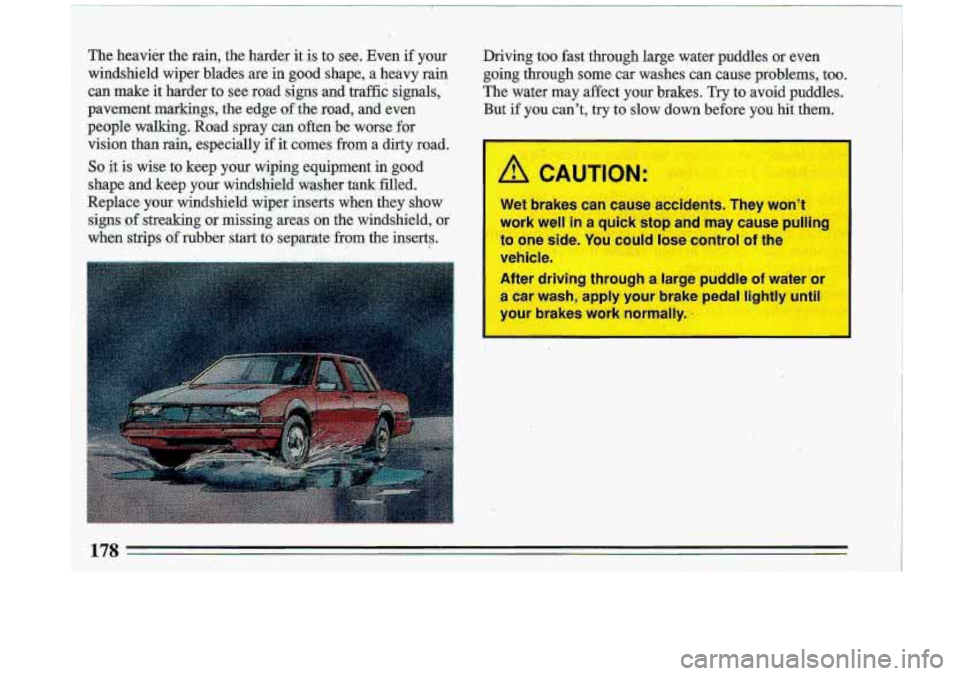
The water may affect your brakes. Try to avoid puddles.
But
if you can't, try to slow down before you hit them.
A I
,A CA JTION:
Wet brakes can cause accidents. They won't
work well in a quick stop and may cause pl ng
to one side.
Yo Zould lo! eo - *oI of -- 3
vehicle.
After driving thro
-=-- -i la.,e p-Jdle 0. ,later
a car wash, apply your brake aedal liahtly unt
1 Iur brakes work normal
178
Page 188 of 340
Driving on steep hills or mountains is different from
driving in
flat or rolling terrain.
' A CAUTION:
If you don't shift down, your brakes could get
o hot that they wouldn't work well. You wou.,
..len have
poor braking or even none going
. down a hill. You could crash. Shift dowr tn Ifit
,our engine assist vnur brakes on a stec,
down hill slope.
If you drive regularly in steep country, or if you're - - -
planning-to visit there, here are some tips that can make
your
trips safer and more enjoyable.
Page 194 of 340
D.riving on Snow or Ice What’s the worst time for this? “Wet ice.” Very cold
snow or ice c.an be slick and hard to drive
on, But wet
ice can be even more’trouble because it may offer
the.
leait traction of all. You can get “wet ice” when’ it’s , ’
about freezing (3ZoF..O0C) and freezing rain begins to
fail. Try to avoid driving on we1 ice until salt and sand
crews can get there.
,.
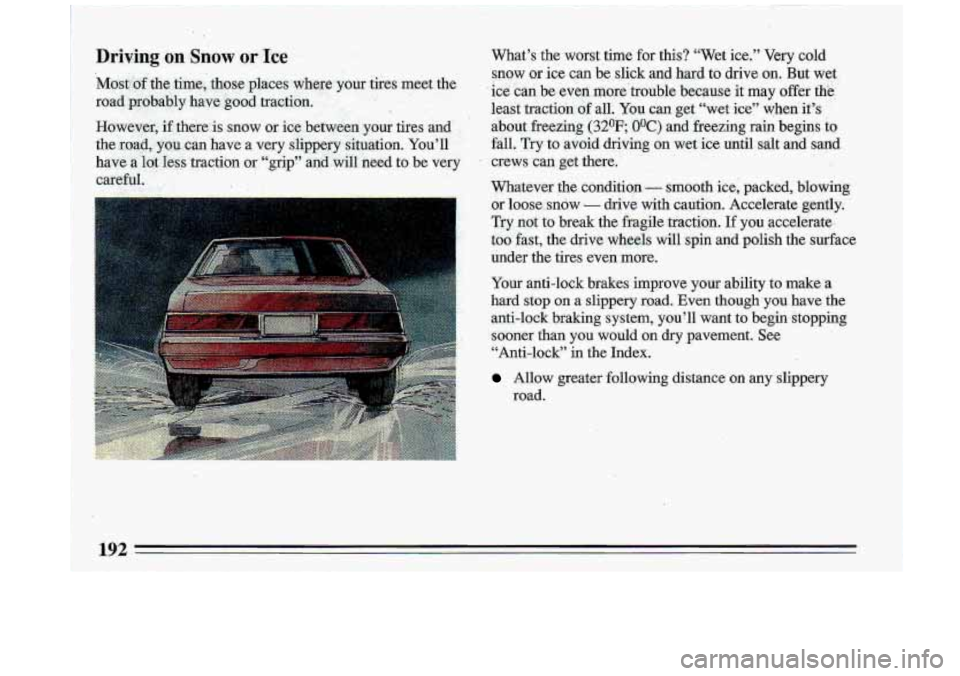
Whatever the conditio,n - smooth ice, packed, blowing
or loose. snow
.- drive with caution. Accelerate gently.
Try .not
to break the fragile traction. If you accelerate,,
too fast, the drive wheels will spin and polish the surface
under the tires even more.
Your anti-lock brakes improve your ability to make. a
hard stop on a slippery road. Even though you have the
anti-lock braking system, you’ll want to begin-stopping
sooner than you would on dry pavement. See “Anti-lock” in the Index.
Allow greater following distance on any slippery
road.
Page 197 of 340
Run your engine only as long as you must. This saves
fuel. When you
run the engine, make it go a little faster
than just idle. That is, push the accelerator slightly. This:
uses less fuel for the heat that you get and it keeps the
battery charged.
You will need a well-charged battery to
restart the vehicle, and possibly for signaling later
on
with your headlights. Let the heater run for awhile.
Then, shut the engine
off and close the window almost
all the way to preserve the heat. Start the engine again
and repeat this only when you feel really uncomfortable
from the cold. But do
it as 'little as possible. Preserve the
fuel
as long as you can. To help keep warm, you can get
out of the vehicle and
do some fairly vigorous exercises
every half hour or
so until help comes.
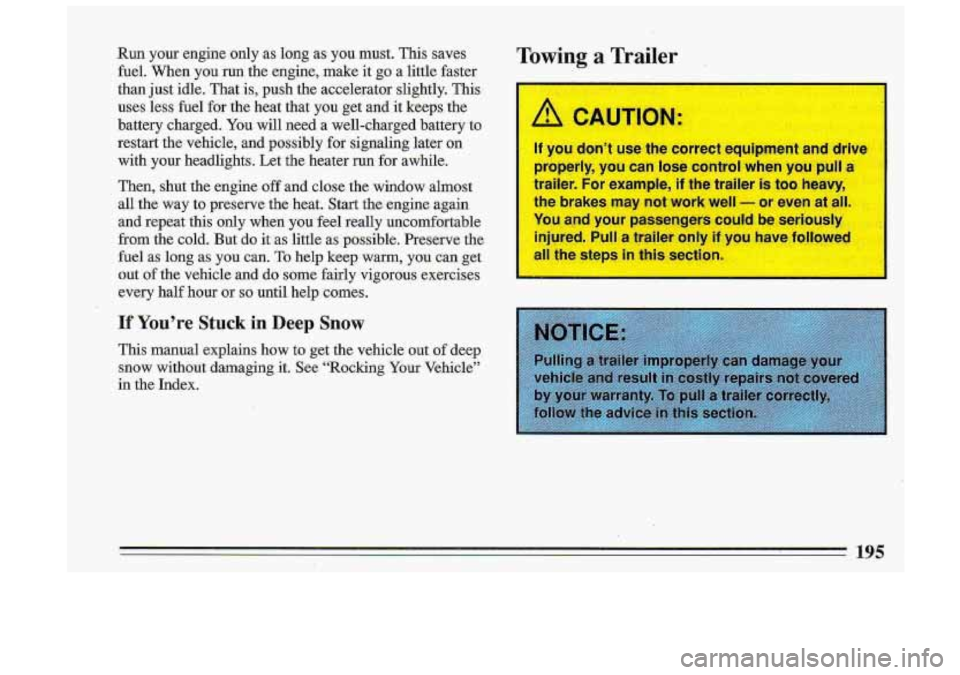
Towing, a Trailer
/! CAUTION-
If you don't use the correct equipment and drive
properly, you can lose control when you
pull a
trailer.
For example, if the trailer is too heavy,
I the brakes may not work well - or even at all,
You and your passengers could be seriously'
injured. Pull
a trailer only if you have followed
I the steps in this section.
Page 200 of 340
Total Weight on Your Vehicle’s Tires
Be sure your vehicle’s tires are inflated to the limit for
cold tires. You’ll find these numbers on the Certification
label at the rear edge
of the driver’s doqr (or see “Tire
Loading” in the Index). Then be sure you don’t go over
the
GVW limit for your vehicle.
Hitches
It’s important to have the correct hitch equipment.
Crosswinds, large trucks going by, and rough roads are
a
few reasons why you’ll need the right hitch. Here are
some rules to follow:
0
0
If you’ll be pulling a trailer that, when loaded, will
weigh more than
2,000 pounds (900 kg), be sure to
use a properly mounted, weight-distributing hitch
and sway control of the proper size. This equipment
is very important for proper vehicle loading and
good handling when you’re driving.
Will you have to make any holes in the body of your
vehicle when you install
a trailer hitch? If you do,
then be sure to seal the holes later when you remove
the hitch. If you don’t seal them, deadly carbon
monoxide (CO) from your exhaust can get into your
vehicle (see “Carbon Monoxide” in the Index). Dirt
and water can, too.
The bumpers on your vehicle are not intended for
hitches.
Do not attach rental hitches or other
bumper-type hitches to them. Use only a
frame-mounted hitch that does not attach to the
bumper.
Safety Chains
You should always attach chains between your vehicle
and your trailer. Cross the safety chains under the
tongue of the trailer
so that the tongue will not drop to
the road
if it becomes separated from the hitch.
Instructions about safety chains may be provided by the
hitch manufacturer or by the trailer manufacturer.
Follow the manufacturer’s recommendation for
attaching safety chains. Always leave just enough slack
so you can turn with your rig. And, never allow safety
chains
to drag on the ground.
Trailer Brakes
If your trailer weighs more than 1,000 pounds (450 kg)
loaded, then it needs its own brakes
- and they must be
adequate. Be sure to read and follow the instructions for
the trailer brakes
so you’ll be able to install, adjust and
maintain them properly. Because you have anti-lock
brakes, do not try to tap into your vehicle’s brake
system.
If you do, both brake systems won’t work well,
or at all.
198
Page 201 of 340
Driving with a Trailer
Towing a trailer requires a certain amount of experience. Before setting out for the open road, you’ll want to get
to
know your rig. Acquaint yourself with the feel of
handling and braking. with the added weight of the
trailer. And always keep in mind that the vehicle you are
driving is now
a good deal longer and not nearly so
responsive as your vehicle is by itself.
Before you start, check the trailer hitch and platform,
safety chains, electrical connector, lights, tires and
mirror adjustment.
If the trailer has electric biakes, start
your yehicle and trailer moving and then apply the
trailer brake controller by hand to be sure the- brakes are
working. This lets you check your electrical connection
at the same time.
During your trip, check occasionally to
be sure that the
load
is secure, and that the Lights.and any trailer brakes
are .still working.
Following Distance
Stay at least twice as far behind the vehicle ahead as you
would when driving your vehicle without a trailer. This
can help
you avoid situations that require heavy braking
and sudden turris.
.
Passing
You’ll need. more passing distance up ahead when
you’re towing a trailer. And, because you’re a good deal \
longer, you’ll need to go much farther beyond the
.
passed vehicle before you can return to your lane.
Backing Up
Hold the bottom of the steering wheel with one hand.
Then, to move the trailer
to the left, just move that hand
to the left.
To mo.ve the trailer to the right, move your
hand to the right. Always back up slowly and, if
possible, have someone guide
you.
Making Turns
When you’re turning with a trailer, make wider turns
than normal.
Do this so your trailer won’t strike soft
shoulders, curbs, road signs, trees, or other objects.
Avoid jerky or sudden maneuvers. Signal well in
advance.
Turn Signals When Towing a Trailer
When you tow a trailer, your vehicle has to have .a
different turn signal flasher and extra wiring. The green
arrows on your instrument panel will
flash whenever
you signal a
turn or lane change. Properly hooked up,
199
Page 266 of 340
Replacing Brake System Parts
The braking system on a modem vehicle is complex. Its
many parts have to’ be of top quality and work. well
together if the vehicle is to have really good braking.
Vehicles we design and test have top-quality
GM brake
parts in them, as your: Buick, does when it is new. When
you replace parts
of your braking system - for
example, when.your brake linings wear down and you
have-to have
new ones put in - be sure you get new
genuine
GM replacement parts. If you don’t, your
brakes may no longer work properly. For example,
if
someone puts in brake linings that are wrong for your
vehicle, the balance between
your front and rear brakes
can change, for the worse.
The braking performance
you’ve come to expect can change
in many other ways
if someone puts in the wrong replacement brake parts.
Battery
Every new Buick has a,Delco Freedom@ battery. You
never have.to add water
to one of these. When it’s time
for a new battery, we recommend a Delco Freedom@
battery. Get one that has the catalog number shown
on
the original battery’s label.
Vehicle Storage,
If you’re not going to drive your vehicle for 25 days or
more, take
off the black, negative (-) cable from the
battery. This
will help keep your battery from running
down.
Batteries have acid that can burn you and gat
that can explode. You can be badly hurt
if you
aren’t careful. See “Jump Starting” in the lndl
for tips on working around a battery without getting hurt.
Contact your dealer to learn how to prepare your vehicle
for longer storage periods.
264 -