Page 186 of 324
Hazard Warning Flashers
c
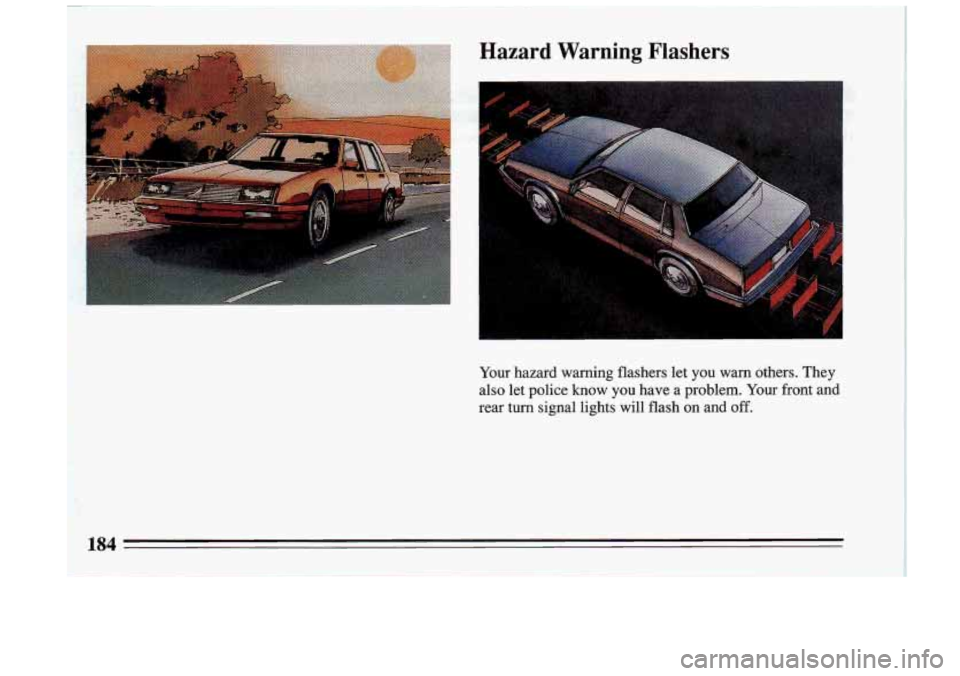
Your hazard warning flashers let you warn others. They
also let police know you have a problem. Your front and
rear turn signal lights will flash on and
off.
Page 187 of 324
I
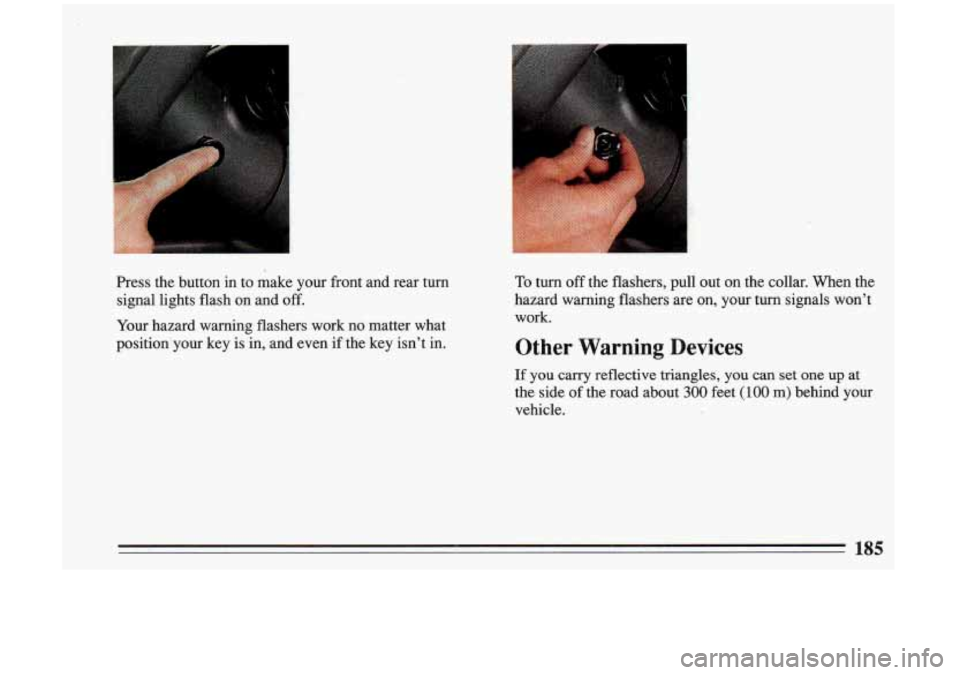
Press the button in to make your front and rear turn
signal lights flash on and
off.
Your hazard warning flashers work no matter what
position your key is in, and even
if the key isn't in.
To turn off the flashers, pull out on the collar. When the
hazard warning flashers are on, your
turn signals won't
work.
Other Warning Devices
If you carry reflective triangles, you can set one up at
the side
of the road about 300 feet (100 m) behind your
vehicle.
185
Page 198 of 324
Engine Overheating
You willi find a coolant temperature gage and the
warning light about a hot engine on your Buick
instrument panel.
If Steam Is Coming From Your Engine:
I
A CAUTION:
Steam from an overheated engine can burn you
badly, even if you just open the hood. Stay away
from the engine if you see or hear steam
coming from
it. Just turn it off and get everyone
away from the vehicle until
it cools down. Wait
until there is no sign of steam or coolant before
opening the hood.
If you keep driving when your engine is
overheated, the liquids in it can catch fire. You
or others could be badly burned. Stop your
engine if
it overheats, and get out of the vehicle
until the engine is cool.
If No Steam Is Coming From Your Engine:
If you get the overheat warning but see or hear no
steam, the problem may not be too serious. Sometimes
the engine can get a little too hot when you:
Climb a long hill on a hot day.
Stop after high speed driving.
Id.le for long periods in traffic.
If you get the overheat warning with no sign of steam,
try this for a minute or
so:
1. Turn off your air conditioner.
2. Turn on your heater to full hot at the highest fan
3. Try to keep your engine under load (in a drive gear
speed and open the window as necessary.
where the engine runs slower).
Page 214 of 324
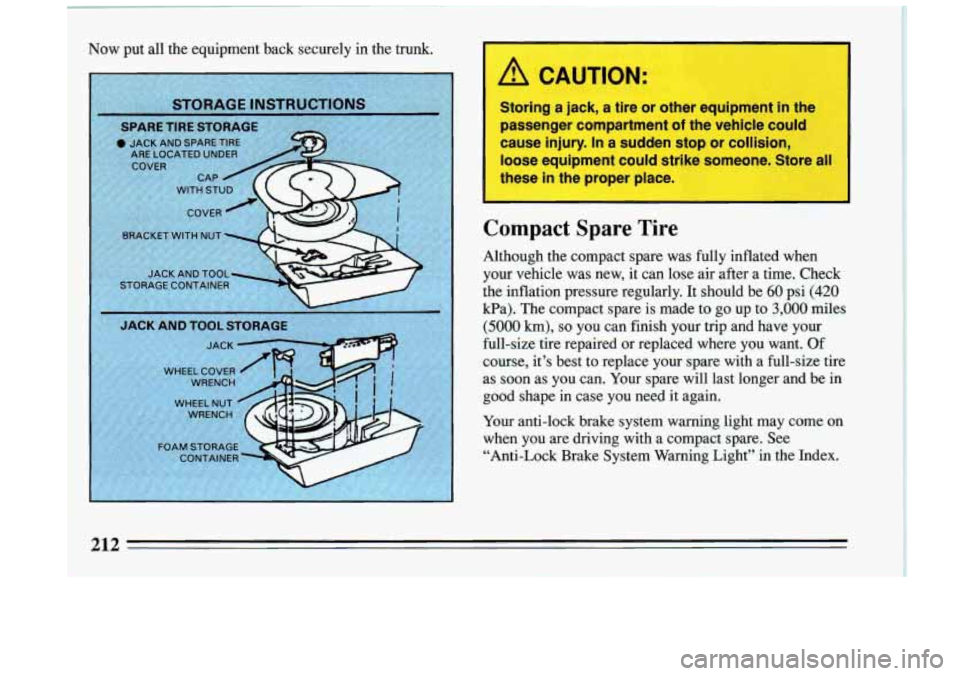
Now put all the equipment back securely in the trunk.
Compact Spare Tire
Although the compact spare was fully inflated when
your vehicle was new, it can lose air after a time. Check
the inflation pressure regularly. It should be
60 psi (420
kPa). The compact spare is made to go up to 3,000 miles
(5000 km), so you can finish your trip and have your
full-size tire repaired or replaced where you want.
Of
course, it’s best to replace your spare with a full-size ti\
re
as soon as you can. Your spare will last longer and be in
good shape in case you need it again.
Your anti-lock brake system warning light may come on
when you are driving with a compact spare. See
“Anti-Lock Brake System Warning Light” in the Index.
212
Page 233 of 324
are made especially for your automatic transaxle.
Damage caused by fluid other than
DEXRONs-IIE is
not covered by your new vehicle warranty.
After adding fluid, recheck the fluid level as
described under
“How to Check.”
When the correct fluid level is obtained, push the
dipstick back in all the way.
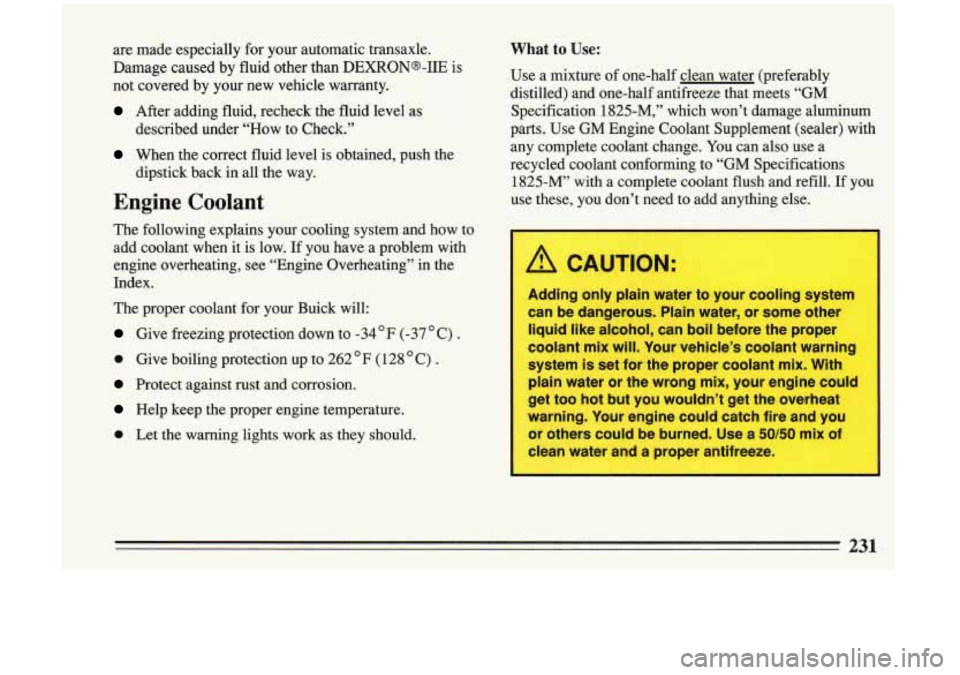
Engine Coolant
The following explains your cooling system and how to
add coolant when it is low. If you have a problem with
engine overheating, see “Engine Overheating” in the
Index.
The proper coolant for your Buick
will:
Give freezing protection down to -34’F (-37 ’ C) .
0 Give boiling protection up to 262 ’ F ( 128 ’ C) .
Protect against rust and corrosion.
Help keep the proper engine temperature.
0 Let the warning lights work as they should.
What to Use:
Use a mixture of one-half clean water (preferably
distilled) and one-half antifreeze that meets “GM Specification 1825-M,” which won’t damage aluminum
parts. Use GM Engine Coolant Supplement (sealer) with
any complete coolant change. You can also use a
recycled coolant conforming to “GM Specifications
1825-M” with a complete coolant flush and-refill.
If you
use these, you don’t need to add anything else.
Adding only plain water to your cooling system
can be dangerous. Plain water, or some other
liquid like alcohol, can boil before the proper
coolant mix will. Your vehicle’s coolant warnin!
system
is set for the proper coolant mix. With
plain water or the wrong mix, your engine coul
get
too hot but you wouldn’t get the overheat
warning. Your engine could catch fire and you
or others could be burned. Use a
50150 mix of
clean water and
a proper antifreeze.
231
Page 238 of 324
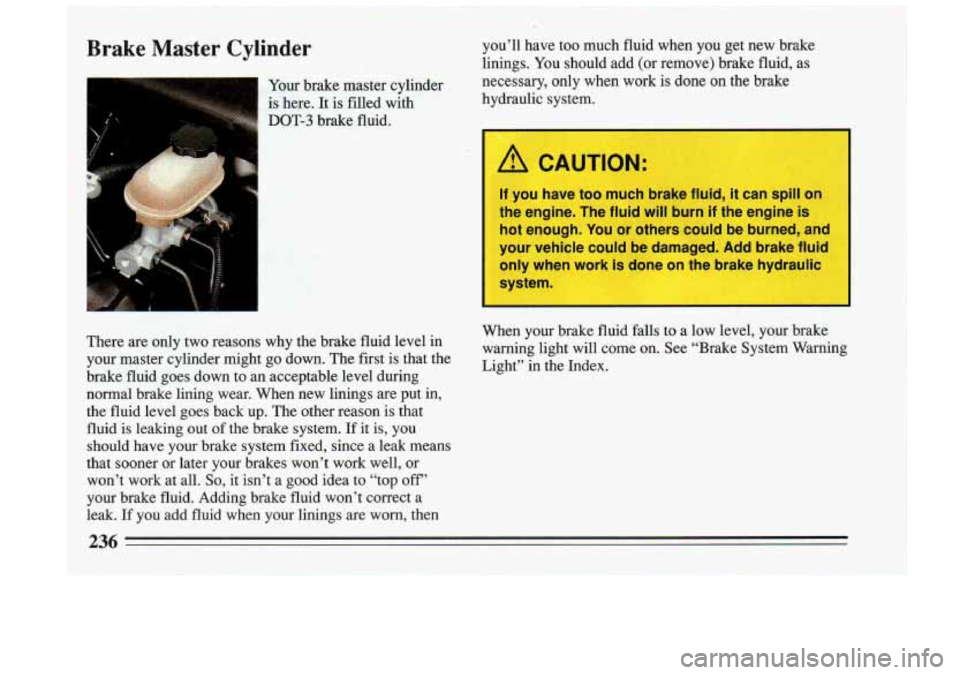
Brake Master Cylinder you’ll have too much fluid when you get new brake
linines. You should add (or remove) brake fluid, as
U
your brake master cylinder necessary, only when work is done on the brake
is here. It is filled with hydraulic system.
DOT-3 brake fluid.
I
I
A CAUTION:
If you have too much brake fluid, it can spill on
the engine. The fluid will burn
if the engine is
hot enough. You or others could be burned,
arr’
your vehicle could be damaged. Add brake flutu
only when work is done on the brake hydraulic
system.
When your brake fluid falls to a low level, your brake
There are only two reasons why the brake fluid level in light will on. See System Warning
your master cylinder might go down. The first is that the Light,’ in the Index,
brake fluid goes down to an acceptable level during
normal brake lining wear. When new linings are put in,
the fluid level goes back
up. The other reason is that
fluid ’is leaking out of the brake system. If it is, you
should have your brake system fixed, since a leak means
that sooner or later
your brakes won’t work well, or
won’t work at all.
So, it isn’t a good idea to “top off’
your brake fluid. Adding brake fluid won’t correct a
leak. If you add fluid when your linings are worn, then
236
Page 269 of 324
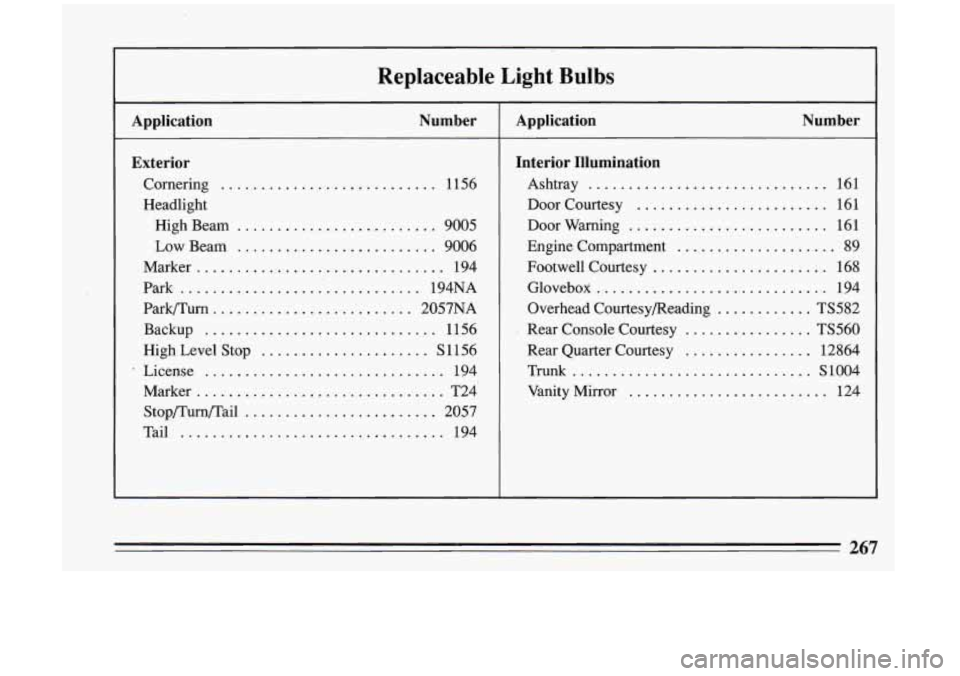
Replaceable Light Bulbs
Application Number
Exterior
Cornering ........................... 1156
Headlight
High Beam
......................... 9005
Low Beam ......................... 9006
Marker
............................... 194
Park
.............................. 194NA
Park/Turn
......................... 2057NA
Backup
............................. 1156
High Level Stop
..................... S1156
. License ............................... 194
Marker
............................... T24
Stop/Turn/Tail
........................ 2057
Tail
................................. 194
Application Number
Interior Illumination
Ashtray .............................. 161
DoorCourtesy
........................ 161
Door Warning ......................... 161
Engine Compartment
..................... 89
Footwell Courtesy
...................... 168
Glovebox
............................. 194
Overhead Courtesy/Reading
............ t5582
Rear Console Courtesy ................ t5560
Rear Quarter Courtesy ................ 12864
Trunk
.............................. 51004
Vanity Mirror ......................... 124
Page 287 of 324
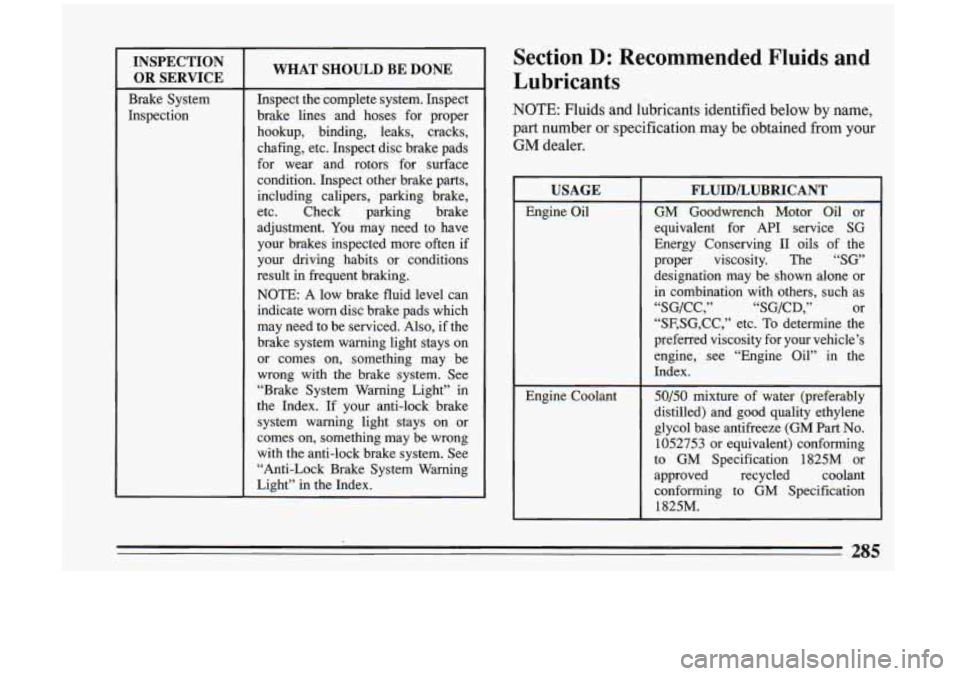
INSPECTION OR SERVICE
Brake System
Inspection
WHAT SHOULD BE DONE
Inspect the complete system. Inspect
brake lines and hoses for proper
hookup, binding, leaks, cracks,
chafing, etc. Inspect disc brake pads
for wear and rotors for surface
condition. Inspect other brake parts, including calipers, parking brake,
etc. Check parking brake
adjustment. You may need to have
your brakes inspected more often if
your driving habits or conditions
result in frequent braking.
NOTE: A low brake fluid level can
indicate worn disc brake pads which
may need to be serviced. Also, if the
brake system warning light stays on
or comes on, something may be
wrong with the brake system. See
“Brake System Warning Light” in
the Index. If your anti-lock brake
system warning light stays on or
comes
-on, something may be wrong
with the anti-lock brake system. See “Anti-Lock Brake System Warning
Light” in the Index.
Section D: Recommended Fluids and
Lubricants
NOTE: Fluids and lubricants identified below by name,
part number or specification may be obtained from your
GM dealer.
USAGE
Engine Oil
Engine Coolant
FLUID/LUBRICANT
GM Goodwrench Motor Oil or
equivalent for API service SG
Energy Conserving
I1 oils of the
proper viscosity. The
“SG’
designation may be shown alone or
in combination with others, such as
“SG/CC,” “SG/CD,” or
“SF,SG,CC,” etc. To determine the
preferred viscosity for your vehicle’s
engine, see “Engine Oil” in the
Index.
50/50 mixture of water (preferably
distilled) and good quality ethylene
glycol base antifreeze
(GM Part No.
1052753 or equivalent) conforming
to GM Specification 1825M
or
approved recycled coolant
conforming to GM Specification
1825M.
285