Page 175 of 324
There is something about an easy stretch of road with
the same scenery, along with the hum of the tires on the
road, the drone of the engine, and the
rush of the wind
against the vehicle that can make you sleepy. Don't let it
happen to you! If it does, your vehicle can leave the
road in less than a second. and you could crash and be
injured.
What can you do about highway hypnosis? First, be
aware that
it can happen.
Then here are some tips:
0 Make sure your vehicle is well ventilated, with a
comfortably cool interior.
0 Keep your eyes moving. Scan the road ahead and to
the sides. Check your rearview mirrors frequently
and your instruments from time to time. This can
help you avoid a fixed stare.'
Wear good sunglasses in bright light. Glare can
cause drowsiness. But don't wear sunglasses at
night. They will drastically reduce your overall vision at the very time you need all the seeing power
you have.
If you get sleepy, pull off the road into a rest, service,
or parking area and take a nap, get some exercise, or
both. For safety, treat drowsiness on the highway as
an emergency.
As in any driving situation, keep pace with traffic and
allow adequate following distances.
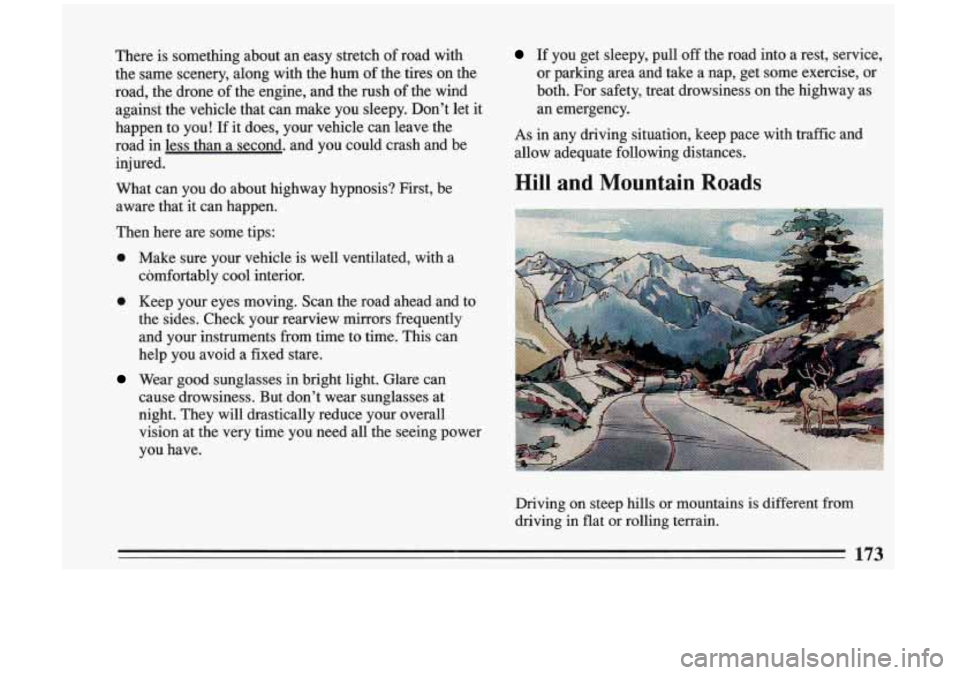
Hill and Mountain Roads
Driving on steep hills or mountains is different from
driving in flat or rolling terrain.
'I
173
Page 192 of 324
I ‘I
I 1
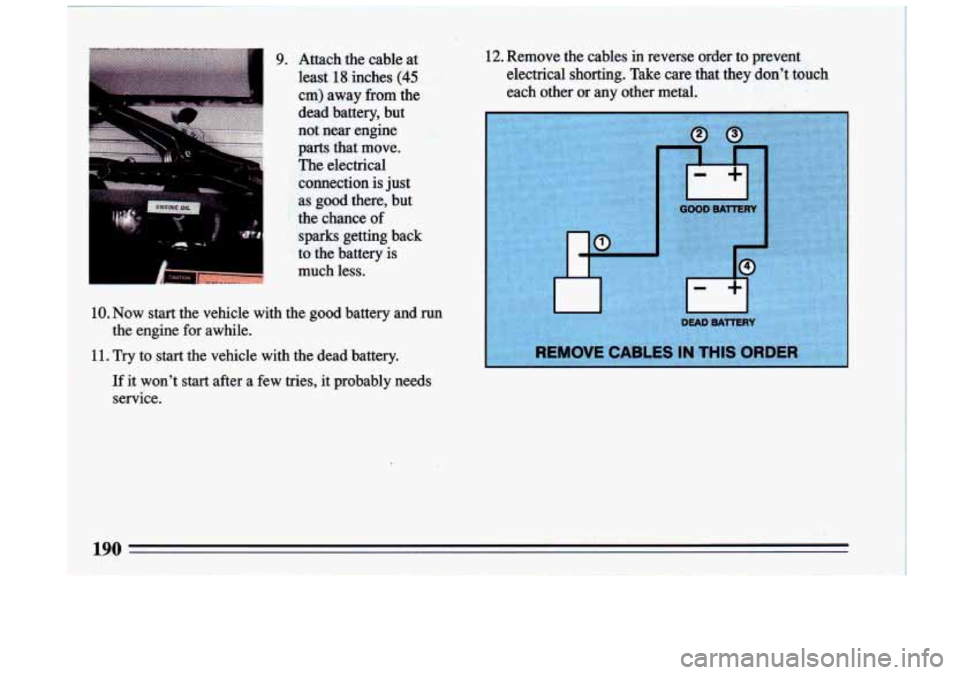
9. Attach the cable at least
18 inches (45
cm) away from the
dead battery, but
not near engine
parts that move.
The electrical
.connection is just
as good there,, but
‘the. chance of
sparks. getting back
to the battery is
much less.
.. 10. Now start the vehicle with the good battery and run
11. Try to start the vehicle with the dead battery.
the engine for awhile.
If it won’t
start after
a few tries, it probably needs
service.
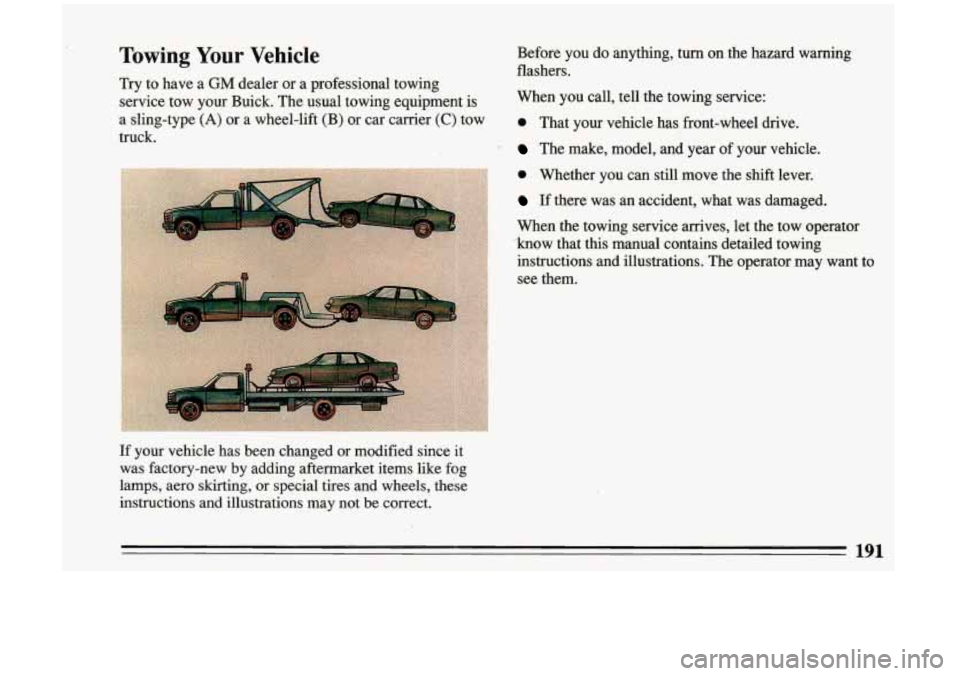
12. Remove the cables in reverse order to prevent
electrical shorting. Take care that they don’t touch
each other or any other metal.
Page 193 of 324
Towing Your Vehicle Before you do anything, turn on the hazard warning
flashers.
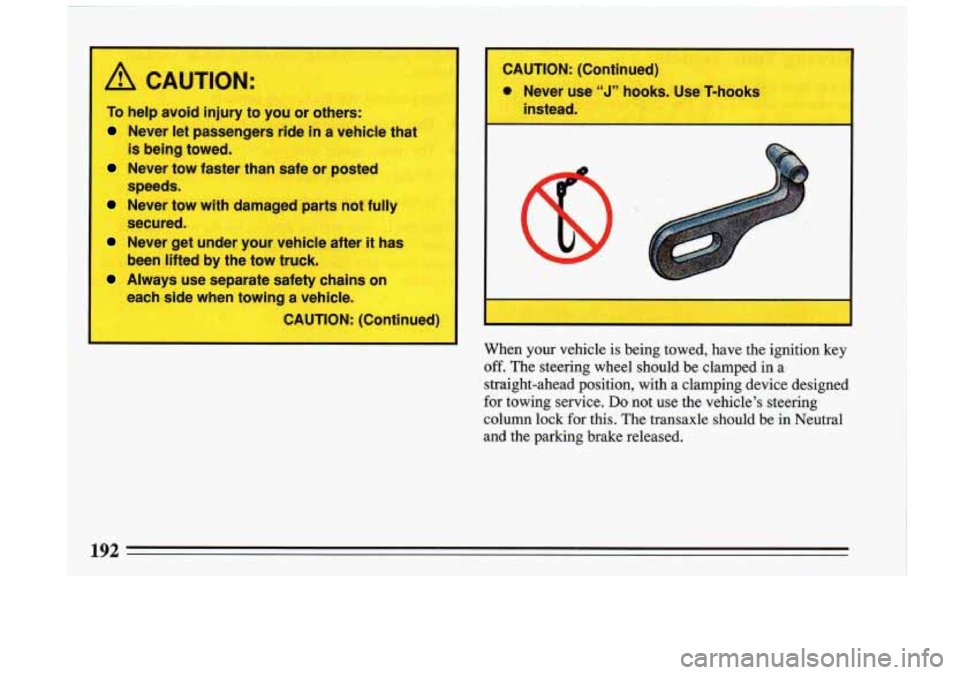
Try to have a
GM dealer or a professional towing
service tow your Buick. The usual towing equipment is When you call, tell the towing service:
a sling-type
(A) Or a wheel-lift (B) Or Car carrier (c) tow 0 That your vehicle has front-wheel drive.
truck.
. The make, model, and year of your vehicle.
If your ‘vehicle has been changed or modified since it
was factory-new by adding aftermarket items like fog
lamps, aero skirting,
or special tires and wheels, these
instructions and illustrations may not be correct.
0 Whether you can still move the shift lever.
If there was an accident, what was damaged.
When the towing service arrives, let the tow operator
-know that this manual contains detailed towing instructions and illustrations. The operator may want to
see them.
191
Page 194 of 324
/! CA TlON:
To help-avok rjury to you or others:
Never let passengers ride in a vehicle that I
Never tow fastt than safe or postec
Never tow ith damaged parts not fully
Never get under your vehicle after it has
Always use separate safety chains on
is being towed.
speec
secured.
been lifted by the tow truck.
each.side when towing a vehicle.
CAUTION: (Continued)
CAUTION: (Continued)
0 Never use “J” hooks. Use T-hooks
instead.
When your vehicle is being towed, have the ignition key off. The steering wheel should be clamped in a.
straight-ahead position, with a clamping device designed
for towing service.
Do not use the vehicle’s steering
column lock for this. The transaxle should be in Neutral
and the parking brake released.
192
Page 199 of 324
If you no longer have the overheat warning, you can
drive. Just to be safe, drive slower for about ten minutes.
If the warning doesn't come back on, you can drive
normally.
If~the warning continues, pull over, stop, and park your
vehicle right away.
If there's still no
sign of steam, you can idle the engine
for two or three minutes while you're parked, to see
if
the warning stops. But then, if you still have the
warning,
TURN OFF THE ENGINE AND GET
EVERYONE OUT
OF THE VEHICLE until it cools
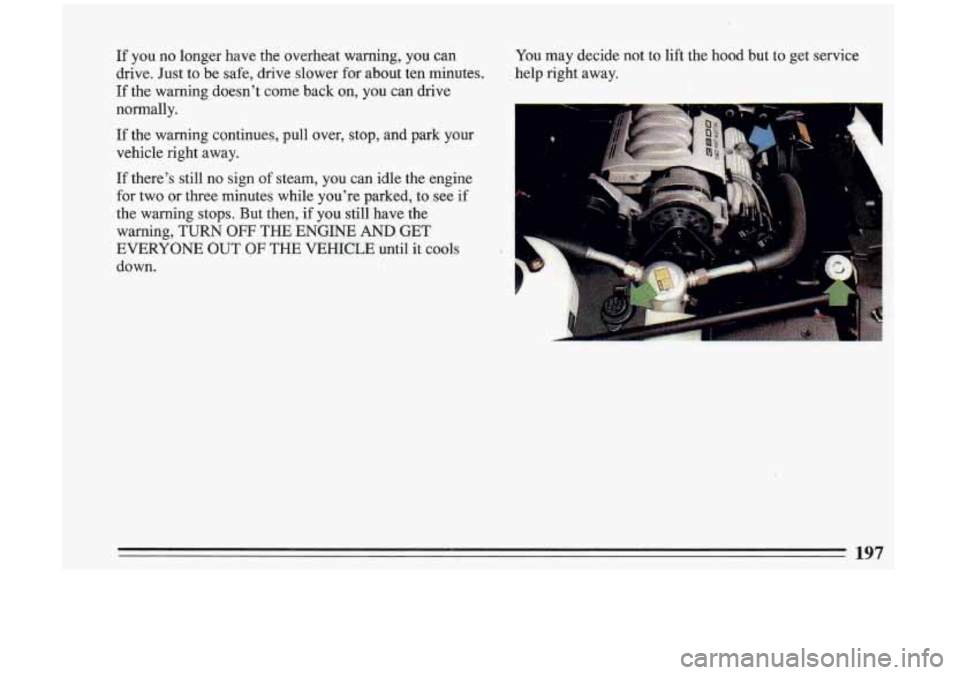
down. You may
decide not to lift the hood but to get service
help right away.
197
Page 218 of 324
A CAUTION: I
You can be injured if you try to do service work
on a vehicle without knowing enough about
it. I
@ Be sure you have sufficient knowledge,
experience, and the proper replacement
parts and tools before you attempt any
Be sure to use the proper nuts, bolts and
other fasteners. "English" and "metric"
fasteners can be easily confused.
If you
use the wrong fasteners, parts
can later
break or fall
off. You could be hurt. $$g?$&$
~~~
vehicle maintenance task. gg@b%j.g ,;.. ,F!(7>>p I &. @fijy+; &~-*.,~<+@ %,.,!+:<$$
"Vil
."C.L.. .
Page 219 of 324
Fuel
Use regular unleaded gasoline rated at 87 octane or
higher: It should meet specifications ASTM D4814 in
the U.S. and CGSB 3.5.92 in Canada. These fuels
should have the proper additives,
so you should not have
to add anything to the fuel.
Use regular unleaded gasoline rated at 87 octane or
higher. It should meet specifications ASTM D4814 in
the U.S. and CGSB 3.5-92 in Canada. These fuels should have the proper additives,
so you should not have
to add anything to the
fuel.
In the U.S. and Canada, it’s easy to be sure you get the
right kind of gasoline (unleaded). You’ll see
“UNLEADED” right on the pump. And only unleaded
nozzles will fit into your vehicle’s filler neck.
Be sure the posted octane
is at least 87. If the octane is
less than
87, you may get a heavy knocking noise when
you drive. If it’s bad enough,
it can damage your engine.
If you’re using fuel rated at 87 octane or higher and you
still hear heavy knocking, your engine needs service.
But don’t worry if you hear a little pinging noise when
you’re accelerating or driving up a hill. That’s normal,
and you don’t have to buy a higher octane fuel to get rid
of pinging. It’s the heavy, constant knock that means
you have a problem. What about gasoline with blending materials that
contain oxygen, such as MTBE or alcohol?
MTBE is “methyl tertiary-butyl ether.” Fuel that is no
more than 15% MTBE is fine for your vehicle.
Ethanol
is ethyl or grain alcohol. Properly-blended fuel
that is no more than
10% ethanol is fine for your
vehicle.
Methanol is methyl or wood alcohol.
217
Page 220 of 324
I
Gasolines for Cleaner Air
Your use of gasoline with detergent additives will help
prevent deposits from forming in your engine and fuel
system. That helps keep your engine in tune and your
emission control system working properly. It’s good €or
your vehicle, and you’ll be doing your part for cleaner
air.
Many gasolines are now blended with materials called oxygenates. General Motors recommends that you use
gasolines with these blending materials, such as MTBE
and ethanol. By doing
so, you can help clean the air,
especially in those parts
of the country that have high
carbon monoxide levels.
In addition, some gasoline suppliers are now producing
reformulated gasolines. These gasolines are specially
designed to reduce vehicle emissions. General Motors
recommends that you use reformulated gasoline. By
doing
so, you can help clean the air, especially in those
parts of the country that have high Ozone levels.
You should ask your service station operators if their
gasolines contain detergents and oxygenates, and if they
have been reformulated
to reduce vehicle emissions.
Fuels in Foreign Countries
If you plan on driving in another country outside the
U.S. or Canada, unleaded fuel may be hard to find. Do
not use leaded gasoline. If you use even one tankful,
your emission controls won’t work well or at all. With
continuous use, spark plugs can get fouled, the exhaust system can corrode, and your engine oil can deteriorate
quickly. Your vehicle’s oxygen sensor will be damaged.
All of that means costly repairs that wouldn’t be covered
by your warranty.
To check on fuel availability, ask an auto club, or
contact a major oil company that does business in the
country where you’ll be driving.
You can also write us at the following address for
advice. Just tell us where you’re going and give your
Vehicle Identification Number
(VIN).
General Motors of Canada Ltd.
International Export Sales
P.O. Box 828
Oshawa, Ontario L1H 7N1, Canada
218