Page 198 of 308
Youlean be burned if you spill coolant on hot
engine parts. Coolant contains ethylene glycol
-d it wiil burn if the engine parts are hot
ough. Don't spill
coolant -on a hot engine.
,- '
.Steam and scalding liquids- from a hot 'bootin!,
system can btow o.ut and burn you badly. They
are under pressure,..and.
if you turn the. radiatr-
pre,ssure cap
- even a little - they can come brl
cooling system, including the, radiator pressye
When the coolant in the coolant recovery tank is at or cap, is hot. Wait for the cooling system'and
above "COLD," start your vehicle. radiator pressure cap to cool if:you-ever have to
If the overheat warning continues, there's one more -turn the pressure cap.
thing you can try. You can add the proper coolant mix 3
directly to the radiator, but be sure the cooling system is
cool before you do it.
- at high speed. Never turn,the cap'when the+;:.::
-, .I
I
196
ProCarManuals.com
Page 199 of 308
x 8
ir
..-,
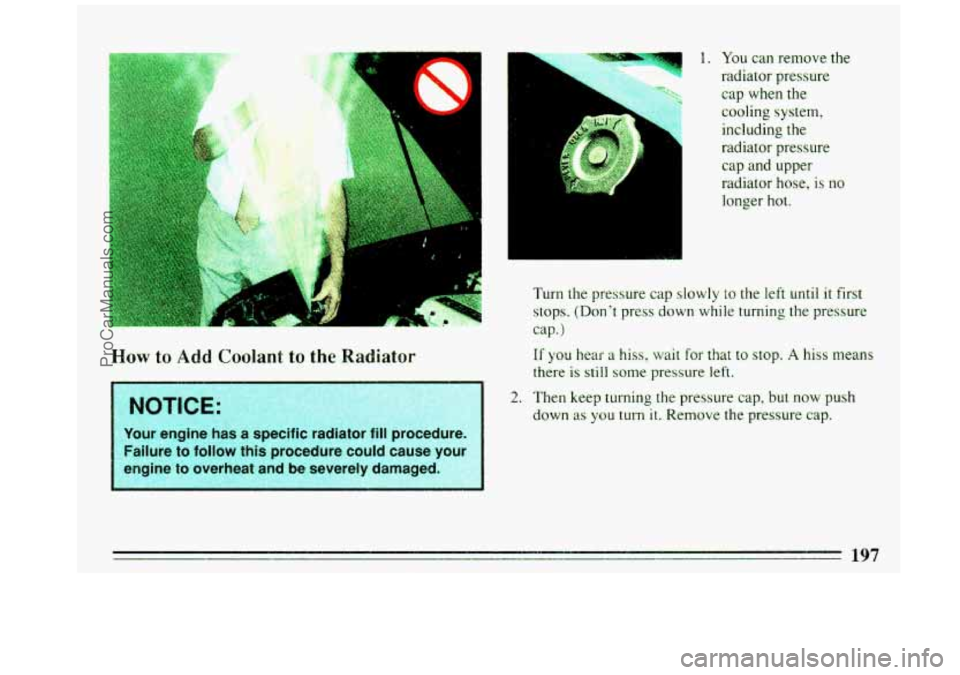
How to Add Coolant to the Radiator
7 1. You can remove the
radiator pressure
cap when
the
cooling system,
including the
radiator pressure
cap and upper
radiator hose, is
no
longer hot.
Turn the pressure cap slowly to the left until it first
stops. (Don't press down while turning the pressure
If you heal- a hiss, wait for that to stop. A hiss means
there
is still some pressure left.
cap.)
197
ProCarManuals.com
Page 200 of 308
..
1 CAI L
L YOU can De Durnea IT
engine parts. Coola
and it will burn if the engine parts are hot
enough. Don't spill coolant
on a hot engin
ji
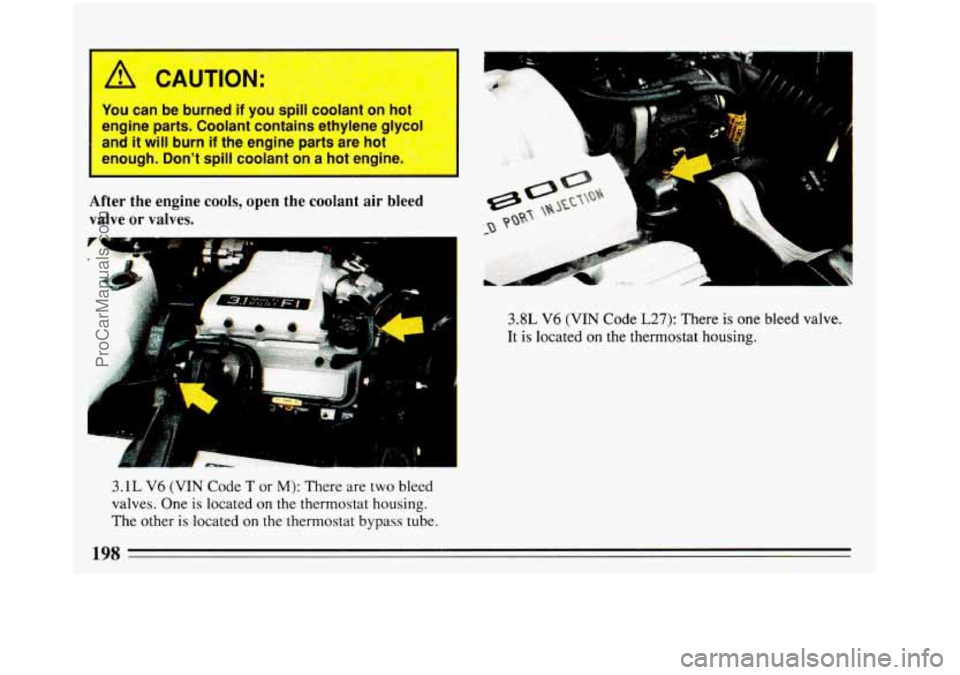
After the engine cools, open the coolant air bleed
valve or valves.
r
3.8L V4 (VIN Code L27): There is one bleed valve.
It is located on the thermostat housing.
.EI.r,
3.1L V6 (VIN Code T or M): There are two bleed
valves. One
is located on the thermostat housing.
The other
is located on the thermostat bypass tube.
ProCarManuals.com
Page 201 of 308
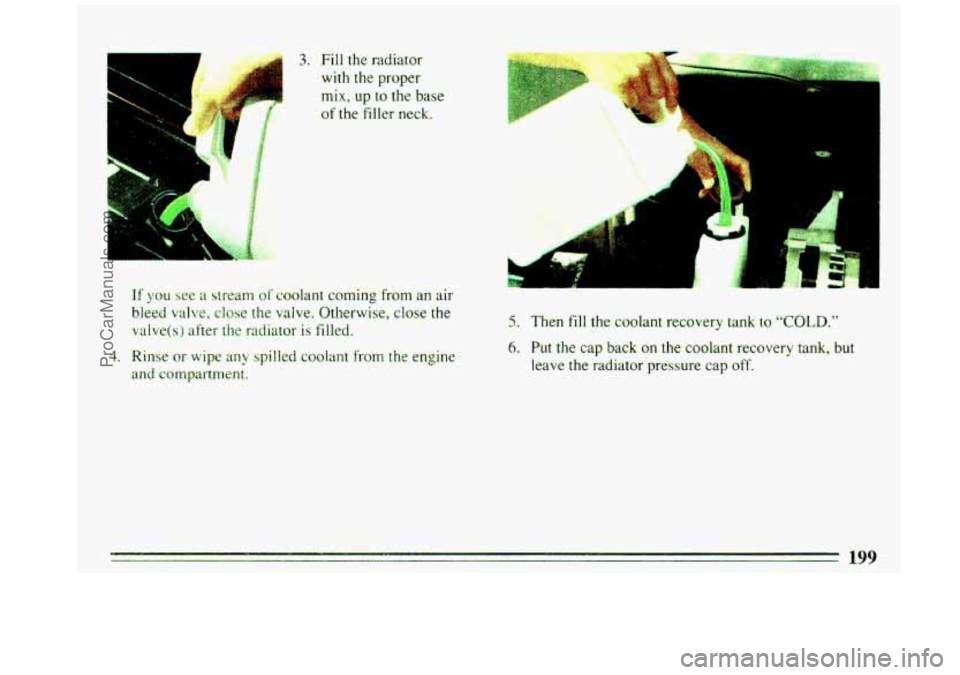
3. Fill the radiator
with the proper
mix,
up to the base
of the filler neck.
If you see a stream of coolant coming from an air
bleed
valve, close the valve. Otherwise, close the
valve(s) after the radiator is filled.
4. Rinse or wipe any spilled coolant nom the engine
and compartment.
5. Then fill the coolant recovery tank to "COLD."
6. Put the cap back on the coolant recovery tank, but
leave the radiator pressure
cap off.
ProCarManuals.com
Page 202 of 308
I.
1
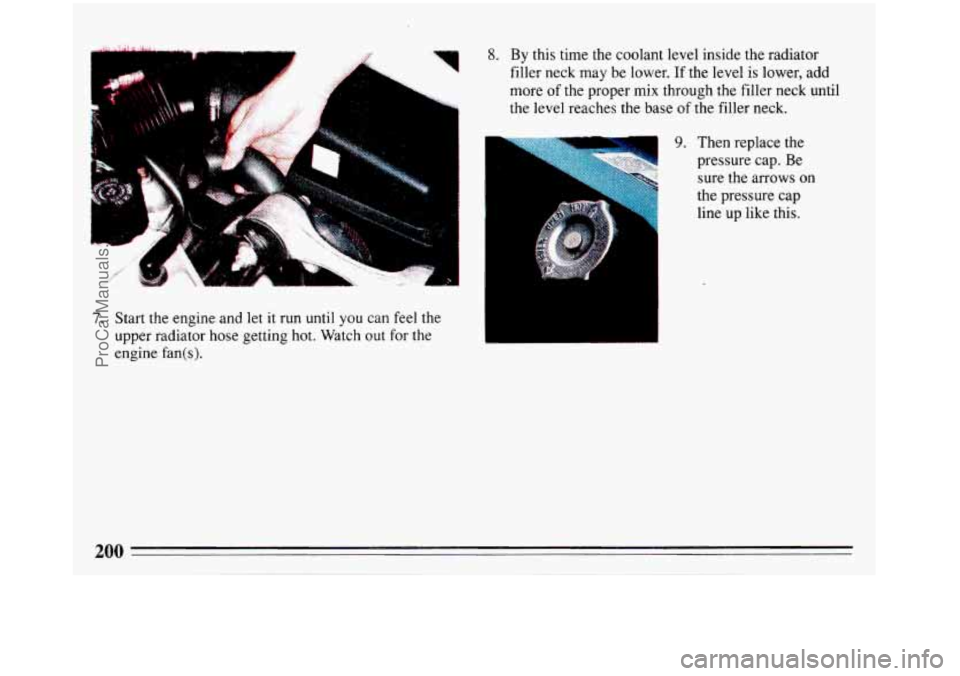
7. Start the engine and let it run until you can feel the
upper radiator hose getting hot. Watch out for the
engine fan(s).
8. By this time the coolant level inside the radiator
filler neck may be lower.
If the level is lower, add
more of the proper mix through the filler neck until
the level reaches the base
of the filler neck.
w 9. Then replace the
pressure cap. Be sure the arrows on
the pressure cap .. .L. ' .
line up like this.
200
.-
ProCarManuals.com
Page 215 of 308
Part 6 Service And Appearance Care
vehicle, and a section devoted to its appearance care.
Part
6 includes:
ServiceTips
...................................................................... 214
Fuel ........................................................................\
.....
HoodRelease ..................................................................... 218
EngineOil ....................................................................... \
AirCleane r.. ..................................................................... 225
Automatic Transaxle Fluid ...........................................................
Enginecoolant .................................................................... 228
Power Steering Fluid .......................... % ....................................
Windshield Washer Fluid ............................................................ 232
Brakes ........................................................................\
...
Battery ........................................................................\
.. 235
BulbReplacement ................................................................. 236
LoadingYourVehicle ...............................................................
Tires ........................................................................\
....
Appearancecare ..................................................................
Vehicle Identification Number (VIN) ..................................................
FusesandCircuitBreakers ........................................................... 257
Capacities and Specifications ......................................................... 263
ProCarManuals.com
Page 221 of 308
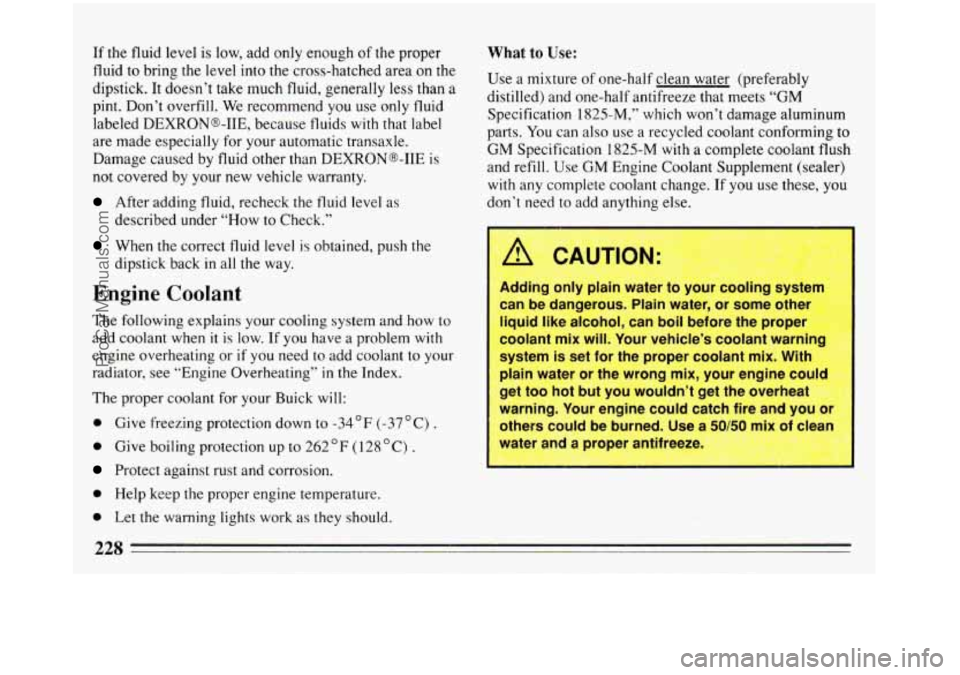
,. ;, ., ,:,’:*< ,. j ;;.*g .;,;.a> -*:~:inh Then go to the front of the
vehicle and release the
secondary hood release.
Lift the hood.
4 CAUTION:
An electric fr ~- der the hood can start up and
. jure you even when the engine is not running.
Keep hands, clothing and tools away from any
underhood electric
fr-
I
c1
A CAUTION:
Things that burn can get on hot engine parts and
start
a fire. These include liquids like gasoline,
oil, coolant, brake fluid, windshield washer and
other fluids, and plastic or rubber. You
or others
could be burned. Be careful not to drop
or spill
1 things that will burn onto a hot engine.
219
ProCarManuals.com
Page 230 of 308
If the fluid level is low, add only enough of the proper
fluid to bring the level into the cross-hatched area on the
dipstick. It doesn’t take much fluid, generally less than a
pint. Don’t overfill. We recommend you use only fluid
labeled DEXRONB-IIE, because fluids with that label
are made especially for your automatic transaxle.
Damage caused by fluid other than DEXRONB-IIE is
not covered by your new vehicle warranty.
After adding fluid, recheck the fluid level as
described under “How
to Check.”
When the correct fluid level is obtained, push the
dipstick back in all the way.
Engine Coolant
The following explains your cooling system and how to
add coolant when
it is low. If you have a problem with
engine overheat.ing or if you need to add coolant to your
radiator, see “Engine Overheating”
in the Index.
The proper coolant for your Buick will:
0 Give freezing protection down to -34OF (-37OC) .
0 Give boiling protection up to 262 OF (128 “C) .
Protect against rust and corrosion.
0 Help keep the proper engine temperature.
0 Let the warning lights work as they should.
What to Use:
Use a mixture of one-half clean water (preferably
distilled) and one-half antifreeze that meets
“GM
Specification 1825-M,” which won’t damage aluminum
parts. You can also use a recycled coolant conforming to
GM Specification 1825-M with a complete coolant flush
and refill. Use GM Engine Coolant Supplement (sealer)
with any complete coolant change. If you use these, you
don’t need to add anything else.
can be aangerous. Plain water, or some other
liquid like alcohol, can boil before the proper
coolant mix will. Your vehicle’s coolant warning
system is set for the proper coolant mix. With
plain water or the wrong mix, your engine could
get too hot but you wouldn’t get the overhe-”
warning. Your engine could catch fire and
yuu or
others could be burned. Use a 50/50 mix of clean
water and a proper antifreeze.
G:~Z.+T~:, p:.t+d+s
228
ProCarManuals.com