1993 BUICK PARK AVENUE stop start
[x] Cancel search: stop startPage 122 of 340
This light will also come on when you set your parking
brake, and the light will stay on if your parking brake
doesn’t release fully. If
you try to drive off with the
parking brake set, a chime will also come
on until you
release the parking brake. If the light and chime stay on
after your parking brake is fully released, it means
you
have a brake problem. If the light and chime come on
while driving, pull
off the road and stop carefully. You
may notice that the pedal is harder to .push. Or, the peda
may go closer to the floor. It may take longer
to stop. If
the light
is still on, have the vehicle towed for service.
(See “Towing Your Car” in the Index.)
I -
A CAUTION:
Your brake system may not be working properly
if the brake warning light is on. Driving with the
brake warning light on can lead to an accident.
If
the light is still on after you’ve pulled off the road
and stopped carefully, have the vehicle towed for
service.
1
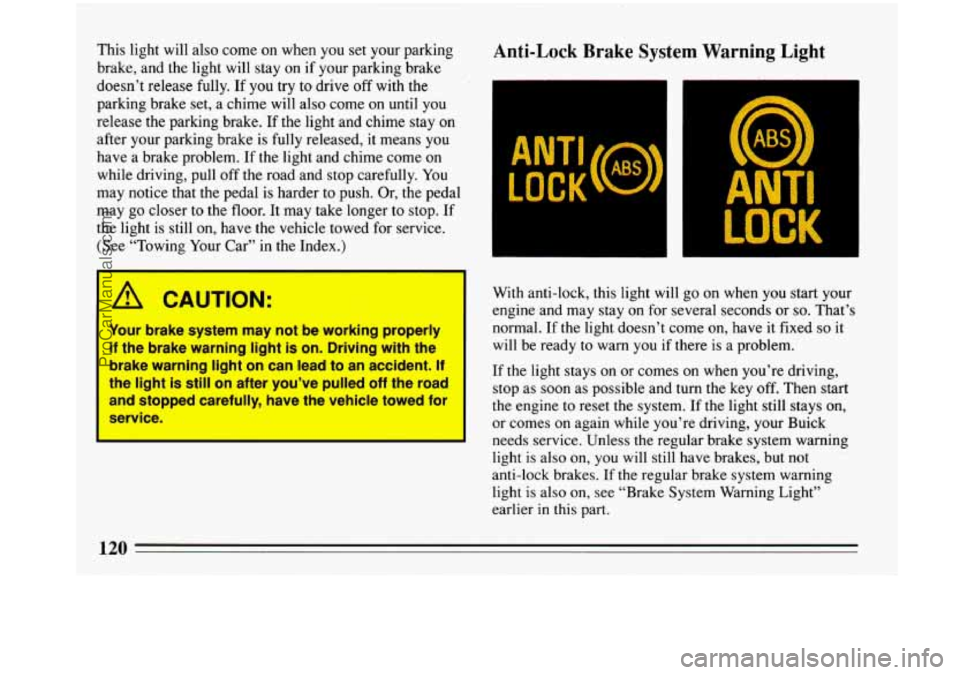
Anti-Lock Brake System Warning Light
With anti-lock, this light will go on when you start your
engine and may stay on for several seconds or
so. That’s
normal. If the light doesn’t come on, have it fixed
so it
will be ready to warn
you if there is a problem.
If the light stays
on or comes on when you’re driving,
stop as soon as possible and turn the key
off. Then start
the engine
to reset the system. If the light still stays on,
or comes on again while you’re driving, your Buick
needs service. Unless the regular brake system warning
light
is also on, you will still have brakes, but not
anti-lock brakes.
If the regular brake system warning
light
is also on, see “Brake System Warning Light”
earlier
in this part.
ProCarManuals.com
Page 125 of 340
have been operating your vehicle under normal driving
conditions,
you should pull off the road, stop your
vehicle and turn off the engine as soon as possible.
HOT COOLANT CAN BURN YOU BADLY!
In “Problems
on the Road,” this manual shows what to
do. See “Engine Overheating”
in the Index.
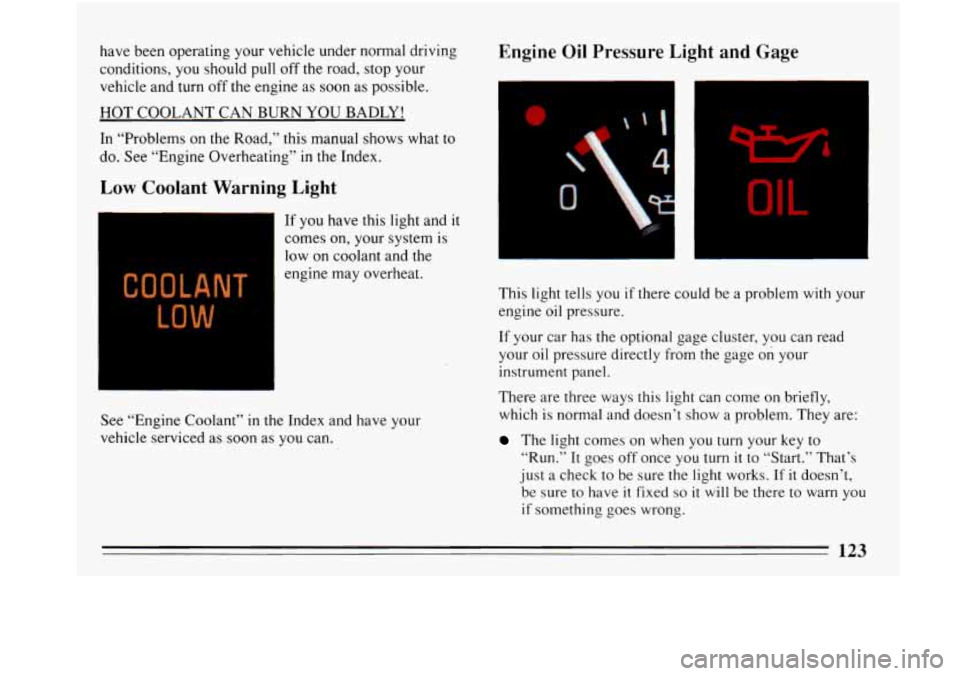
Low Coolant Warning Light
I
1
If you have this light and it
comes on, your system
is
low on coolant and the
engine may overheat.
See “Engine Coolant” in the Index and have your
vehicle serviced as soon as you can.
Engine Oil Pressure Light and Gage
0‘ 1
I
This light tells you if there could be a problem with your
engine oil pressure.
If your car has the optional gage cluster, you can read
your oil pressure directly from the gage
on your
instrument panel.
There are three ways this light can come on briefly,
which
is normal and doesn’t show a problem. They are:
The light comes on when you turn your key to
“Run.” It goes off once you turn
it to “Start.” That’s
just a check to be sure the light works. If it doesn’t,
be sure to have it fixed so it will be there to warn you
if something goes wrong.
123
ProCarManuals.com
Page 154 of 340
Insert a disc partway into the slot, label side up. The
player will pull it in. Wait a few seconds and the disc
should play.
If the disc comes back out, check whether:
The disc is upside down.
It is dirty, scratched, or wet.
There’s too much moisture in the air. (If there is,
wait about one hour and try again.)
RCL
Press RCL to see what track is playing. Press it again
within 5 seconds to see how long the CD has been
playing that track. The display will automatically return
to the time of day.
The track number also appears when you change the
volume, or when a new track starts to play.
COMP
Pressing the COMP button makes soft and loud passages
more equal in volume.
COMP will appear in the display.
RDM
The RDM button means random and when it is pressed,
your
CD player will play the tracks in random order
rather than sequential
1,2,3 ... order. Pressing RDM
again will play the disc in sequential order.
REV
Press and hold REV to return rapidly to a favorite
passage in a track. Note the seconds counter reading in
the display. Release it to play the passage.
FWD
Press and hold FWD to advance quickly within a track.
Release it to resume playing. Watch the display to ston
at
a specific passage.
PREV
Press PREV to hear the previous track. If you hold this
button or press it more than once,
the disc will retreat to
previous tracks.
NEXT
Press NEXT to hear the next track now (instead of
waiting until the present track is finished.) If you hold
this button, or press it more than once, the disc will
advance further.
STlPL
Press ST/PL (Stop/Play) and the disc will stop and the
radio will play. Press ST/PL again
to restart the disc at
the point where it stopped.
ProCarManuals.com
Page 155 of 340
Press the PWR button or turn the ignition key off to stop
the disc player. The disc stays in the player and will
resume playing at the point where it stopped.
EJECT
Press EJCT, the disc will eject and the radio will play.
The disc will start at track
1 when you reinsert it.
As a feature to protect the disc,
if you turn the ignition off
with the disc partway out of the slot (after eject), it will be
drawn back into the player in about 30 seconds. The disc
will play at track
1 when the radio is turned on again.
Anti-Theft Feature
Delco-Loc I1 is a security feature for the compact disc
player. It can be used or ignored.
If ignored, the system
plays normally. If it is used, your player won’t be usable
if it’s ever stolen, because it won’t turn on.
The instructions below tell you how to enter your
personal secret code into the system. If your vehicle loses
battery power for any reason, you must unlock the system
with the secret code again before the system will
turn on.
Be sure to read through the entire procedure and become
familiar with
the appropriate buttons and knobs before
starting.
Step
1. Write clown any 6-digit number and keep it in a
safe place. Step
2. Turn
the ignition to the ACC or RUN position.
Step
3. Press PWR to turn the radio off.
Step 4. Press preset 1 and 4 buttons together. Hold them
until
“---” shows on the display (at least 5 seconds).
You are now ready to enter your secret code. If you
pause more than
15 seconds between steps you may
have to start over.
Step
5. Press SET and “000” will appear on the display.
Step 6. Press SEEK and hold
it until the first digit of
your code appears.
Step 7. Rotate the tune knob right or left to make the
next two numbers agree
with your code.
Step
8. Press AM-FM knob and “000” will appear. Now
you are ready to enter the second three digits of the code
according to steps
6 and 7.
Step 9. Press the AM-FM knob. The display will show
“rEP” for
5 seconds, and then “OOO” will appear indicating
that some steps are to
be repeated for verification.
Step
10. Repeat steps 6,7, and 8.
Step 11. Press the AM-FM knob. If the display shows
“SEC”, the verification process was successful and the
system
is SECURE. If the display shows “---”, the
verification steps were not successful and the entire
sequence must be started again.
ProCarManuals.com
Page 168 of 340
time. A green arrow means you may drive in that lane.
Look for the signs posted to warn drivers what hours
and days these systems are in effect.
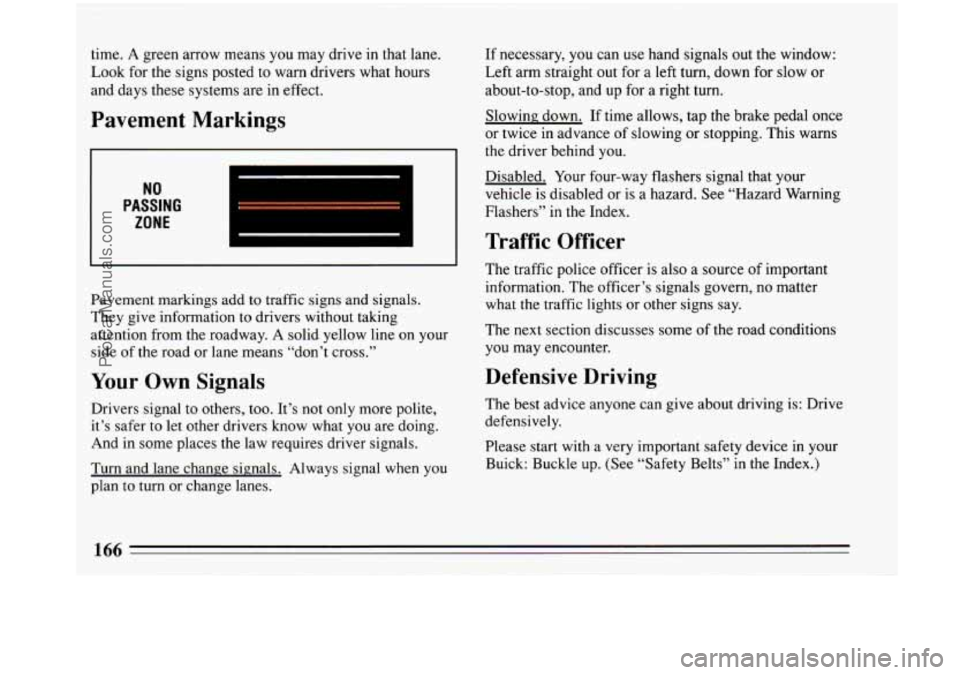
Pavement Markings
NO
PASSING
ZONE
Pavement markings add to traffic signs and signals.
They give information to drivers without taking
attention from the roadway. A solid yellow line
on your
side of the road
or lane means “don’t cross.”
Your Own Signals
Drivers signal to others, too. It’s not only more polite,
it’s safer to let other drivers know what you are doing.
And in some places the law requires driver signals.
Turn and lane change signals. Always signal when you
plan to turn or change lanes.
If necessary, you can use hand signals out the window:
Left arm straight
out for a left turn, down for slow or
about-to-stop, and up for a right turn.
Slowing down. If time allows, tap the brake pedal once
or twice in advance of slowing or stopping. This warns
the driver behind you.
Disabled. Your four-way flashers signal that your
vehicle
is disabled or is a hazard. See “Hazard Warning
Flashers” in the Index.
Traffic Officer
The traffic police officer is also a source of important
information. The officer’s signals govern, no matter
what the traffic lights or other signs say.
The next section discusses some of the road conditions
you may encounter.
Defensive Driving
The best advice anyone can give about driving is: Drive
defensively.
Please start with a very important safety device in your
Buick: Buckle up. (See “Safety Belts” in the Index.)
ProCarManuals.com
Page 174 of 340
---
1 A CAUTION:
“Riding” your brakes can cause them to overheat
to the point
that they won’t work well. You might
not be able to stop your vehicle
in time to avoid
an accident.
If you “ride” your brakes, they will I
get so hot they will require a lot of pedal force to
slow you down. Avoid “riding” the brakes.
‘I
E:
e brakes weafs them out much faster
You would need costly brake replacement much
sooner than normal, and
it also reduces fuel
If you keep pace with the traffic and allow realistic
following distances,
you will eliminate a lot of
unnecessary braking. That means better braking and
longer brake life.
If your engine ever stops while you’re driving, brake
normally but don’t pump your brakes. If
you do, the pedal
may get harder to push down.
If your engine
stops,
you will still have some power brake assist.
But you will use it when you brake. Once the power
assist is used up, it may take longer to stop and the
brake pedal will be harder to push.
Anti-Lock Brakes (ABS)
Your Buick has an advanced electronic braking system
that will help prevent skidding.
This light on the instrument panel will
go on when you
start your vehicle.
See “Anti-lock Brake System Warning Light” in the
Index.
ANTI
LOCK ANTI
LOCK
ProCarManuals.com
Page 176 of 340
I CAUTION:
Anti-lock doesn’t change the time you need to
get your foot
up to the brake pedal. If you get too
close to the vehicle in front of you, you won’t
have time to
apply your brakes ifethat vehicle
suddenly
stows or stops. Always leave enough
room up ahead to stop, even though you have
antblock brakes.
To Use Anti-Lock:
Don’t pump the brakes. Just hold the brake pedal down
and let anti-lock work for
you.
When you start your vehicle and begin to drive away,
you may hear a momentary motor or clicking noise. And
you may even notice that your brake pedal moves a little
while this is going on. This is the ABS system testing
itself. You may also hear this during a hard stop.
Traction Control System (Option)
Your vehicle may have a traction control system that
limits wheel spin. This is especially useful
in slippery
road conditions. The traction control system works at
low speeds only, such as when you accelerate from a stop. It
applies brake pressure
to an individual wheel
that the system senses is about to spin.
You may feel the system working, or you may notice
some noise, but this is normal.
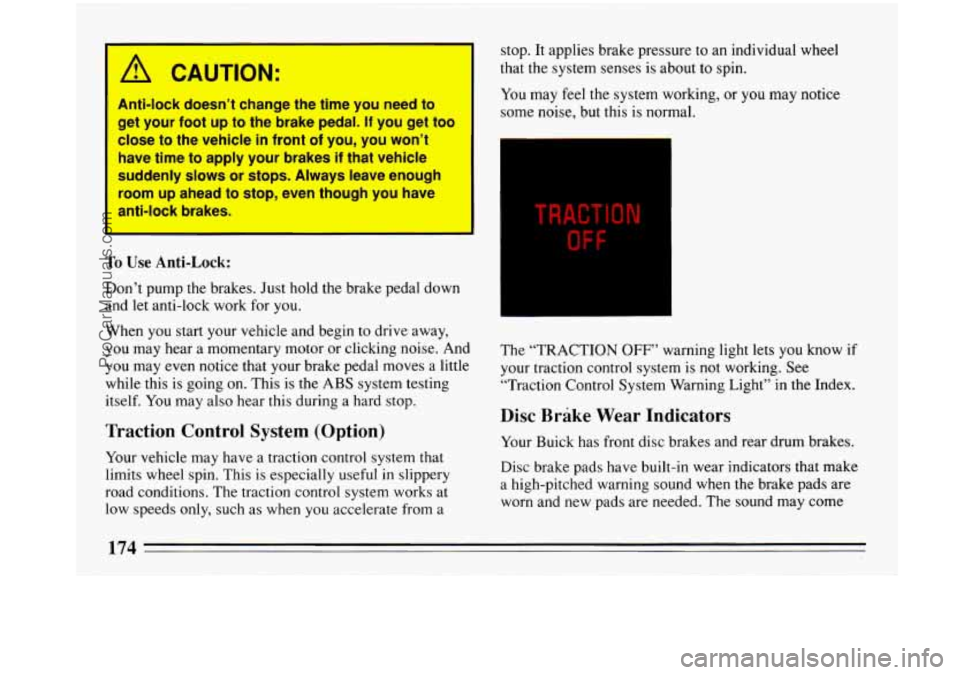
TRACTION
OFF
The “TRACTION OFF” warning light lets you know if
your traction control system is not working. See
“Traction Control System Warning Light” in the Index.
Disc Brake Wear Indicators
Your Buick has front disc brakes and rear drum brakes.
Disc brake pads have built-in wear indicators that make
a high-pitched warning sound when the brake pads are
worn and new pads are needed. The sound may come
174
ProCarManuals.com
Page 181 of 340
So here are some tips for passing:
“Drive ahead.” Look down the road, to the sides, and
to crossroads for situations that might affect your
passing patterns.
If you have any doubt whatsoever
about making a successful pass, wait for a better
time.
Watch for traffic signs, pavement markings, and
lines. If you can see a sign up ahead that might
indicate a turn or an intersection, delay your pass. A
broken center line usually indicates it’s all right to
pass (providing the road ahead is clear). Never cross
a solid line
on your side of the lane or a double solid
line, even if the road seems empty of approaching
traffic.
If you suspect that the driver of the vehicle you want
to pass isn’t aware of your presence, tap the
horn a
couple of times before passing.
Do not get too close to the vehicle you want to pass
while you’re awaiting an opportunity. For one thing,
following
too closely reduces your area of vision,
especially if you’re following
a larger vehicle. Also,
you won’t have adequate space if the vehicle ahead
suddenly slows or stops. Keep back a reasonable
distance.
When it looks like a chance to pass is coming up,
start to accelerate but stay in the right lane and don’t
get too close. Time your move
so you will be
increasing speed as
the time comes to move into the
other lane. If the way is clear to pass, you will have a
“running start’’ that more than makes up for the
distance you would lose by dropping back. And if
something happens to cause you to cancel your pass,
you need only slow down and drop back again and
wait for another opportunity.
If other cars are lined up to pass a slow vehicle, wait
your turn.
But take care that someone isn’t trying to
pass you as you pull out to pass the slow vehicle.
Remember to glance over your shoulder and check
the blind spot.
Check your mirrors, glance over your shoulder, and
start your
left lane change signal before moving out
of the right lane to pass. When you are far enough
ahead of the passed vehicle
to see its front in your
inside mirror, activate your right lane change signal
and move back into the right lane. (Remember that
your right outside mirror
is convex. The vehicle you
just passed may seem to be farther away from you
than it really
is.)
ProCarManuals.com