1993 BUICK PARK AVENUE steering
[x] Cancel search: steeringPage 78 of 340
steering wheel will remain locked, just as it was before
you inserted the key.
OFF: This position lets you turn off the engine but still
turn the steering wheel.
It doesn’t lock the steering
wheel like “Lock.” Use “Off’ if
you must have your car
in motion while the engine is off (for example, if your
car is being pushed).
RUN: This is the position for driving.
START This position starts your engine.
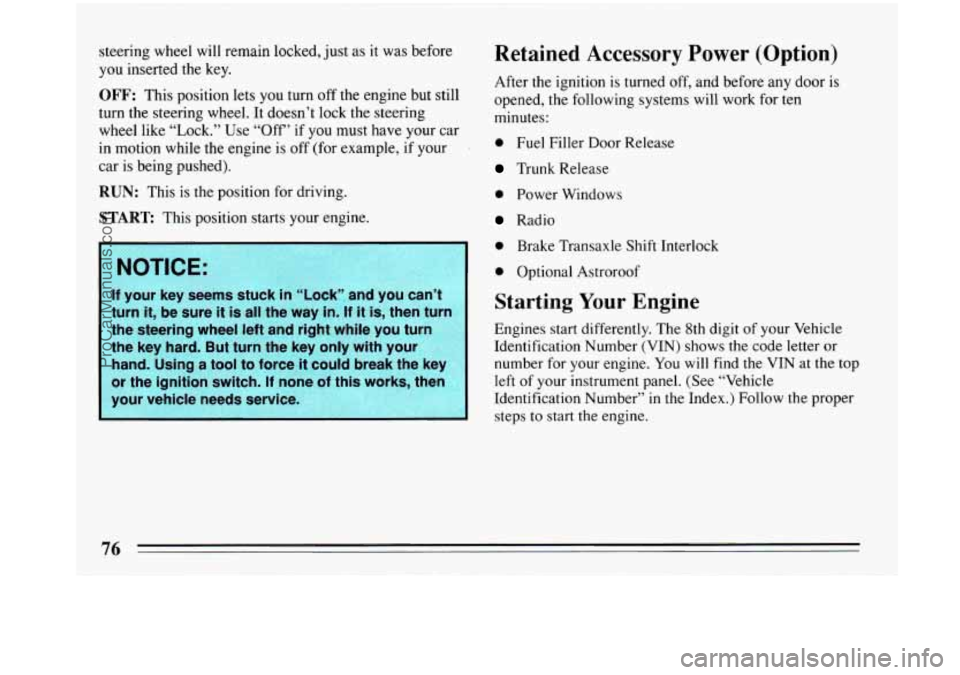
NOTICE:
If your key seems stuck in “Lock” and you can’t
turn
it, be sure it is all the way in. If it is, then turn
the steering wheel left and right while you turn
the key hard. But turn the key only with your
hand. Using a tool to force
it could break the key
or the ignition switch. If none of this works, then
your vehicle needs service.
p’
Retained Accessory Power (Option)
After the ignition is turned off, and before any door is
opened, the following systems will work for ten
minutes:
0 Fuel Filler Door Release
Trunk Release
0 Power Windows
Radio
0 Brake Transaxle Shift Interlock
0 Optional Astroroof
Starting Your Engine
Engines start differently. The 8th digit of your Vehicle
Identification Number
(VIN) shows the code letter or
number for your engine. You will find the
VIN at the top
left of your instrument panel. (See “Vehicle
Identification Number” in the Index.) Follow the proper
steps to start the engine.
ProCarManuals.com
Page 92 of 340
Power Windows
I
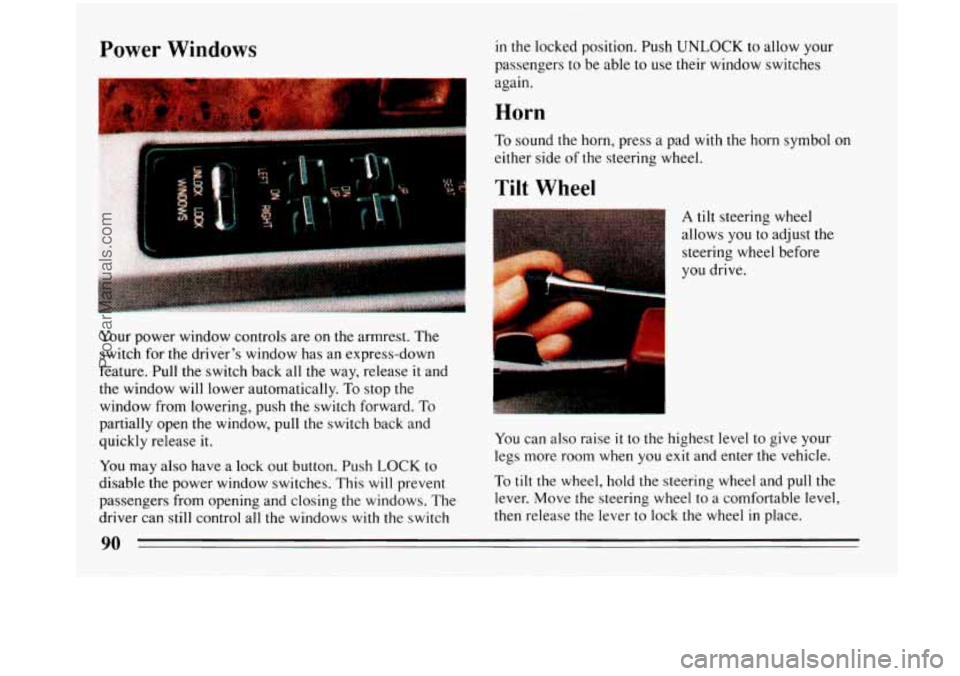
Your power window controls are on the armrest. The
switch for the driver’s window has an express-down
feature. Pull the switch back all
the way, release it and
the window will lower automatically.
To stop the
window from lowering, push the switch forward.
To
partially open the window, pull the switch back and
quickly release it.
You may
also have a lock out button. Push LOCK to
disable the power window switches. This will prevent
passengers
from opening and closing the windows. The
driver can still control all the windows
with the switch
in the locked position. Push UNLOCK to allow your
passengers to be able to use their window switches
again.
Horn
To sound the horn, press a pad with the horn symbol on
either side
of the steering wheel.
Tilt Wheel
i
I
A tilt steering wheel
allows you to adjust the
steering wheel before
you drive.
You can also raise it to the highest level to give your
legs more room when
you exit and enter the vehicle.
To
tilt the wheel, hold the steering wheel and pull the
lever. Move the steering wheel to
a comfortable level,
then release the lever to lock
the wheel in place.
ProCarManuals.com
Page 93 of 340
The Turn Signal/Headlight Beam
Lever Turn Signal and Lane Change Indicator
H
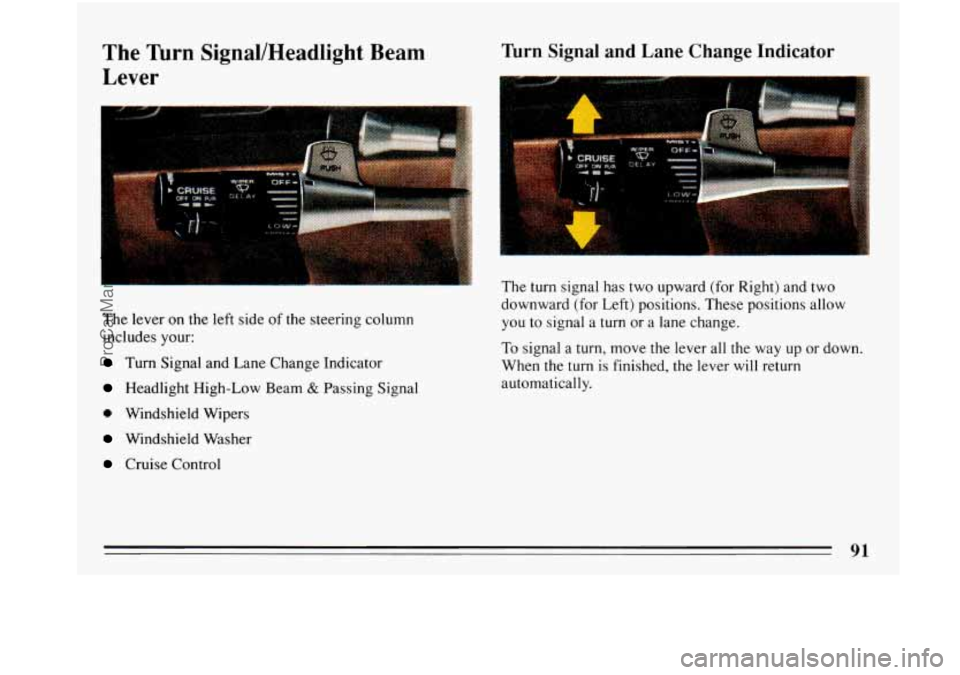
The lever on the left side of the steering column
includes your:
Turn Signal and Lane Change Indicator
Headlight High-Low Beam & Passing Signal
0 Windshield Wipers
Windshield Washer
Cruise Control
C!
The turn signal has two upward (for Right) and two
downward (for Left) positions. These positions allow
you to signal a turn or a lane change.
To signal a turn, move the lever all the way
up or down.
When the turn
is finished, the lever will return
automatically.
ProCarManuals.com
Page 161 of 340
@ Part 4 Your Driving and the Road
~ . ~~~~~ ~~~ ~ ~ ~~ ~ ~~ ~ ~~ ~ ~ ~~ ~ ~
Here you’ll find information about driving on different kinds of roads and in varying weather conditions . We’ve also
included many other useful tips on driving
.
Part 4 includes:
RoadSigns
....................................................................... \
DefensiveDriving .................................................................
DrunkenDriving ................................................................
Control of a Vehicle ......................... ...................................
Braking .....................................................................
Steering .....................................................................
Passing .....................................................................
LossofControl ...............................................................
DrivingatNight ...................................................................
DrivingintheRain .................................................................
Driving in Fog, Mist and Haze ........................................................
CityDriving ......................................................................
FreewayDriving ...................................................................
DrivingonaLongTrip .............................................................
HillandMountainRoads ............................................................
ParkingonHills ...................................................................
TowingaTrailer ...................................................................
WinterDriving ....................................................................
160
166
167 170
171
176
178
180
181
183 186
187
188
190
192 194
197
201
ProCarManuals.com
Page 172 of 340
alcohol in a person’s system can make crash injuries
worse. That’s especially true for brain, spinal cord and
heart injuries. That means that if anyone who has been
drinking
-- driver or passenger -- is in a crash, the
chance of being killed or permanently disabled is higher
than if that person had not been drinking. And we’ve
already
seen that the chance of a crash itself is higher for
drinking drivers.
/I CAUTION:
Drlnklng and then driving Is very dangerous.
Your reflexes, perceptions, and judgment wlll be
affected by even a small amount of alcohol. You
could have a serious - or even fatal - accident if
you drive after drinking. Please don’t drink and
drive or rlde with a driver who has been drinking.
Ride home in a cab; or if you’re with a group,
designate a driver who will not drink
Control of a Vehicle
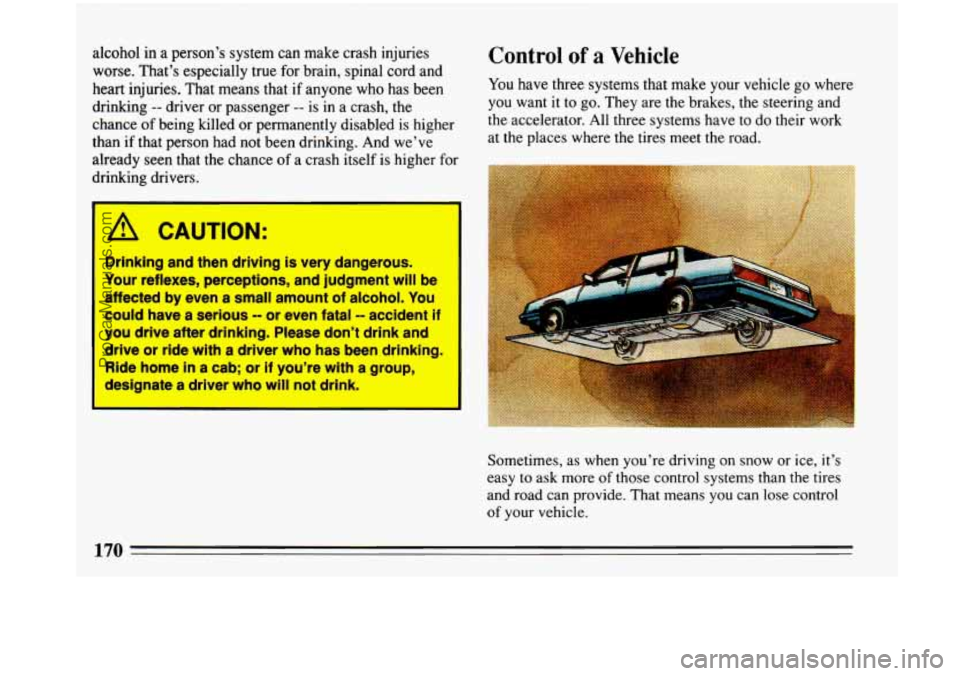
You have three systems that make your vehicle go where
you want it to go. They are the brakes, the steering and
the accelerator. All three systems have to do their work
at
the places where the tires meet the road.
Sometimes, as when you’re driving on snow or ice, it’s
easy
to ask more of those control systems than the tires
and road can provide. That means you can lose control
of your vehicle.
ProCarManuals.com
Page 178 of 340
Braking in Emergencies
Use your anti-lock braking system when you need to.
With anti-lock, you ‘can steer and brake at the same time.
In many emergencies, steering can help you more than
even the very best braking.
Steering
Power Steering
If you lose power steering assist because the engine
stops
or the system fails to function, you can steer but it
.will take much more effort.
Steering Tips
Driving on Curves
It’s important to take curves at a reasonable speed.
A lot of the “driver lost control” accidents mentioned on
the news happen on curves. Here’s
why:
Experienced driver or beginner, each.of us is subject to
the same laws of physics when driving on curves. The
traction of the tires against the road surface makes it
possible for the vehicle to changejts path when you
turn
the front wheels. If there’s no traction, inertia will keep
the vehicle going in the same direction. If you’ve ever
tried to steer a vehicle on wet ice, you’ll understand this. The
traction you can get in a curve depends on the
condition of your tires and the road surface, the angle
at
which the curve is banked, and your speed. While
you’re in a curve, speed is the one factor you can
control.
Suppose you’re steering through a sharp curve. Then
you suddenly accelerate.
Those two control systems
-- steering .and acceleration --
can overwhelm those places where the tires meet the
road and make you lose control.
What should you do
if this ever happens? Let up on the
.accelerator pedal, steer the vehicle the way you want it
to go, and slow down.
Speed limit signs near curves
warn that you should
adjust your speed. Of course,
the posted speeds are
based on good weather and road conditions. Under less
favorable conditions you’ll want to go slower.
If you need to reduce your speed as you approach a
curve, do it before you enter the curve, while your front
wheels are straight ahead.
Try to adjust
your speed so you can “drive” through the
curve. Maintain a reasonable, steady speed. Wait to
accelerate until you are out of the curve, and then
accelerate gently into the straightaway.
176 I
ProCarManuals.com
Page 179 of 340
When you drive into a curve at night, it’s harder to see
the road ahead of you because it bends away from the
straight beams of your lights. This is one good reason to
drive slower.
Steering in Emergencies
There are timi% when steering can be more effective
than braking. For example,
you come over a hill and
find a truck stopped in your lane, or a car suddenly pulls
out from nowhere, or a child darts out from between
parked cars and stops right
in front of you. You can
avoid these problems by braking
-- if you can stop in
time. But sometimes you can’t; there isn’t room. That’s
the time for evasive action
-- steering around the
problem.
Your Buick can perform very well
in emergencies like
these. First apply your brakes. It is better to remove as
much speed as you can from a possible collision. Then
steer around the problem, to the left or right depending
on the space available.
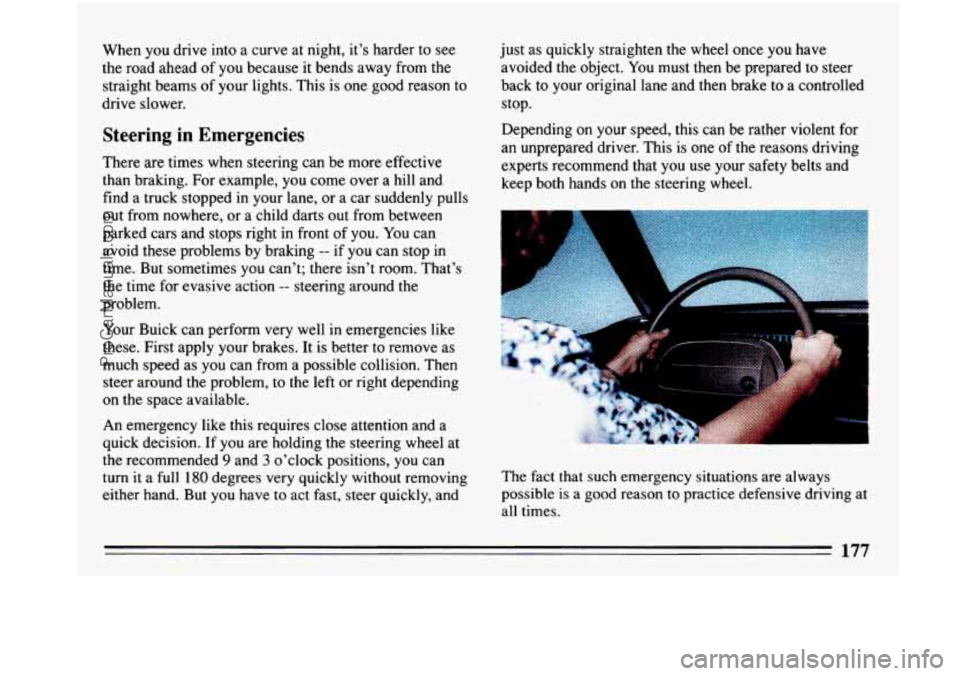
An emergency like this requires close attention and a
quick decision. If you are holding the steering wheel at
the recommended 9 and 3 o’clock positions, you can
turn it a full 180 degrees very quickly without removing
either hand. But you have
to act fast, steer quickly, and just as
quickly straighten the wheel once you have
avoided the object. You must then be prepared to steer
back
to your original lane and then brake to a controlled
stop.
Depending on your speed, this can be rather violent for
an unprepared driver. This is one of the reasons driving
experts recommend
that you use your safety belts and
keep both hands on the steering wheel.
I
D
The fact that such emergency situations are always
possible
is a good reason to practice defensive driving at
all times.
177
ProCarManuals.com
Page 180 of 340
Off-Road Recovery
You may find sometime that your right wheels have
dropped
off the edge of a road onto the shoulder while
you’re driving.
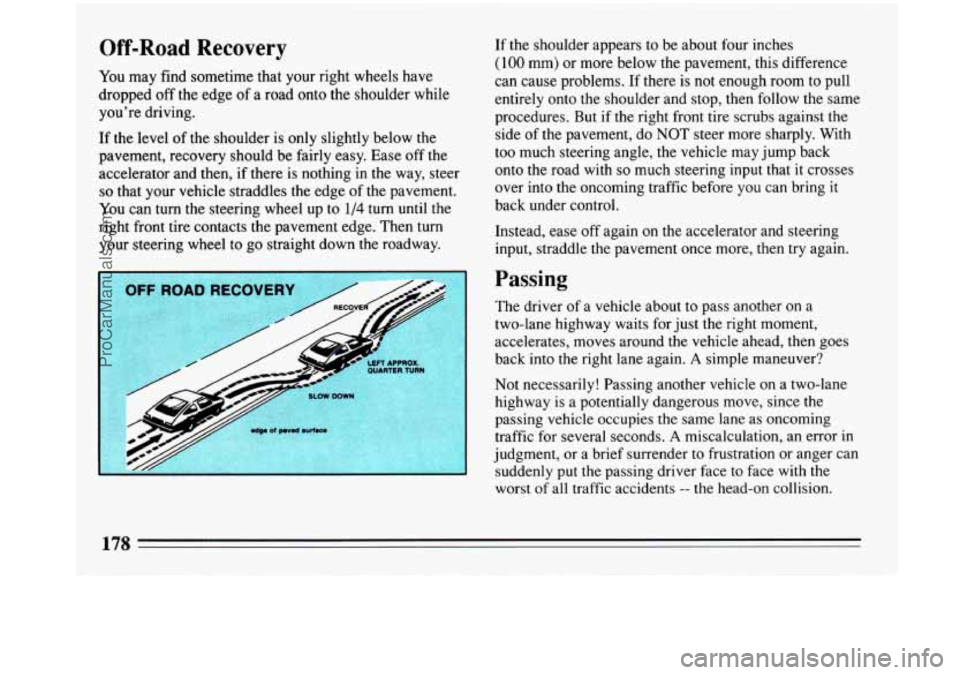
If the level
of the shoulder is only slightly below the
pavement, recovery should be fairly easy. Ease off the
accelerator and then, if there is nothing in the way, steer
so that your vehicle straddles the edge of the pavement.
You can turn the steering wheel up
to 1/4 turn until the
right front tire contacts the pavement edge. Then turn
your steering wheel to
go straight down the roadway.
If the shoulder appears to be about four inches
(100 mm) or more below the pavement, this difference
can cause problems.
If there is not enough room to pull
entirely onto the shoulder and stop, then follow the same
procedures. But
if the right front tire scrubs against the
side
of the pavement, do NOT steer more sharply. With
too much steering angle, the vehicle may jump back
onto the road with
so much steering input that it crosses
over into the oncoming traffic before you can bring it
back under control.
Instead, ease off again on the accelerator and steering
input, straddle
the pavement once more, then try again.
Passing
The driver of a vehicle about to pass another on a
two-lane highway waits for just the right moment,
accelerates, moves around the vehicle ahead, then goes
back
into the right lane again. A simple maneuver?
Not necessarily! Passing another vehicle on a two-lane
highway is a potentially dangerous move, since the
passing vehicle occupies the same lane as oncoming
traffic for several seconds.
A miscalculation, an error in
judgment, or a brief surrender to frustration or anger can
suddenly put the passing driver face to face with the
worst
of all traffic accidents -- the head-on collision.
178
ProCarManuals.com