1993 BUICK PARK AVENUE check engine light
[x] Cancel search: check engine lightPage 202 of 340
A CAUTION:
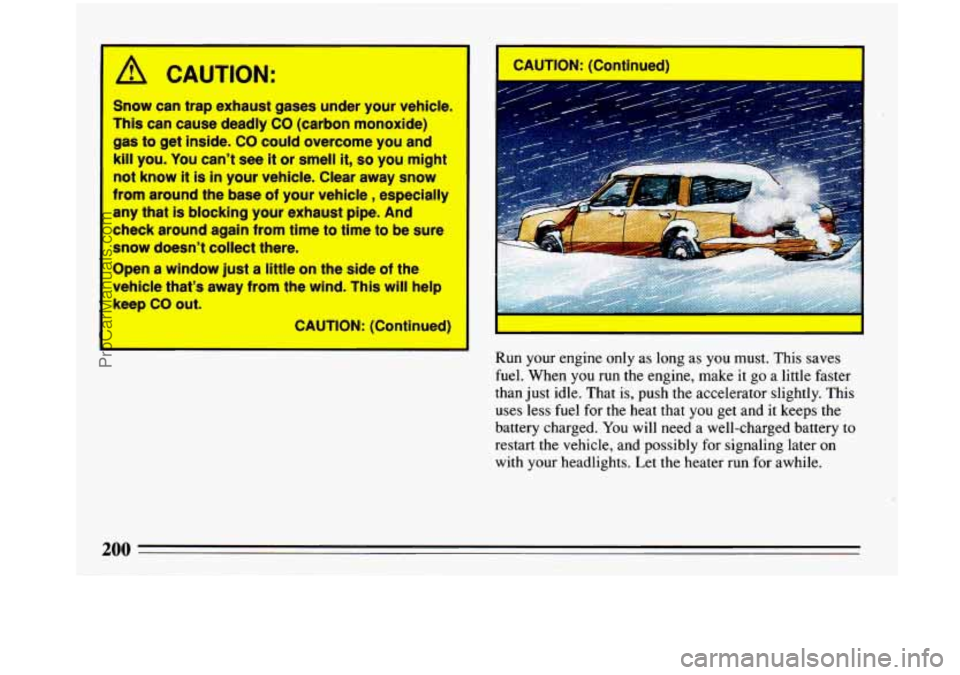
Snow can trap exhaust gases under your vehicle.
This can cause deadly
CO (carbon monoxide)
gas to get inside. CO could overcome you and
kill you. You can’t see it or smell it, so you might
not know it is in your vehicle. Clear away snow
from around the base of your vehicle, especially
any that
is blocking your exhaust pipe. And
check around again from time to time to be sure
snow doesn’t collect there.
Open
a window just a little on the side of the
vehicle that’s away from the wind. This will help
keep CO out.
CAUTION: (Continued)
LCAUTION:
Run your engine only as long as you must. This saves
fuel. When you run the engine, make it go a little faster
than just idle. That is, push the accelerator slightly. This
uses less fuel for the heat that you get and it keeps the
battery charged. You will need a well-charged battery
to
restart the vehicle, and possibly for signaling later on
with your headlights. Let the heater run for awhile.
ProCarManuals.com
Page 208 of 340
the trailer lights will also flash, telling other drivers
you’re about to turn, change lanes or stop.
When towing a trailer, the green arrows
on your
instrument panel will flash for turns even
if the bulbs on
the trailer are burned out. Thus, you may think drivers
behind you are seeing your signal when they are not. It’s
important to check occasionally to be sure the trailer
bulbs are still working.
Your vehicle has bulb warning lights. When you plug
trailer lights into your vehicle’s lighting system, its bulb warning lights may not
let you know if one of your
lights goes
out. So, when you have trailer lights plugged
in, be sure
to check your vehicle and trailer lights from
time to time to be sure they’re-all working. Once
you
disconnect the trailer lights, the bulb warning lights
again can
tell you if one of your vehicle lights is out.
Driving On Grades
Reduce speed and shift to a lower gear before you start
down a long
or steep downgrade. If you don’t shift
down, you might have to use your brakes
so much that
they would get hot and no longer work well. On
a long uphill grade, shift down to
“D or 3” (Drive)
and reduce your speed to around
45 mph (70 km/h) to
reduce the possibility of engine and transaxle
overheating.
Parking on Hills
You really should not park your vehicle, with a trailer
attached,
on a hill. If something goes wrong, your rig
could start to move. People can be injured, and both
your vehicle and the trailer can be damaged.
But
if you ever have to park your rig on a hill, here’s
how to do it:
1. Apply your regular brakes, but don’t shift into “F’”
(Park) yet.
2. Have someone place chocks under the trailer wheels.
3. When the wheel chocks are in place, release the
regular brakes until the chocks absorb the load.
4. Reapply the regular brakes. Then apply your parking
brake, and
then shift to “P’ (Park).
5. Release the regular brakes.
ProCarManuals.com
Page 216 of 340
A CAUTION:
Using a match near a battery can cause battery
gas to explode. People have been hurt doing
this, and some have been blinded. Use a
flashlight if you need more light.
Be sure the battery has enoug,h water. You don’t
need to add water to the Delco Freedom@ battery
installed in’ every new GM vehicle. But if a battery
has filler caps,
be sure the right amount of fluid
is there. If it is low, add water to’ take care of that
first
If you don’tt, explosive gas could be present.
Battery fluid contains acid that can burn you.
Don’t get
it on you. If you accidentally get it in
your eyes or on your skin, flush the place with
water and
get medical help immediately.
5. Check that the jumper cables don’t have loose or
missing insulation. If they do, you could get a shock.
The vehicles could be damaged, too.
Before you connect the cables, here are some basic
th.ings
you should know. Positive (+) will go to
positive
(+) a~d mgative (-) will go to negative (-) or a
metal engine part. Don’t connect
(+) to (-) or you’ll
get a short that would damage the battery and maybe
other parts,
too.
‘
A CAUTION:
Fans or other moving engine parts can injure you
badly. Keep your hands away from moving parts
once the engines are running.
214
ProCarManuals.com
Page 253 of 340
The powertrain control module (PCM), works with a
vacuum control to regulate the increased pressure
required during specific driving conditions. When this
increased pressure or boost, is not desired such as during
idling and light throttle cruising, the excess air that the
Supercharger is pumping is routed through a bypass. All
of these controls, working together provide high
performance character and fuel efficiency in the
3800
V6 Supercharged Buick engine.
The power steering pump uses a remote reservoir
mounted on the throttle and cruise control cable bracket.
See “Maintenance Schedule’’ in the Index for when you
should check the fluid.
The supercharged
3800 engine uses two accessory drive
belts. One belt drives the generator and the power
steering pump. The second belt drives the supercharger,
coolant pump and air conditioning compressor. Each
belt has
its own tensioner and idler pulley. See
“Maintenance Schedule’’ in the Index for when you
should check the accessory drive belts and supercharger
oil level. Have your dealer check the oil level in the
supercharger.
Engine Oil
It’s a good idea to check your engine oil every time you
get fuel. In order to get an accurate reading, the oil must
be warm and the vehicle must be on level ground.
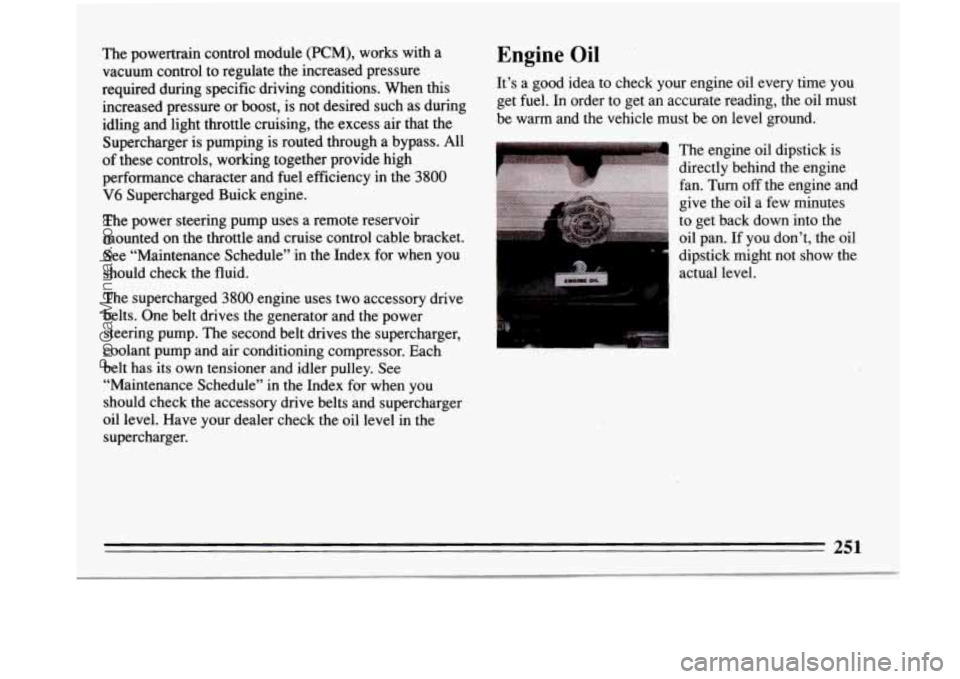
The engine oil dipstick is
directly behind the engine
fan. Turn
off the engine and
give the oil a few minutes
to get back down into the
oil pan. If you don’t, the oil
dipstick might not &ow the
actual level.
ProCarManuals.com
Page 260 of 340
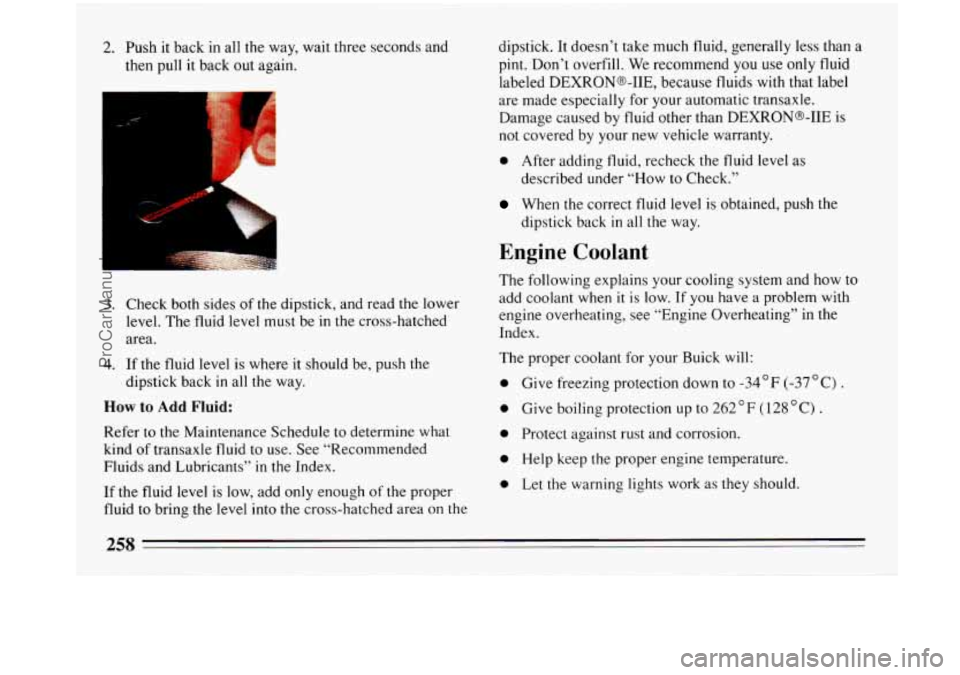
2. Push it back in all the way, wait three seconds and
then pull it back out again.
3. Check both sides of the dipstick, and read the lower
level. The fluid level must be in the cross-hatched
area.
4. If the fluid level is where it should be, push the
dipstick back
in all the way.
How to Add Fluid:
Refer to the Maintenance Schedule to determine what
kind of transaxle fluid to use. See “Recommended
Fluids and Lubricants” in the Index.
If the fluid level is low, add only enough of the proper
fluid to bring the level
into the cross-hatched area on the dipstick, It
doesn’t take much fluid, generally less than a
pint. Don’t overfill. We recommend
you use only fluid
labeled DEXRONWIE, because
fluids with that label
are made especially for your automatic transaxle.
Damage caused by fluid other than DEXRONB-IIE is
not covered by your new vehicle warranty.
0 After adding fluid, recheck the fluid level as
described under “How to Check.”
When the correct fluid level is obtained, push the
dipstick back
in all the way.
Engine Coolant
The following explains your cooling system and how to
add coolant when
it is low. If you have a problem with
engine overheating, see “Engine Overheating” in the
Index.
The proper coolant for your Buick will:
0 Give freezing protection down to -34°F (-37 “C) .
0 Give boiling protection up to 262 F ( 128 ” C) .
0 Protect against rust and corrosion.
0 Help keep the proper engine temperature.
0 Let the warning lights work as they should.
ProCarManuals.com
Page 262 of 340
To Check Coolant: When your engine is cold, the
coolant level should be at
“FULL COLD,” or a little
higher. When your engine is warm, the level should be
up to
“FULL HOT,” or a little higher.
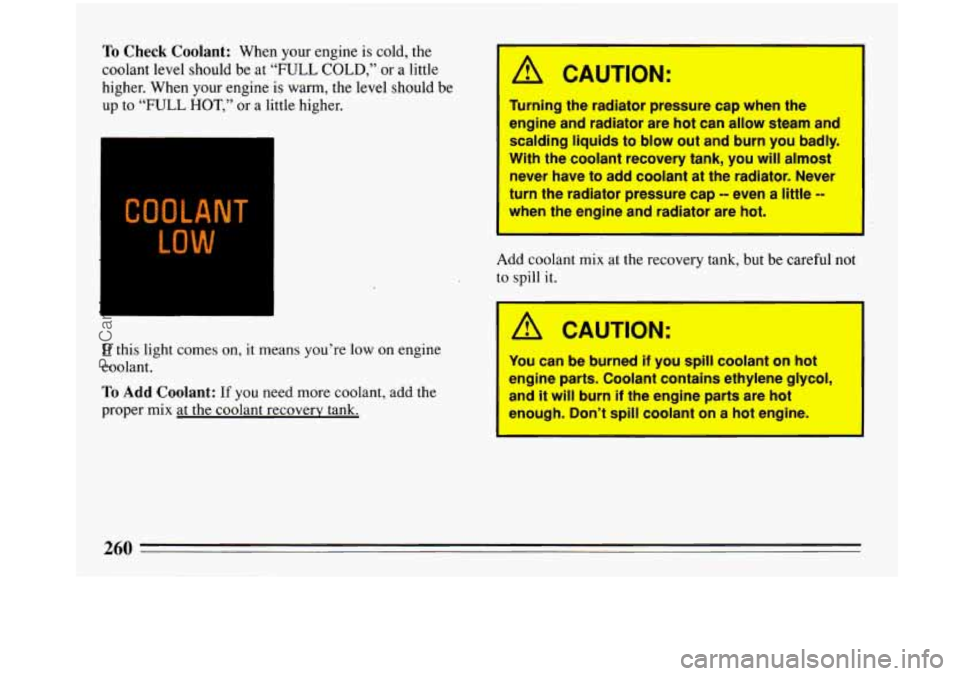
If this light comes
on, it means you’re low on engine
coolant.
To Add Coolant: If you need more coolant, add the
proper mix at the coolant recovery .tank.
‘ CAUTION:
T‘urning the radiator pressure cap when the
engine and radiator are hot can allow steam and
scalding liquids to blow out and burn you badly.
With the coolant recovery tank, you will almost
never have to add coolant at the radiator. Never
turn the radiator pressure cap -- even a little -
#hen the engine and radiator are hot.
I
Add coolant mix at the recovery tank, but be careful not
to spill it.
A CAUTION:
You can be burned if you spill coolant on hot
engine parts. Coolant contains ethylene glycol,
and it will burn
if the engine parts are hot
enough. Don’t spill coolant on a hot engine.
ProCarManuals.com
Page 311 of 340
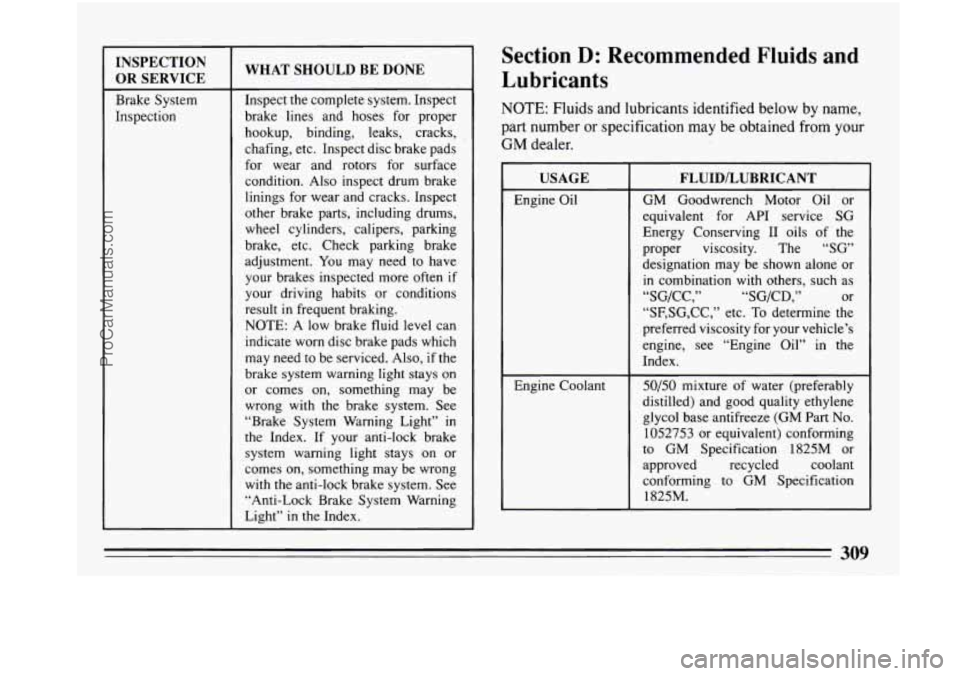
INSPECTION
OR SERVICE
Brake System
Inspection
WHAT SHOULD BE DONE
Inspect the complete system. Inspect
brake lines and hoses for proper
hookup, binding, leaks, cracks, chafing, etc. Inspect disc brake pads
for wear and rotors for surface
condition. Also inspect drum brake
linings for wear and cracks. Inspect
other brake parts, including drums,
wheel cylinders, calipers, parking
brake, etc. Check parking brake
adjustment.
You may need to have
your brakes inspected more often
if
your driving habits or conditions
result
in frequent braking.
NOTE: A low brake fluid level can
indicate worn disc brake pads which
may need
to be serviced. Also, if the
brake system warning light stays on
or comes
on, something may be
wrong with
the brake system. See
“Brake System Warning Light”
in
the Index. If your anti-lock brake
system warning light stays on or
comes on, something may be wrong
with
the anti-lock brake system. See
“Anti-Lock Brake System Warning
Light”
in the Index.
Section D: Recommended Fluids and
Lubricants
NOTE: Fluids and lubricants identified below by name,
part number or specification may be obtained from your
GM dealer.
USAGE
Engine Oil
Engine Coolant
FLUID/LUBRICANT
GM Goodwrench Motor Oil or
equivalent for API service SG
Energy Conserving I1 oils of the
proper viscosity. The
“SG”
designation may be shown alone or
in combination with others, such as
“SG/CC,” “SG/CD,”
or
“SF,SG,CC,” etc. To determine the
preferred viscosity for your vehicle’s
engine, see “Engine Oil” in the
Index.
50/50 mixture of water (preferably
distilled) and good quality ethylene
glycol base antifreeze (GM
Part No.
1052753 or equivalent) conforming
to GM Specification 1825M or
approved recycled coolant
conforming to GM Specification
1825M.
ProCarManuals.com
Page 324 of 340
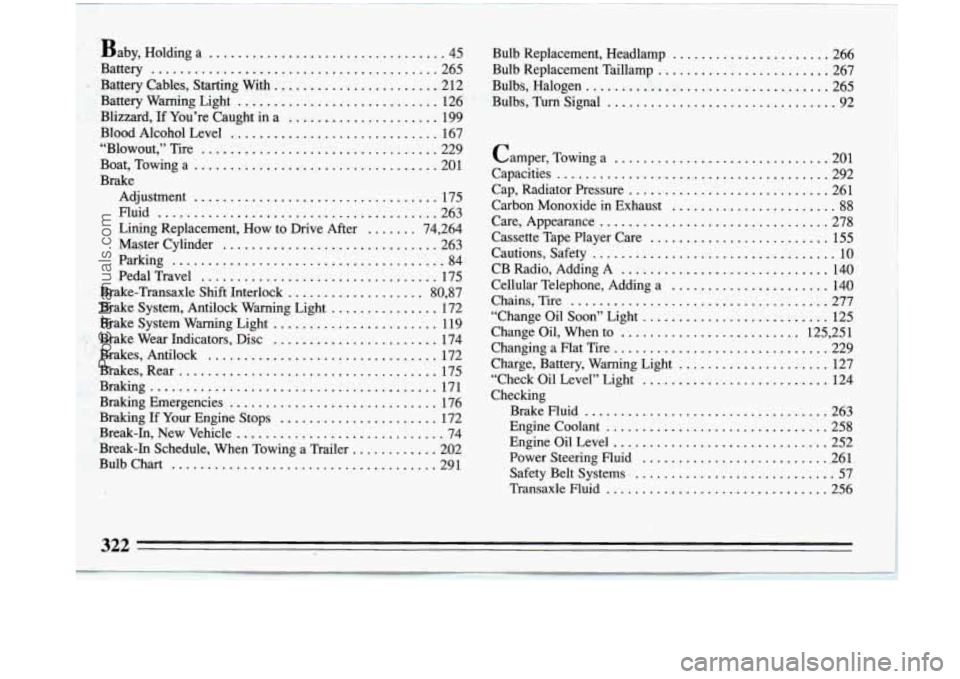
Baby. Holding a ................................. 45
Battery
........................................ 265
. Battery Cables, Starting With ....................... 212
Battery Warning Light
............................ 126
Blizzard,
If You’re Caught in a ..................... 199
Blood Alcohol Level
............................. 167
“Blowout,
” Tire ................................. 229
Boat, Towinga
.................................. 201
Brake
Adjustment
.................................. 175
Fluid
....................................... 263
Lining Replacement, How to Drive After
....... 74, 264
Master Cylinder
.............................. 263
Brake-Transaxle
Shift Interlock ................... 80, 87
Brake System, Antilock Warning Light
............... 172
Brake System Warning Light
....................... 119
Brake Wear Indicators,
Disc ....................... 174
Brakes, Antilock
................................ 172
Brakes, Rear
..................................... 175
Braking
........................................ 171
Braking Emergencies
............................. 176
Braking
If Your Engine Stops ...................... 172
Break-In, New Vehicle
............................ -74
Break-In Schedule, When Towing a Trailer
............ 202
Parking
...................................... 84
PedalTravel
................................. 175
Bulbchart
..................................... 291
Bulb Replacement. Headlamp ...................... 266
Bulb Replacement Taillamp
........................ 267
Bulbs. Halogen
.................................. 265
Bulbs. Turn Signal
................................ 92
camper. Towing a
.............................. 201
Capacities
...................................... 292
Cap. Radiator Pressure
............................ 261
Carbon Monoxide in Exhaust
....................... 88
Care. Appearance ................................ 278
Cassette Tape Player Care
......................... 155
Cautions. Safety
.................................. 10
CB Radio. Adding A
............................. 140
Cellular Telephone. Adding a
...................... 140
Chains. Tire
.................................... 277
“Change Oil Soon” Light
.......................... 125
Change Oil. When to
......................... 125. 251
Changing a Flat Tire
.............................. 229
Charge. Battery. Warning Light
..................... 127
“Check Oil Level” Light
.......................... 124
Engine Coolant
............................... 258
Engine Oil Level ............................... 252
Power Steering Fluid
.......................... .26 1.
Safety Belt Systems ............................ 57
Transaxle Fluid
............................... 256
Checking
BrakeFluid
.................................. 263
322
ProCarManuals.com