Page 187 of 324
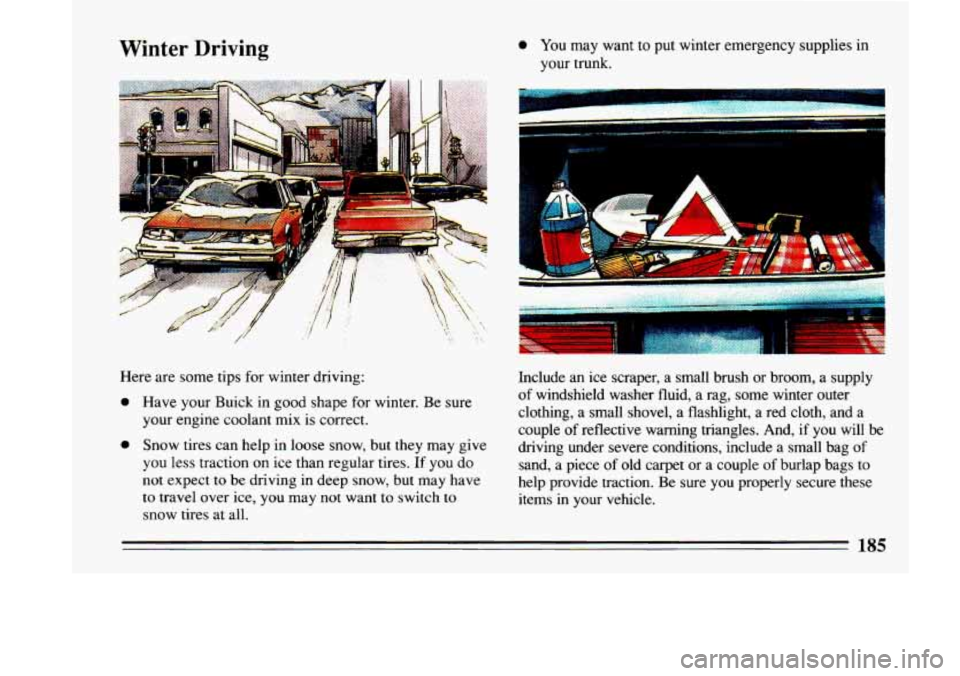
Winter Driving 0 You may want to put winter emergency supplies in
your trunk.
Here are some tips for winter driving:
0 Have your Buick in good shape for winter. Be sure
your engine coolant mix
is correct.
0 Snow tires can help in loose snow, but they may give
you less traction
on ice than regular tires. If you do
not expect
to be driving in deep snow, but may have
to travel over ice, you may not want to switch to
snow tires at all. Include an ice scraper,
a small brush
or broom, a supply
of windshield washer fluid, a rag, some winter outer
clothing, a small shovel, a flashlight, a red cloth, and a
couple
of reflective warning triangles. And, if you will be
driving under severe conditions, include a small bag
of
sand, a piece of old carpet or a couple of burlap bags to
help provide traction. Be sure you properly secure these
items in your vehicle.
185
Page 194 of 324
e e Will you have to make any holes in the body of your vehicle when you install a trailer hitch? If you
do,
then be sure to seal the holes later when you remove
the hitch. If you don’t seal them, deadly carbon
monoxide
(CO) from your exhaust can get into your
vehicle (see “Carbon Monoxide” in the Index). Dirt
and water can, too.
The bumpers on your vehicle are not intended for
hitches.
Do not attach rental hitches or other
bumper-type hitches to them. adequate.
Be sure to read and follow the instructions for
the trailer brakes
so you’ll be able to install, adjust and
maintain them properly. Because you have anti-lock
brakes, do not try to tap into your vehicle’s brake
system.
If you do, both brake systems won’t work well,
or at all.
Driving with a Trailer
Towing a trailer requires a certain amount of experience.
Before setting out for the open road, you’ll want to get
to know your rig. Acquaint yourself with the feel of
handling and braking with the added weight of the
trailer. And always keep in mind that the vehicle you are
driving is now a good deal longer and not nearly
so
responsive as your vehicle is by itself.
Safety Chains
You should always attach chains between your vehicle
and your trailer.
Cross the safety chains under the
tongue
of the trailer so that the tongue will not drop to
the road if it becomes separated from the hitch.
Instructions about safety chains may be provided by the
hitch manufacturer or by the trailer manufacturer.
Follow the manufacturer’s recommendation for
attaching safety chains. Always leave just enough slack
so you can turn with your rig. And, never allow safety
chains to drag
on the ground.
Trailer Brakes
If your trailer weighs more than 1,000 pounds (450 kg)
loaded, then it needs its own brakes
-- and they must be
192
~-
Before you start, check the trailer hitch and platform,
safety chains, electrical connector, lights, tires
and
mirror adjustment. If the trailer has electric brakes, start
your vehicle and trailer moving and then apply the
trailer brake controller by hand to be sure the brakes are
working. This lets you check your electrical connection
at the same time.
During your trip, check occasionally
to be sure that the
load is secure, and that the lights and any trailer brakes
are still working.
Page 206 of 324
Before you do anything, turn on the hazard warning
flashers.
When you call, tell the towing service:
That your vehicle has front-wheel drive.
The make, model, and year of your vehicle.
Whether you can still move the shift lever.
If there was an accident, what was damaged.
When the towing service arrives, let
the tow operator
know that this manual contains detailed towing instructions and illustrations. The operator may want to
see them.
A CAUTION:
To help avoid injury to you or others:
0 Never let passengers ride in a vehicle that
@ Never tow faster than safe or posted
0 Never tow with damaged parts not fully
Never get under your vehicle after it has
Always use separate safety chains on each
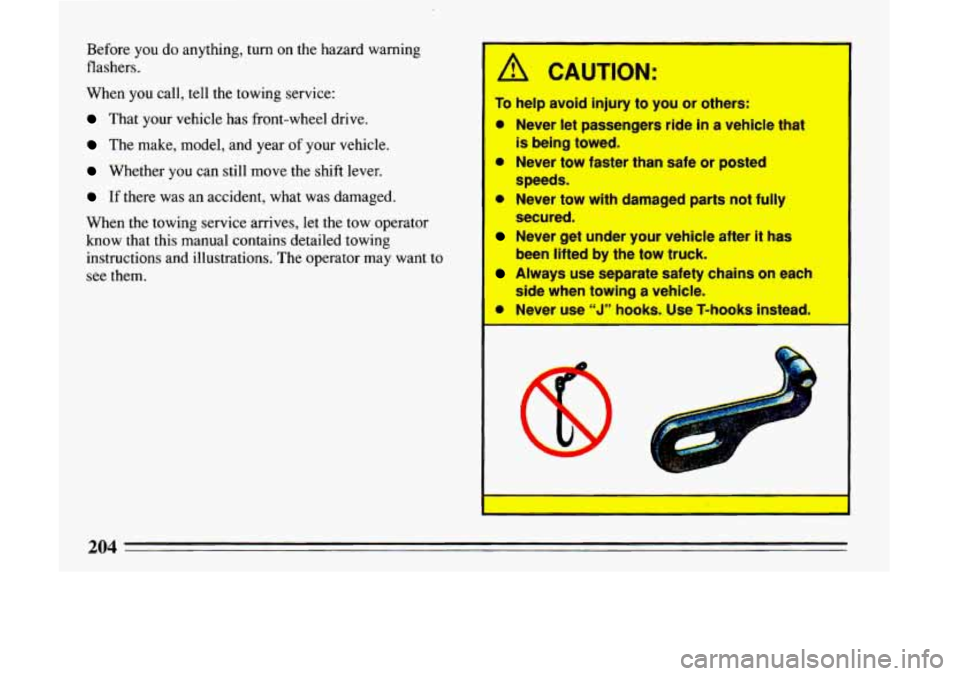
@ Never use “J’* hooks. Use T-hooks instead.
is being towed.
speeds.
secured.
been lifted
by the tow truck.
side when towing
a vehicle.
rn
204
Page 207 of 324
When your vehicle is being towed, have the ignition key
off. The steering wheel should be clamped in a
straight-ahead position, with a clamping device designed
for towing service.
Do not use the vehicle’s steering
column lock for this. The transaxle should be in Neutral
and the parking brake released.
Don’t have your vehicle towed on the front wheels,
unless
you must. If the vehicle must be towed on the
front wheels, don’t
go more than 55 mph (88 kph) or
farther than
500 miles (800 km) or your transaxle will
be damaged.
If these limits must be exceeded, then the
front wheels have to be supported on a dolly.
-
A CAUTION:
A vehicle can fall from a car carrier if it isn’t
properly secured, This can cause a collision,
serious personal injury and vehlcle damage. The
vehicle should be tightly secured with chains
or
steel cables before it is transported.
Don’t use substitutes (ropes, leather straps,
canvas webbing, etc.) that can be cut by sharp
zdges underneath the towed vehicle.
Page 228 of 324
/I CAUTION:
Incorrect wheel nuts or improperly tlghtened
wheel nuts
can cause-the wheel to become loose
and even’come
off. This could lead to an
acclelent. Be sure to use the correct wheel nuts.
If you have to replace them, be sure to get the
right kind.
Stop somewhere
as soon as you can and have
the nuts tightened with a torque wrench to 100 ft.
Ibs. (1 40 Nmm).
Don’t try to put a wheel cover on your compact spare
tire. It won’t fit. Store the wheel cover in
the trunk until
you have the flat tire repaired or replaced.
Wheel covers won’t fit on your compact spare. If
you try to put a wheel cover on your compact
spare, you could damage the cover or the spare.
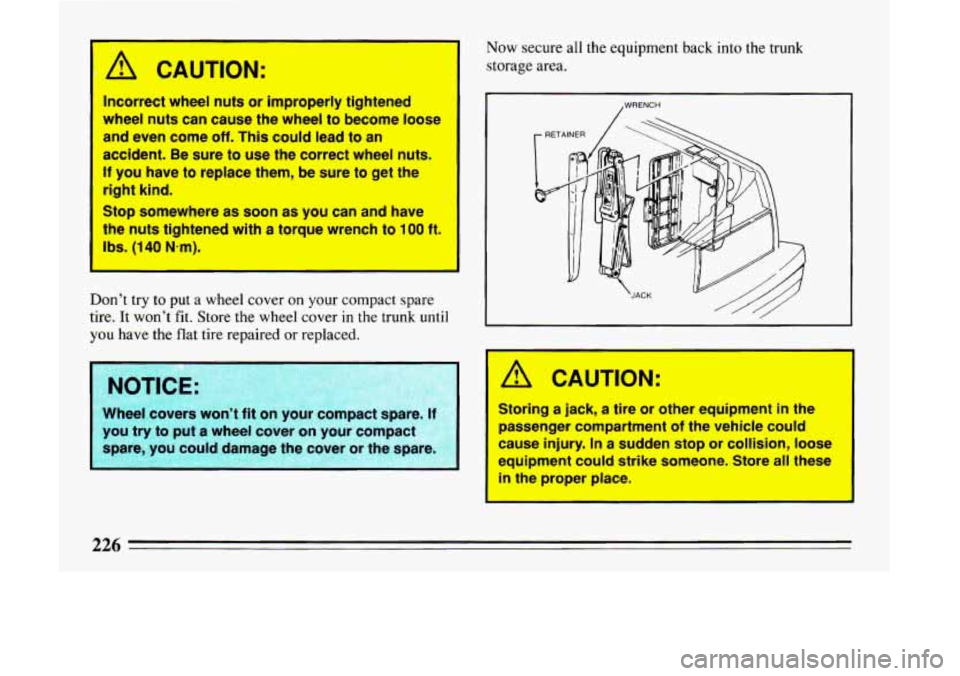
Now secure all the equipment back into the trunk
storage area.
I /WRENCH
&!b, CAUTION:
I
Storing a jack, a tire or other equipment in the
passenger compartment of the vehicle could
cause injury. In a sudden stop
or collision, loose
equipment could strike someone. Store
all these
in the proper place.
226
Page 235 of 324
Filling Your Tank
.. .-
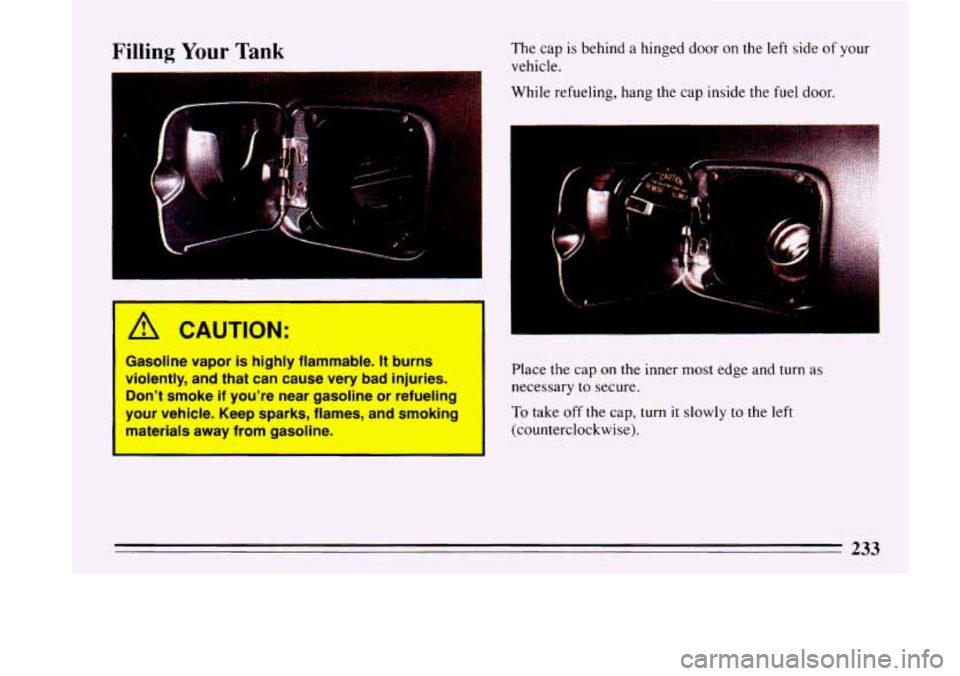
The cap is behind a hinged door on the left side of your
vehicle.
While refueling, hang the cap inside the fuel door.
I
A CAUTION:
Gasoline vapor is highly flammable. It burns
violently, and that can cause very bad injuries.
Don’t smoke
if you’re near gasoline or refueling
your vehicle. Keep sparks, flames, and smoking
materials away from gasoline.
Place the cap on the inner most edge and turn as
necessary to secure.
To take off the cap, turn it slowly to the left
(counterclockwise).
233
Page 256 of 324
b, CAUTION:
Do not load your vehicle any heavier than the
GVWR or the maximum front and rear GAWRs. If
you do, parts on your vehicle can break, or it can
change the way your vehicle handles. These
could cause you
to lose control. Also,
overloading can shorten the life of your vehicle.
I
1
Your warranty does not cover parts or
components
that fail because of overloading.
If you put things inside your vehicle -- like suitcases,
tools, packages,
or anything else -- they will go as fast
as the vehicle goes.
If you have to stop or turn quickly,
or if there is a crash, they’ll keep going.
A CAUTION:
Things you put inside your vehicle can strike and
injure people
in a sudden stop or turn, or in a
eras h. 0
Put things in the trunk of your vehicle.
In a trunk, put them as far forward as you
can. Try to spread the weiqht evenly.
Never stack heavier things, like suitcases,
inside the vehicle
so that some of them are
above the tops
of the seats.
.I When you brry something inside the
vehicle, secure
it whenever you can.
0 Don’t leave a seat folded down unless you
need to.
254
Page 263 of 324
‘A CAUTION:
0
Using the wrong replacement wheels, wheel
bolts,
or whwl nuts on your vehicle can be
dangerous. It could affect the braking and
handling
of your vehicle, make your tires lose air
and make you lose control.
You could have a
collision in which you or others could be injured.
Always use the correctwheel, wheel bolts, and
wheel
nuts for replacement.
NOTICE:
I
The wrong wheel can also cause problems with
bearing life, brake cooling,
speedometerlodometer calibration, headlight
aim, bumper height, vehicle ground clearance,
and tire
or tire chai
Used Rep1 Vheels - - -
’A CAUTION:
Putting a used wheel on your vehicle is
dangerous. You can’t know how it’s been used or
how many miles it’s been driven.
It could fail
suddenly and cause an accident. If you have to
replace a wheel use anew
GM original
equipment wheel.
I
Tire Chains
NOTICE
Use tire chains
SAE Class “S”
size for your
and tighten them as tightly as possible with
ends securely fastened. Drive
slowly and fol
the chain ma
hear the chai
retighten them.
If the contact continues, .elow
down until it stops. Driving ton fast with 4
on will damage your vehicle.
261