Page 211 of 324
If you no longer have the overheat warning, you can
drive. Just
to be safe, drive slower for about ten minutes.
If the warning doesn't come back on, you can drive
normally.
If
the warning continues, pull over, stop, and park your
vehicle right away.
If there's still no sign
of steam, you can idle the engine
for two or three minutes while you're parked, to see if
the warning stops. But then, if you still have the
warning, TURN
OFF THE ENGINE AND GET
EVERYONE OUT OF THE VEHICLE until it cools
down. You
may decide not to lift
the hood but to get service
help right away.
I 4
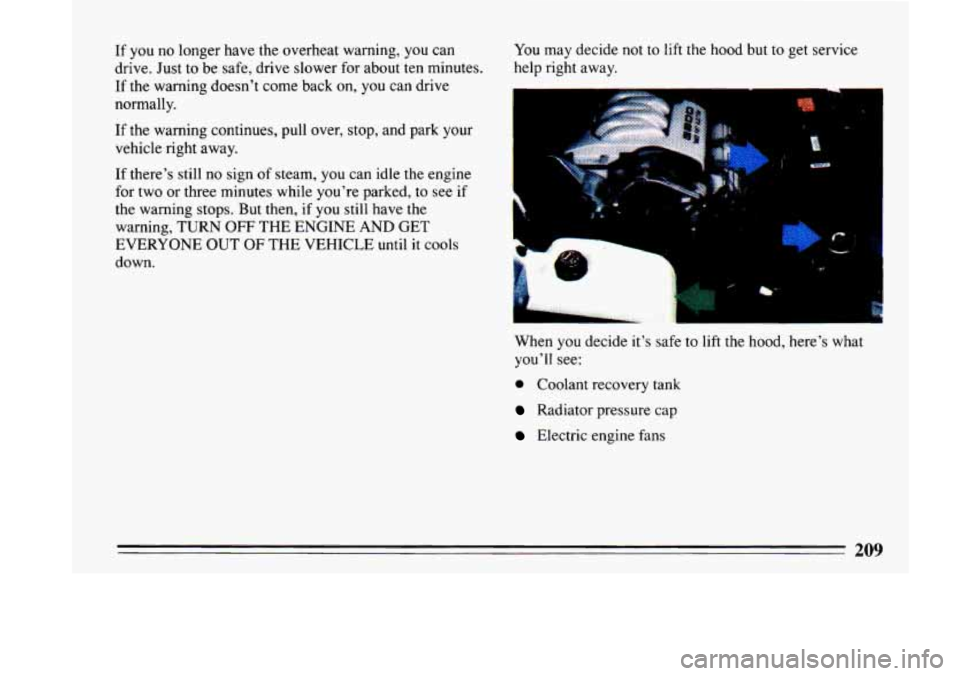
When you decide it's safe to lift the hood, here's what
you'll
see:
0 Coolant recovery tank
Radiator pressure cap
Electric engine fans
209
Page 212 of 324
0 -' e
A! ek-bic fan under the kod-can start up even
when' the endne is not runniiig and can Injure
yoG. Keep hands, clothing and tools away from
any underhood electric fan.
I
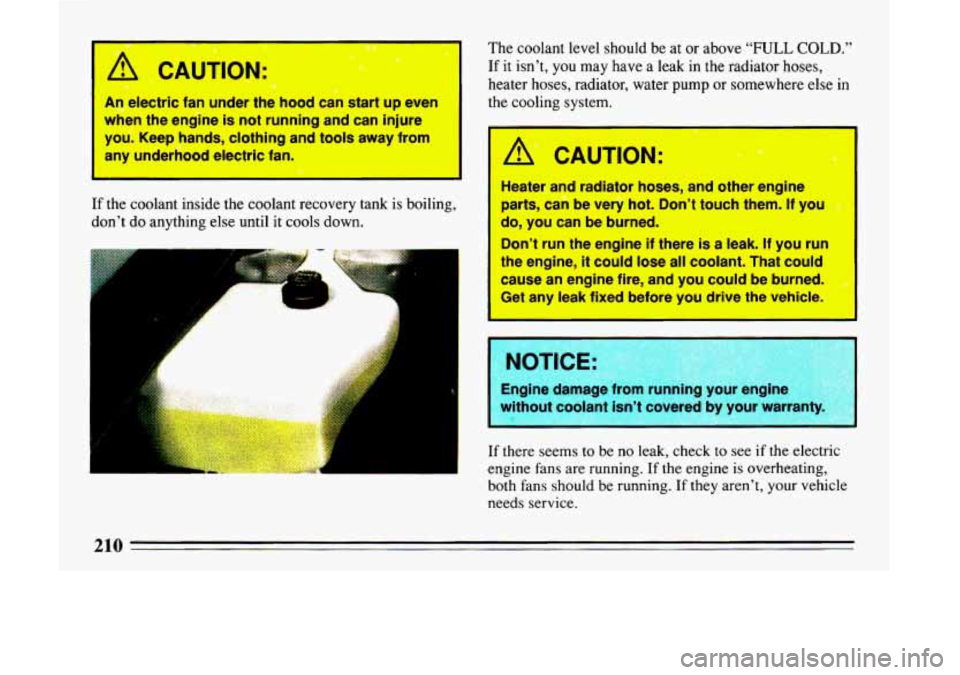
If the coolant inside the coolant recovery tank is boiling,
don't do anything else until it cools down.
I-
rs-
L
I
P
The coolant level should be at or above "FULL COLD.''
If it isn't, you may have a leak in the radiator hoses,
heater hoses, radiator, water
pump or somewhere else in
the cooling system,
I
/A CAUTION: 0
Heater and radiator hoses, and other engine
parts, can be very
hot. Don't touch them. If you p
do, you can be burned.
Don't run the engine if there is a leak.
If you run
the engine,
it could lose all coolant. That could
cause an engine fire, and you could be burned.
Get any leak fixed before you drive the vehicle.
I
Engine damage from running your engine
without coolant isn't covered by your warranty.
If there seems to be no leak, check to see if the electric
engine fans are running.
If the engine is overheating,
both fans
should be running. If they aren't, your vehicle
needs service.
Page 213 of 324
How to Add Coolant to the Coolant
Recovery Tank
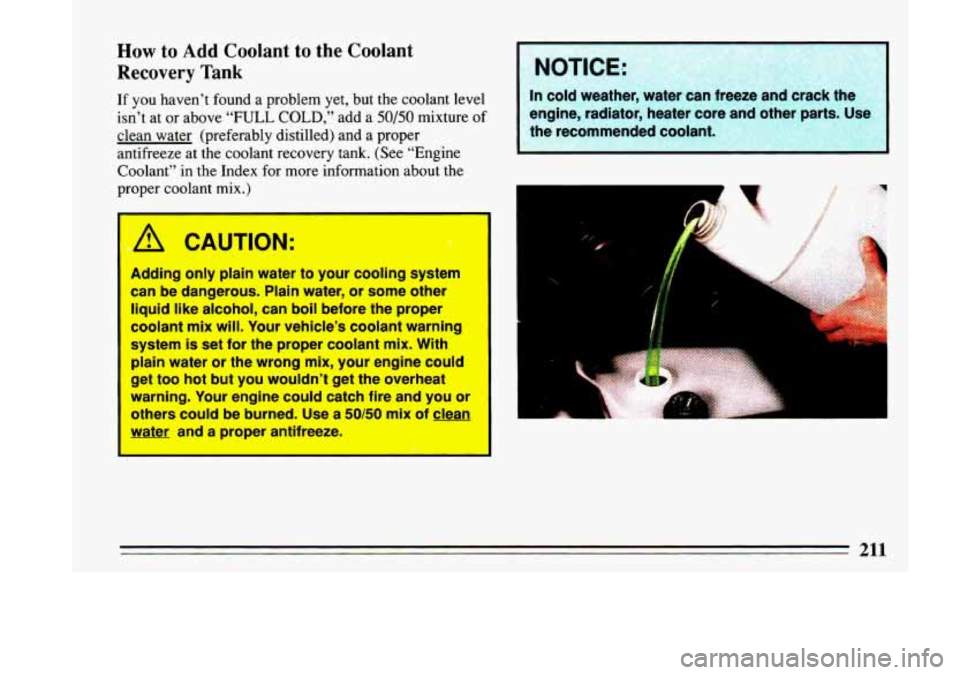
If you haven’t found a problem yet, but the coolant level
isn’t at or above
“FULL COLD,” add a 50/50 mixture of
clean water (preferably distilled) and
a proper
antifreeze at the coolant recovery tank. (See “Engine
Coolant”
in the Index for more information about the
proper coolant mix.)
‘A CAUTION: Q
Adding only plain water to your cooling system
can be dangerous. Plain water,
or some other
liquid like alcohol, can boil before the proper
coolant
mix will. Your vbhicle’s coolant warning
system
is set for the properecoolant mix. With
plain water or the’wrong mix, your engine could
get too hot
but you douldn’t get the overheat
warning.
Your engine could catch fire and you or
others could be burned. Use a 50/50 mix of clean
water and
a proper antifreeze.”
I NOTICE 1
I fr ze an :rack In cold weather, water c
engine, radiator, heater core and other parts. Us€
the recommended coolant. I
211
Page 214 of 324
A CAUTION:
You can be burned if you spill coolant on hot
engine parts. Coolant contains ethylene
glycol
and it will burn if the engine parts are hot
enough. Don’t
spill coolant on a hot engine.
When the coolant in the coolant recovery tank is at or
above “FULL COLD,” start your vehicle.
If the overheat warning continues, there’s one more
thing you can try.
You can add the proper coolant mix
directly to the radiator, but be sure the cooling system
is
cool before you do it.
Steam and scalding -liquids from a hot cooling
system
can blow out and burn you badly. They
are under pressure,
and if you turn the radiator
pressure cap
- even a little -- they can come out
at high speed..Never turn the cap when the
cooling system, including the radiatorpressure
cap, is hot. Wait for the cooling system and
radiator pressure
cap to cool if you ever have40
turn the pressure cap.
212
Page 230 of 324
If You’re Stuck: In Sand, Mud, Ice or
Snow
What you don’t want to do when your vehicle is stuck is
to spin your wheels. The method known as “rocking”
can help you get out when you’re stuck, but you must
use caution.
1 LAUTION:
If you let your tires spin at high speed, they can
explode and you or others could be injured. And,
the transaxle or other parts of the vehicle can
overheat. That could cause an engine
compartment fire or other damage. When you’re
stuck, spin the wheels as little as possible. Don’t
spin the wheels above 35 mph (55 km/h) as
own on the speedometer.
I
I AOTICE:
Spinning your troy pal I
vehicle as well as the tires. If you spin the wheels
too fast while shifting your transaxle
forth, you can destroy your transaxle.
Rocking your vehicle to get it out:
First, turn your steering wheel left and right. That will
clear the area around your front wheels. Then shift back
and forth between
“R” (Reverse) and a forward gear ,
spinning the wheels as little as possible. Release the
accelerator pedal while you shift, and press lightly on
the accelerator pedal when the transaxle
is in gear. If
that doesn’t get
you out after a few tries, you may need
to be towed out. If you do need to be towed out, see
“Towing Your Car” in the Index.
Page 245 of 324
3.
4.
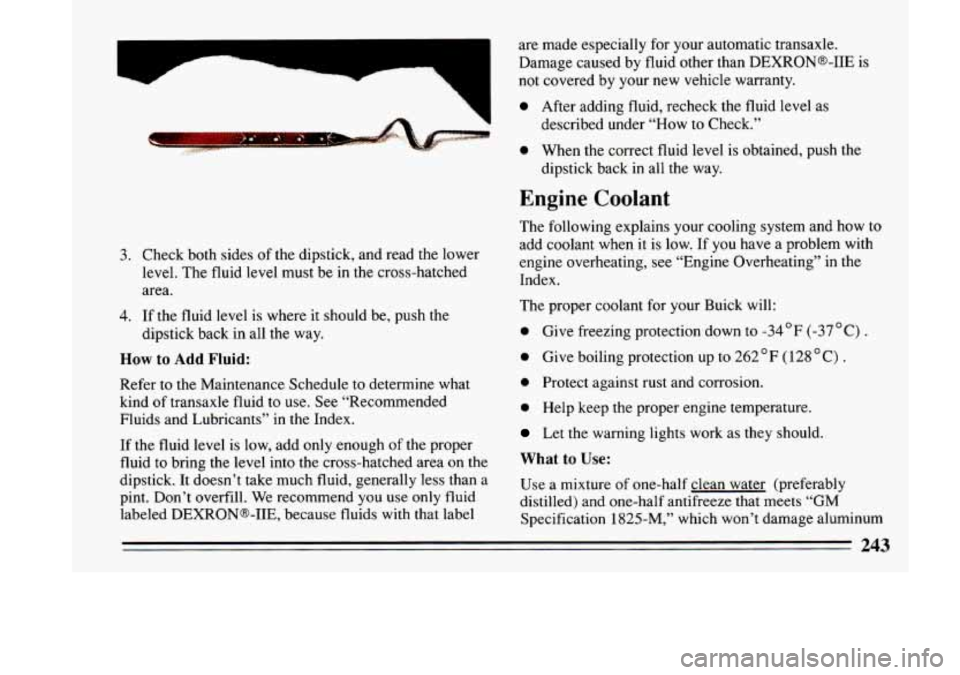
Check both sides of the dipstick, and read the lower
level. The fluid level must be in the cross-hatched
area.
If the fluid level is where it should be, push the
dipstick back in all the way.
How to Add Fluid:
Refer to the Maintenance Schedule to determine what
kind
of transaxle fluid to use. See “Recommended
Fluids and Lubricants” in the Index.
If the fluid level
is low, add only enough of the proper
fluid to bring the level into the cross-hatched area on the
dipstick. It doesn’t take much fluid, generally less than a
pint. Don’t overfill. We recommend you use only fluid
labeled DEXRONa-IIE, because fluids with that label are made especially for your automatic transaxle.
Damage caused by fluid other than DEXRONs-IIE
is
not covered by your new vehicle warranty.
0 After adding fluid, recheck the fluid level as
described under “How to Check.”
0 When the correct fluid level is obtained, push the
dipstick back in all the way.
Engine Coolant
The following explains your cooling system and how to
add coolant when it is low. If you have a problem with
engine overheating, see “Engine Overheating” in the
Index.
The proper coolant for your Buick will:
0 Give freezing protection down to -34OF (-37OC) .
0 Give boiling protection up to 262°F (128 “C) .
0 Protect against rust and corrosion.
0 Help keep the proper engine temperature.
Let the warning lights work as they should.
What to Use:
Use a mixture of one-half clean water (preferably
distilled) and one-half antifreeze that meets
“GM
Specification 1825-M,” which won’t damage aluminum
243
Page 246 of 324
parts. You can also use a recycled coolant conforming to
GM Specification 1825-M with a complete coolant flush
and refill. Use GM Engine Coolant Supplement (sealer)
with any complete coolant change.
If you use these, you
don’t need
to add anything else.
I k!, CAUTION:
Adding only plain water to your cooling system
can be dangerous. Plain water,
or some other
liquid like alcohol, can boil before the proper
coolant mix will. Your vehicle’s coolant warning
system
is set for the proper coolant mix. With
plain water or the wrong mix, your engine could
get too
hot but you wouldn’t get the overheat
warning. Your engine could catch fire
and you or
others could be burned.
Use a 5050 mix of clean
water and a proper antifreeze.
I
I NO IC i:
IT you use an Improper coolant mix, your engine
could overheat and be badly damaged. The
repair cost wouldn’t be covered
by your
warranty.
Too much water in the mix can treeze
and crack the engine, radiator, heater core and other
parts.
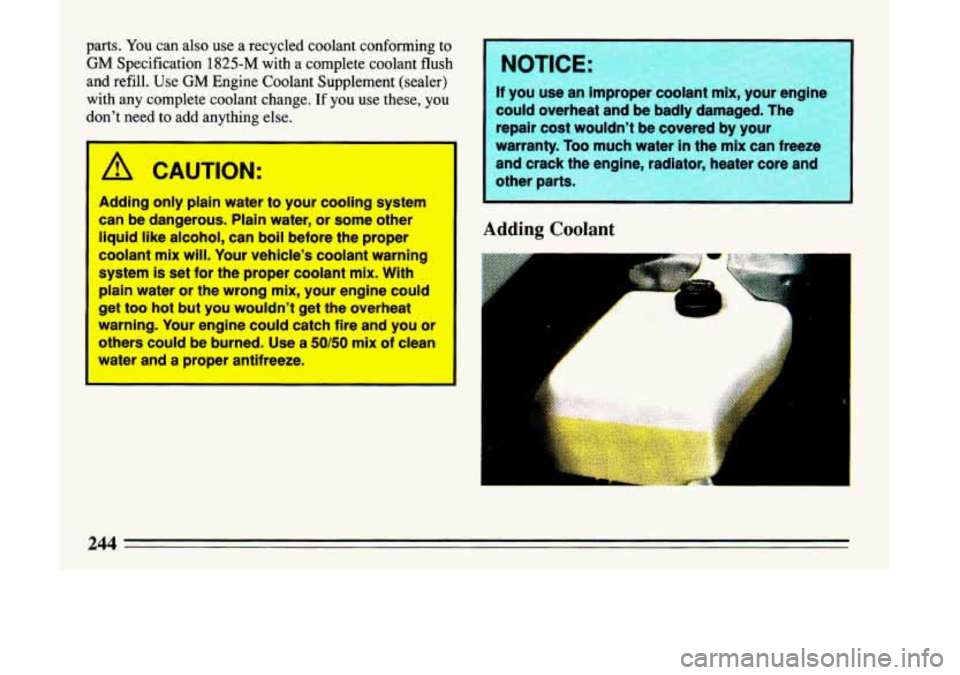
Adding Coolant
Page 247 of 324
To Check Coolant: When your engine is cold, the
coolant level should
be at “FULL COLD,’’ or a little
higher. When your engine is
warm, the level should be
up to “FULL HOT,” or a little higher.
To Add Coolant: If you need more coolant, add the
proper mix at the coolant recovery tank.
I
I
A CAUTION:
Turning the radiator pressure cap when the
engine and radiator are hot can
allow steam and
scaldlng
liquids to blow out and burn you badly.
With the coolant recovery tank, you will almost
never have
to add coolant at the radiator. Never
turn the radiator pressure cap -- even a little -
when the engine and radiator are hot.
Add coolant mix at the recovery tank, but be careful not
to spill
it.
A CAUTION: I
You can be burned if you spill coolant on hot
engine parts. Coolant contains ethylene glycol,
-..d
it will burn if the engine parts are hot
enough. Don’t spill coolant on a hot engine.
Radiator Pressure Cap
I Tour rar
I I.
cap IS a 13 PSI (105 kPa1
pressure-rype cap and must be tightly Insrawe
to prevent coolant loss and possible engine
damage from overheating. Be sure the arrows
o
I
the cap line up with
radiator filler neck. I
When you replace your radiator pressure cap, an AC@
cap is recommended.
245