Page 213 of 324
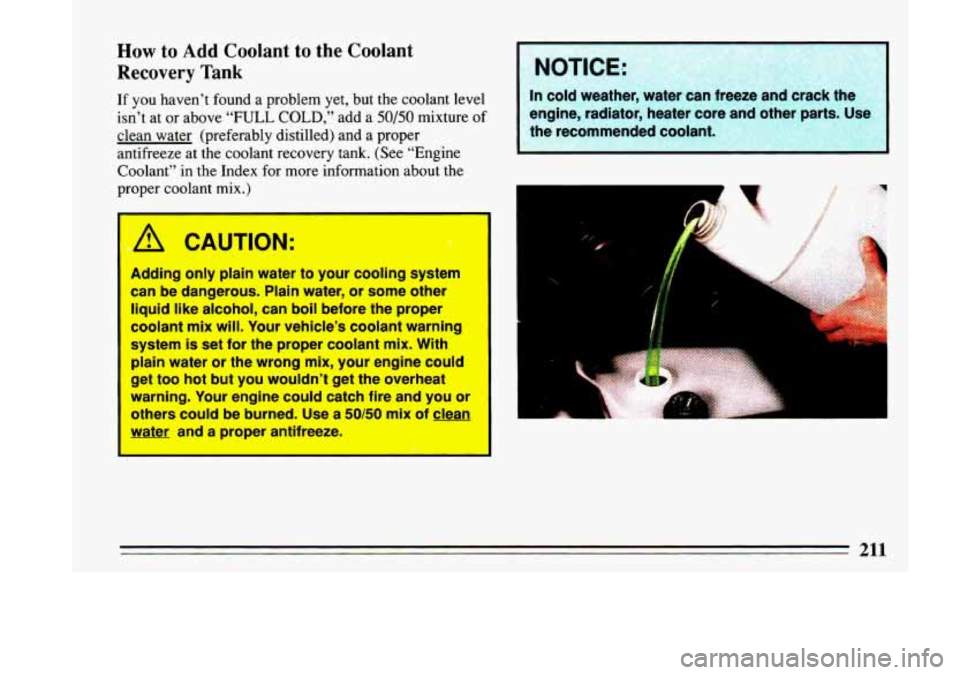
How to Add Coolant to the Coolant
Recovery Tank
If you haven’t found a problem yet, but the coolant level
isn’t at or above
“FULL COLD,” add a 50/50 mixture of
clean water (preferably distilled) and
a proper
antifreeze at the coolant recovery tank. (See “Engine
Coolant”
in the Index for more information about the
proper coolant mix.)
‘A CAUTION: Q
Adding only plain water to your cooling system
can be dangerous. Plain water,
or some other
liquid like alcohol, can boil before the proper
coolant
mix will. Your vbhicle’s coolant warning
system
is set for the properecoolant mix. With
plain water or the’wrong mix, your engine could
get too hot
but you douldn’t get the overheat
warning.
Your engine could catch fire and you or
others could be burned. Use a 50/50 mix of clean
water and
a proper antifreeze.”
I NOTICE 1
I fr ze an :rack In cold weather, water c
engine, radiator, heater core and other parts. Us€
the recommended coolant. I
211
Page 214 of 324
A CAUTION:
You can be burned if you spill coolant on hot
engine parts. Coolant contains ethylene
glycol
and it will burn if the engine parts are hot
enough. Don’t
spill coolant on a hot engine.
When the coolant in the coolant recovery tank is at or
above “FULL COLD,” start your vehicle.
If the overheat warning continues, there’s one more
thing you can try.
You can add the proper coolant mix
directly to the radiator, but be sure the cooling system
is
cool before you do it.
Steam and scalding -liquids from a hot cooling
system
can blow out and burn you badly. They
are under pressure,
and if you turn the radiator
pressure cap
- even a little -- they can come out
at high speed..Never turn the cap when the
cooling system, including the radiatorpressure
cap, is hot. Wait for the cooling system and
radiator pressure
cap to cool if you ever have40
turn the pressure cap.
212
Page 215 of 324
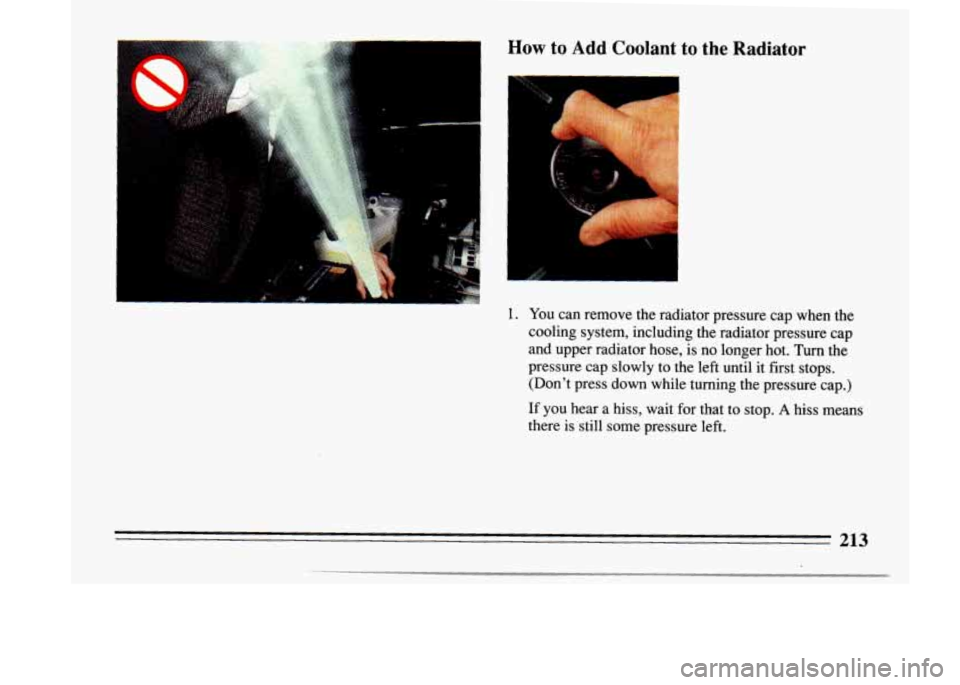
How to Add Coolant to the Radiator I
A@' #, I
1. You can remove the radiator pressure cap when the
cooling system, including the radiator pressure cap
and upper radiator hose,
is no longer hot. Turn the
pressure cap slowly to the left until
it first stops.
(Don't press down while turning the pressure cap.)
If you hear a hiss, wait for that to stop. A hiss means
there is still
some pressure left.
213
Page 245 of 324
3.
4.
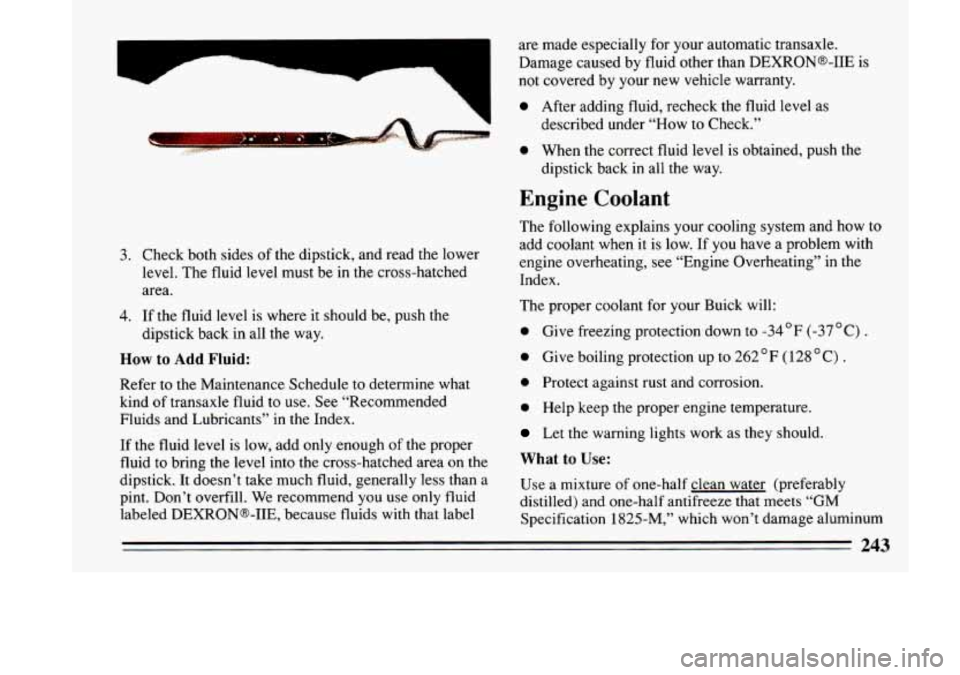
Check both sides of the dipstick, and read the lower
level. The fluid level must be in the cross-hatched
area.
If the fluid level is where it should be, push the
dipstick back in all the way.
How to Add Fluid:
Refer to the Maintenance Schedule to determine what
kind
of transaxle fluid to use. See “Recommended
Fluids and Lubricants” in the Index.
If the fluid level
is low, add only enough of the proper
fluid to bring the level into the cross-hatched area on the
dipstick. It doesn’t take much fluid, generally less than a
pint. Don’t overfill. We recommend you use only fluid
labeled DEXRONa-IIE, because fluids with that label are made especially for your automatic transaxle.
Damage caused by fluid other than DEXRONs-IIE
is
not covered by your new vehicle warranty.
0 After adding fluid, recheck the fluid level as
described under “How to Check.”
0 When the correct fluid level is obtained, push the
dipstick back in all the way.
Engine Coolant
The following explains your cooling system and how to
add coolant when it is low. If you have a problem with
engine overheating, see “Engine Overheating” in the
Index.
The proper coolant for your Buick will:
0 Give freezing protection down to -34OF (-37OC) .
0 Give boiling protection up to 262°F (128 “C) .
0 Protect against rust and corrosion.
0 Help keep the proper engine temperature.
Let the warning lights work as they should.
What to Use:
Use a mixture of one-half clean water (preferably
distilled) and one-half antifreeze that meets
“GM
Specification 1825-M,” which won’t damage aluminum
243
Page 246 of 324
parts. You can also use a recycled coolant conforming to
GM Specification 1825-M with a complete coolant flush
and refill. Use GM Engine Coolant Supplement (sealer)
with any complete coolant change.
If you use these, you
don’t need
to add anything else.
I k!, CAUTION:
Adding only plain water to your cooling system
can be dangerous. Plain water,
or some other
liquid like alcohol, can boil before the proper
coolant mix will. Your vehicle’s coolant warning
system
is set for the proper coolant mix. With
plain water or the wrong mix, your engine could
get too
hot but you wouldn’t get the overheat
warning. Your engine could catch fire
and you or
others could be burned.
Use a 5050 mix of clean
water and a proper antifreeze.
I
I NO IC i:
IT you use an Improper coolant mix, your engine
could overheat and be badly damaged. The
repair cost wouldn’t be covered
by your
warranty.
Too much water in the mix can treeze
and crack the engine, radiator, heater core and other
parts.
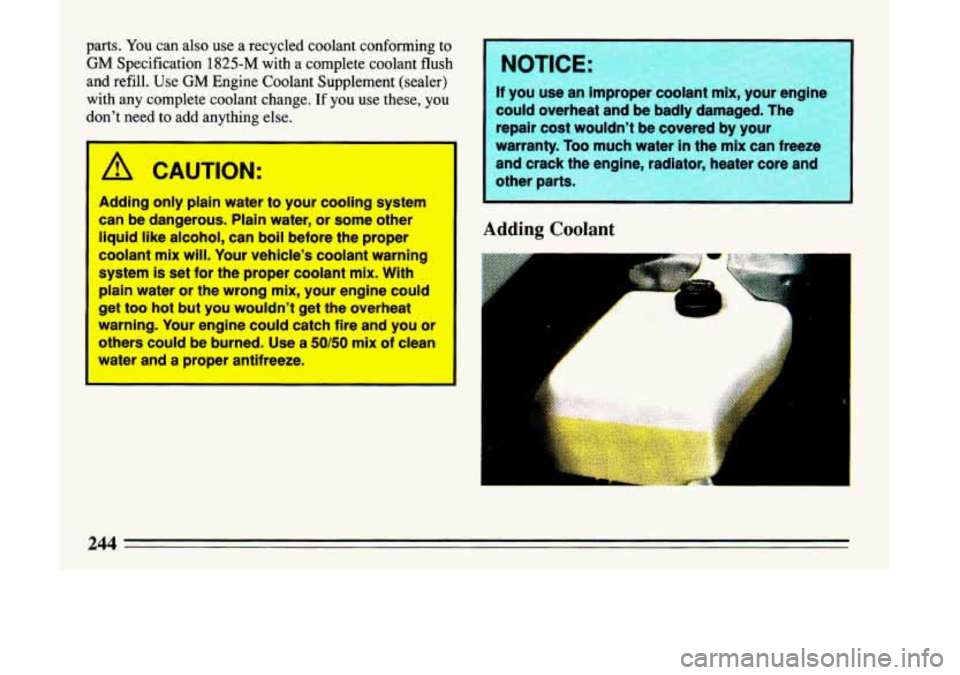
Adding Coolant
Page 263 of 324
‘A CAUTION:
0
Using the wrong replacement wheels, wheel
bolts,
or whwl nuts on your vehicle can be
dangerous. It could affect the braking and
handling
of your vehicle, make your tires lose air
and make you lose control.
You could have a
collision in which you or others could be injured.
Always use the correctwheel, wheel bolts, and
wheel
nuts for replacement.
NOTICE:
I
The wrong wheel can also cause problems with
bearing life, brake cooling,
speedometerlodometer calibration, headlight
aim, bumper height, vehicle ground clearance,
and tire
or tire chai
Used Rep1 Vheels - - -
’A CAUTION:
Putting a used wheel on your vehicle is
dangerous. You can’t know how it’s been used or
how many miles it’s been driven.
It could fail
suddenly and cause an accident. If you have to
replace a wheel use anew
GM original
equipment wheel.
I
Tire Chains
NOTICE
Use tire chains
SAE Class “S”
size for your
and tighten them as tightly as possible with
ends securely fastened. Drive
slowly and fol
the chain ma
hear the chai
retighten them.
If the contact continues, .elow
down until it stops. Driving ton fast with 4
on will damage your vehicle.
261
Page 273 of 324
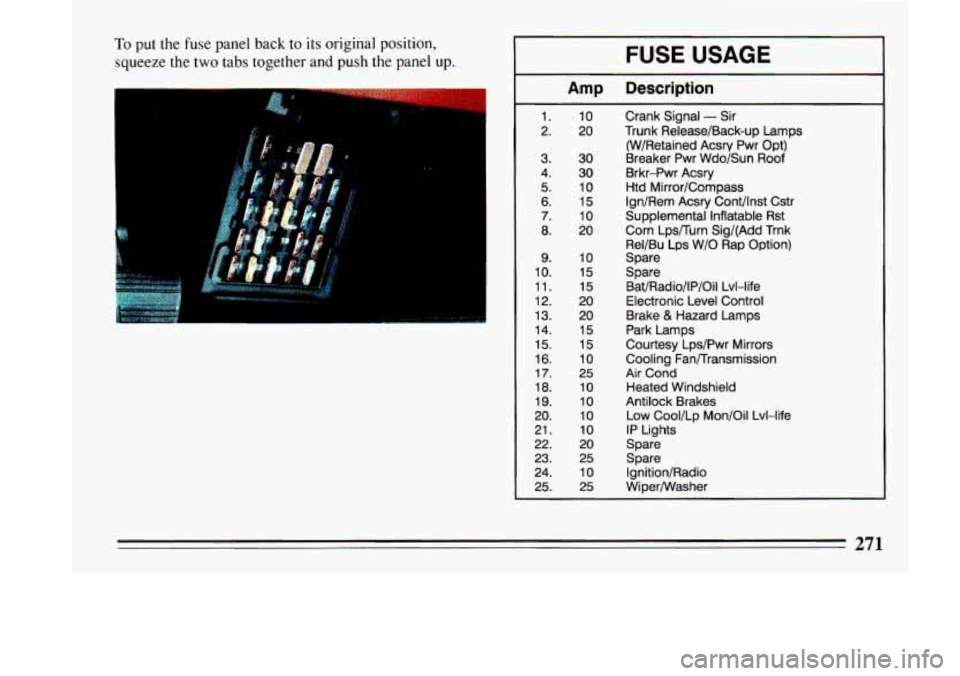
To put the fuse panel back to its original position,
squeeze the two tabs together and push the panel up.
r
E
6
P-
..
-
FUSE USAGE
--- ~
Amp Description
1.
2.
3.
4.
5.
6.
7.
8.
9.
10.
11.
12.
13.
14.
15.
16.
17.
18.
19.
20.
21.
22.
23.
24.
25. 10
20
30
30
10
15
10
20
10
15
15
20
20
15 15
10
25
10
10 10
10
20
25
10
25
Crank Signal - Sir
Trunk Release/Back-up Lamps (W/Retained Acsrv Pwr Opt)
Breaker Pwr Wdo/Sun Roof
Brkr-Pwr Acsry
Htd Mirror/Compass
Ign/Rem Acsry Cont/lnst Cstr
Supplemental Inflatable
Rst
Corn Lpsflurn Sig/(Add Trnk
Rel/Bu Lps W/O Rap Option)
Spare
Spare
Bat/Radio/lP/Oil Lvl-life
Electronic Level Control
Brake
& Hazard Lamps
Park Lamps
Courtesy Lps/Pwr Mirrors
Cooling Fanflransmission
Air Cond
Heated Windshield
Antilock Brakes Low Cool/Lp Mon/Oil Lvl-life
IP Lights
Spare
Spare Ignition/Radio
WiperWasher
271
Page 277 of 324
Capacities and Specifications
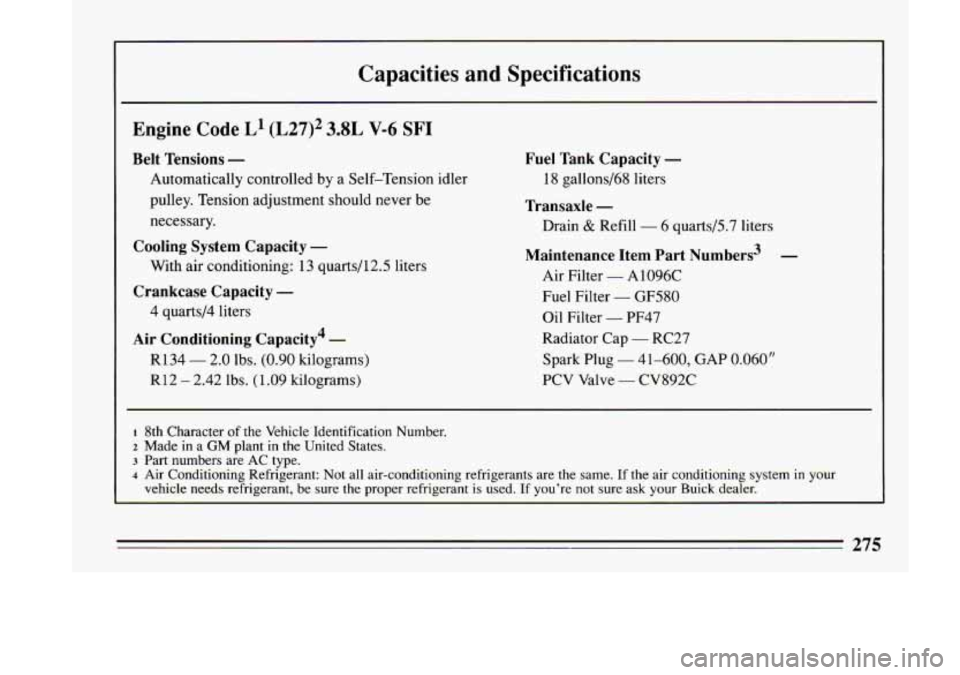
Engine Code L1 (L27)2 3.8L V-6 SF1
Belt Tensions -
Automatically controlled by a Self-Tension idler
pulley. Tension adjustment should never
be
necessary.
Cooling System Capacity -
Crankcase Capacity -
Air Conditioning Capacity4 -
With air conditioning: 13 quarts/l2.5 liters
4 quarts/4 liters
R134
- 2.0 lbs. (0.90 kilograms)
R12 - 2.42 lbs. ( 1.09 kilograms)
Fuel Tank Capacity -
18 gallons/68 liters
Transaxle -
Drain & Refill - 6 quarts/5.7 liters
Maintenance Item Part Numbers3 -
Air Filter - A1096C
Fuel Filter
- GF580
Oil Filter
- PF47
Radiator Cap - RC27
Spark Plug
- 41-600, GAP 0.060”
PCV Valve
- CV892C
1 8th Character of the Vehicle Identification Number.
2 Made in a GM plant in the United States.
3 Part numbers are AC type.
4 Air Conditioning Refrigerant: Not all air-conditioning refrigerants are the same. If the air conditioning system in your
vehicle needs refrigerant, be sure the proper refrigerant
is used. If you’re not sure ask your Buick dealer.