1993 BUICK CENTURY fuel system
[x] Cancel search: fuel systemPage 14 of 324

I
Vehicle Symbols
These are some of the symbols you will find on your vehicle.
For example,
these symbols
are used on an
original battery:
POSSIBLE A
CAUTION
INJURY
PROTECT EYES BY
SHIELDING
CAUSTIC
ACID COULD CAUSE
BATTERY
BURNS AVOID
SPARKS
OR
FLAMES
SPARK
OR ,111,
COULD FLAME
EXPLODE BATTERY
These symbols
are important
for. you and
your passengers
whenever your
vehicle
is
driven:
DOOR LOCK
UNLOCK
FASTEN SEAT
4
BELTS
POWER
WINDOW
These symbols
have
to do with
your lights:
SIGNALS e3
TURN
WARNING
A
HAZARD
FLASHER
HIGH BEAM
OR =, =o
FOG LAMPS # 0
These symbols
are on some
of
your controls:
WINDSHIELD ' ' ' 0- 0-
WIPER &
WASHER
t0 @e4 i
WINDSHIELD=
WASHER I
wlNDsHIELDw DEFROSTER
WINDOW
@
REAR
DEFOGGER
VENTILATING FAN
HEADLAMP
-
WIPER -
WASHER zQ
Thes, ,ymbols
are used on
warning and indicator lights:
COOLANT F-
ENGINE
TEMP
--
CHARGING I-1
BATTERY SYSTEM
FUEL
ENGINE OIL wb
PRESSURE
TEMP
OIL &
ANTILOCK BRAKE (i)
Here are some
other symbols
you may see:
FUSE
RADIO
k
VOLUME a
CONDITIONING AIR a
HATCHBACK e
TRUNK
RELEASE
SPEAKER
b
ProCarManuals.com
Page 107 of 324
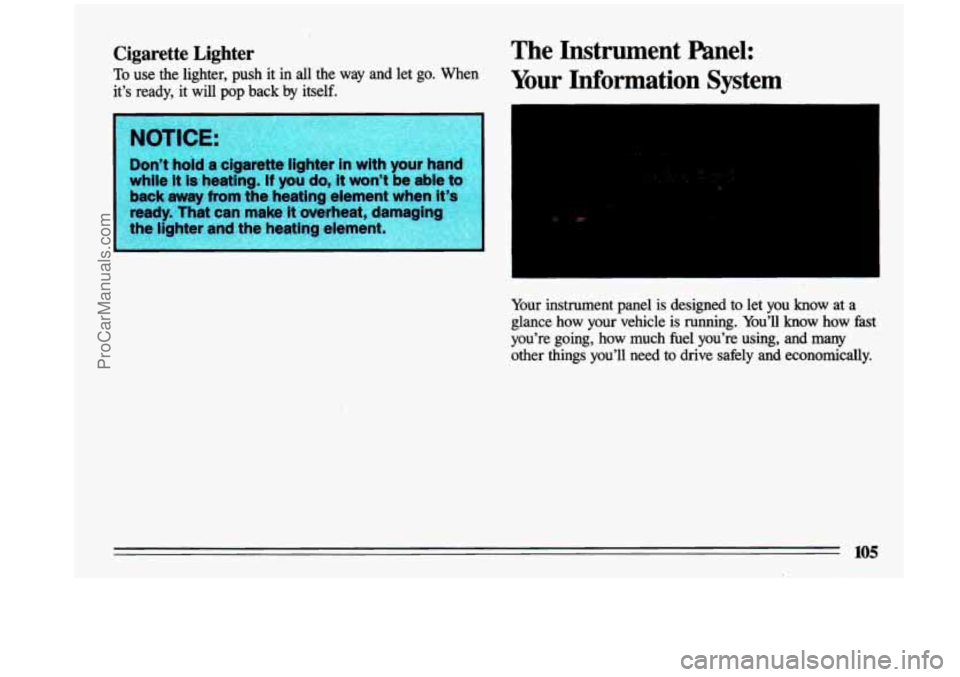
Cigarette Lighter
To use the lighter, push it in all the way and let go. When
it’s ready, it will pop back by itself.
The Instrument Panel:
Your Information System
L
Your instrument panel is designed to let you know at a
glance
how your vehicle is running. You’ll know how fast
you’re going,
how much fuel you’re using, and many
other things you’ll need to drive safely
and economically.
105
ProCarManuals.com
Page 113 of 324
X"' 1 r-l
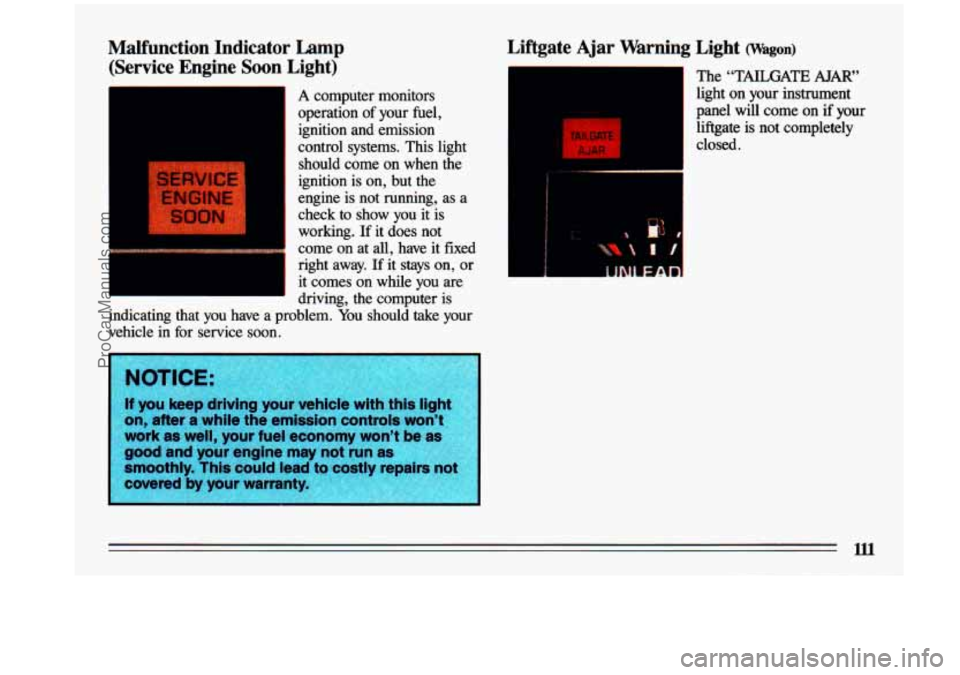
Malfunction Indicator Lamp
(Service Engine Soon Light)
A computer monitors
I operation of your fuel,
ignition and. emission
control systems. This light should come on when the
ignition is on, but the
engine is not running, as a
check to show
you it is
working.
If it does not
come on at all, have it fixed
right away.
If it stays on, or
it comes on while you are
driving, the computer is
I
indicating that you have a problem. You should take your
vehicle in
for service soon.
Liftgate Ajar Warning Light (Wagon)
.-
- The "TAILGATE AJAR"
~ light on your instrument
panel
will come on if your
I
TAI! GAY E
ALAR
liftgate is not completely
1 closed.
ProCarManuals.com
Page 116 of 324
1
Your Buick Comfort Control
Syst m -
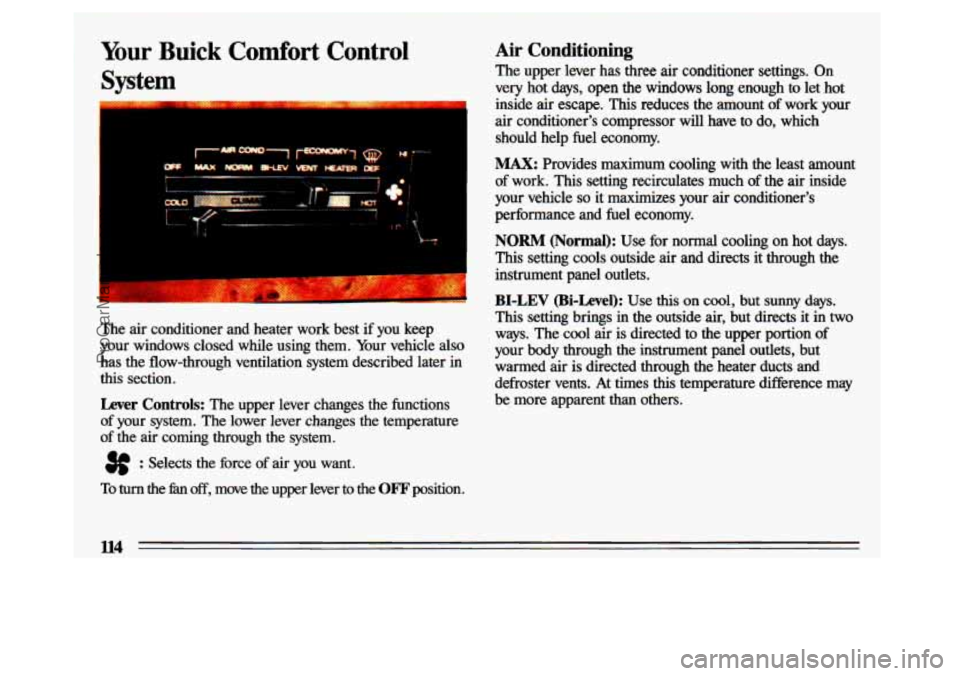
The air conditioner and heater work best if you keep
your windows closed while using them. Your vehicle
also
has the flow-through ventilation system described later in
this section.
Lever Controls: The upper lever changes the functions
of your system. The lower lever changes the temperature
of the air coming through the system.
3f : Selects the force of air you want.
Air Conditioning
The upper lever has three air conditioner settings. On
very hot days, open the windows long enough to let hot
inside air escape.
This reduces the amount of work your
air conditioner's compressor
will have to do, which
should help fuel economy.
MAX: Provides maximum cooling with the least amount
of work. This setting recirculates much of the air inside
your vehicle
so it maximizes your air conditioner's
performance and
fuel economy.
NORM (Normal): Use for normal cooling on hot days.
This setting cools outside air and directs it through the
instrument panel outlets.
BI-LEV (Bi-Level): Use this on cool, but sunny days.
This setting brings in the outside air, but directs it in two\
ways. The cool air
is directed to the upper portion of
your body through the instrument panel
outlets, but
warmed air is directed through the heater ducts and
defroster vents. At times
this temperature difference may
be more apparent than others.
To turn the 5x1 off, move the upper lever to the OF'F position.
ll4
ProCarManuals.com
Page 226 of 324
Gasolines for Cleaner Air
Your use of gasoline with detergent additives will help
prevent deposits
from forming in your engine and fuel
system. That helps keep your engine in tune and your
emission control system working properly. It’s good for
your vehicle, and you’ll be doing your part for cleaner
air.
Many gasolines
are now blended with materials called
oxygenates. General Motors recommends that you use gasolines
with these blending materials, such as MTBE
and ethanol.
By doing so, you can help clean the air,
especially
in those parts of the country that have high
carbon monoxide levels.
In addition, some gasoline suppliers are now producing
reformulated gasolines. These gasolines are specially
designed to reduce vehicle emissions. General Motors recommends that you use reformulated gasoline. By
doing
so, you can help clean the air, especially in those
parts of the country that have high ozone levels.
You should ask your service station operators if their
gasolines contain detergents and oxygenates, and if they
have been reformulated to reduce vehicle emissions.
F’uels in Foreign Countries
If you plan on driving in another country outside the U.S.
or Canada, unleaded fuel may be hard to find.
Do not use leaded gasoline. If you use even one tankful,
your emission controls won’t work well or at
all. With
continuous use, spark plugs can get fouled, the exhaust
system can corrode, and your engine oil can deteriorate
quickly. Your vehicle’s oxygen sensor will be damaged.
All of that
means costly repairs that wouldn’t be covered
by your warranty.
To check on fuel availability, ask an auto club, or contact
a major oil company that does business in the country
where
you’ll be driving.
You
can also write us at the following address for advice.
Just tell us where you’re going and give your Vehicle Identification Number
(VIN) .
General Motors of Canada Ltd.
International Export Sales
P. 0. Box 828
Oshawa, Ontario L1H 7N1, Canada
I
224
ProCarManuals.com
Page 265 of 324
Sheet Metal Damage
If your vehicle is damaged and requires sheet metal
repair or replacement, make sure the body repair shop
applies anti-corrosion material to the parts repaired or
replaced to restore corrosion protection.
Foreign Material
Calcium chloride and other salts, ice melting agents, road
oil and tar, tree sap, bird droppings, chemicals from
industrial chimneys, and other foreign matter can damage
your vehicle’s finish if they remain on painted surfaces. Use cleaners that are marked safe for painted surfaces for
these stains.
Finish Damage
Any stone chips, fractures or deep scratches in the finish
should be repaired right away. Bare metal will corrode
quickly and may develop into a major repair expense.
Minor chips and scratches
can be repaired with touch-up
materials available from your dealer or other service
outlets. Larger areas of finish damage can be corrected in
your dealer’s body and paint shop.
Underbody Maintenance
Chemicals used for ice and snow removal and dust
control can collect on the underbody. If these
are not
removed, accelerated corrosion (rust) can occur on the
underbody parts such as fuel lines, frame,
floor pan, and
exhaust system even though they have corrosion
protection.
At least every spring, flush these materials from the
underbody
with plain water. Clean any areas where mud
and other debris can collect. Dirt packed
in closed areas
of the frame should be loosened before being flushed.
Your dealer or an underbody vehicle washing system can
do this for you.
Chemical paint Spotting
Some weather and atmospheric conditions can create a
chemical fdlout. Airborne pollutants can
f$ll upon and
attack painted surfaces on your vehicle. This damage can
take
two forms: blotchy, ringlet-shaped discolorations,
and small irregular dark
spots etched into the paint
surhce.
Although no defect in the paint job causes
this, Buick
will repair, at no charge to the owner, the surfaces
of new
vehicles damaged by this fallout condition within 12
months or 12,OOO miles (20 OOO km) of purchase,
whichever comes first.
ProCarManuals.com
Page 269 of 324

Fuse Usage
I
I
Fuse Rating
(AMPS)
A
B
C
D E
15
20
10
10
15
ECM; MAF Sensor (3300 Engine only)
ECM Injectors/Coil
Eng. A/C Relay; EGR Solenoid; Canister Purge Solenoid
Fan/Elect; Generator; DRL Module
Turn Signal Flasher; Back-up Lights;
TruWLiftgate Release
Fuse
F
G
H
I
J
K
L
M
Rating
(AMPS)
10
20
20
10
20
20
30"
5
Circuitry N
0
P
Q
10
30"
25
20
15
15
15
Circuitry
Supplemental Inflatable Restraint (Air Bagj
Tail; Park; Side Marker; License Plate; Stop/Turn Signal
Heater/Air Conditioner
Gages; Warning Indicators; Torque Convert
Clutch; Audible Warning System; Computer Command Control; Trunk Release; Brake
Warning Indicator; Rear Defog Switch;
Speedometer
Stop Lights; Hazard Flashers
Interior, Underhood, Courtesy, I/P, Trunk Lights; Door
Locks; Horn Relay, Passive Restraint
System, Deck Lid Release, Power Antenna
Liftgate Release; Power Windows
Illumination for: I/P, Radio,
Pod Lights,
Ashtray, Console Light, Heater-A/C Control,
Defog Switch, Headlight Switch
Radio, Cruise Control
Seats, Door
Locks, Rear Defog
Windshield Wipe/Wash
Cigarette Lighter
Safety Belt/Chirne (ICAM) Module (Located
behind the fuse block, above the hush panel.)
Remote Lock Control (Located behind the fuse
block, above the hush panel.) Fuel Pump, ECM (Located under the hood.)
*Circuit Breaker
267
ProCarManuals.com
Page 272 of 324

Capacities and Specifications
Engine Code N1 (LGP2 3300 (3.3L) V6 MFI
Belt Tensions-Automatically controlled by a self-tensioning idler pulley. Tension
Cooling System Capacity
adjustment should never be necessary.
Complete System
................................................. 10.5 Quarts
Radiator and Recovery
Tank Only .................................... 3.4 Quarts
crankcase Capacity
(Less Filter) ..................................... 4 Quarts
Air Conditioning Refrigerant Capacity (Rl2) ........................... 2.38 Pounds
Not all air conditioning refrigerants are the same. If the air\
conditioning system in your vehicle needs refrigerant, be sure the proper refrigera\
nt is used. If
you’re not sure, ask your Buick dealer.
Fuel Tank Capacity
................................................ 16.5 Gallons
8th Character of the Vehicle Identification Number. * Made in a GM plant in the United States.
9.9 Liters
3.2 Liters
3.8 Liters
1.07 Kilograms
62.6 Liters
270
ProCarManuals.com