Page 203 of 324
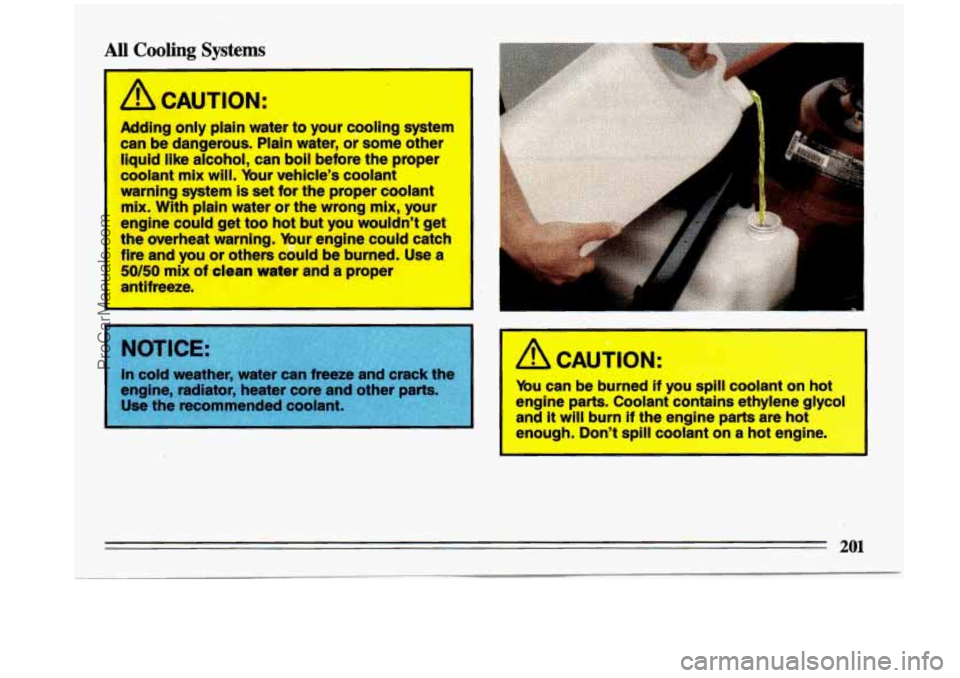
All Cooling Systems
A CAUTION:
Adding only plain water to your c.ooling system
can be dangerous. Plain water, or some other
liquid like alcohol, can boil before the proper
coolant mix will. Your vehicle's coolant
warning system is set for the proper coolant
mix.
With plain water or the wrong mix, your
engine could get too hot but you wouldn't get
the overheat warning.
Your engine could catch
fire and you or others could be burned. Use a
50/50 mix of clean water and a proper
antifreeze.
I
I
A CAUTION:
You can be burned if you spill coolant on hot
engine parts. Coolant contains ethylene
glycol
and it will burn if the engine parts are hot
enough. Don't spill coolant on
a hot engine. I
201
ProCarManuals.com
Page 206 of 324
i
5. Put the cap back on the coolant recovery tank, but
leave the radiator pressure cap off.
k
6. Start the engine and let it run until you can feel the
upper radiator hose getting hot. Watch out for the
engine fan.
7. By this time, the coolant level inside the radiator filler
neck may be lower.
If the level is lower, add more of
the proper mix through the filler neck until the level
reaches the base
of the filler neck.
204
ProCarManuals.com
Page 223 of 324

.
n
Part 6 Service and Appearance Care
. .
Here you will find information about the care of your Buick . This part begins with service and fuel information.
and then
it shows how to check important fluid and lubricant levels . There is also technical information about
your vehicle. and a section devoted to
its appearance care .
Part 6 includes:
Service ........................................................................\
..... 222
Fuel ........................................................................\
...... 223
HoodRelease ....................................................................... \
226
Engine Oil ........................................................................\
. 227
Aircleaner ........................................................................\
2.3
TransaxleFluid ..................................................................... 236
Enginecoolant ..................................................................... 239
Power Steering Fluid ................................................................. 241
Windshield Washer Fluid .............................................................. 242
Brakes ........................................................................\
.... 243
Battery ........................................................................\
.... 244
BulbReplacement ................................................................... 245
Tires ........................................................................\
...... 251
Loadingyourvehicle ................................................................. 249
Appearancecare .................................................................... 258
Vehicle Identification Number (VIN), Add-on Electrical Equipment ............................ 265
Capacities and Specifications .......................................................... -270
Fuses&CircuitBreakers .............................................................. 266
ReplacementBulbs .................................................................... 269
ProCarManuals.com
Page 229 of 324
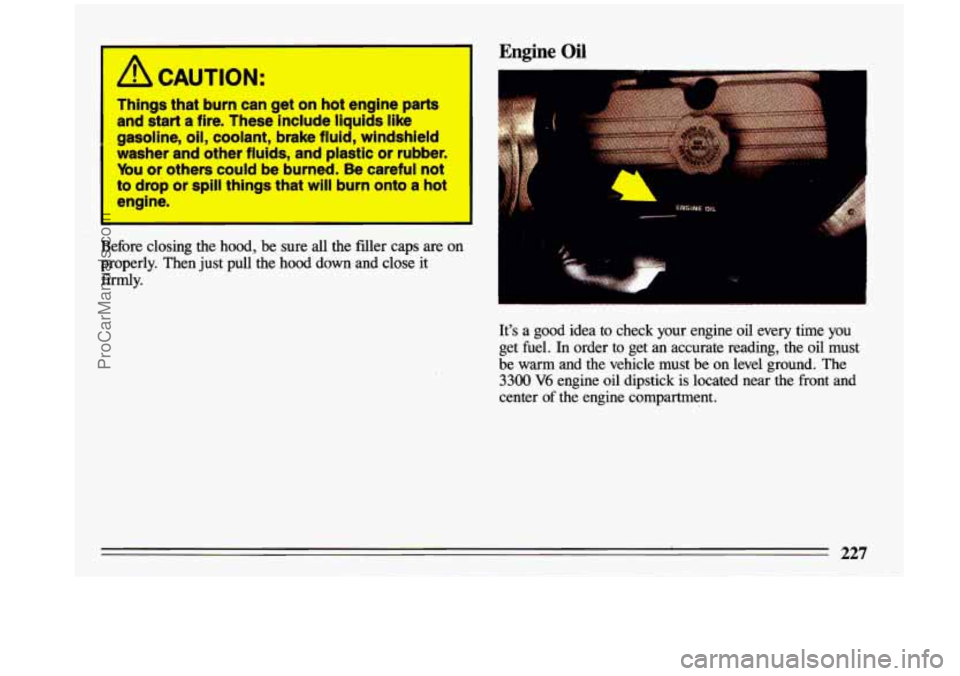
/i CAUTION:
Things that burn can get on hot engine parts
and start
a fire. These include liquids like
gasoline, oil, coolant, brake fluid, windshield
washer and other fluids, and plastic or rubber.
You or others could be burned. Be careful not
to drop
or spill things that will burn onto a hot
engine.
Before closing the hood, be sure all the filler caps are on
properly. Then just pull the hood down and close it
firmly.
Engine Oil
I‘
I
It’s a good idea to check your engine oil every time you
get fuel. In order to get an accurate reading, the oil must
be warm and the vehicle must be on level ground. The
3300 V6 engine oil dipstick is located near the front and
center
of the engine compartment.
ProCarManuals.com
Page 241 of 324
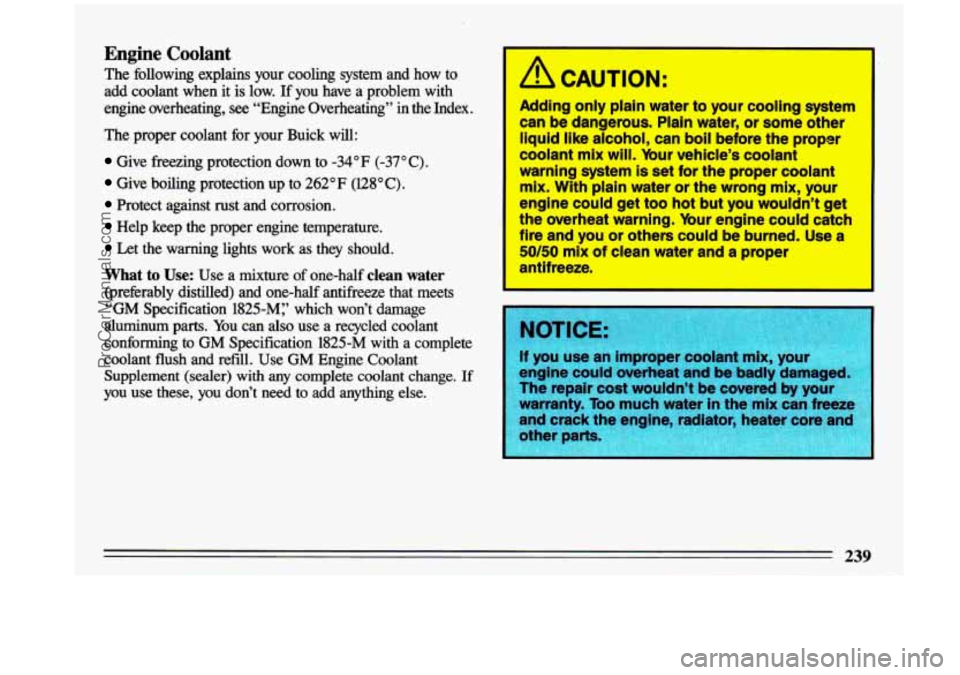
Engine Coolant
The following explains your cooling system and how to
add coolant when it is low.
If you have a problem with
engine overheating, see “Engine Overheating” in the Index. \
The proper coolant for your Buick will:
Give freezing protection down to -34°F (-37°C).
Give boiling protection up to 262” F (128” C).
Protect against rust and corrosion.
Help keep the proper engine temperature.
Let the warning lights work as they should.
What to Use: Use a mixture of one-half clean water
(preferably distilled) and one-half antifreeze that meets
“GM Specification 1825-Mi’ which won’t damage
aluminum parts. You can also use a recycled coolant
conforming to GM Specification 1825-M with a complete
coolant flush
and refill. Use GM Engine Coolant
Supplement
(sealer) with any complete coolant change. If
you use these, you don’t need to add anything else.
I
A CAUTION:
Adding only plain water to your coollng system
can
be dangerous. Plain water, or some other
liquid
like alcohol, can boil before the proper
coolant mix will. Mur vehicle’s coolant
warning system
Is set for the proper coolant
mix. With plain water or the wrong mlx, your
engine could get too hot but you wouldn’t get
the overheat warning. bur engine could catch
fire and you or others’could be burned. Use a
50/50 mPx of clean water and a proper
antifreeze.
I
: warranty. Too much
l
and crack t
other parts
239
ProCarManuals.com
Page 242 of 324
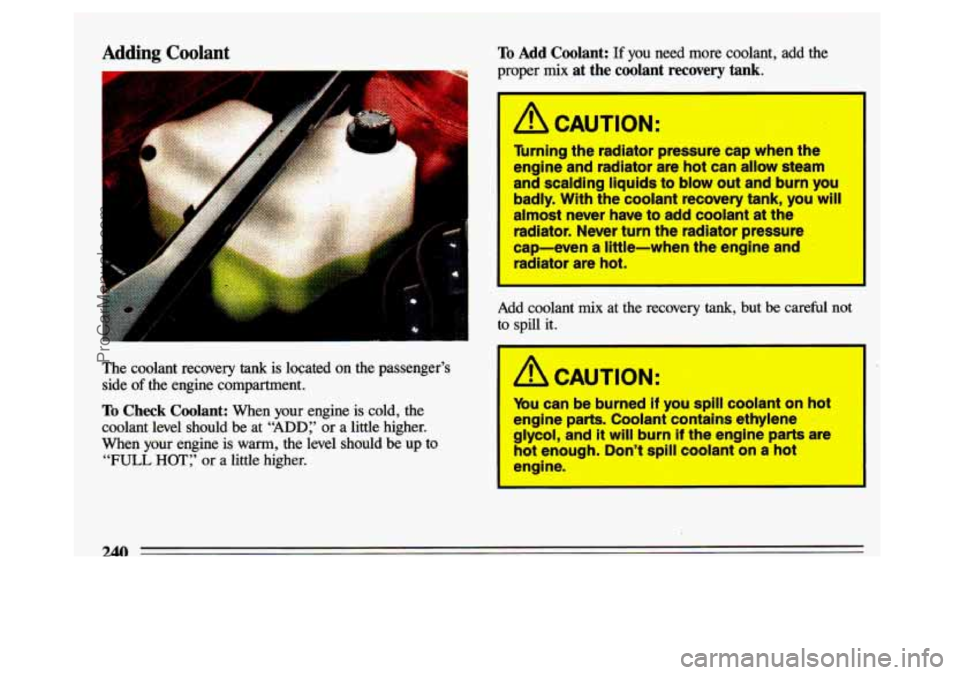
Adding Coolant
..
The coolant recovery tank is located on the passenger’s
side
of the engine compartment.
To Check Coolant: When your engine is cold, the
coolant level should be at “ADD:’
or a little higher.
When your engine
is warm, the level should be up to
“FULL HOT:’ or a little higher.
To Add Coolant: If you need more coolant, add the
proper
mix at the coolant recovery tank.
/i CAUTION:
Turning the radiator pressure cap when the
engine and radiator are hot can allow steam
and scalding liquids to blow out and burn you
badly.
With the coolant recovery tank, you will
almost never have
to add coolant at the
radiator. Never turn the radiator pressure
cap-even
a little-when the engine and
radiator are hot.
Add coolant mix at the recovery tank, but be careful not
to spill it.
A CAUTION:
You can be burned if you spill coolant on hot
engine parts. Coolant contains ethylene
glycol, and
it will burn if the engine parts are
hot enough. Don’t spill coolant on
a hot
engine.
240
ProCarManuals.com
Page 243 of 324
Radiator Pressure Cap
ur radiator cap is a 15 psi (105 kPa)
When you replace your radiator pressure cap, an AC@
cap is recommended.
Thermostat
Engine coolant temperature is controlled by a thermostat
in the engine coolant system. The thermostat stops the
flow of coolant through the radiator until the coolant
reaches a preset temperature.
When you replace
your thermostat, an AC@ thermostat is
recommended.
Power Steering Fluid
mp ”-- How to Check Power
Steering Fluid:
I Unscrew the cap and wipe
the dipstick with a clean f rag. Replace the cap and
completely tighten it. Then
remove the cap again and
look at the fluid level on the
dipstick. .1,. ,,
When me engine compartment is hot, the level should
When the engine compartment is cool, the level should
be at the “H” (Hot) mark.
be at the “C” (Cold) mark.
What to Add:
Refer to the Maintenance Schedule to determine what
kind
of fluid to use. See “Recommended Fluids and
Lubricants” in the Index.
241
ProCarManuals.com
Page 244 of 324
When adding power steering fluid or making a
complete fluid change, always use the proper
fluid. Failure to use the proper fluid can cause
leaks and damage hoses and seals.
,- . ,.
Windshield Washer Fluid
To Add:
The windshield washer reservoir is located at the driver’s
side
of the engine compartment. The rear window washer fluid reservoir (for the wagon)
is the smaller
reservoir next
to the coolant recovery tank.
Open the cap labeled “WASHER FLUID ONLY? Add
washer fluid until the bottle
is full.
ProCarManuals.com