Identification Numbers
Your car has several identifying numbers located in various places.
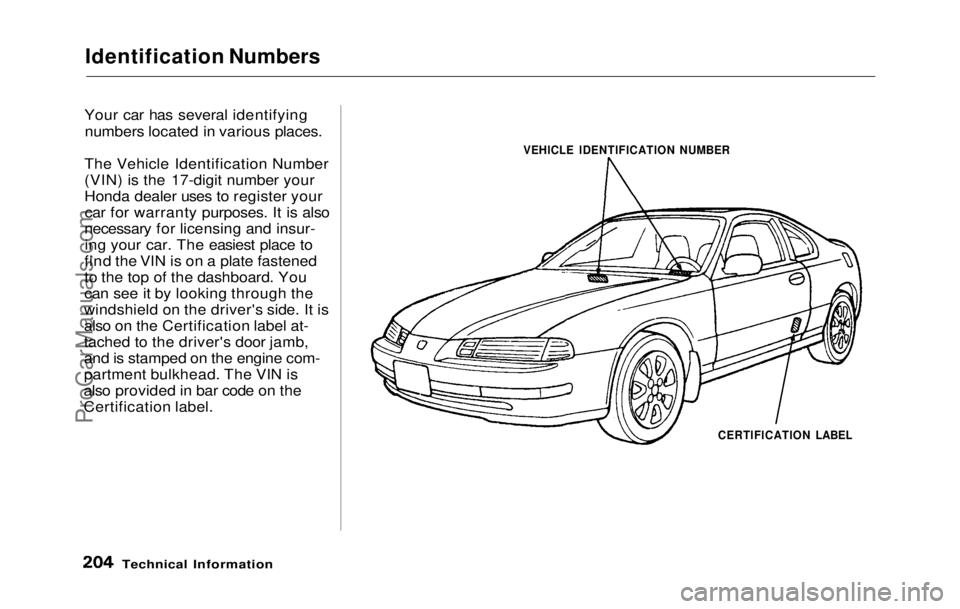
The Vehicle Identification Number
(VIN) is the 17-digit number your
Honda dealer uses to register your car for warranty purposes. It is also
necessary for licensing and insur- ing your car. The easiest place to
find the VIN is on a plate fastened
to the top of the dashboard. You
can see it by looking through the
windshield on the driver's side. It is
also on the Certification label at-
tached to the driver's door jamb,
and is stamped on the engine com-
partment bulkhead. The VIN is
also provided in bar code on the
Certification label.
Technical Information
VEHICLE IDENTIFICATION NUMBER
CERTIFICATION LABELProCarManuals.comMain Menu Table of Contents s t
Supplemental Restraint System
The Honda
Supplemental Restraint
System (SRS) is standard on all
Preludes sold in the U.S. and the
SR, SR 4WS sold in Canada.
The SRS includes the steering
wheel airbag assembly, sensors in the dashboard, and a control unit
with sensors behind the center
console.
(On Si 4WS model)
The system also has a dashboard-
mounted airbag assembly for the
passenger.
The sensors are decelerometers,
set to trigger in a frontal impact that generates more force than a 10
mile per hour barrier crash. For the
SRS to activate, at least two sen-
sors must trigger. This duplication
is to prevent accidental activation. When the control unit receives
trigger signals from at least two
sensors, it sends voltage to the
airbag. The control unit stores this
charge in capacitors to insure
reliability even if a severe impact damages the car's battery or
electrical connections.
The electrical charge sent to the
airbag assembly ignites its propel-
lant, which burns instantaneously.
The gas produced by the burning propellant inflates the airbag in
about 40 milliseconds (1/25 of a
second).
The airbag is vented so it stays inflated for only an instant and
does not block the driver's vision.
Smoke from the burned propellant
comes out of the airbag and into
the car's interior. This is normal
and does not mean there is a fire.
The airbag collapses onto the driver's lap. The airbag unit can inflate only one
time. After use, your Honda dealer
must check the complete Supple-
mental Restraint System and re-
place the airbag assembly.
To ensure long-term reliability, the
SRS uses gold-plated electrical
connections throughout. Exposed
components are sealed with epoxy.
The control unit monitors the SRS circuitry whenever the ignition is
ON (II). If the control unit senses
any faults, it turns on the SRS
indicator light on the instrument
panel. Take the car to your Honda
dealer to diagnose and repair the system as soon as possible.
The SRS needs no regular mainte-
nance other than an inspection by
your Honda dealer ten years after
manufacture.
Technical InformationProCarManuals.comMain Menu Table of Contents s t
Index
DANGER, Explanation of.............. ii
Dashboard........................................ 30
Daytime Running Lights.............. 40
Dead Battery, What to Do........... 191
Defects, Reporting Safety ............ 26
Defogger, Rear Window ............... 56
Defrosting the Windows............... 74
DEXRON ®
II Automatic
Transmission Fluid.................. 144
Dimensions.................................... 206
Dimming the Headlight
s .............. 40
Dipstick Automatic Transmission........
144
Engine Oil................................. .
135
Directional Signals........................
.
41
Disabled, Towing Your Car If ... 202
Disc Brake Wear Indicators.......
116
Disposal o f
Used Oil.....................
138
Doors
Locking an
d Unlocking ............ 48
Power Door Locks ..................... 48
DOT Tire Quality Grading......... 161
Downshifting,
5-speed Transmission.............. 111
Driving .......................................... .
107
Economy.................................... 104
In Bad Weather......................... 119
In Foreign Countries................. 99
Economy, Fuel.............................. 104
Emergencies on the Road........... 183 Battery, Jump Starting............ 191
Changing a Flat Tire............... 185
Charging System Light........... 196
Check Engine Light................. 197
Checking the Fuses.................
200
Low Oi l
Pressure Light........... 195
Manually Closing Sunroof...... 198
Overheated Engine.................. 193
Emergency Brake ......................... 61
Emergency Flashers...................... 56
Emission Controls......................... 211
Engine Check Light....................... 34, 197
Coolant Temperature Gauge... 38
Oil Pressure Light............. 33, 195
Oil, What Kind to Use .............
135
Overheating............................... 193
Specifications........................... 206
Ethano l
in Gasoline........................ 98
Evaporative Emission Controls......................................
211
Exhaust Fumes.............................. .
25
Expectant Mothers, Use of Seat Belts by.................................. 8
Exterior, Cleaning the.................
176
Fabric, Cleaning........................... 179
Fan, Interior.................................... 68
Fan, Radiator.................................. 27
Features, Comfort
and Convenience........................ 67
Filling the Gas Tank.................... 100
Filters
Air
............................................... 149
Fuel............................................. 150
Oil ............................................... 137
First Gear, Shifting...................... 111
5-Speed Transmissio n
Checkin
g Fluid Level..............
145
CONTINUED
ProCarManuals.comMain Menu s t