Page 676 of 1333

MAIN TE N AN CE R EM IN DER L IG HT R ESET P R O CED URES
�1991 M it s u bis h i M onte ro
1983-96 MAINTENANCE
Chrysler Motors/Mitsubishi Maintenance Reminder Lights
Dodge; Challenger, Colt, Colt Vista, Conquest, Raider,
Ram-50
Eagle; Summit, Summit Wagon
Plymouth; Colt, Colt Vista, Sapporo
Mitsubishi; 3000GT, Cordia, Diamante, Eclipse,
Expo/Expo LRV, Galant, Mirage, Montero, Pickup, Precis,
Sigma, Starion, Tredia, Van/Wagon
EGR/MAINTENANCE REQUIRED WARNING LIGHT
1) On some models, an EGR or MAINTENANCE REQUIRED warning
light in dash will come on as a reminder to have EGR system serviced
(each 50,000 miles), oxygen sensor replaced (each 80,000 miles) or
evaporative carbon canister replaced (100,000 miles).
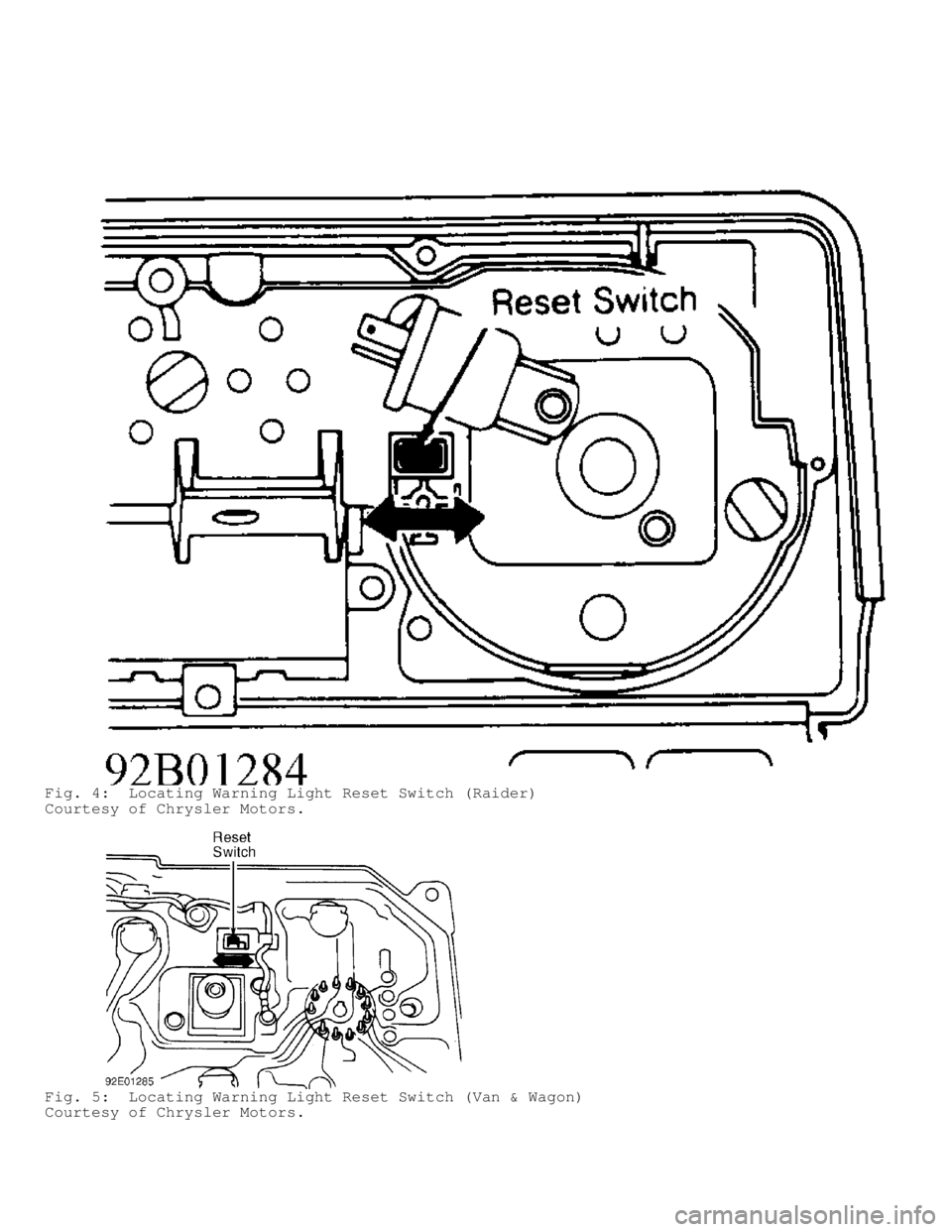
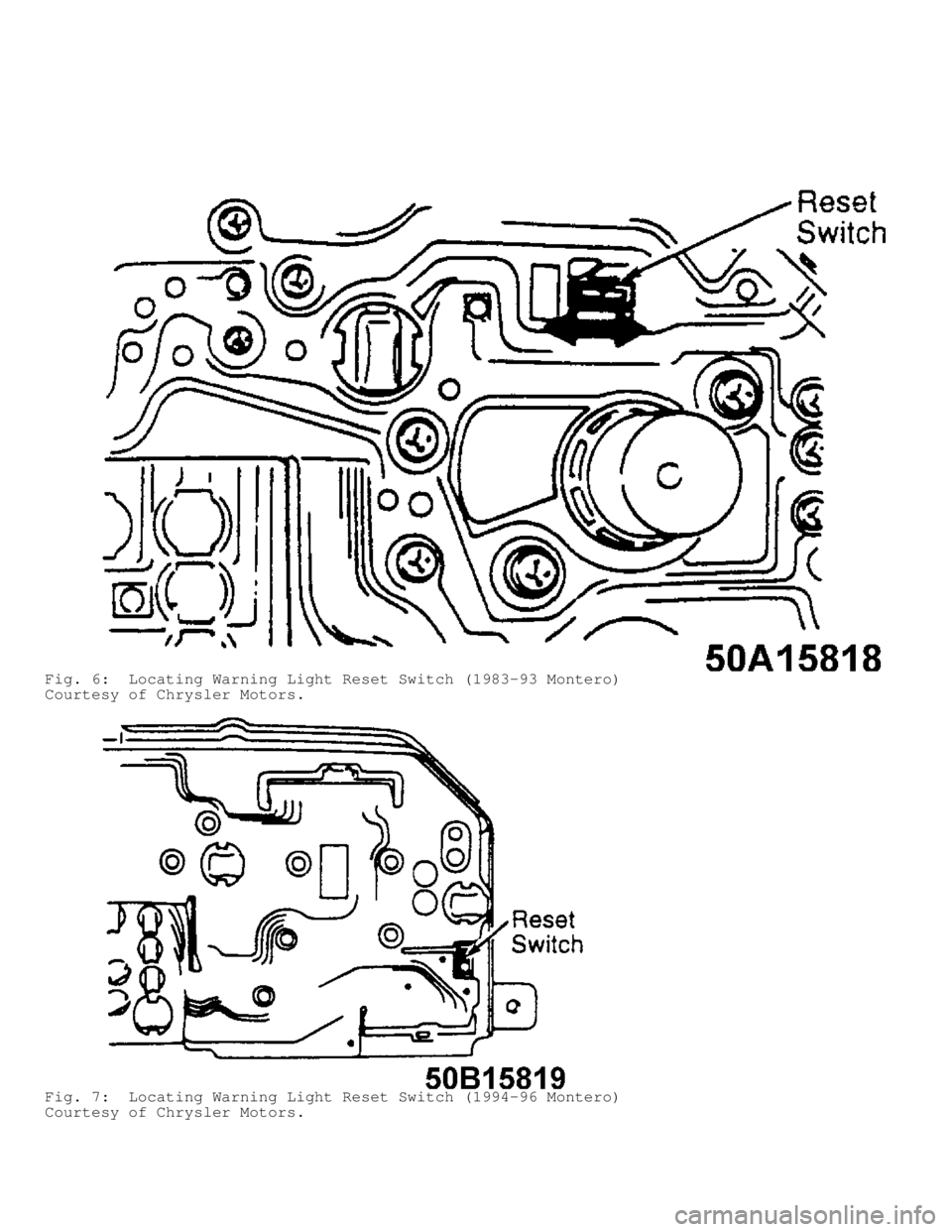
2) After servicing or replacing components, reset mileage
counter. On all models except 1987-95 Pickup and 1987-93 Ram-50, reset
switch is located on back of instrument cluster.
3) On 1987-95 Pickup and 1987-93 Ram-50, reset switch is on
lower right corner of instrument cluster, behind instrument cluster
face trim. Slide switch to other side to reset indicator light.
4) Remove warning light bulb after 150,000 mile servicing on
Colt Vista and Wagon. Remove bulb after 120,000 mile servicing on Ram-
50.
Fig. 1: Locating Warning Light Reset Switch (Colt Vista; Colt
Wagon is Similar)
Courtesy of Chrysler Motors.
Page 677 of 1333
Fig. 2: Locating Warning Light Reset Switch (1985-86 Pickup & Ram-50)\
Courtesy of Chrysler Motors.
Fig. 3: Locating Warning Light Reset Switch (1987-92 Pickup & Ram-50)\
Courtesy of Chrysler Motors.
Page 678 of 1333
Fig. 4: Locating Warning Light Reset Switch (Raider)
Courtesy of Chrysler Motors.
Fig. 5: Locating Warning Light Reset Switch (Van & Wagon)
Courtesy of Chrysler Motors.
Page 679 of 1333
Fig. 6: Locating Warning Light Reset Switch (1983-93 Montero)
Courtesy of Chrysler Motors.
Fig. 7: Locating Warning Light Reset Switch (1994-96 Montero)
Courtesy of Chrysler Motors.
Page 697 of 1333

WARNING: Avoid breathing R-134a refrigerant and PAG lubricant vapors,
exposure may irritate eyes, nose and throat. To remove
R-134a from system use R-134a recycling equipment that meets
SAE J2210 specifications. If accidental system discharge
occurs, ventilate work area before resuming service.
ANTI-LOCK BRAKE SYSTEM
The anti-lock brake system contains electronic equipment that
can be susceptible to interference caused by improperly installed or
high output radio transmitting equipment. Since this interference
could cause the possible loss of the anti-lock braking capability,
such equipment should be installed by qualified professionals.
On models equipped with anti-lock brake systems, ALWAYS
observe the following cautions:
* DO NOT attempt to bleed hydraulic system without first
referring to the appropriate ANTI-LOCK BRAKE SYSTEM article
in the BRAKES Section.
* DO NOT mix tire sizes. As long as tires remain close to the
original diameter, increasing the width is acceptable.
Rolling diameter must be identical for all 4 tires. Some
manufacturers recommend tires of the same brand, style and
type. Failure to follow this precaution may cause inaccurate
wheel speed readings.
* Use ONLY recommended brake fluids. DO NOT use silicone brake
fluids in an ABS-equipped vehicle.
REPLACING BLOWN FUSES
Before replacing a blown fuse, remove ignition key, turn off
all lights and accessories to avoid damaging the electrical system. Be
sure to use fuse with the correct indicated amperage rating. The use
of an incorrect amperage rating fuse may result in a dangerous
electrical system overload.
BATTERY WARNING
WARNING: When battery is disconnected, vehicles equipped with
computers may lose memory data. When battery power is
restored, driveability problems may exist on some vehicles.
These vehicles may require a relearn procedure. See
appropriate COMPUTER RELEARN PROCEDURES article in the
GENERAL INFORMATION section below.
BRAKE FLUID
For vehicles equipped with a traction control system, idle
engine while pouring brake fluid into reservoir.
CATALYTIC CONVERTER
Continued operation of vehicle with a severe malfunction
could cause converter to overheat, resulting in possible damage to
converter and vehicle.
ELECTROSTATIC DISCHARGE SENSITIVE (ESD) PARTS
WARNING: Many solid state electrical components can be damaged by
static electricity (ESD). Some will display a warning label,
but many will not. Discharge personal static electricity by
Page 730 of 1333
SER VIC E IN DIC ATO R & W AR NIN G L IG HTS
�1991 M it s u bis h i M onte ro
1983-92 MAINTENANCE
Mitsubishi Service Indicator & Warning Lights
Montero
SERVICE INDICATOR & WARNING LIGHTS
Fig. 1: 1983-88 Dash Gauges & Warning Lights
Courtesy of Mitsubishi Motor Sales of America, Inc.
Page 731 of 1333
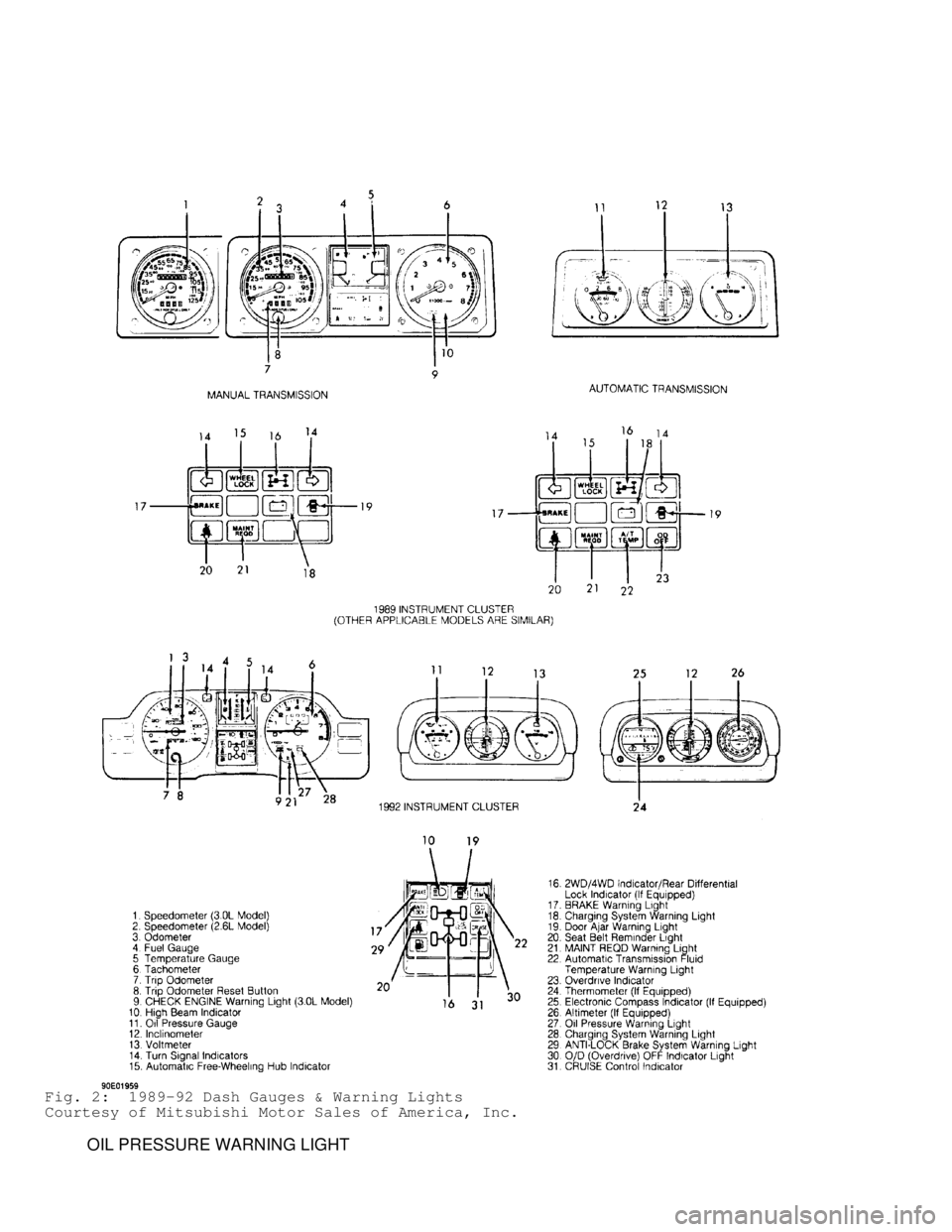
Fig. 2: 1989-92 Dash Gauges & Warning Lights
Courtesy of Mitsubishi Motor Sales of America, Inc.
OIL PRESSURE WARNING LIGHT
Page 732 of 1333

Light comes on with the ignition switch in the "ON" position
as a bulb check, but should go out shortly after engine is started. If
light remains on or comes on while driving, it indicates low oil
pressure and possible system malfunction. Have the system checked and
serviced immediately. Do not operate vehicle until cause is located
and corrected.
ALTERNATOR WARNING LIGHT
Light comes on with the ignition switch in the "ON" position
as a bulb check and goes out after engine is started. If light remains
on or comes on while driving, it indicates possible fault in the
electrical charging system. The alternator belt may be loose or
broken. Have the system checked and serviced promptly. Do not drive
vehicle if alternator belt is loose or broken.
"BRAKE" WARNING LIGHT
Light comes on with the ignition switch in the "ON" position
as a bulb check and goes out after engine is started. Light will also
come on with the parking brake fully or partially engaged. If light
remains on or comes on at any other time, it indicates low brake fluid
level in the master cylinder reservoir or the parking brake switch may
be damaged. Have the system checked and serviced immediately if brake
fluid level is low. Do not continue driving if further trouble is
experienced.
"CHECK ENGINE" WARNING LIGHT (IF EQUIPPED)
Light is designed to come on briefly with the ignition switch
in the "ON" position as a bulb check. If light remains on or comes on
while driving, it indicates fault in an exhaust gas related component
and the system is not functioning properly. Have the system checked
and serviced as soon as possible.
"MAINTENANCE REQUIRED" WARNING LIGHT (IF EQUIPPED)
Light comes on at 50,000 miles, 80,000 miles, 100,000 miles
and 120,000 miles (150,000 miles on 1990-91 models) as a service
reminder that it is time for the periodic maintenance of the emission
control system. Have the system inspected and serviced as necessary
when light comes on. Continued operation of vehicle without having
system serviced after warning light comes on may adversely affect
proper performance of the emission control system. Reset warning
light, after the system has been checked, by pushing the reset switch
in front of the combination meter. Remove the warning light bulb after
the last maintenance service at 120,000 miles (150,000 miles on 1990-
91 models).
"A/T TEMPERATURE" WARNING LIGHT (IF EQUIPPED)
Light comes on when the automatic transmission fluid
temperature becomes abnormally high. If light comes on, reduce engine
speed, stop car and put it in "P" (Park) position. Leave engine
running until light goes out. Normal vehicle operation may be resumed
after light has gone out. If light does not go out, have the system
checked and serviced as necessary.
WHEEL LOCK INDICATOR LIGHT (IF EQUIPPED)
Light comes on when automatic free-wheeling hubs are locked.
If ignition is turned off, indicator light will not come on when
\
Courtesy of Chrysler Motors.
Fig. 3: Locating Warning Light Reset Switch (1987-92 Pickup & Ram-50)\
Courtesy of Chrysler Moto")