Page 100 of 391

5-jENGINE- Base Engine9-15Operation of the Lash Adjuster
When the valve starts opening
/f-b
During the valve opening stroke
n
6EN0254
When the valve coiqpletesthe opening stroke
6EN0257
6EN0256
(1) Before the valve starts opening:
--
No external load is applied to the
plunger, thus
causing the plunger to be pushed UP
by theplunger spring, maintaining zero clearance.
.(2) When the valve starts opening:
When the cam pushes the rocker arm, the ball inthe high-pressure chamber immediately is held
pressed against the seat by the hydraulic press-
ure. fully closing the high-pressure chamber. AS
the check ball closes, the pressure in the
high-pressure chamber surges causing the plun-ger to support the load from rocker arm, which
.allows the valve to start ooenino.
- -__
(3) During the valve opening stroke:
A very small amount of oil leaks through the
clearance between the lash adjuster body and
plunger.
(4) When the valve completes its opening stroke:
There is no external load being applied to the
plunger as the valve closes, causing the plunger
to be pushed up by the plunger spring. This
causes the pressure in the high-pressure cham-
ber to be lowered, which pushes the check ball
open. The oil which has leaked is replaced in thehigh-pressure chamber from the reservoir cham-
ber.
-
Page 101 of 391
9-16ENGINE- Base Engine
Hydraulic Flow to Lash Adjusters
To lash adjuster onthe exhaust side
P
)
5-Valve body
.Lash adjuster
6EN0107
:.-.
2:.
4
‘.’Relief plunger
I?.,:.:.;
/Lash adjuster
-Cylinder head bolt hole
PlugTo
tash adjuster onthe intake side
Relief spring
-Valve body
6EN0108The oil moves through the cylinder head bolt hoie to
the oil passages drilled in the cylinder head. Andthen has its pressure regulated by the valve body k
pressure regulator) and is supplied to each
la:
adjuster.
-:
Page 103 of 391
9-18ENGINE- Base Engine
(1) The intake camshaft, exhaust camshaft, and the
oil pump are driven by a single timing belt.
(2) Timing belt tension varies at different engine
temperatures and ages of the belt. The autotensioner absorbs these changes in belt
ten+n,not only to prevent the noise problem
getting worse, but to improve durability as weli’l
AUTO TENSIONER
Piston -1
Check ball-4,
SpringTensioner
cwllev
6EN0116
LOoil seal
6ENOWThe auto tensioner applies tension to the timing belt
by causing the tensioner arm to move back and
forth in the directions shown by arrow
@I.The bottom figure shows the construction of the
aUt0 tensioner. The chambers on the right and leftof the piston
are filled with silicone oil.
Both the tensioner pulley and idler pulley are of the
ball bearing type into which grease has been
packed.
Page 104 of 391

,_-.._-~_._. I _ ‘... ----
ENGINE- Base Engine9-19
Reservoir
chamber/
Reservoir
chamber
PressurechamberOperation of the Auto Tensioner
WHEN THE BELT TENSION HAS INCREASED
(1) The tensioner arm pushes the piston in the direction shown
by
arrow @, causing the hydraulic pressure in the pressurechamber to build up.
(2) The check ball closes.
(3) The oil inthepressure chamber is compressed by the
piston, which causes a small amount of oil to gradually leak
through the clearance between the piston and cylinder into
the reservoir chamber. This causes the piston to move
slowly in the direction shown by arrow
@.
(4) The piston stops moving when the load in the direction @balances the spring tension, which determines the load,
i.e., tension, applied to the belt.
WHEN THE BELT TENSION HAS DECREASED
(1) The piston moves in the direction shown by arrow @I by the
spring tension.
(2) As the piston moves, the hydraulic pressure in the pressure
chamber becomes lower than that in the reservoir cham-
ber.
(3) The check ball opens.
(41 Oil enters the pressure chamber.
(5) The piston stops moving when the belt tension balances
the spring tension, which determines the tension applied to
the belt.
_ . _ ---___- -
Page 105 of 391
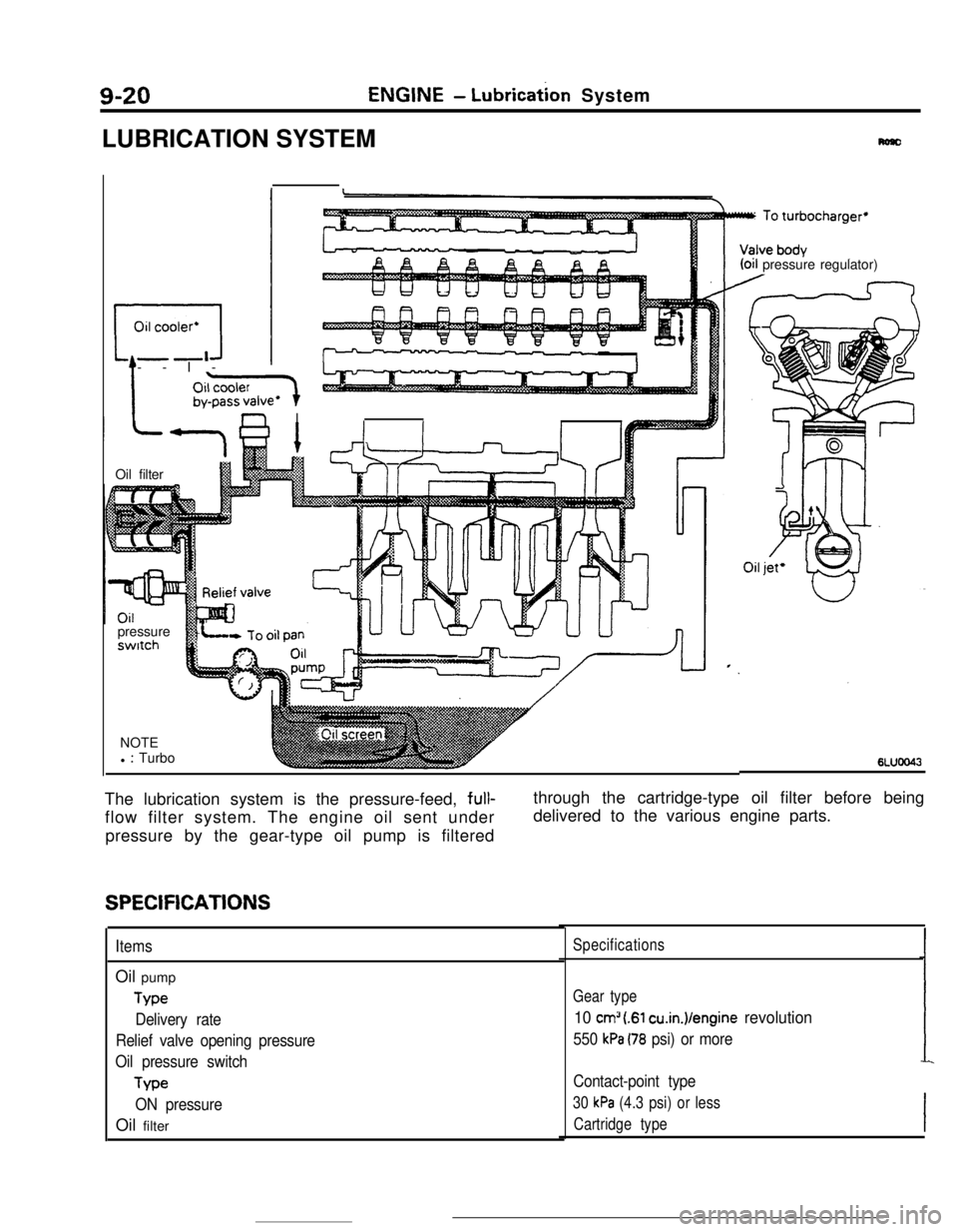
9-20ENGINE- Lubricathn System
LUBRICATION SYSTEM
nasllOil cooler*
r-4--I-
(oil pressure regulator)
I
n I-1Oil filter
pressureswttch
NOTE
l
: Turbo6LUOO43The lubrication system is the pressure-feed, full-
flow filter system. The engine oil sent under
pressure by the gear-type oil pump is filteredthrough the cartridge-type oil filter before being
delivered to the various engine parts.
SPECIFICATIONS
ItemsOil pump
Type
Delivery rate
Relief valve opening pressure
Oil pressure switch
Type
ON pressureOil filter
Specifications
Gear type
10 cm” (.Sl cu.in.)/engine revolution
550 kPa (78 psi) or more
Contact-point type
30 kPa (4.3 psi) or less
Cartridge type
Page 115 of 391

FUEL SYSTEM - General14-3The fuel is supplied under pressure by the in-tanksent to the engine control unit.
type fuel pump, and is injected from injectors into allThe crank angle sensor converts the crank
angle,
cders. The injectors are activated by signals fromthat is, engine turning state into an electric signal
tk, engine control unit, and the amount of fueland sends it to the engine control unit.
injected is determined according to the drivingThe engine control unit, based on these signals,
conditions.determines the basic activation timing of the
injec-The intake air passes through the air flow sensor,
tars. The amount of intake air is determined by the
throttle body, air intake plenum and intake manifold,degree of opening of the throttle
valye,, and during
and finally enters the combustion chamber. The airengine idling, the amount of intake
arr IS regulated
flow sensor detects the amount of air flow and
by the idle speed control servo.converts this data to electric pulse signals that are
EGR temperature sensor (California) 7
Waste gate solenoid valve
Purge control solenoid valve
EGR control solenoid valve Fuel pump relay
Control relay
Air conditioner relay
Diagnosis output
Ignition coil
Control relay (Fuel pump drive
signal)Vehicle speed
SensorIgnition switch “ST” terminal
Ignition switch
‘IG” terminal
Air conditioner switch
Power steering
switch
Inhibitor switch
Idle speed
ontrol servoFast idle
air valve
-Throttle
&r -kilo m-i&inn’Power transistorleturn to-
uel tank- Fuel from
Coolant temperature sensor
Coolant temperature switchFuel-pressure
control valve
Detonation sensor
4
Page 118 of 391

14-6FUEL SYSTEM -Fuel Supply and Fuel Pressure Control
intake manifold/I\
Engine
Fuel
03AOOlOThe fuel supply system comprises electromagnetic
type injectors, a delivery pipe, a fuel pressure
regulator, a motor-driven fuel pump, and the engine
control unit, which activates and controls the injec-
tors and fuel pump based on data supplied by the
various sensors.
After being filtered by an in-tank filter, the fuel is
pumped from the tank and is filtered again by an
external filter before it is distributed to the injectors
through the delivery pipe. The pressure of fuel
delivered to the injectors is regulated by the fuel
pressure
reoulator; excess fuel after pressure reg-ulation has been performed is returned to the fuel
tankThe injectors are activated on command from the
engine control unit and inject the fuel to each intake
port of cylinder head sequentially according to the
predetermined ignition order.
In addition, a fuel-pressure control valve has been
equipped in order to maintain idling stability of turbo
models immediately after restarting under high- -
temperature conditions.
The fuel tank is located under the floor of the rear
seat, thus giving it protection in the event of a
rear-end collision. A fuel pump drive terminal is
provided in the engine compartment for greater
serviceability.
-
SPECIFICATIONSItems
Fuel pump
Type
Delivery rate
liters (gals.VHr
Delivery pressurekPa (psi)
Fuel pressure regulator
Tvw
Regulated fuel pressurekPa (psi)
Fuel filter
Rated flow rate
liters (qts.)/min.
Filter areacm’ (in.‘)
Injectors
TypeCoil resistance
n
--
.- -_-_
SpecificationsMotor-driven, in-tank type
Minimum 90 (23.8)
450 - 600 (64 - 85)
Diaphragm type
335 (47.6)
255 (36.3)
2
(2.1)
1,500 (233)Solenoid type
,.13-16
2-3
I
Page 122 of 391
14-10
INJECTORFUEL SYSTEM
-Fuel Supply and Fuel Pressure Control
Intake port
lelivelYPipte
,FilterSpringAn injector is mounted on each of the four intake ports of the
cylinder head.
The injector is activated by electric current controlled by the
engine control unit.Wh-en current flows through the solenoid coil, the plunger and
needle valve, which form a single unit are magnetically
attracted, causing the injector nozzle to open and fuel to be
injected.When the current is interrupted, the plunger and needle valve
are pushed back by the spring, closing the injector nozzle.