1990 HONDA PRELUDE belt
[x] Cancel search: beltPage 17 of 143
Inspection
All parts of the seat belts, including the belt fabric, should be regularly inspected for fraying, loosening, wear and other damage.
Keep the belts in good condition at all times to reduce the chance of
being injured in an accident, and to minimize any injuries that do
occur. Make sure the buckles, retractors, tongue plates, guides and anchors all work properly.
Don't let anything get inside the buckle or the retractor; it could
cause latch or retractor failure.
The components of the front automatic lap/shoulder belts are
contained in the doors. If the doors are damaged in an accident, have the dealer check the restraint system's function. The
automatic lap/shoulder belts may not function properly if the door is not completely repaired.
Cleaning
The belts should be always kept clean and dry; wet or damp belts can cause rewinding problems. The front seat belts are coated for resistance to water and stains. To clean the belts, pull them all the
way out of their retractors and use warm water; then let them air-
dry fully extended, in the shade, with the car windows open. Do not scrub or use detergents to clean the seat belts.
Never bleach, dye or clean the belts with chemical solvents; it
will weaken the fabric.
Do not remove the seat belts from the car to wash them.
Replacement
Replace the seat belt if:
1. The beltin g is cut, punctured, burned, etc.
2. Th
e buckle or retractor does not work properly.
3. It was being worn at the time of a collision (also cheek for deformation damage at all seat belt anchor points).
4. Its condition is questionable.ProCarManuals.comMain Menu t s
Page 21 of 143
Warning and Indicator Lights
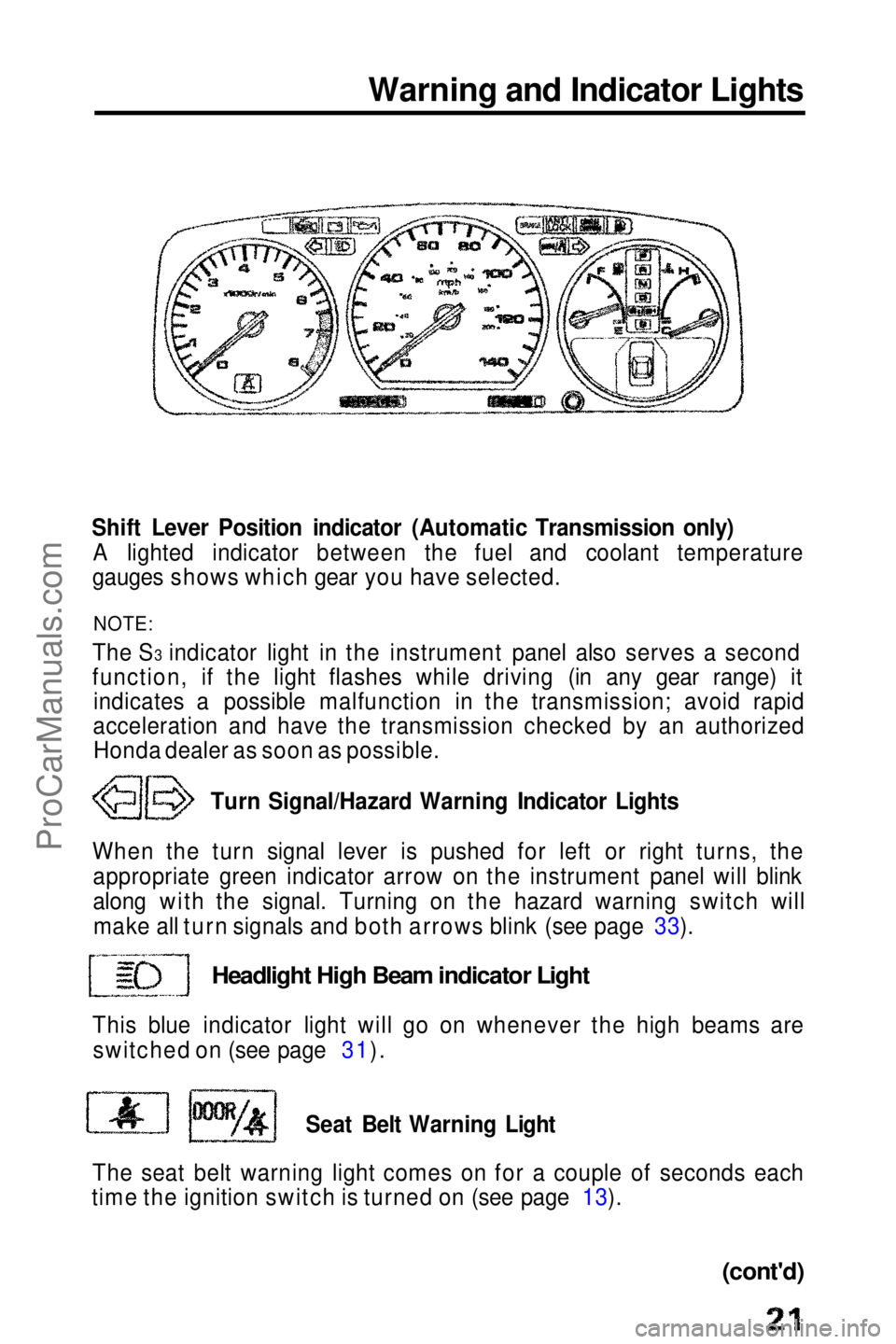
Shift Lever Position indicator (Automatic Transmission only) A lighted indicator between the fuel and coolant temperature
gauges shows which gear you have selected.
NOTE:
The S3 indicator light in the instrument panel also serves a second
function, if the light flashes while driving (in any gear range) it indicates a possible malfunction in the transmission; avoid rapid
acceleration and have the transmission checked by an authorized Honda dealer as soon as possible.
Turn Signal/Hazard Warning Indicator Lights
When the turn signal lever is pushed for left or right turns, the appropriate green indicator arrow on the instrument panel will blink
along with the signal. Turning on the hazard warning switch willmake all turn signals and both arrows blink (see page 33).
Headlight High Beam indicator Light
This blue indicator light will go on whenever the high beams are switched on (see page 31).
Seat Belt Warning Light
The seat belt warning light comes on for a couple of seconds each
time the ignition switch is turned on (see page 13).
(cont'd)ProCarManuals.comMain Menu t s
Page 23 of 143

Charging System Warning Light
The charging system warning light comes on when there is a problem with the electrical charging system or when the ignition
switch is turned on with the engine not running. If the light comes
on while driving, stop the car and check to see if the alternator belt is loose or broken.
To check the belt tension, stop the engine and push with about 98N (22 Ib) of force on the middle of the belt as shown. The belt should
deflect about:
10
—
12 mm (0.4
—
0.5 in) If the engine has been running,
some engine components may
be hot enough to burn you. Keep hands away from the
radiator fan. The fan may start
automatically without warning
and run for up to 15 minutes,
even after the engine is turned
off.
NOTE:
If necessary, have the charging system checked by an authorized
Honda dealer.
Check Engine Warning Light
This light comes on for a couple of seconds each time the ignition is
turned on. It will also come on, and remain on, if there is a
malfunction in the emission control system. If the light comes on
while driving, avoid driving at high speed, and have the system checked by a Honda dealer as soon as possible.
Parking Brake/Brake Failure Warning Light
Check the brake warning light every time you start the car.
With the parking brake set, the warning light should go on when the
ignition switch is turned to II or III, With the parking brake released,
the light should go on when the ignition switch is turned to III. If the light goes on at any other time, it means the brake fluid level in the
master cylinder reservoir is too low ; add fluid and have your dealer
check for leaks and brake pad wear immediately. See page 99. BRAKE
(cont'd)ProCarManuals.comMain Menu t s
Page 63 of 143

Safety Items
Before driving away, check that: The doors are closed properly. The mirrors are properly adjusted, and the windows clean.
The driver and passengers are wearing properly adjusted seat
belts.
The head restraints are properly adjusted.
The warning and indicator lights are operating properly.
The brake pedal feels normal.
All luggage and cargo is secured.
Nothing is interfering with the driver's feet or blocking vision to
the rear.
While driving remember to: Always drive defensively; expect the unexpected. Reduce your speed during night hours and bad weather.
Follow at a safe distance; don't tailgate.
Get off the highway when you are tired; stop and take a rest.
When stopping for repairs: Park the car well off the road.
Turn on the hazard warning flasher. Use flares or other warning devices to warn other motorists.
After parking your car: Apply the parking brake and shift to first gear if equipped withmanual transmission, or PARK on automatic transmission
equipped cars.
Make sure the windows are closed and all doors are locked.
If parked on a hill:
Turn the front wheels away from the curb if facing uphill.
Turn the front wheels toward the curb if facing downhill. Never leave children unattended in a parked car.
Take your
keys.ProCarManuals.comMain Menu t s
Page 77 of 143

Check the following items at each fuel stop:
1. Engine oil level.
2. Radiator coolant level.
Check the following items periodically: 1. Brakes: for braking efficiency, brake pedal travel and hydraulic fluid level.
2. Lights: for operation of headlights, taillights, side marker lights, stoplights, turn signals and back-up lights.
3. Tires: for correct pressures (including spare); inspect for cuts and uneven or excessive wear. Rotate every 7,500 miles (12,000 km)
in the pattern shown on page 107.
4. Steering: for excessive play or vibration while driving. 5. Exhaust system: for leaks or loose mounts.
6. Wipers: for operation of windshield wipers and washer, and condition of wiper blades.
7. Seat belts: for condition of fabric and buckles, and operation of the restraint mechanism.
8. Battery condition.
(cont'd)ProCarManuals.comMain Menu t s
Page 108 of 143

Air Conditioner Care
Condenser and Radiator
Check the engine radiator and the air conditioner condenser (in front
of the radiator) for accumulated dirt, insects or leaves. Carefully brush or hose them off to assure maximum cooling performance.
CAUTION:
Radiator and condenser fins are very thin and easily damaged; do
not bend them with the high water pressure or brush.
Compressor Drive Belt Check the compressor bett tension monthly, during periods when
you use the air conditioner a lot.
If the engine has been running, some engine components may be
hot enough to burn you.
When pushed with 98 N (22 Ib) of force midway between the
compressor drive pulley and the engine crankshaft pulley, the beltshould deflect about: 10-12 mm (0.4—0.5 in)
ADJUSTER COMPRESSOR DRIVE
PULLEY
CRANKSHAFT
PULLEYProCarManuals.comMain Menu t s
Page 135 of 143

Warranty Service
Warranty The following warranties are provided with every new vehicle: 1. New Car Limited Warranty
2. Emission Control Systems Defects Warranty
3. Emissions Performance Warranty
4. Battery Limited Warranty 5. Rust Perforation Limited Warranty
6. Accessory Limited Warranty 7. Replacement Parts Limited Warranty
8. Replacement Muffler Lifetime Limited Warranty
9. Seat Belt Limited Warranty.
All warranties pertaining to your car can be found in the warranty
booklet provided with your new car except the required
maintenance schedule which is contained here in the Owner's
Manual.
If you are unable to obtain warranty service or are dissatisfied with
the warranty decision or service you received at an authorized Honda dealership, you should review the matter with that
dealership's Service Manager. This will normally resolve your problem. If it does not resolve your problem you should appeal the
decision with the owner of the dealership. Please bear in mind that
your problem will likely be resolved at the dealership, using the
dealer's facilities, equipment and personnel. So it is very important
that your initial contact be with the dealer or his management. After following these steps, if you wish to have the matterreviewed by American Honda you should contact the Automobile
Zone Office serving your area, as shown on the map on the inside of
the back cover. When contacting American Honda, please provide
the Automobile Zone Office with the following information:
Vehicle Identification Number
Servicing Dealer Name and Address
Date of Purchase
Mileage on your Car
Your Name, Address, and Phone Number
Nature of Problem
Selling Dealer
After a review of the facts, you will be advised of what can be done.ProCarManuals.comMain Menu t s
Page 137 of 143

Index
(cont'd)
Air Conditioner
Operation.....................................
43
Service.......................................108
Air Filte
r ...........................................95
Air Pressure, Tires........................105
Aluminum Alloy Wheels...............111
Antifreeze ..................See
"Radiator coolant"
Anti Lock Brakes(ALB) ..................18 ALB Warning Light .....................
24
ALB Fluid
.....................................
99
Anti-theft Steering
Column Lock
System.........................................58
Appearance Care .........................
110
Ashtrays..........................................38
Audio System
.................................
47
Automatic Transmission
Driving Technique ......................68
Fluid.............................................87
Operation....................................67
Shift Lever
Position
Indicator .................................
21 Battery
Charging System Warning
Light.......................................23
Jump Starting ...........................119 Maintenance .............................100
Specification ........................... 126
Beeper System Fasten Seat Belt Beeper ............13
Key Reminder .............................58
Light Reminder Chime ................30
Belts,Seat...............See "Seat Belts"
Brake Lamp Warning Light.............25
Brakes Brake Failure Warning Light .......................................23
Brake Fluid...................................99
Brake System Design .................98
Brake Wear .................................98
Brake Wear Indicators................98
Parking Brake ..............................39
Parking Brake Warning Light .......................................23
Break-in Period ..................................2
Bulb
Replacement.............................103
Specification .............................126
Buzzer ............See "Beeper System"
Capacities......................................125
Care and Cleaning.........................110
Catalytic Converter .....................134
Certification Label ........................127
Chains,Tires ................................. 106
Child Restraint System ..................14
Cigarette Lighter .............................38
Clock................................................37
COMPACT Spare Tire .................114Coolant Temperature Gauge .........20
Cooling(with A/C) ...........................44 Cooling System ...............................88
Crankcase Emission ControlSystem ..........................................
130
Cruise Control
Opeartion...................................
35Indicator .....................................22
Defogger.........................................28
Defroster .........................................45
Dimmer Switch, Headlights...........31
Doors
Locks............................................3
Warning Light ............................25
Emergency
Changing Flat Tire ...................116
Hazard Warning System ..........33If the Retractable Headlights do not operate ...................123
If the Sunroof Won't
Close .....................................54
If Your Car Gets Stuck ...........122
Jump Starting .........................119Towing.....................................121Warning and
Indicator
Lights....................................21
ProCarManuals.comMain Menu t s