1988 OPEL CALIBRA catalytic converter
[x] Cancel search: catalytic converterPage 151 of 525
Refitting
17Proceed as described in paragraphs 11
to 15 inclusive.
Models with rear disc brakes
(SOHC)
General
18The procedure is as described for models
with rear drum brakes, remembering the
following points.
19Ignore the references to removal and
refitting of the brake drum.
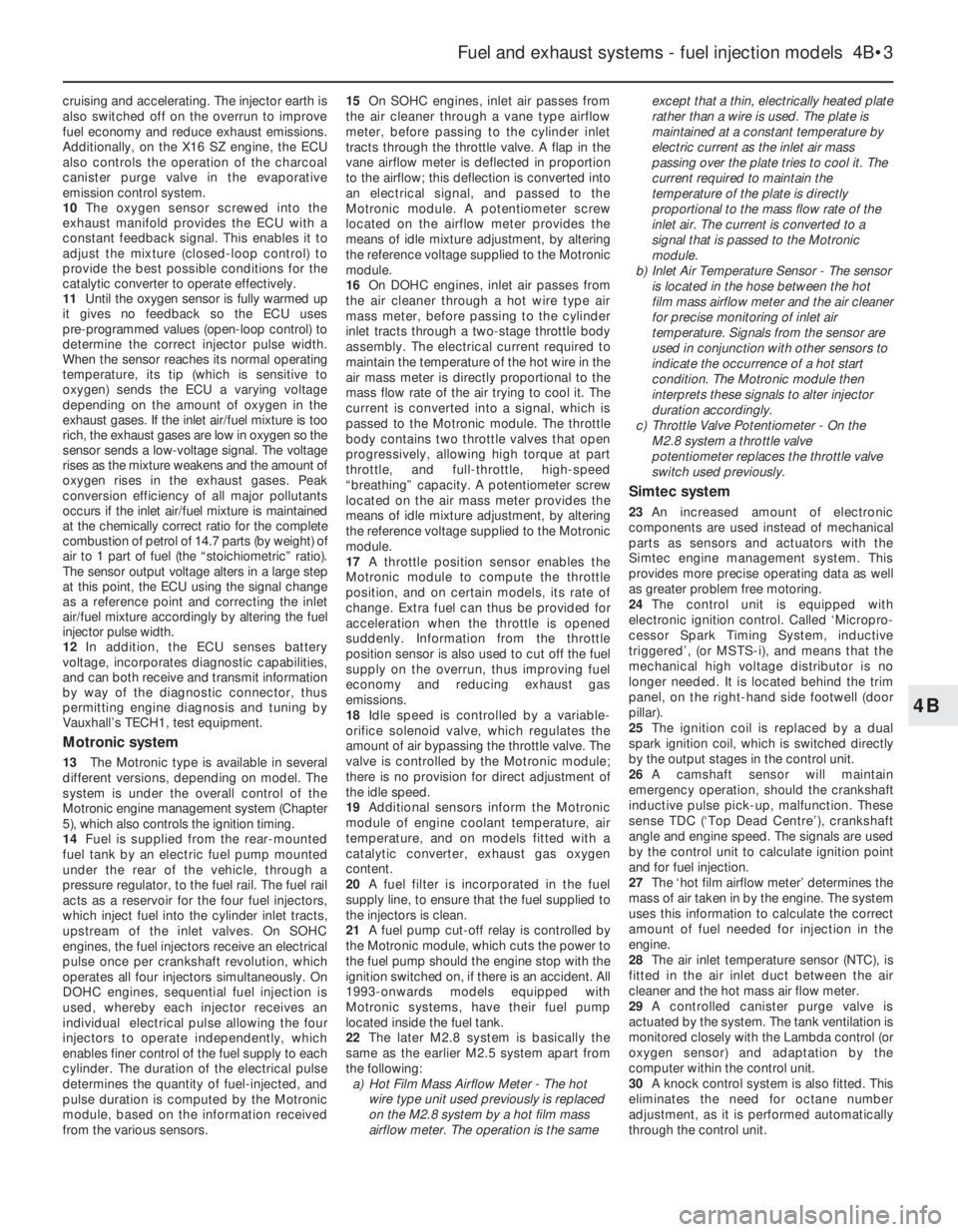
20Note that there is no lockplate securing
the handbrake cable to the brake backplate,
but the return spring must be unhooked from
the cable end.
21On models with a catalytic converter,
when removing the longer cable, unscrew the
four securing nuts and withdraw the exhaust
centre box heat shield by carefully sliding it
round the centre box.
DOHC models
Removal
22The left and right-hand handbrake cables,
and the equaliser yoke, are removed as an
assembly on DOHC models.
23Loosen the rear roadwheel bolts, then
chock the front wheels, jack up the rear of the
vehicle, and support securely on axle stands
(see “Jacking and Vehicle Support”)
positioned under the body side members.
Remove the roadwheels.
24Note the routing of the handbrake cables,
as an aid to refitting.
25On models with a catalytic converter,
unscrew the four securing nuts and withdraw
the exhaust centre box heat shield by
carefully sliding it round the centre box.
26Note the length of exposed thread at the
cable equaliser yoke, then unscrew the
securing nut and disconnect the equaliser
yoke from the handbrake lever operating rod.
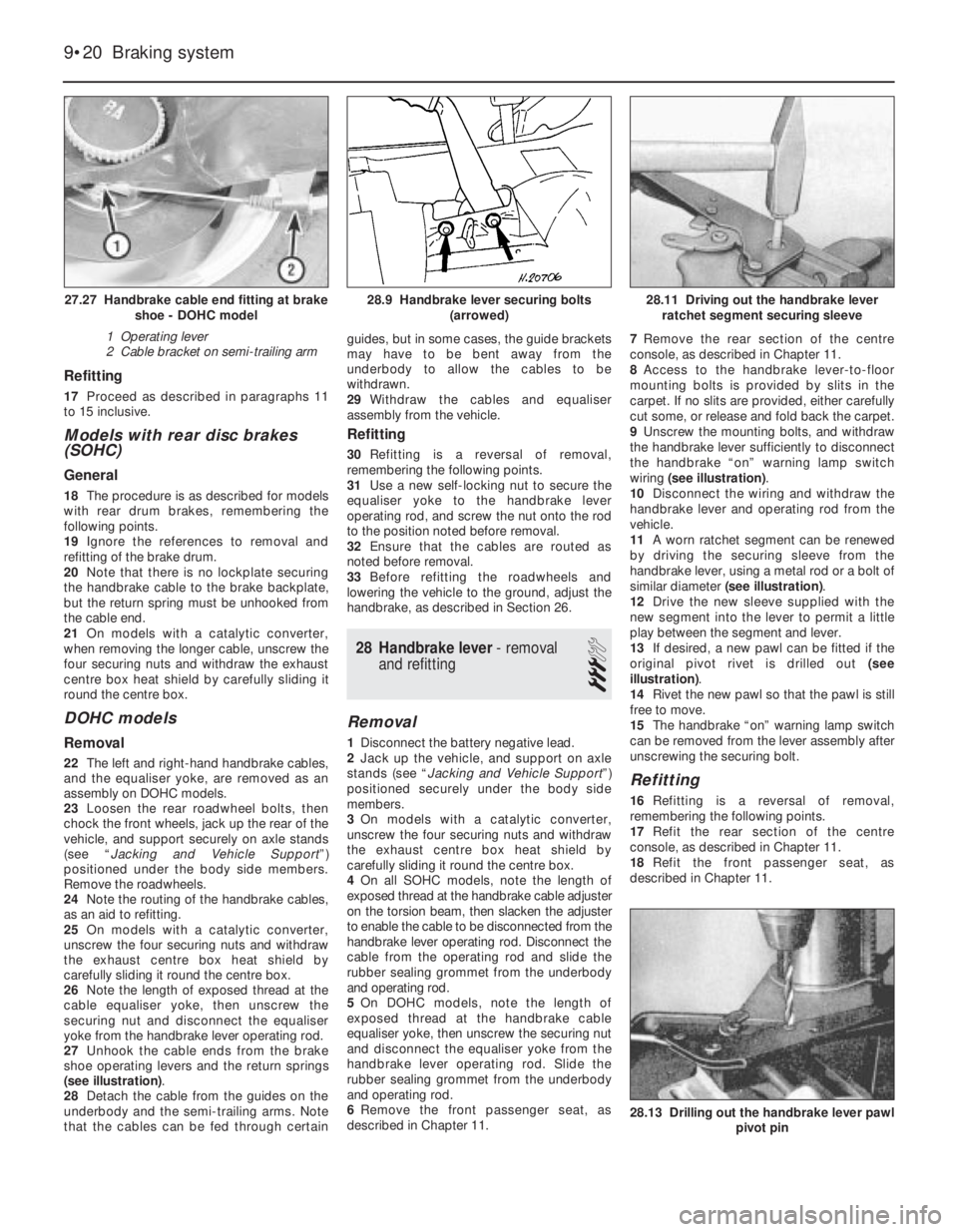
27Unhook the cable ends from the brake
shoe operating levers and the return springs
(see illustration).
28Detach the cable from the guides on the
underbody and the semi-trailing arms. Note
that the cables can be fed through certainguides, but in some cases, the guide brackets
may have to be bent away from the
underbody to allow the cables to be
withdrawn.
29Withdraw the cables and equaliser
assembly from the vehicle.
Refitting
30Refitting is a reversal of removal,
remembering the following points.
31Use a new self-locking nut to secure the
equaliser yoke to the handbrake lever
operating rod, and screw the nut onto the rod
to the position noted before removal.
32Ensure that the cables are routed as
noted before removal.
33Before refitting the roadwheels and
lowering the vehicle to the ground, adjust the
handbrake, as described in Section 26.
28Handbrake lever - removal
and refitting
3
Removal
1Disconnect the battery negative lead.
2Jack up the vehicle, and support on axle
stands (see “Jacking and Vehicle Support”)
positioned securely under the body side
members.
3On models with a catalytic converter,
unscrew the four securing nuts and withdraw
the exhaust centre box heat shield by
carefully sliding it round the centre box.
4On all SOHC models, note the length of
exposed thread at the handbrake cable adjuster
on the torsion beam, then slacken the adjuster
to enable the cable to be disconnected from the
handbrake lever operating rod. Disconnect the
cable from the operating rod and slide the
rubber sealing grommet from the underbody
and operating rod.
5On DOHC models, note the length of
exposed thread at the handbrake cable
equaliser yoke, then unscrew the securing nut
and disconnect the equaliser yoke from the
handbrake lever operating rod. Slide the
rubber sealing grommet from the underbody
and operating rod.
6Remove the front passenger seat, as
described in Chapter 11.7Remove the rear section of the centre
console, as described in Chapter 11.
8Access to the handbrake lever-to-floor
mounting bolts is provided by slits in the
carpet. If no slits are provided, either carefully
cut some, or release and fold back the carpet.
9Unscrew the mounting bolts, and withdraw
the handbrake lever sufficiently to disconnect
the handbrake “on” warning lamp switch
wiring (see illustration).
10Disconnect the wiring and withdraw the
handbrake lever and operating rod from the
vehicle.
11A worn ratchet segment can be renewed
by driving the securing sleeve from the
handbrake lever, using a metal rod or a bolt of
similar diameter (see illustration).
12Drive the new sleeve supplied with the
new segment into the lever to permit a little
play between the segment and lever.
13If desired, a new pawl can be fitted if the
original pivot rivet is drilled out (see
illustration).
14Rivet the new pawl so that the pawl is still
free to move.
15The handbrake “on” warning lamp switch
can be removed from the lever assembly after
unscrewing the securing bolt.
Refitting
16Refitting is a reversal of removal,
remembering the following points.
17Refit the rear section of the centre
console, as described in Chapter 11.
18Refit the front passenger seat, as
described in Chapter 11.
9•20Braking system
28.13 Drilling out the handbrake lever pawl
pivot pin
28.11 Driving out the handbrake lever
ratchet segment securing sleeve28.9 Handbrake lever securing bolts
(arrowed)27.27 Handbrake cable end fitting at brake
shoe - DOHC model
1 Operating lever
2 Cable bracket on semi-trailing arm
Page 154 of 525
4B
General
Injection system type:
C16 NZ, C16 NZ2, X16 SZ and C18 NZ . . . . . . . . . . . . . . . . . . . . . . . Multec Central Fuel Injection
20 NE, C20 NE and 20 SEH, (up to 1990) . . . . . . . . . . . . . . . . . . . . . Motronic M4.1
20 NE, C20 NE and 20 SEH, (from 1990) . . . . . . . . . . . . . . . . . . . . . . Motronic M1.5
20 XEJ and C20 XE, (up to 1993) . . . . . . . . . . . . . . . . . . . . . . . . . . . . Motronic M2.5
C20 XE (from 1993) . . . . . . . . . . . . . . . . . . . . . . . . . . . . . . . . . . . . . . . Motronic M2.8
X20 XEV . . . . . . . . . . . . . . . . . . . . . . . . . . . . . . . . . . . . . . . . . . . . . . . Simtec 56.1
Fuel tank capacity:
All models . . . . . . . . . . . . . . . . . . . . . . . . . . . . . . . . . . . . . . . . . . . . . . 63.0 ± 2 litres
Fuel octane rating *
Leaded . . . . . . . . . . . . . . . . . . . . . . . . . . . . . . . . . . . . . . . . . . . . . . . . 98 RON (4-star)
Unleaded (refer to Chapter 5) * . . . . . . . . . . . . . . . . . . . . . . . . . . . . . . 95 RON (Premium)
* Note
: Models fitted with a catalytic converter (engine code prefixed by ‘C’ or ‘X’), must only be operated on unleadedfuel.
Idle settings
Idle speed:
C16 NZ and X16 SZ . . . . . . . . . . . . . . . . . . . . . . . . . . . . . . . . . . . . . . 850 ± 80 rpm
C16 NZ2 . . . . . . . . . . . . . . . . . . . . . . . . . . . . . . . . . . . . . . . . . . . . . . . 880 ± 80 rpm
C18 NZ
Manual transmission models . . . . . . . . . . . . . . . . . . . . . . . . . . . . . 880 ± 80 rpm
Automatic transmission models . . . . . . . . . . . . . . . . . . . . . . . . . . . 830 ± 80 rpm
20 NE, C20 NE and 20 SEH . . . . . . . . . . . . . . . . . . . . . . . . . . . . . . . . 800 ± 80 rpm
20 XEJ and C20 XE . . . . . . . . . . . . . . . . . . . . . . . . . . . . . . . . . . . . . . . 940 ± 80 rpm
X20 XEV . . . . . . . . . . . . . . . . . . . . . . . . . . . . . . . . . . . . . . . . . . . . . . . 850 ± 160 rpm
Note:Idle speed adjustment is not possible on these models, for information only
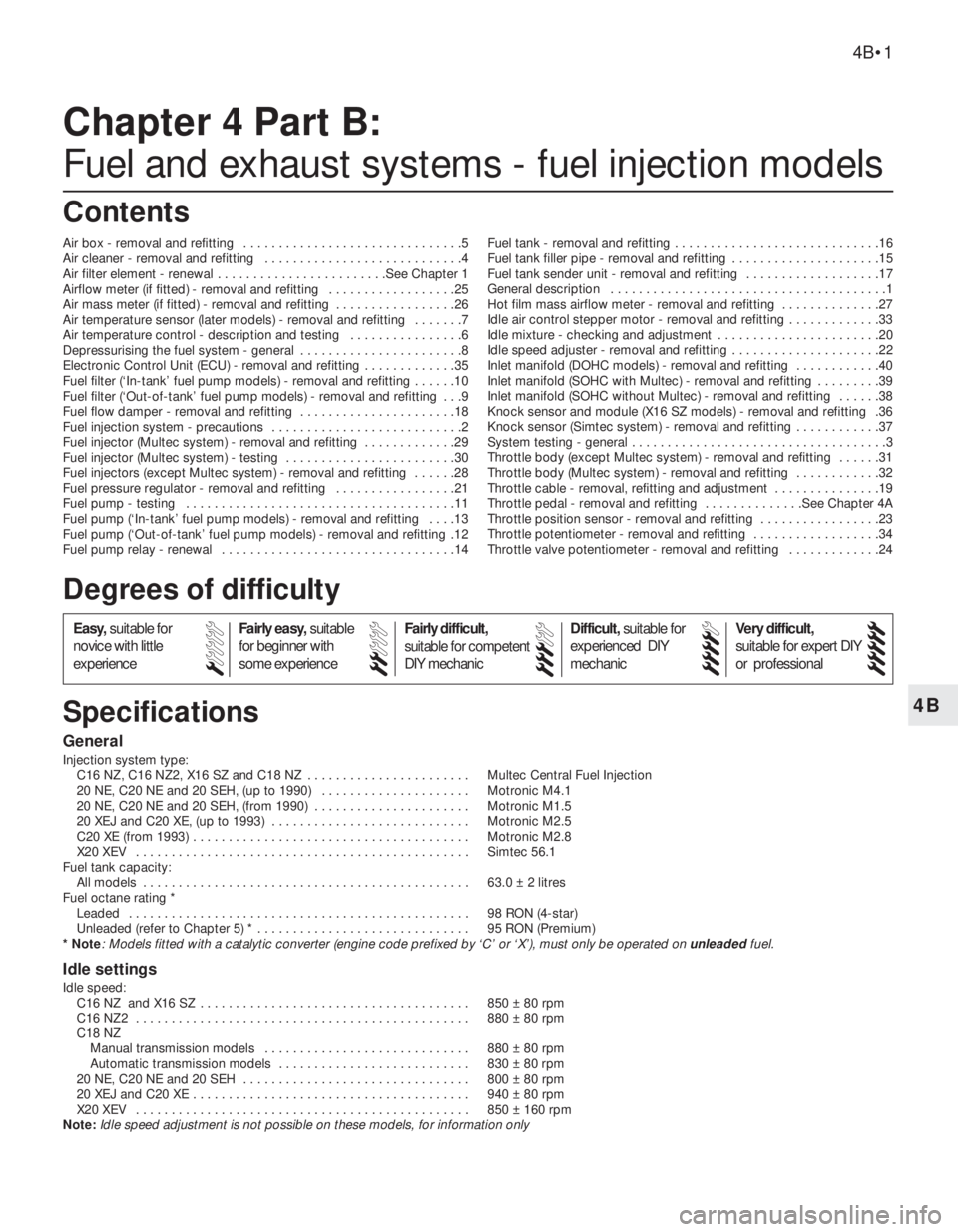
Chapter 4 Part B:
Fuel and exhaust systems - fuel injection models
Air box - removal and refitting . . . . . . . . . . . . . . . . . . . . . . . . . . . . . . .5
Air cleaner - removal and refitting . . . . . . . . . . . . . . . . . . . . . . . . . . . .4
Air filter element - renewal . . . . . . . . . . . . . . . . . . . . . . . .See Chapter 1
Airflow meter (if fitted) - removal and refitting . . . . . . . . . . . . . . . . . .25
Air mass meter (if fitted) - removal and refitting . . . . . . . . . . . . . . . . .26
Air temperature sensor (later models) - removal and refitting . . . . . . .7
Air temperature control - description and testing . . . . . . . . . . . . . . . .6
Depressurising the fuel system - general . . . . . . . . . . . . . . . . . . . . . . .8
Electronic Control Unit (ECU) - removal and refitting . . . . . . . . . . . . .35
Fuel filter (‘In-tank’ fuel pump models) - removal and refitting . . . . . .10
Fuel filter (‘Out-of-tank’ fuel pump models) - removal and refitting . . .9
Fuel flow damper - removal and refitting . . . . . . . . . . . . . . . . . . . . . .18
Fuel injection system - precautions . . . . . . . . . . . . . . . . . . . . . . . . . . .2
Fuel injector (Multec system) - removal and refitting . . . . . . . . . . . . .29
Fuel injector (Multec system) - testing . . . . . . . . . . . . . . . . . . . . . . . .30
Fuel injectors (except Multec system) - removal and refitting . . . . . .28
Fuel pressure regulator - removal and refitting . . . . . . . . . . . . . . . . .21
Fuel pump - testing . . . . . . . . . . . . . . . . . . . . . . . . . . . . . . . . . . . . . .11
Fuel pump (‘In-tank’ fuel pump models) - removal and refitting . . . .13
Fuel pump (‘Out-of-tank’ fuel pump models) - removal and refitting .12
Fuel pump relay - renewal . . . . . . . . . . . . . . . . . . . . . . . . . . . . . . . . .14Fuel tank - removal and refitting . . . . . . . . . . . . . . . . . . . . . . . . . . . . .16
Fuel tank filler pipe - removal and refitting . . . . . . . . . . . . . . . . . . . . .15
Fuel tank sender unit - removal and refitting . . . . . . . . . . . . . . . . . . .17
General description . . . . . . . . . . . . . . . . . . . . . . . . . . . . . . . . . . . . . . .1
Hot film mass airflow meter - removal and refitting . . . . . . . . . . . . . .27
Idle air control stepper motor - removal and refitting . . . . . . . . . . . . .33
Idle mixture - checking and adjustment . . . . . . . . . . . . . . . . . . . . . . .20
Idle speed adjuster - removal and refitting . . . . . . . . . . . . . . . . . . . . .22
Inlet manifold (DOHC models) - removal and refitting . . . . . . . . . . . .40
Inlet manifold (SOHC with Multec) - removal and refitting . . . . . . . . .39
Inlet manifold (SOHC without Multec) - removal and refitting . . . . . .38
Knock sensor and module (X16 SZ models) - removal and refitting .36
Knock sensor (Simtec system) - removal and refitting . . . . . . . . . . . .37
System testing - general . . . . . . . . . . . . . . . . . . . . . . . . . . . . . . . . . . . .3
Throttle body (except Multec system) - removal and refitting . . . . . .31
Throttle body (Multec system) - removal and refitting . . . . . . . . . . . .32
Throttle cable - removal, refitting and adjustment . . . . . . . . . . . . . . .19
Throttle pedal - removal and refitting . . . . . . . . . . . . . .See Chapter 4A
Throttle position sensor - removal and refitting . . . . . . . . . . . . . . . . .23
Throttle potentiometer - removal and refitting . . . . . . . . . . . . . . . . . .34
Throttle valve potentiometer - removal and refitting . . . . . . . . . . . . .24
4B•1
Specifications Contents
Easy,suitable for
novice with little
experienceFairly easy,suitable
for beginner with
some experienceFairly difficult,
suitable for competent
DIY mechanic
Difficult,suitable for
experienced DIY
mechanicVery difficult,
suitable for expert DIY
or professional
Degrees of difficulty
54321
Page 155 of 525
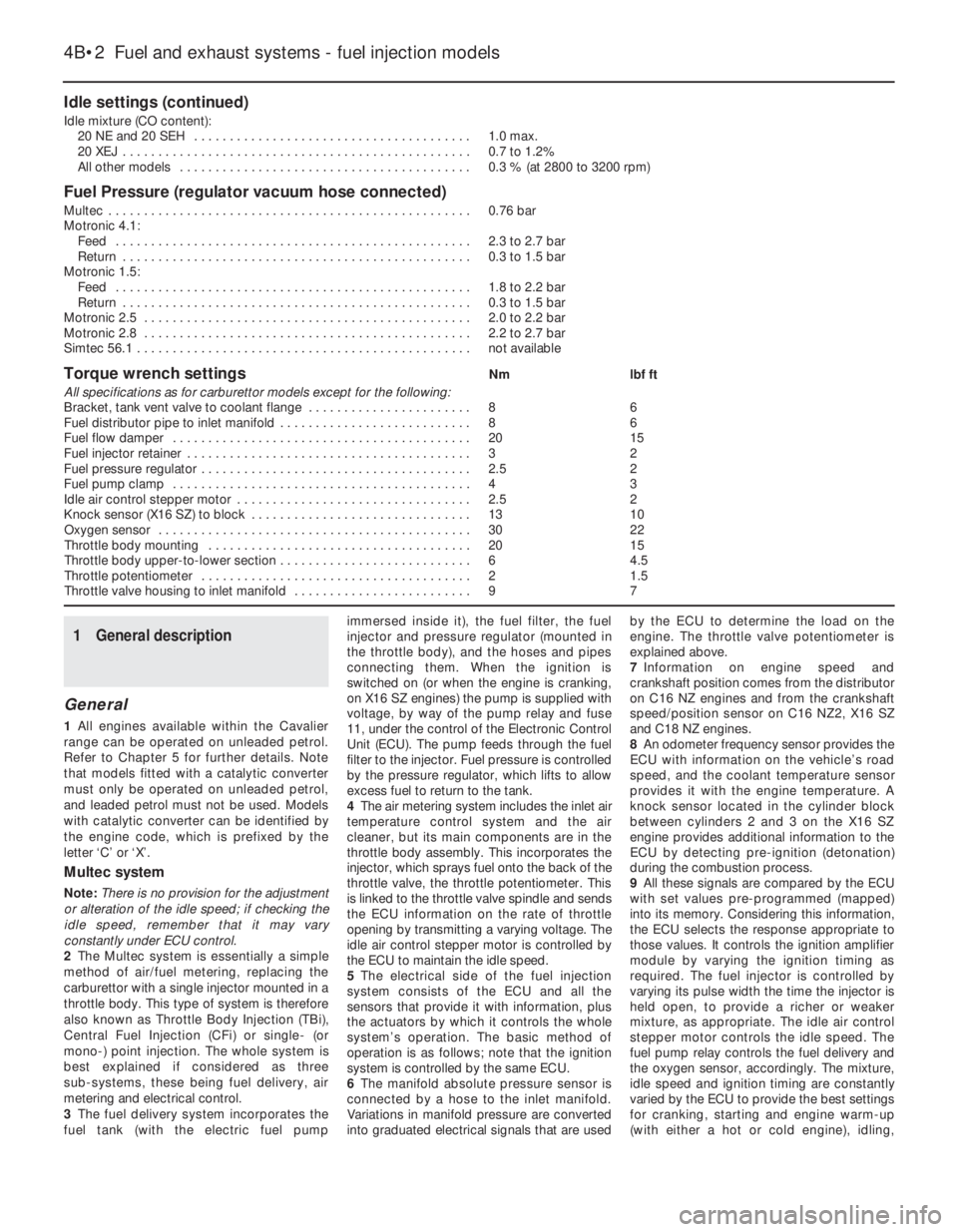
Idle settings (continued)
Idle mixture (CO content):
20 NE and 20 SEH . . . . . . . . . . . . . . . . . . . . . . . . . . . . . . . . . . . . . . .1.0 max.
20 XEJ . . . . . . . . . . . . . . . . . . . . . . . . . . . . . . . . . . . . . . . . . . . . . . . . .0.7 to 1.2%
All other models . . . . . . . . . . . . . . . . . . . . . . . . . . . . . . . . . . . . . . . . .0.3 % (at 2800 to 3200 rpm)
Fuel Pressure (regulator vacuum hose connected)
Multec . . . . . . . . . . . . . . . . . . . . . . . . . . . . . . . . . . . . . . . . . . . . . . . . . . .0.76 bar
Motronic 4.1:
Feed . . . . . . . . . . . . . . . . . . . . . . . . . . . . . . . . . . . . . . . . . . . . . . . . . .2.3 to 2.7 bar
Return . . . . . . . . . . . . . . . . . . . . . . . . . . . . . . . . . . . . . . . . . . . . . . . . .0.3 to 1.5 bar
Motronic 1.5:
Feed . . . . . . . . . . . . . . . . . . . . . . . . . . . . . . . . . . . . . . . . . . . . . . . . . .1.8 to 2.2 bar
Return . . . . . . . . . . . . . . . . . . . . . . . . . . . . . . . . . . . . . . . . . . . . . . . . .0.3 to 1.5 bar
Motronic 2.5 . . . . . . . . . . . . . . . . . . . . . . . . . . . . . . . . . . . . . . . . . . . . . .2.0 to 2.2 bar
Motronic 2.8 . . . . . . . . . . . . . . . . . . . . . . . . . . . . . . . . . . . . . . . . . . . . . .2.2 to 2.7 bar
Simtec 56.1 . . . . . . . . . . . . . . . . . . . . . . . . . . . . . . . . . . . . . . . . . . . . . . .not available
Torque wrench settingsNmlbf ft
All specifications as for carburettor models except for the following:
Bracket, tank vent valve to coolant flange . . . . . . . . . . . . . . . . . . . . . . .86
Fuel distributor pipe to inlet manifold . . . . . . . . . . . . . . . . . . . . . . . . . . .86
Fuel flow damper . . . . . . . . . . . . . . . . . . . . . . . . . . . . . . . . . . . . . . . . . .2015
Fuel injector retainer . . . . . . . . . . . . . . . . . . . . . . . . . . . . . . . . . . . . . . . .32
Fuel pressure regulator . . . . . . . . . . . . . . . . . . . . . . . . . . . . . . . . . . . . . .2.52
Fuel pump clamp . . . . . . . . . . . . . . . . . . . . . . . . . . . . . . . . . . . . . . . . . .43
Idle air control stepper motor . . . . . . . . . . . . . . . . . . . . . . . . . . . . . . . . .2.52
Knock sensor (X16 SZ) to block . . . . . . . . . . . . . . . . . . . . . . . . . . . . . . .1310
Oxygen sensor . . . . . . . . . . . . . . . . . . . . . . . . . . . . . . . . . . . . . . . . . . . .3022
Throttle body mounting . . . . . . . . . . . . . . . . . . . . . . . . . . . . . . . . . . . . .2015
Throttle body upper-to-lower section . . . . . . . . . . . . . . . . . . . . . . . . . . .64.5
Throttle potentiometer . . . . . . . . . . . . . . . . . . . . . . . . . . . . . . . . . . . . . .21.5
Throttle valve housing to inlet manifold . . . . . . . . . . . . . . . . . . . . . . . . .97
1General description
General
1All engines available within the Cavalier
range can be operated on unleaded petrol.
Refer to Chapter 5 for further details. Note
that models fitted with a catalytic converter
must only be operated on unleaded petrol,
and leaded petrol must not be used. Models
with catalytic converter can be identified by
the engine code, which is prefixed by the
letter ‘C’ or ‘X’.
Multec system
Note: There is no provision for the adjustment
or alteration of the idle speed; if checking the
idle speed, remember that it may vary
constantly under ECU control.
2The Multec system is essentially a simple
method of air/fuel metering, replacing the
carburettor with a single injector mounted in a
throttle body. This type of system is therefore
also known as Throttle Body Injection (TBi),
Central Fuel Injection (CFi) or single-(or
mono-) point injection. The whole system is
best explained if considered as three
sub-systems, these being fuel delivery, air
metering and electrical control.
3The fuel delivery system incorporates the
fuel tank (with the electric fuel pumpimmersed inside it), the fuel filter, the fuel
injector and pressure regulator (mounted in
the throttle body), and the hoses and pipes
connecting them. When the ignition is
switched on (or when the engine is cranking,
on X16 SZ engines) the pump is supplied with
voltage, by way of the pump relay and fuse
11, under the control of the Electronic Control
Unit (ECU). The pump feeds through the fuel
filter to the injector. Fuel pressure is controlled
by the pressure regulator, which lifts to allow
excess fuel to return to the tank.
4The air metering system includes the inlet air
temperature control system and the air
cleaner, but its main components are in the
throttle body assembly. This incorporates the
injector, which sprays fuel onto the back of the
throttle valve, the throttle potentiometer. This
is linked to the throttle valve spindle and sends
the ECU information on the rate of throttle
opening by transmitting a varying voltage. The
idle air control stepper motor is controlled by
the ECU to maintain the idle speed.
5The electrical side of the fuel injection
system consists of the ECU and all the
sensors that provide it with information, plus
the actuators by which it controls the whole
system’s operation. The basic method of
operation is as follows; note that the ignition
system is controlled by the same ECU.
6The manifold absolute pressure sensor is
connected by a hose to the inlet manifold.
Variations in manifold pressure are converted
into graduated electrical signals that are usedby the ECU to determine the load on the
engine. The throttle valve potentiometer is
explained above.
7Information on engine speed and
crankshaft position comes from the distributor
on C16 NZ engines and from the crankshaft
speed/position sensor on C16 NZ2, X16 SZ
and C18 NZ engines.
8An odometer frequency sensor provides the
ECU with information on the vehicle’s road
speed, and the coolant temperature sensor
provides it with the engine temperature. A
knock sensor located in the cylinder block
between cylinders 2 and 3 on the X16 SZ
engine provides additional information to the
ECU by detecting pre-ignition (detonation)
during the combustion process.
9All these signals are compared by the ECU
with set values pre-programmed (mapped)
into its memory. Considering this information,
the ECU selects the response appropriate to
those values. It controls the ignition amplifier
module by varying the ignition timing as
required. The fuel injector is controlled by
varying its pulse width the time the injector is
held open, to provide a richer or weaker
mixture, as appropriate. The idle air control
stepper motor controls the idle speed. The
fuel pump relay controls the fuel delivery and
the oxygen sensor, accordingly. The mixture,
idle speed and ignition timing are constantly
varied by the ECU to provide the best settings
for cranking, starting and engine warm-up
(with either a hot or cold engine), idling,
4B•2Fuel and exhaust systems - fuel injection models
Page 156 of 525
4B
cruising and accelerating. The injector earth is
also switched off on the overrun to improve
fuel economy and reduce exhaust emissions.
Additionally, on the X16 SZ engine, the ECU
also controls the operation of the charcoal
canister purge valve in the evaporative
emission control system.
10The oxygen sensor screwed into the
exhaust manifold provides the ECU with a
constant feedback signal. This enables it to
adjust the mixture (closed-loop control) to
provide the best possible conditions for the
catalytic converter to operate effectively.
11Until the oxygen sensor is fully warmed up
it gives no feedback so the ECU uses
pre-programmed values (open-loop control) to
determine the correct injector pulse width.
When the sensor reaches its normal operating
temperature, its tip (which is sensitive to
oxygen) sends the ECU a varying voltage
depending on the amount of oxygen in the
exhaust gases. If the inlet air/fuel mixture is too
rich, the exhaust gases are low in oxygen so the
sensor sends a low-voltage signal. The voltage
rises as the mixture weakens and the amount of
oxygen rises in the exhaust gases. Peak
conversion efficiency of all major pollutants
occurs if the inlet air/fuel mixture is maintained
at the chemically correct ratio for the complete
combustion of petrol of 14.7 parts (by weight) of
air to 1 part of fuel (the “stoichiometric” ratio).
The sensor output voltage alters in a large step
at this point, the ECU using the signal change
as a reference point and correcting the inlet
air/fuel mixture accordingly by altering the fuel
injector pulse width.
12In addition, the ECU senses battery
voltage, incorporates diagnostic capabilities,
and can both receive and transmit information
by way of the diagnostic connector, thus
permitting engine diagnosis and tuning by
Vauxhall’s TECH1, test equipment.
Motronic system
13The Motronic type is available in several
different versions, depending on model. The
system is under the overall control of the
Motronic engine management system (Chapter
5), which also controls the ignition timing.
14Fuel is supplied from the rear-mounted
fuel tank by an electric fuel pump mounted
under the rear of the vehicle, through a
pressure regulator, to the fuel rail. The fuel rail
acts as a reservoir for the four fuel injectors,
which inject fuel into the cylinder inlet tracts,
upstream of the inlet valves. On SOHC
engines, the fuel injectors receive an electrical
pulse once per crankshaft revolution, which
operates all four injectors simultaneously. On
DOHC engines, sequential fuel injection is
used, whereby each injector receives an
individual electrical pulse allowing the four
injectors to operate independently, which
enables finer control of the fuel supply to each
cylinder. The duration of the electrical pulse
determines the quantity of fuel-injected, and
pulse duration is computed by the Motronic
module, based on the information received
from the various sensors.15On SOHC engines, inlet air passes from
the air cleaner through a vane type airflow
meter, before passing to the cylinder inlet
tracts through the throttle valve. A flap in the
vane airflow meter is deflected in proportion
to the airflow; this deflection is converted into
an electrical signal, and passed to the
Motronic module. A potentiometer screw
located on the airflow meter provides the
means of idle mixture adjustment, by altering
the reference voltage supplied to the Motronic
module.
16On DOHC engines, inlet air passes from
the air cleaner through a hot wire type air
mass meter, before passing to the cylinder
inlet tracts through a two-stage throttle body
assembly. The electrical current required to
maintain the temperature of the hot wire in the
air mass meter is directly proportional to the
mass flow rate of the air trying to cool it. The
current is converted into a signal, which is
passed to the Motronic module. The throttle
body contains two throttle valves that open
progressively, allowing high torque at part
throttle, and full-throttle, high-speed
“breathing” capacity. A potentiometer screw
located on the air mass meter provides the
means of idle mixture adjustment, by altering
the reference voltage supplied to the Motronic
module.
17A throttle position sensor enables the
Motronic module to compute the throttle
position, and on certain models, its rate of
change. Extra fuel can thus be provided for
acceleration when the throttle is opened
suddenly. Information from the throttle
position sensor is also used to cut off the fuel
supply on the overrun, thus improving fuel
economy and reducing exhaust gas
emissions.
18Idle speed is controlled by a variable-
orifice solenoid valve, which regulates the
amount of air bypassing the throttle valve. The
valve is controlled by the Motronic module;
there is no provision for direct adjustment of
the idle speed.
19Additional sensors inform the Motronic
module of engine coolant temperature, air
temperature, and on models fitted with a
catalytic converter, exhaust gas oxygen
content.
20A fuel filter is incorporated in the fuel
supply line, to ensure that the fuel supplied to
the injectors is clean.
21A fuel pump cut-off relay is controlled by
the Motronic module, which cuts the power to
the fuel pump should the engine stop with the
ignition switched on, if there is an accident. All
1993-onwards models equipped with
Motronic systems, have their fuel pump
located inside the fuel tank.
22The later M2.8 system is basically the
same as the earlier M2.5 system apart from
the following:
a)Hot Film Mass Airflow Meter - The hot
wire type unit used previously is replaced
on the M2.8 system by a hot film mass
airflow meter. The operation is the sameexcept that a thin, electrically heated plate
rather than a wire is used. The plate is
maintained at a constant temperature by
electric current as the inlet air mass
passing over the plate tries to cool it. The
current required to maintain the
temperature of the plate is directly
proportional to the mass flow rate of the
inlet air. The current is converted to a
signal that is passed to the Motronic
module.
b)Inlet Air Temperature Sensor -The sensor
is located in the hose between the hot
film mass airflow meter and the air cleaner
for precise monitoring of inlet air
temperature. Signals from the sensor are
used in conjunction with other sensors to
indicate the occurrence of a hot start
condition. The Motronic module then
interprets these signals to alter injector
duration accordingly.
c)Throttle Valve Potentiometer -On the
M2.8 system a throttle valve
potentiometer replaces the throttle valve
switch used previously.
Simtec system
23An increased amount of electronic
components are used instead of mechanical
parts as sensors and actuators with the
Simtec engine management system. This
provides more precise operating data as well
as greater problem free motoring.
24The control unit is equipped with
electronic ignition control. Called ‘Micropro-
cessor Spark Timing System, inductive
triggered’, (or MSTS-i), and means that the
mechanical high voltage distributor is no
longer needed. It is located behind the trim
panel, on the right-hand side footwell (door
pillar).
25The ignition coil is replaced by a dual
spark ignition coil, which is switched directly
by the output stages in the control unit.
26A camshaft sensor will maintain
emergency operation, should the crankshaft
inductive pulse pick-up, malfunction. These
sense TDC (‘Top Dead Centre’), crankshaft
angle and engine speed. The signals are used
by the control unit to calculate ignition point
and for fuel injection.
27The ‘hot film airflow meter’ determines the
mass of air taken in by the engine. The system
uses this information to calculate the correct
amount of fuel needed for injection in the
engine.
28The air inlet temperature sensor (NTC), is
fitted in the air inlet duct between the air
cleaner and the hot mass air flow meter.
29A controlled canister purge valve is
actuated by the system. The tank ventilation is
monitored closely with the Lambda control (or
oxygen sensor) and adaptation by the
computer within the control unit.
30A knock control system is also fitted. This
eliminates the need for octane number
adjustment, as it is performed automatically
through the control unit.
Fuel and exhaust systems - fuel injection models 4B•3
Page 162 of 525
4B
4Clamp the fuel hoses on either side of the
damper, to minimise fuel loss when the hoses
are disconnected.
5Loosen the clamp screws, and disconnect
the fuel hoses from the damper. Be prepared
for fuel spillage, and take adequate fire
precautions.
6Unscrew the securing nut, and withdraw
the damper from the bracket.
Refitting
7Refitting is a reversal of removal.
8Run the engine and check for leaks on
completion. If leakage is evident; stop the
engine immediately, and rectify the problem
without delay.
19Throttle cable - removal,
refitting and adjustment
3
Removal
1This procedure is basically the same as
described in Chapter 4A, but note the
following.
2Not all models are fitted with an air box.
Ignore references to it, if not applicable.
3For “carburettor” substitute “throttle body”,
and note that the cable bracket is bolted to
the inlet manifold.
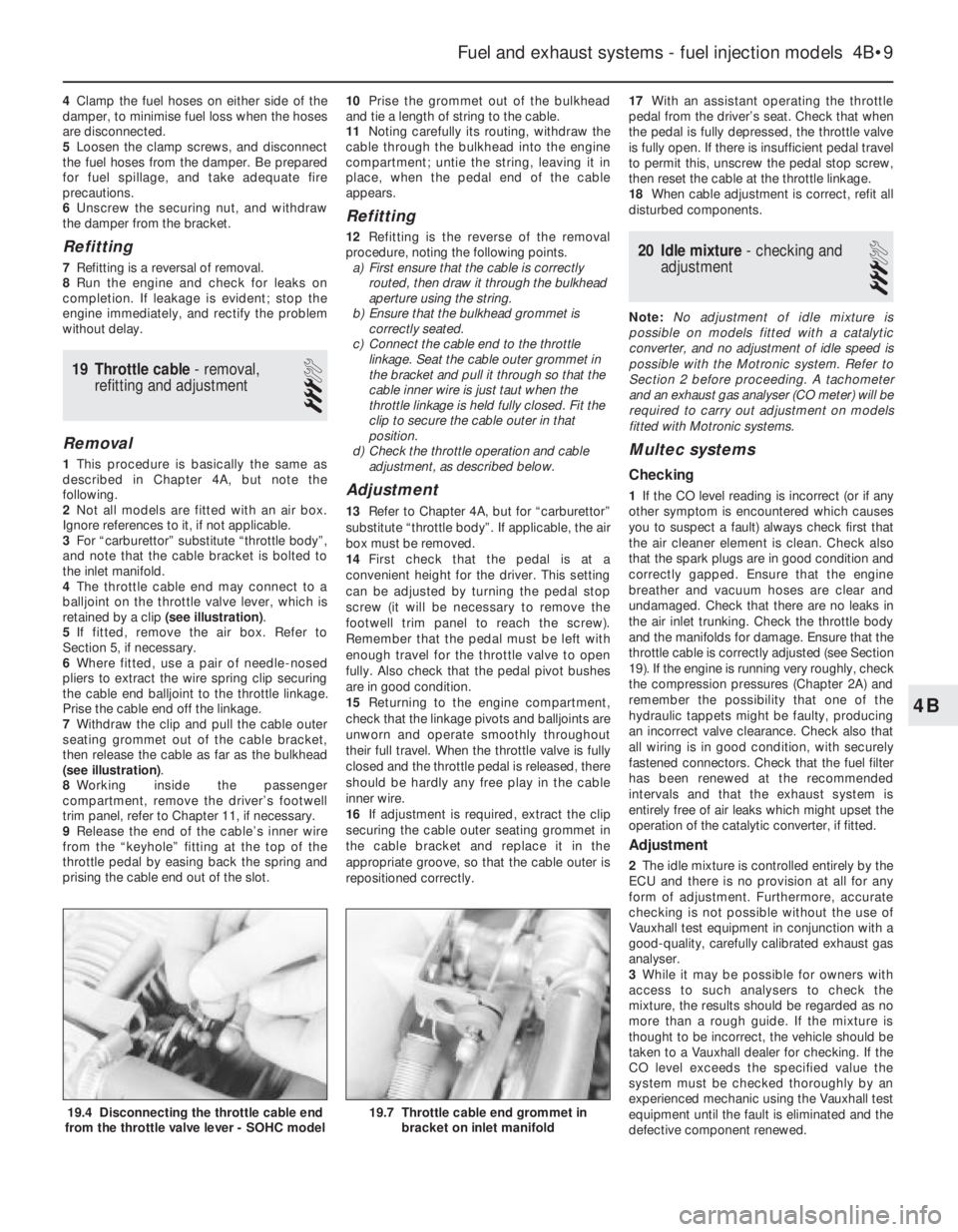
4The throttle cable end may connect to a
balljoint on the throttle valve lever, which is
retained by a clip (see illustration).
5If fitted, remove the air box. Refer to
Section 5, if necessary.
6Where fitted, use a pair of needle-nosed
pliers to extract the wire spring clip securing
the cable end balljoint to the throttle linkage.
Prise the cable end off the linkage.
7Withdraw the clip and pull the cable outer
seating grommet out of the cable bracket,
then release the cable as far as the bulkhead
(see illustration).
8Working inside the passenger
compartment, remove the driver’s footwell
trim panel, refer to Chapter 11, if necessary.
9Release the end of the cable’s inner wire
from the “keyhole” fitting at the top of the
throttle pedal by easing back the spring and
prising the cable end out of the slot.10Prise the grommet out of the bulkhead
and tie a length of string to the cable.
11Noting carefully its routing, withdraw the
cable through the bulkhead into the engine
compartment; untie the string, leaving it in
place, when the pedal end of the cable
appears.
Refitting
12Refitting is the reverse of the removal
procedure, noting the following points.
a)First ensure that the cable is correctly
routed, then draw it through the bulkhead
aperture using the string.
b)Ensure that the bulkhead grommet is
correctly seated.
c)Connect the cable end to the throttle
linkage. Seat the cable outer grommet in
the bracket and pull it through so that the
cable inner wire is just taut when the
throttle linkage is held fully closed. Fit the
clip to secure the cable outer in that
position.
d)Check the throttle operation and cable
adjustment, as described below.
Adjustment
13Refer to Chapter 4A, but for “carburettor”
substitute “throttle body”. If applicable, the air
box must be removed.
14First check that the pedal is at a
convenient height for the driver. This setting
can be adjusted by turning the pedal stop
screw (it will be necessary to remove the
footwell trim panel to reach the screw).
Remember that the pedal must be left with
enough travel for the throttle valve to open
fully. Also check that the pedal pivot bushes
are in good condition.
15Returning to the engine compartment,
check that the linkage pivots and balljoints are
unworn and operate smoothly throughout
their full travel. When the throttle valve is fully
closed and the throttle pedal is released, there
should be hardly any free play in the cable
inner wire.
16If adjustment is required, extract the clip
securing the cable outer seating grommet in
the cable bracket and replace it in the
appropriate groove, so that the cable outer is
repositioned correctly.17With an assistant operating the throttle
pedal from the driver’s seat. Check that when
the pedal is fully depressed, the throttle valve
is fully open. If there is insufficient pedal travel
to permit this, unscrew the pedal stop screw,
then reset the cable at the throttle linkage.
18When cable adjustment is correct, refit all
disturbed components.
20Idle mixture - checking and
adjustment
3
Note: No adjustment of idle mixture is
possible on models fitted with a catalytic
converter, and no adjustment of idle speed is
possible with the Motronic system. Refer to
Section 2 before proceeding. A tachometer
and an exhaust gas analyser (CO meter) will be
required to carry out adjustment on models
fitted with Motronic systems.
Multec systems
Checking
1If the CO level reading is incorrect (or if any
other symptom is encountered which causes
you to suspect a fault) always check first that
the air cleaner element is clean. Check also
that the spark plugs are in good condition and
correctly gapped. Ensure that the engine
breather and vacuum hoses are clear and
undamaged. Check that there are no leaks in
the air inlet trunking. Check the throttle body
and the manifolds for damage. Ensure that the
throttle cable is correctly adjusted (see Section
19). If the engine is running very roughly, check
the compression pressures (Chapter 2A) and
remember the possibility that one of the
hydraulic tappets might be faulty, producing
an incorrect valve clearance. Check also that
all wiring is in good condition, with securely
fastened connectors. Check that the fuel filter
has been renewed at the recommended
intervals and that the exhaust system is
entirely free of air leaks which might upset the
operation of the catalytic converter, if fitted.
Adjustment
2The idle mixture is controlled entirely by the
ECU and there is no provision at all for any
form of adjustment. Furthermore, accurate
checking is not possible without the use of
Vauxhall test equipment in conjunction with a
good-quality, carefully calibrated exhaust gas
analyser.
3While it may be possible for owners with
access to such analysers to check the
mixture, the results should be regarded as no
more than a rough guide. If the mixture is
thought to be incorrect, the vehicle should be
taken to a Vauxhall dealer for checking. If the
CO level exceeds the specified value the
system must be checked thoroughly by an
experienced mechanic using the Vauxhall test
equipment until the fault is eliminated and the
defective component renewed.
Fuel and exhaust systems - fuel injection models 4B•9
19.7 Throttle cable end grommet in
bracket on inlet manifold19.4 Disconnecting the throttle cable end
from the throttle valve lever - SOHC model
Page 163 of 525

4Where applicable, the only test of the
catalytic converter’s efficiency is to check the
level of CO in the exhaust gas. This is
measured at the tailpipe with the engine
running (with no load) at 3000 rpm. If the CO
level exceeds the specified value, the Vauxhall
test equipment must be used to check the
entire fuel injection/ignition system. If the
engine is mechanically sound, once the
system has been eliminated, the fault must lie
in the converter, which must be renewed.
Motronic systems
Checking
5In order to check the idle mixture adjustment,
the following conditions must be met:
a)The engine must be at normal operating
temperature
b)All electrical consumers (cooling fan,
heater blower, headlamps etc.) must be
switched off
c)The spark plug gaps must be correctly
adjusted see Chapter 1
d)The throttle cable free play must be
correctly adjusted - see Section 19
e)The air inlet trunking must be free from
leaks, and the air filter must be clean
Adjustment
6Connect a tachometer and an exhaust gas
analyser to the vehicle in accordance with the
equipment manufacturer’s instructions.
7Start the engine and turn it at 2000 rpm for
approximately 30 seconds, then allow it to
idle. Check that the idle speed is within the
specified limits. No adjustment of idle speed
is possible, and if outside the specified limits,
the problem should be referred to a dealer.
8With the idle speed correct, check the CO
level in the exhaust gas. If it is outside the
specified limits, adjust by means of the idle
mixture adjustment screw in the airflow meter
or air mass meter, as applicable. In
production, the screw is covered by a
tamperproof plug; ensure that no local or
national laws are being broken before
removing the plug.9If the cooling fan cuts in during the
adjustment procedure, stop the adjustments,
and proceed when the cooling fan stops.
10When the idle mixture is correctly set,
stop the engine and disconnect the test
equipment.
Simtec systems
11Adjustment is not possible on these
models.
21Fuel pressure regulator -
removal and refitting
3
Note:Refer to Section 2 before proceeding
Removal
SOHC models (except Multec systems)
1Disconnect the battery negative lead.
2For improved access, remove the idle
speed adjuster as described in Section 22.
Disconnect the wiring harness housing from
the fuel injectors and move it to one side,
taking care not to strain the wiring. Pull up on
the wiring harness housing, and compress the
wiring plug retaining clips to release the
harness housing from the injectors.
3Position a wad of rag beneath the pressure
regulator, to absorb the fuel that will be
released as the regulator is removed.
4Loosen the clamp screws and disconnect
the fuel hoses from the regulator. Be prepared
for fuel spillage, and take adequate fire
precautions.
5Disconnect the vacuum pipe from the top
of the pressure regulator and withdraw the
regulator.
SOHC models (with Multec system)
6Depressurise the fuel system, as described
in Section 8.
7Remove the air box. Refer to Section 5, if
necessary.
8Disconnect the battery earth lead.9Noting the dowels locating the cover,
carefully unscrew the fuel pressure regulator
cover Torx-type screws (size TX 15). Ensure
that the spring does not fly out as the cover is
released. Remove the cover spring seat,
spring and diaphragm, noting how each is
fitted (see illustration).
10The diaphragm must be renewed
whenever the cover is disturbed. If any of the
regulator’s other components are worn or
damaged, they can be renewed only as part
of the throttle body upper section assembly.
DOHC models
11Disconnect the battery negative lead.
12Disconnect the wiring plug from the air
mass meter. Recover the sealing ring.
13Loosen the clamp screw securing the air
trunking to the right-hand end of the air mass
meter.
14Using an Allen key or hexagon bit,
unscrew the four bolts securing the air box to
the throttle body. Lift the air box from the
throttle body and disconnect the hose from
the base of the air box, then withdraw the air
box/air mass meter assembly.
15Disconnect the two breather hoses from
the rear of the camshaft cover, and move
them to one side.
16Disconnect the wiring plug from the
throttle position sensor.
17Disconnect the vacuum pipe from the top
of the pressure regulator (see illustration).
18Position a wad of rag beneath the
regulator, to absorb the fuel that will be
released as the regulator is removed.
19Using a spanner or socket, and working
underneath the regulator, unscrew the four
Torx type securing bolts, then withdraw the
regulator. Be prepared for fuel spillage, and
take adequate fire precautions.
Refitting
20Refitting is a reversal of removal, ensuring
that all wires, pipes and hoses are correctly
reconnected. Note that on DOHC models, the
4B•10Fuel and exhaust systems - fuel injection models
21.17 Fuel pressure regulator (arrowed) - DOHC model21.9 Fuel pressure regulator cover
A Locating dowels B Mounting screws
Page 187 of 525
36Timing belt renewal
3
1To minimise risk of major damage to the
engine the timing belt (or cambelt, as it is
sometimes called), needs replacing at least,
on every major service.
2It is good practise however, not only to
renew the belt whenever major engine work is
carried out, but also if you buy a used car with
unclear service history.
3Some models are fitted with an inspection
cover to view the condition of the belt. Whilst
others involve a lot more work.
4Full details on checking and replacement
are shown in Chapters 2A or 2B, as
appropriate.
37Spark plug renewal (DOHC)
2
1This procedure is basically the same shown
in Section 30. However on these models, a
spark plug cover needs to be removed from
the camshaft cover before the plugs can be
removed.
2Take great care when removing and
refitting spark plugs on these engines (see
illustration). Hairline cracks in the ceramic of
the plug can cause occasional or complete
ignition failure. Damage to the catalytic
converter may also occur.
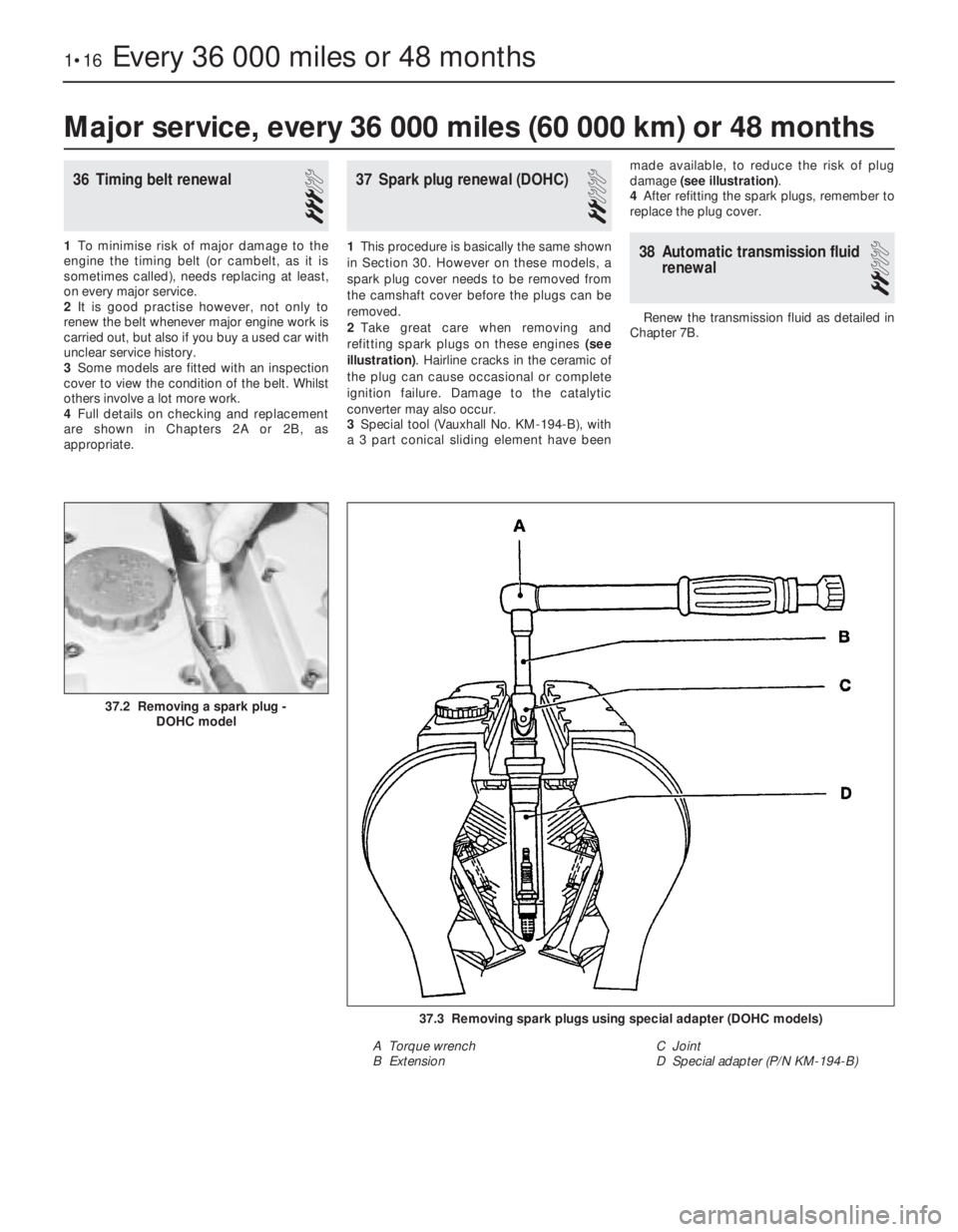
3Special tool (Vauxhall No. KM-194-B), with
a 3 part conical sliding element have beenmade available, to reduce the risk of plug
damage (see illustration).
4After refitting the spark plugs, remember to
replace the plug cover.38Automatic transmission fluid
renewal
2
Renew the transmission fluid as detailed in
Chapter 7B.
1•16Every 36 000 miles or 48 months
37.3 Removing spark plugs using special adapter (DOHC models)
A Torque wrench
B ExtensionC Joint
D Special adapter (P/N KM-194-B)
37.2 Removing a spark plug -
DOHC model
Major service, every 36 000 miles (60 000 km) or 48 months
Page 250 of 525

MOTTest Checks REF•11
MExamine the handbrake mechanism,
checking for frayed or broken cables,
excessive corrosion, or wear or insecurity of
the linkage. Check that the mechanism works
on each relevant wheel, and releases fully,
without binding.
MIt is not possible to test brake efficiency
without special equipment, but a road test can
be carried out later to check that the vehicle
pulls up in a straight line.
Fuel and exhaust systems
MInspect the fuel tank (including the filler
cap), fuel pipes, hoses and unions. All
components must be secure and free from
leaks.
MExamine the exhaust system over its entire
length, checking for any damaged, broken or
missing mountings, security of the retaining
clamps and rust or corrosion.
Wheels and tyres
MExamine the sidewalls and tread area of
each tyre in turn. Check for cuts, tears, lumps,
bulges, separation of the tread, and exposure
of the ply or cord due to wear or damage.
Check that the tyre bead is correctly seated
on the wheel rim, that the valve is sound andproperly seated, and that the wheel is not
distorted or damaged.
MCheck that the tyres are of the correct size
for the vehicle, that they are of the same size
and type on each axle, and that the pressures
are correct.
MCheck the tyre tread depth. The legal
minimum at the time of writing is 1.6 mm over
at least three-quarters of the tread width.
Abnormal tread wear may indicate incorrect
front wheel alignment.
Body corrosion
MCheck the condition of the entire vehicle
structure for signs of corrosion in load-bearing
areas. (These include chassis box sections,
side sills, cross-members, pillars, and all
suspension, steering, braking system and
seat belt mountings and anchorages.) Any
corrosion which has seriously reduced the
thickness of a load-bearing area is likely to
cause the vehicle to fail. In this case
professional repairs are likely to be needed.
MDamage or corrosion which causes sharp
or otherwise dangerous edges to be exposed
will also cause the vehicle to fail.
Petrol models
MHave the engine at normal operating
temperature, and make sure that it is in good
tune (ignition system in good order, air filter
element clean, etc).
MBefore any measurements are carried out,
raise the engine speed to around 2500 rpm,
and hold it at this speed for 20 seconds. Allowthe engine speed to return to idle, and watch
for smoke emissions from the exhaust
tailpipe. If the idle speed is obviously much
too high, or if dense blue or clearly-visible
black smoke comes from the tailpipe for more
than 5 seconds, the vehicle will fail. As a rule
of thumb, blue smoke signifies oil being burnt
(engine wear) while black smoke signifies
unburnt fuel (dirty air cleaner element, or other
carburettor or fuel system fault).
MAn exhaust gas analyser capable of
measuring carbon monoxide (CO) and
hydrocarbons (HC) is now needed. If such an
instrument cannot be hired or borrowed, a
local garage may agree to perform the check
for a small fee.
CO emissions (mixture)
MAt the time of writing, the maximum CO
level at idle is 3.5% for vehicles first used after
August 1986 and 4.5% for older vehicles.
From January 1996 a much tighter limit
(around 0.5%) applies to catalyst-equipped
vehicles first used from August 1992. If the
CO level cannot be reduced far enough to
pass the test (and the fuel and ignition
systems are otherwise in good condition) then
the carburettor is badly worn, or there is some
problem in the fuel injection system or
catalytic converter (as applicable).
HC emissionsMWith the CO emissions within limits, HC
emissions must be no more than 1200 ppm
(parts per million). If the vehicle fails this test
at idle, it can be re-tested at around 2000 rpm;
if the HC level is then 1200 ppm or less, this
counts as a pass.
MExcessive HC emissions can be caused by
oil being burnt, but they are more likely to be
due to unburnt fuel.
Diesel models
MThe only emission test applicable to Diesel
engines is the measuring of exhaust smoke
density. The test involves accelerating the
engine several times to its maximum
unloaded speed.
Note: It is of the utmost importance that the
engine timing belt is in good condition before
the test is carried out.
M
Excessive smoke can be caused by a dirty
air cleaner element. Otherwise, professional
advice may be needed to find the cause.
4Checks carried out on
YOUR VEHICLE’S EXHAUST
EMISSION SYSTEM
REF