1988 BMW 3 SERIES Diff
[x] Cancel search: DiffPage 10 of 228
0•10Roadside Repairs
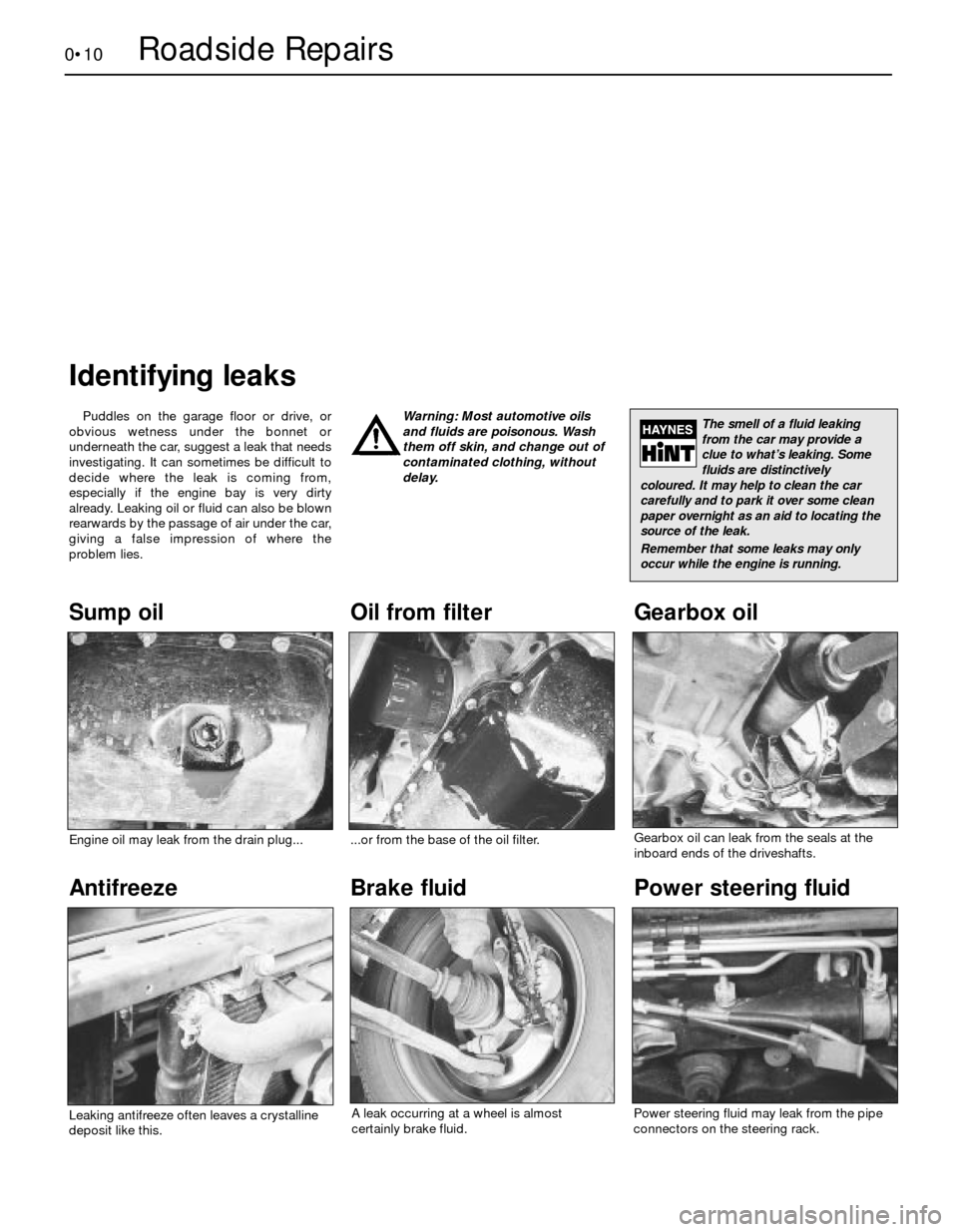
Puddles on the garage floor or drive, or
obvious wetness under the bonnet or
underneath the car, suggest a leak that needs
investigating. It can sometimes be difficult to
decide where the leak is coming from,
especially if the engine bay is very dirty
already. Leaking oil or fluid can also be blown
rearwards by the passage of air under the car,
giving a false impression of where the
problem lies.Warning: Most automotive oils
and fluids are poisonous. Wash
them off skin, and change out of
contaminated clothing, without
delay.
Identifying leaks
The smell of a fluid leaking
from the car may provide a
clue to what’s leaking. Some
fluids are distinctively
coloured. It may help to clean the car
carefully and to park it over some clean
paper overnight as an aid to locating the
source of the leak.
Remember that some leaks may only
occur while the engine is running.
Sump oil Gearbox oil
Brake fluid Power steering fluidOil from filter
Antifreeze
Engine oil may leak from the drain plug......or from the base of the oil filter.
Leaking antifreeze often leaves a crystalline
deposit like this.Gearbox oil can leak from the seals at the
inboard ends of the driveshafts.
A leak occurring at a wheel is almost
certainly brake fluid.Power steering fluid may leak from the pipe
connectors on the steering rack.
Page 11 of 228

1
Engine
Oil filter
M10 engines . . . . . . . . . . . . . . . . . . . . . . . . . . . . . . . . . . . . . . . . . . . . Champion C121
M20 engines . . . . . . . . . . . . . . . . . . . . . . . . . . . . . . . . . . . . . . . . . . . . Champion C160
M30 engines
3-Series . . . . . . . . . . . . . . . . . . . . . . . . . . . . . . . . . . . . . . . . . . . . . . Champion C160
5-Series . . . . . . . . . . . . . . . . . . . . . . . . . . . . . . . . . . . . . . . . . . . . . . Champion X115
M40 engines . . . . . . . . . . . . . . . . . . . . . . . . . . . . . . . . . . . . . . . . . . . . Champion X120
Valve clearances (intake and exhaust)
M10 engines
Cold . . . . . . . . . . . . . . . . . . . . . . . . . . . . . . . . . . . . . . . . . . . . . . . . . 0.20 mm
Hot . . . . . . . . . . . . . . . . . . . . . . . . . . . . . . . . . . . . . . . . . . . . . . . . . 0.25 mm
M20 engines
Cold . . . . . . . . . . . . . . . . . . . . . . . . . . . . . . . . . . . . . . . . . . . . . . . . . 0.25 mm
Hot . . . . . . . . . . . . . . . . . . . . . . . . . . . . . . . . . . . . . . . . . . . . . . . . . 0.30 mm
M30 engines
Cold . . . . . . . . . . . . . . . . . . . . . . . . . . . . . . . . . . . . . . . . . . . . . . . . . 0.30 mm
Hot . . . . . . . . . . . . . . . . . . . . . . . . . . . . . . . . . . . . . . . . . . . . . . . . . 0.35 mm
M40 engines . . . . . . . . . . . . . . . . . . . . . . . . . . . . . . . . . . . . . . . . . . . . Hydraulic adjusters
Cooling system
Antifreeze mixture . . . . . . . . . . . . . . . . . . . . . . . . . . . . . . . . . . . . . . . . . . 40% antifreeze/60% water
Chapter 1
Routine maintenance and servicing
Air filter renewal . . . . . . . . . . . . . . . . . . . . . . . . . . . . . . . . . . . . . . . . . 20
Automatic transmission fluid and filter change . . . . . . . . . . . . . . . . . 28
Automatic transmission fluid level check . . . . . . . . . . . . . . . . . . . . . 8
Battery check, maintenance and charging . . . . . . . . . . . . . . . . . . . . 13
Brake system check . . . . . . . . . . . . . . . . . . . . . . . . . . . . . . . . . . . . . 26
Cooling system - draining, flushing and refilling . . . . . . . . . . . . . . . . 29
Cooling system check . . . . . . . . . . . . . . . . . . . . . . . . . . . . . . . . . . . . 22
Differential lubricant change . . . . . . . . . . . . . . . . . . . . . . . . . . . . . . . 32
Differential lubricant level check . . . . . . . . . . . . . . . . . . . . . . . . . . . . 17
Driveshaft gaiter check . . . . . . . . . . . . . . . . . . . . . . . . . . . . . . . . . . . 25
Drivebelt check, adjustment and renewal . . . . . . . . . . . . . . . . . . . . . 11
Engine idle speed and CO level check and adjustment . . . . . . . . . . 12
Engine oil and filter change . . . . . . . . . . . . . . . . . . . . . . . . . . . . . . . . 6
Engine timing belt renewal . . . . . . . . . . . . . . . . . . . . . . . . . . . . . . . . 35
Exhaust system check . . . . . . . . . . . . . . . . . . . . . . . . . . . . . . . . . . . 23
Evaporative Emissions Control (EVAP) system check . . . . . . . . . . . 33
Fluid level checks . . . . . . . . . . . . . . . . . . . . . . . . . . . . . . . . . . . . . . . 4
Fuel filter renewal . . . . . . . . . . . . . . . . . . . . . . . . . . . . . . . . . . . . . . . 30 Fuel system check . . . . . . . . . . . . . . . . . . . . . . . . . . . . . . . . . . . . . . 21
Introduction . . . . . . . . . . . . . . . . . . . . . . . . . . . . . . . . . . . . . . . . . . . . 1
Manual transmission lubricant change . . . . . . . . . . . . . . . . . . . . . . . 31
Manual transmission lubricant level check . . . . . . . . . . . . . . . . . . . . 16
Power steering fluid level check . . . . . . . . . . . . . . . . . . . . . . . . . . . . 7
Routine maintenance . . . . . . . . . . . . . . . . . . . . . . . . . . . . . . . . . . . . 2
Service light resetting . . . . . . . . . . . . . . . . . . . . . . . . . . . . . . . . . . . . 34
Spark plug check and renewal . . . . . . . . . . . . . . . . . . . . . . . . . . . . . 14
Spark plug HT leads, distributor cap and rotor - check
and renewal . . . . . . . . . . . . . . . . . . . . . . . . . . . . . . . . . . . . . . . . . . 15
Steering and suspension check . . . . . . . . . . . . . . . . . . . . . . . . . . . . 24
Throttle linkage - check and lubrication . . . . . . . . . . . . . . . . . . . . . . 19
Tyre and tyre pressure checks . . . . . . . . . . . . . . . . . . . . . . . . . . . . . 5
Tyre rotation . . . . . . . . . . . . . . . . . . . . . . . . . . . . . . . . . . . . . . . . . . . 9
Tune-up general information . . . . . . . . . . . . . . . . . . . . . . . . . . . . . . . 3
Underbonnet hoses - check and renewal . . . . . . . . . . . . . . . . . . . . . 10
Valve clearances - check and adjustment . . . . . . . . . . . . . . . . . . . . 18
Wiper blades - check and renewal . . . . . . . . . . . . . . . . . . . . . . . . . . 27
1•1
Easy,suitable for
novice with little
experienceFairly easy,suitable
for beginner with
some experienceFairly difficult,
suitable for competent
DIY mechanic
Difficult,suitable for
experienced DIY
mechanicVery difficult,
suitable for expert
DIY or professional
Degrees of difficulty
Specifications Contents
Page 14 of 228

Maintenance schedule
The following maintenance intervals are based on the assumption
that the vehicle owner will be doing the maintenance or service work,
as opposed to having a dealer service department do the work.
Although the time/mileage intervals are loosely based on factory rec-
ommendations, most have been shortened to ensure, for example, that
such items as lubricants and fluids are checked/changed at intervals
that promote maximum engine/driveline service life. Also, subject to
the preference of the individual owner interested in keeping his or her
vehicle in peak condition at all times, and with the vehicle’s ultimate
resale in mind, many of the maintenance procedures may be
performed more often than recommended in the following schedule.
We encourage such owner initiative.
When the vehicle is new, it should be serviced initially by a factory-
authorised dealer service department, to protect the factory warranty.
In many cases, the initial maintenance check is done at no cost to the
owner (check with your dealer service department for more
information).
1•4Maintenance and servicing
Every 250 miles or weekly, whichever
comes first
m mCheck the engine oil level (Section 4)
m mCheck the engine coolant level (Section 4)
m mCheck the brake fluid level (Section 4)
m mCheck the clutch fluid level (Section 4)
m mCheck the washer fluid level (Section 4)
m mCheck the tyres and tyre pressures (Section 5)
Every 6000 miles or 6 months,
whichever comes first
All items listed above, plus:
m mChange the engine oil and oil filter (Section 6)
m mCheck the power steering fluid level (Section 7)
m mCheck the tyres, and rotate if necessary (Section 9)
m mCheck the automatic transmission fluid level
(Section 8)
m mCheck the underbonnet hoses (Section 10)
m mCheck/adjust the drivebelts (Section 11)
m mCheck engine idle speed and CO (Section 12)
Every 12 000 miles or 12 months,
whichever comes first
All items listed above, plus:
m mCheck/service the battery (Section 13)
m mCheck the spark plugs (Section 14)
m mCheck/renew the HT leads, distributor cap and
rotor (Section 15)
m mCheck/top-up the manual transmission lubricant
(Section 16)
m mCheck the differential oil level (Section 17)
m mCheck the valve clearances, and adjust if
necessary - does not apply to M40 engines
(Section 18)
m mCheck and lubricate the throttle linkage (Section 19)
m mRenew the air filter (Section 20)
m mCheck the fuel system (Section 21)
m mInspect the cooling system (Section 22)
m mInspect the exhaust system (Section 23)
m mInspect the steering and suspension components
(Section 24)
m mCheck the driveshaft gaiter(s) (Section 25)
m mInspect the brakes (Section 26)
m mInspect/renew the windscreen wiper blades
(Section 27)
Every 24 000 miles or 2 years,
whichever comes first
All items listed above plus:
m mChange the automatic transmission fluid and filter
(Section 28)
m mDrain, flush and refill the cooling system (Section 29)
m mRenew the spark plugs (Section 14)
m mCheck/renew the spark plug HT leads (Section 15)
m mRenew the fuel filter (Section 30)
m mChange the manual transmission lubricant (Section 31)
m mChange the differential oil (Section 32)
m mCheck the evaporative emissions system, where
applicable (Section 33)
m mReset the service indicator lights (Section 34)
m mRenew brake fluid by bleeding (see Chapter 9)
m mCheck the handbrake operation (see Chapter 9)
Every 60 000 miles
m
mRenew the timing belt (Section 35)
Page 16 of 228

1•6Maintenance and Servicing
Front underbody view of a UK model 318i
(1988)
1 Radiator
2 Engine oil drain plug
3 Front suspension control arm (left-hand
side)
4 Front anti-roll bar
5 Clutch slave cylinder
6 Transmission
7 Exhaust downpipe
8 Front suspension control arm (right-hand
side)
Typical rear underside components
1 Exhaust system
2 Differential fill/check plug
3 Driveshaft boot
4 Fuel tank filler tube
5 Differential drain plug
6 Rear brake
7 Rear shock absorber
Page 19 of 228

inhibitors wear out, so it must be renewed at
the specified intervals.
Brake and clutch fluid
Warning: Brake fluid can harm
your eyes and damage painted
surfaces, so use extreme caution
when handling or pouring it. Do
not use brake fluid that has been standing
open or is more than one year old. Brake
fluid absorbs moisture from the air, which
can cause a dangerous loss of brake
effectiveness. Use only the specified type
of brake fluid. Mixing different types (such
as DOT 3 or 4 and DOT 5) can cause brake
failure.
14The brake master cylinder is mounted at
the left rear corner of the engine
compartment. The clutch fluid reservoir
(manual transmission models) is mounted on
the right-hand side.
15To check the clutch fluid level, observe
the level through the translucent reservoir.
The level should be at or near the step
moulded into the reservoir. If the level is low,
remove the reservoir cap to add the specified
fluid (see illustration).
16The brake fluid level is checked by looking
through the plastic reservoir mounted on the
master cylinder (see illustration). The fluid
level should be between the MAX and MIN
lines on the reservoir. If the fluid level is low,
first wipe the top of the reservoir and the cap
with a clean rag, to prevent contamination of
the system as the cap is unscrewed. Top-up
with the recommended brake fluid, but do not
overfill.
17While the reservoir cap is off, check the
master cylinder reservoir for contamination. If
rust deposits, dirt particles or water droplets
are present, the system should be drained
and refilled.
18After filling the reservoir to the proper
level, make sure the cap is seated correctly, to
prevent fluid leakage and/or contamination.
19The fluid level in the master cylinder will
drop slightly as the disc brake pads wear.
There is no need to top up to compensate for
this fall provided that the level stays above the
MIN line; the level will rise again when new
pads are fitted. A very low level may indicateworn brake pads. Check for wear (see Sec-
tion 26).
20If the brake fluid level drops consistently,
check the entire system for leaks immediately.
Examine all brake lines, hoses and
connections, along with the calipers, wheel
cylinders and master cylinder (see Sec-
tion 26).
21When checking the fluid level, if you
discover one or both reservoirs empty or
nearly empty, the brake or clutch hydraulic
system should be checked for leaks and bled
(see Chapters 8 and 9).
Windscreen washer fluid
22Fluid for the windscreen washer system is
stored in a plastic reservoir in the engine
compartment (see illustration).
23In milder climates, plain water can be
used in the reservoir, but it should be kept no
more than two-thirds full, to allow for
expansion if the water freezes. In colder
climates, use windscreen washer system
antifreeze, available at any car accessory
shop, to lower the freezing point of the fluid.
This comes in concentrated or pre-mixed
form. If you purchase concentrated antifreeze,
mix the antifreeze with water in accordance
with the manufacturer’s directions on the
container.
Caution: Do not use cooling
system antifreeze - it will damage
the vehicle’s paint.
5 Tyre and tyre pressure
checks
1
1Periodic inspection of the tyres may save
you the inconvenience of being stranded with
a flat tyre. It can also provide you with vital
information regarding possible problems in
the steering and suspension systems before
major damage occurs.
2Tyres are equipped with bands that will
appear when tread depth reaches 1.6 mm, at
which time the tyres can be considered worn
out. This represents the legal minimum tread
depth; most authorities recommend renewing
any tyre on which the tread depth is 2 mm or
less. Tread wear can be monitored with a
simple, inexpensive device known as a tread
depth indicator (see illustration).
3Note any abnormal tyre wear (see
illustration overleaf). Tread pattern irregular-
ities such as cupping, flat spots and more
wear on one side than the other are
indications of front end alignment and/or
wheel balance problems. If any of these
conditions are noted, take the vehicle to a tyre
specialist to correct the problem.
4Look closely for cuts, punctures and
embedded nails or tacks. Sometimes, after a
nail has embedded itself in the tread, a tyre
will hold air pressure for a short time, or may
1•9
4.22 The windscreen washer fluid reservoir
is located in the right front corner of the
engine compartment on most models4.16 The brake fluid level should be kept
above the MIN mark on the translucent
reservoir - unscrew the cap to add fluid4.15 Adding hydraulic fluid to the clutch
fluid reservoir
5.4a If a slow puncture is suspected,
check the valve core first to make sure it’s
tight5.2 Use a tyre tread depth indicator to
monitor tyre wear - they are available at
car accessory shops and service stations,
and cost very little
1
Weekly Checks
Page 21 of 228

Every 6000 miles or 6 months, whichever comes first
1•11
6.17a Unscrew the bolt . . .
1
Every 6000 miles
6 Engine oil and filter change
1
Warning: Prolonged skin contact
with used engine oil is
hazardous. Use a barrier cream
and wear gloves during this procedure.
Change out of oil-soaked clothing
immediately.
1Make sure that you have all the necessary
tools before you begin this procedure (see
illustration). You should also have plenty of rags
or newspapers handy for mopping up oil spills2Start the engine and allow it to reach
normal operating temperature - oil and sludge
will flow more easily when warm. If new oil, a
filter or tools are needed, use the vehicle to go
and get them, thus warming up the engine oil
at the same time.
3Park on a level surface, and switch off the
engine when it’s warmed up. Remove the oil
filler cap from the valve cover.
4Access to the oil drain plug and filter will be
improved if the vehicle can be lifted on a hoist,
driven onto ramps, or supported by axle
stands.
Warning: DO NOT work under a
vehicle supported only by a
hydraulic or scissors-type jack -
always use axle stands!
5If you haven’t changed the oil on this
vehicle before, get under it, and locate the
drain plug and the oil filter. Note that on some
engines, the oil filter is located on the top left-
hand side of the engine. The exhaust
components will be hot as you work, so note
how they are routed to avoid touching them.
6Being careful not to touch the hot exhaust
components, position a drain pan under the
plug in the bottom of the engine.
7Clean the area around the plug, then
remove the plug (see illustration). It’s a good
idea to wear a rubber glove while unscrewing
the plug the final few turns, to avoid being
scalded by hot oil. Hold the drain plug againstthe threads as you unscrew it, then pull it
away from the drain hole suddenly. This will
place your arm out of the way of the hot oil, as
well as reducing the chances of dropping the
drain plug into the drain pan.
8It may be necessary to move the drain pan
slightly as oil flow slows to a trickle. Inspect
the old oil for the presence of metal particles,
which could give early warning of engine
wear.
9After all the oil has drained, wipe off the
drain plug with a clean rag. Any small metal
particles clinging to the plug would
immediately contaminate the new oil.
10Refit the plug and tighten it securely. Use
a new washer if necessary.
11Move the drain pan into position under the
oil filter.
Canister-type oil filter
12Loosen the spin-off type oil filter by
turning it anti-clockwise with a filter spanner.
Any standard filter spanner will work.
13Sometimes the spin-off type oil filter is
screwed on so tightly that it can’t be easily
loosened. If it is, punch a metal bar or long
screwdriver directly through it, and use it as a
T-bar to turn the filter. Be prepared for oil to
spurt out of the canister as it’s punctured.
14Once the filter is loose, use your hands to
unscrew it from the block. Just as the filter is
detached from the block, immediately tilt the
open end up to prevent oil inside the filter
from spilling out.
15Using a clean rag, wipe off the mounting
surface on the block. Also, make sure that
none of the old sealing ring remains stuck to
the mounting surface. It can be removed with
a scraper if necessary.
16Compare the old filter with the new one,
to make sure they are the same type. Smear
some engine oil on the rubber sealing ring of
the new filter, and screw it into place (see
illustration). Overtightening the filter will
damage the sealing ring, so don’t use a filter
spanner. Most filter manufacturers
recommend tightening the filter by hand only.
Normally, they should be tightened three-
quarters of a turn after the sealing ring
contacts the block, but be sure to follow the
directions on the filter or container.
6.1 These tools are required when
changing the engine oil and filter
1 Drain pan- It should be fairly shallow in
depth, but wide enough to prevent spills
2 Rubber gloves- When removing the drain
plug and filter, you will get oil on your
hands (the gloves will prevent burns)
3 Socket bar - Sometimes the oil drain plug
is tight, and a long bar is needed to loosen
it. The correct-size ring spanner may work
just as well
4 Socket- To be used with the bar or a
ratchet (must be the correct size to fit the
drain plug - six-point preferred)
5 Filter spanner - This is a metal band-type
spanner, which requires clearance around
the filter to be effective. This tool is not
required on all engines.
6 Filter spanner- This type fits on the bottom
of the filter and can be turned with a ratchet
or breaker bar (different-size spanners are
available for different types of filters) This
tool is not required on all engines.
6.7 Using a ring spanner to remove the oil
drain plug
6.16 Lubricate the oil filter sealing ring
with clean engine oil before refitting the
filter on the engine
Frequent oil changes are the
most important preventive
maintenance procedures that
can be done by the home
mechanic. As engine oil ages, it
becomes diluted and contaminated,
which leads to premature engine wear.
Page 24 of 228

stripes moulded into them. Various systems
require hoses with different wall thicknesses,
collapse resistance and temperature
resistance. When fitting new hoses, be sure
the new ones are made of the same material.
5Often the only effective way to check a
hose is to remove it completely from the
vehicle. If more than one hose is removed, be
sure to label the hoses and fittings to ensure
correct refitting.
6When checking vacuum hoses, be sure to
include any plastic T-fittings in the check.
Inspect the connections for cracks which
could cause leakage.
7A small piece of vacuum hose can be used
as a stethoscope to detect vacuum leaks.
Hold one end of the hose to your ear and
probe around vacuum hoses and fittings,
listening for the “hissing” sound characteristic
of a vacuum leak.
Warning: When probing with the
vacuum hose stethoscope, be
careful not to touch moving
engine components such as the
drivebelt, cooling fan, etc.
Fuel hoses
Warning: There are certain
precautions which must be taken
when servicing or inspecting fuel
system components. Work in a
well-ventilated area, and do not allow open
flames (cigarettes, appliance pilot lights,
etc.) or bare light bulbs near the work
area. Mop up any spills immediately, and
do not store fuel-soaked rags where they
could ignite. If you spill any fuel on your
skin, rinse it off immediately with soap and
water. When you perform any kind of work
on the fuel system, wear safety glasses,
and have a fire extinguisher on hand.
8The fuel hoses are usually under pressure,
so if any fuel hoses are to be disconnected,
be prepared to catch spilled fuel.
Warning: On vehicles equipped
with fuel injection, you must
depressurise the fuel system
before servicing the fuel hoses.
Refer to Chapter 4 for details.9Check all rubber fuel hoses for deterioration
and chafing. Check especially for cracks in
areas where the hose bends, and just before
connectors, such as where a hose attaches to
the fuel pump or fuel filter, for example.
10Only high-quality fuel hose should be
used. Never, under any circumstances, use
unreinforced vacuum hose, clear plastic
tubing or water hose for fuel hoses.
11Band-type clamps are commonly used on
fuel hoses. These clamps often lose their
tension over a period of time, and can be
“sprung” during removal. Renew all band-type
clamps with screw clamps whenever a hose is
renewed.
Metal lines
12Sections of metal line are often used
between the fuel pump and fuel injection
system. Check carefully to make sure the line
isn’t bent, crimped or cracked.
13If a section of metal line must be renewed,
use seamless steel tubing only, since copper
and aluminium tubing do not have the
strength necessary to withstand the vibration
caused by the engine.
14Check the metal brake lines where they
enter the master cylinder and brake
proportioning or ABS unit (if used) for cracks
in the lines and loose fittings. Any sign of
brake fluid leakage calls for an immediate
thorough inspection of the braking system.
Power steering hoses
15Check the power steering hoses for leaks,
loose connections and worn clamps. Tighten
loose connections. Worn clamps or leaky
hoses should be renewed.
11 Drivebelt check, adjustment
and renewal
1
Check
1The drivebelts, sometimes called V-belts or
simply “fan” belts, are located at the front of
the engine, and play an important role in the
overall operation of the vehicle and itscomponents. Due to their function and
material make-up, the belts are prone to
failure after a period of time, and should be
inspected and adjusted periodically to prevent
major engine damage.
2The number of belts used on a particular
vehicle depends on the accessories fitted.
Drivebelts are used to turn the alternator,
power steering pump, water pump, and air
conditioning compressor. Depending on the
pulley arrangement, a single belt may be used
to drive more than one of these components.
3With the engine switched off, open the
bonnet and locate the various belts at the
front of the engine. Using your fingers (and a
torch, if necessary), move along the belts,
checking for cracks and separation of the belt
plies. Also check for fraying and glazing,
which gives the belt a shiny appearance (see
illustration). Both sides of the belts should be
inspected, which means you will have to twist
each belt to check the underside.
4The tension of each belt is checked by
pushing firmly with your thumb and seeing
how much the belt moves (deflects). Measure
the deflection with a ruler (see illustration). A
good rule of thumb is that the belt should
deflect 6 mm if the distance from pulley
centre-to-pulley centre is between 180 and
280 mm. The belt should deflect 13 mm if the
distance from pulley centre-to-pulley centre is
between 300 and 400 mm.
Adjustment
5If it is necessary to adjust the belt tension,
either to make the belt tighter or looser, it is
done by moving a belt-driven accessory on its
bracket. (When the same belt drives more
than one accessory, normally only one
accessory is moved when making
adjustment.)
6For each component, there will be an
adjusting bolt and a pivot bolt. Both bolts
must be loosened slightly to enable you to
move the component. On some components,
the drivebelt tension can be adjusted by
turning an adjusting bolt after loosening the
lockbolt (see illustration).
7After the two bolts have been loosened,
1•14
11.6 Loosen the nut on the other end of
the adjuster bolt (arrowed) and turn the
bolt to increase or decrease tension on the
drivebelt11.4 Measuring drivebelt deflection with a
straightedge and ruler11.3 Here are some of the more common
problems associated with drivebelts
(check the belts very carefully to prevent
an untimely breakdown)
Every 6000 miles
Page 26 of 228

13 Battery check, maintenance
and charging
2
Check and maintenance
Warning: Certain precautions
must be followed when checking
and servicing the battery.
Hydrogen gas, which is highly
flammable, is always present in the battery
cells, so keep lighted tobacco and all other
flames and sparks away from it. The
electrolyte inside the battery is actually
dilute sulphuric acid, which will cause
injury if splashed on your skin or in youreyes. It will also ruin clothes and painted
surfaces. When disconnecting the battery
cables, always detach the negative cable
first, and connect it last!
1Battery maintenance is an important
procedure, which will help ensure that you are
not stranded because of a dead battery.
Several tools are required for this procedure
(see illustration).
2Before servicing the battery, always switch
off the engine and all accessories, and
disconnect the cable from the negative
terminal of the battery.
Caution: If the radio in your
vehicle is equipped with an anti-
theft system, make sure you have
the correct activation code before
disconnecting the battery.
Note: If, after connecting the battery, the
wrong language appears on the instrument
panel display, refer to page 0-7 for the
language resetting procedure.
3A low-maintenance battery is standard
equipment. The cell caps can be removed and
distilled water can be added, if necessary.
Later models may be fitted with a
“maintenance-free” battery, which is sealed.
4Remove the caps and check the electrolyte
level in each of the battery cells. It must be
above the plates. There’s usually a split-ring
indicator in each cell to indicate the correct
level. If the level is low, add distilled water
only, then refit the cell caps.Caution: Overfilling the cells may
cause electrolyte to spill over
during periods of heavy charging,
causing corrosion and damage to
nearby components.
5If the positive terminal and cable clamp on
your vehicle’s battery is equipped with a
rubber protector, make sure that it’s not torn
or damaged. It should completely cover the
terminal.
6The external condition of the battery should
be checked periodically. Look for damage
such as a cracked case.
7Check the tightness of the battery cable
clamps to ensure good electrical connections.
Check the entire length of each cable, looking
for cracked or abraded insulation and frayed
conductors.
8If corrosion (visible as white, fluffy deposits)
is evident, remove the cables from the
terminals, clean them with a battery brush,
and reconnect them (see illustrations).
Corrosion can be kept to a minimum by fitting
specially treated washers available at car
accessory shops, or by applying a layer of
petroleum jelly or suitable grease to the
Every 12 000 miles or 12 months, whichever comes first
1•16
13.8d When cleaning the cable clamps, all
corrosion must be removed (the inside of
the clamp is tapered to match the taper on
the post, so don’t remove too much
material)
13.8c Regardless of the type of tool used
on the battery posts, a clean, shiny surface
should be the result
13.1 Tools and materials required for
battery maintenance
1 Face shield/safety goggles- When
removing corrosion with a brush, the acidic
particles can easily fly up into your eyes
2 Baking soda - A solution of baking soda and
water can be used to neutralise corrosion
3 Petroleum jelly- A layer of this on the
battery posts will help prevent corrosion
4 Battery post/cable cleaner- This wire-
brush cleaning tool will remove all traces of
corrosion from the battery posts and cable
clamps
5 Treated felt washers- Placing one of
these on each post, directly under the
cable clamps, will help prevent corrosion
6 Puller- Sometimes the cable clamps are
very difficult to pull off the posts, even after
the nut/bolt has been completely loosened.
This tool pulls the clamp straight up and off
the post without damage
7 Battery post/cable cleaner - Here is
another cleaning tool which is a slightly
different version of No 4 above, but it does
the same thing
8 Rubber gloves- Another safety item to
consider when servicing the battery;
remember that’s acid inside the battery!
13.8b Removing a cable from the battery
post with a spanner - sometimes special
battery pliers are required for this
procedure, if corrosion has caused
deterioration of the nut (always remove the
earth cable first, and connect it last!)
13.8a Battery terminal corrosion usually
appears as light, fluffy powder
Every 12 000 miles