1987 PORSCHE 944 roof
[x] Cancel search: roofPage 3 of 66

INDEX
A
ABS Acceleration diagram Accelerator pedal Air Bag System Air - cleaner
- conditioner
- filter
Alternator warning light Antifreeze Antilock, Brake system Anti-theft alarm Ashtray Automatic- garage door
- speed control
- transmission
- transmission fluid B
Battery
Boost pressure gauge
Brake - booster
- fluid
- fluid warning light
- pads
- parking
- pedal
- system
- warning light
Break-in hints
Bulb replacing
Buzzer 28,39
118-129
55
20, 21, 38, 3980, 8144-4680,81 39
74,75,11028, 39
11
42, 98
25
29
53-55
78,110,128
90-9234
27
39,79,11039
27,37,47,79,80 26
26, 27
26,27,11537
47
93-98
10,18,24,30
C/D
CASIS
Capacities
Car care instructions
Casis
Catalytic Converter
Cautions
Central locking
Central warning light
Cigarette lighter
Cleaning
Clock
Clutch pedal
Collapsible spare tire
Control warning light system
Coolant Temperature Gauge
Cooling system
Corrosion prevention
Dashboard
Defogging/defrosting
Dimensions
Doors
Driving hints
E/F
Electrical system
Emergency- flasher
- starting
Emission Control System
Engine - cooling
- exhaust
- hood
- number
- oil checking & changing
- oil
-speed, max 35
110
61-66
35
50,10267
13
37
41
61-66 40
27
85
36-39 36
74-77
65-66
24
44-46 114
12,138-9, 48, 49
89-92
41
92
100-103 74-77
48
586
69-72
69,110,111,128
34,47,52,106-
108
Fan control switch knob
Fan, radiator
Filling capacities
Fog lights
Fuel - economy
- evaporation control
- gauge
- recommendation
- tank
Fuses and relays
G/H
Gas Station Information
Gasohol
Gasoline
Gear ratio diagram
Gearshift lever
Glove compartment
Hatchback
Headlights
Headlight- dimmer
- flasher
- switch
- washing system
Heater/ventilation controls
Hood - front
- rear
Horn
I/J
Ignition/steering lock
Instrument illumination
Instruments
Interior ligh 44
36, 74 110
30, 96, 97
49
103 37
50, 51
50,110
89,126
126-129 51
50,51
122-125 52-55
42
56
30,95,99 30
30
30
31,32,81,11044-4658
56,57
21,24
24
30
33-40
43, 98
4
Jack
- supports
K/L
Keys
Kickdown
Lane changer
Leather
License plate light
Light switch
Lights - ashtray
- fog
- interior
- license plate
- parking
- turn signal
Locks - doors, wheels
Loudspeakers
Lubricants
Luggage compartment
M/O
Manual transmission
- oil
Mirrors
Oil- change
- consumption
- filter changing
- pressure gauge
- pressure warning light
Octane rating
Oxygen Sensor
P/R
Paint code number 68
87, 88, 129
10-11,86 55
30
65
98
30
98
30, 96, 97
43, 9898
30, 37, 93, 94
30,93,94
10-13, 86 89
110,111 57
52,122-125 77,11022,43
71,72
47, 69
71, 72 38
38
50, 51,106-108 101,102
7
Parking- brake
- lights
Performance
Power assisted steering
Power train
Power windows
Prop-up roof
Radiator fan
Rear - hood
- view mirrors
- window defogger
- wiper
Recirculation Switch
Refrigerant
Relays
Rims
Roof racks
Roof, removable S
Safe driving hints
Safetybelts
Safety belt warning light
Safety compliance sticker
Seat heating System
Seats
Sekuriflex windshield
Shift indicator
Shift points
Side marker lights
Ski racks
Snow- chains
- tires
Spare tire, collapsible
Spark plugs
Specifications, engine
26, 3730,37,93,94116731091259, 6036, 7456,572241424446,11089,12664,112,11357,11459, 60
8-9
17-21,6518,3771514-1631, 63, 643552-559457,11483, 84,112,113
83,84, 111,113
85106-108106-109
Speedometer
Starting procedures
Sun visors
T/U
Tachometer
Technical data
Tirepressure
Tires
Tool kit
Trip odometer
Transmission oil
Trunk
Turn signal lights
Undercoating
Unleaded fuel
V/W
Vehicle identification
Ventilation
Voltmeter
Warning/indicator lights
Washer reservoir
Washing
Water temperature gauge
Weatherstrips
Weights
Wheel alignment
Wheel nuts, lockable
Wheels
Wheel changing
Windows
Windshield- washer reservoir
- wiper/washer lever 3324, 2543
34, 35105-12582,112,113,12947,82-87,112,113683377, 78,11056,5730, 37, 93, 9465, 66,10050, 51,106-108,110
6-744-463835-4081,11061-6636641141158647,64,82-87,11285-8812,63,6481,11031
5
Page 7 of 66
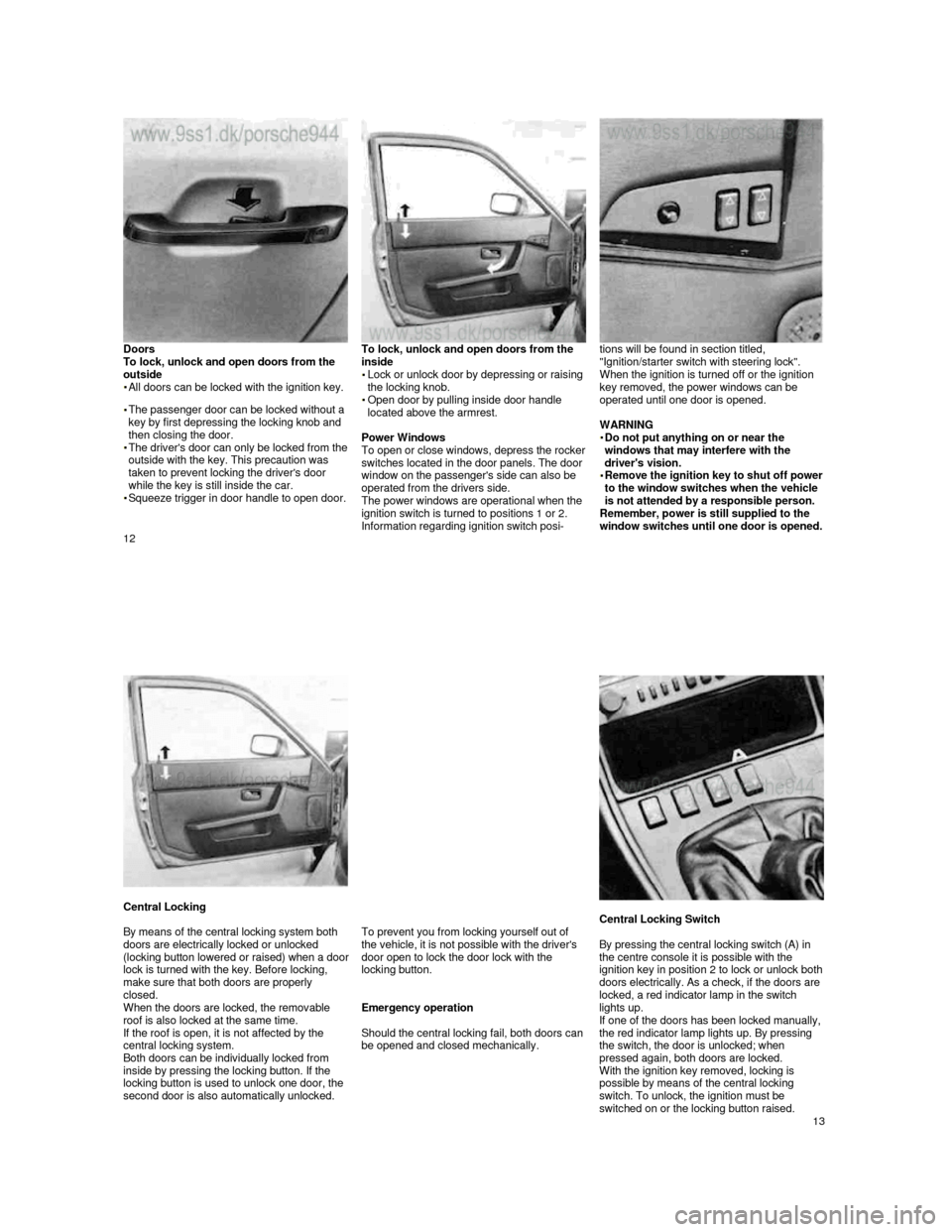
Doors To lock, unlock and open doors from the
outside
All doors can be locked with the ignition key.
The passenger door can be locked without a
key by first depressing the locking knob and
then closing the door.
The driver's door can only be locked from the outside with the key. This precaution was
taken to prevent locking the driver's door
while the key is still inside the car. Squeeze trigger in door handle to open door.
To lock, unlock and open doors from the inside
Lock or unlock door by depressing or raising
the locking knob.
Open door by pulling inside door handle
located above the armrest.
Power Windows
To open or close windows, depress the
rocker switches located in the door panels. The door window on the passenger's side can also be operated from the drivers side.
The power windows are operational when the
ignition switch is turned to positions 1 or 2.
Information regarding ignition switch posi- tions will be found in section titled,
"Ignition/starter switch with steering lock".
When the ignition is turned off or the ignition
key removed, the power windows can be
operated until one door is opened.
WARNING
Do not put anything on or near the windows that may interfere with the
driver's vision.
Remove the ignition key to shut off power to the window switches when the vehicle
is not attended by a responsible person.
Remember, power is still supplied to the
window switches until one door is opened. 12
Central Locking
By means of the central locking system both
doors are electrically locked or unlocked
(locking button lowered or raised) when a door lock is turned with the key. Before locking,
make sure that both doors are properly
closed.
When the doors are locked, the removable
roof is also locked at the same time.
If the roof is open, it is not affected by the
central locking system.
Both doors can be individually locked from
inside by pressing the locking button. If the
locking button is used to unlock one door, the
second door is also automatically unlocked.
To prevent you from locking yourself out of
the vehicle, it is not possible with the driver's
door open to lock the door lock with the
locking button.
Emergency operation
Should the central locking fail, both doors can
be opened and closed mechanically. Central Locking Switch
By pressing the central locking switch (A) in
the centre console it is possible with the
ignition key in position 2 to lock or unlock both doors electrically. As a check, if the doors are
locked, a red indicator lamp in the switch
lights up.
If one of the doors has been locked manually,
the red indicator lamp lights up. By pressing
the switch, the door is unlocked; when
pressed again, both doors are locked.
With the ignition key removed, locking is
possible by means of the central locking
switch. To unlock, the ignition must be
switched on or the locking button raised. 13
Page 30 of 66
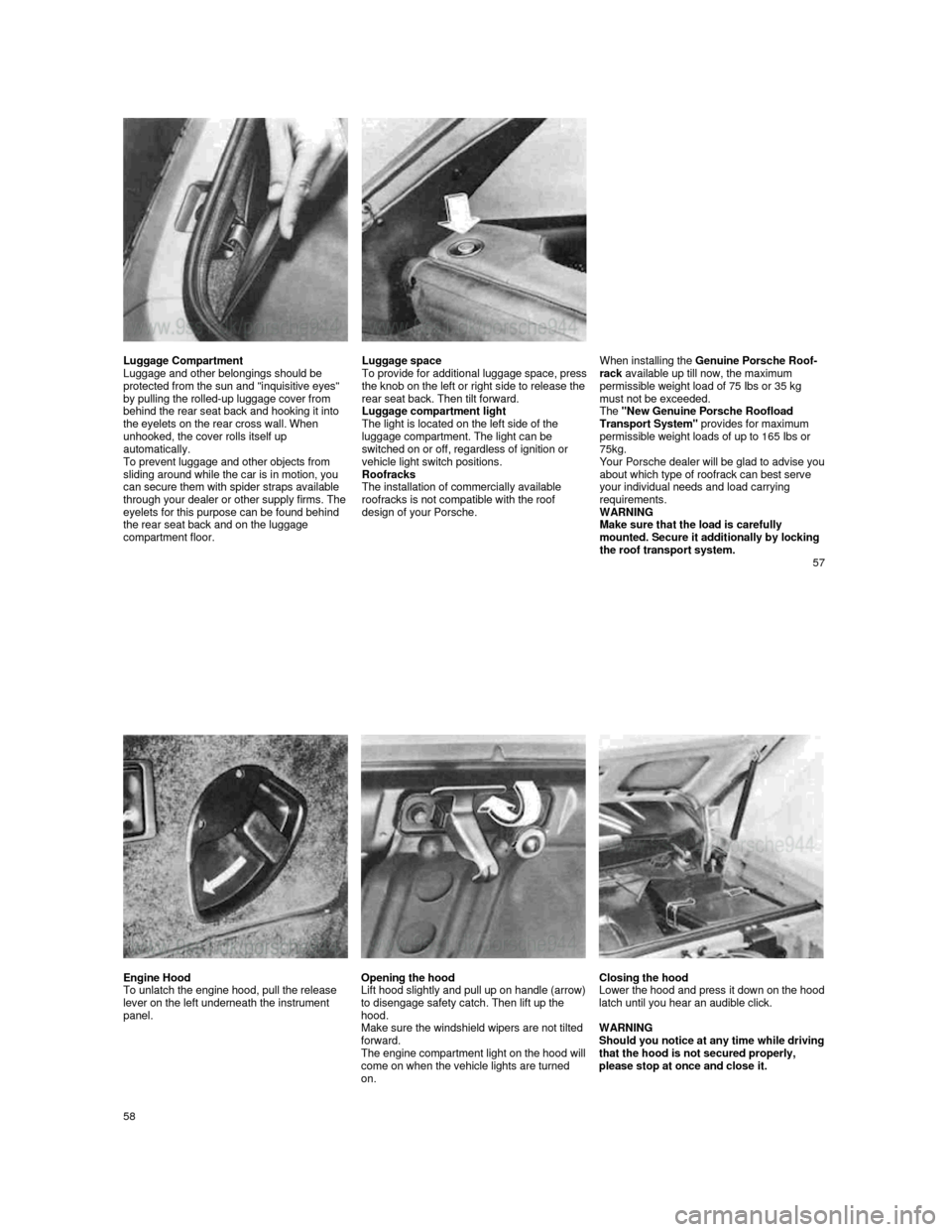
Luggage Compartment
Luggage and other belongings should be
protected from the sun and "inquisitive eyes"
by pulling the rolled-up luggage cover from
behind the rear seat back and hooking it into
the eyelets on the rear cross wall. When
unhooked, the cover rolls itself up
automatically.
To prevent luggage and other objects from
sliding around while the car is in motion, you
can secure them with spider straps available
through your dealer or other supply firms. The
eyelets for this purpose can be found behind
the rear seat back and on the luggage
compartment floor. Luggage space
To provide for additional luggage space, press the knob on the left or right side to release the rear seat back. Then tilt forward.
Luggage compartment light
The light is located on the left side of the
luggage compartment. The light can be
switched on or off, regardless of ignition or
vehicle light switch positions.
Roofracks
The installation of commercially available
roofracks is not compatible with the roof
design of your Porsche.
When installing the Genuine Porsche Roof-
rack available up till now, the maximum
permissible weight load of 75 Ibs or 35 kg
must not be exceeded.
The "New Genuine Porsche Roofload
Transport System" provides for maximum
permissible weight loads of up to 165 Ibs or
75kg.
Your Porsche dealer will be glad to advise you about which type of roofrack can best serve
your individual needs and load carrying
requirements.
WARNING
Make sure that the load is carefully
mounted. Secure it additionally by locking
the roof transport system.
57
Engine Hood
To unlatch the engine hood, pull the release
lever on the left underneath the instrument
panel. Opening the hood
Lift hood slightly and pull up on handle (arrow) to disengage safety catch. Then lift up the
hood.
Make sure the windshield wipers are not tilted
forward.
The engine compartment light on the hood will come on when the vehicle lights are turned
on.
Closing the hood
Lower the hood and press it down on the hood latch until you hear an audible click.
WARNING
Should you notice at any time while driving that the hood is not secured properly,
please stop at once and close it.
58
Page 31 of 66
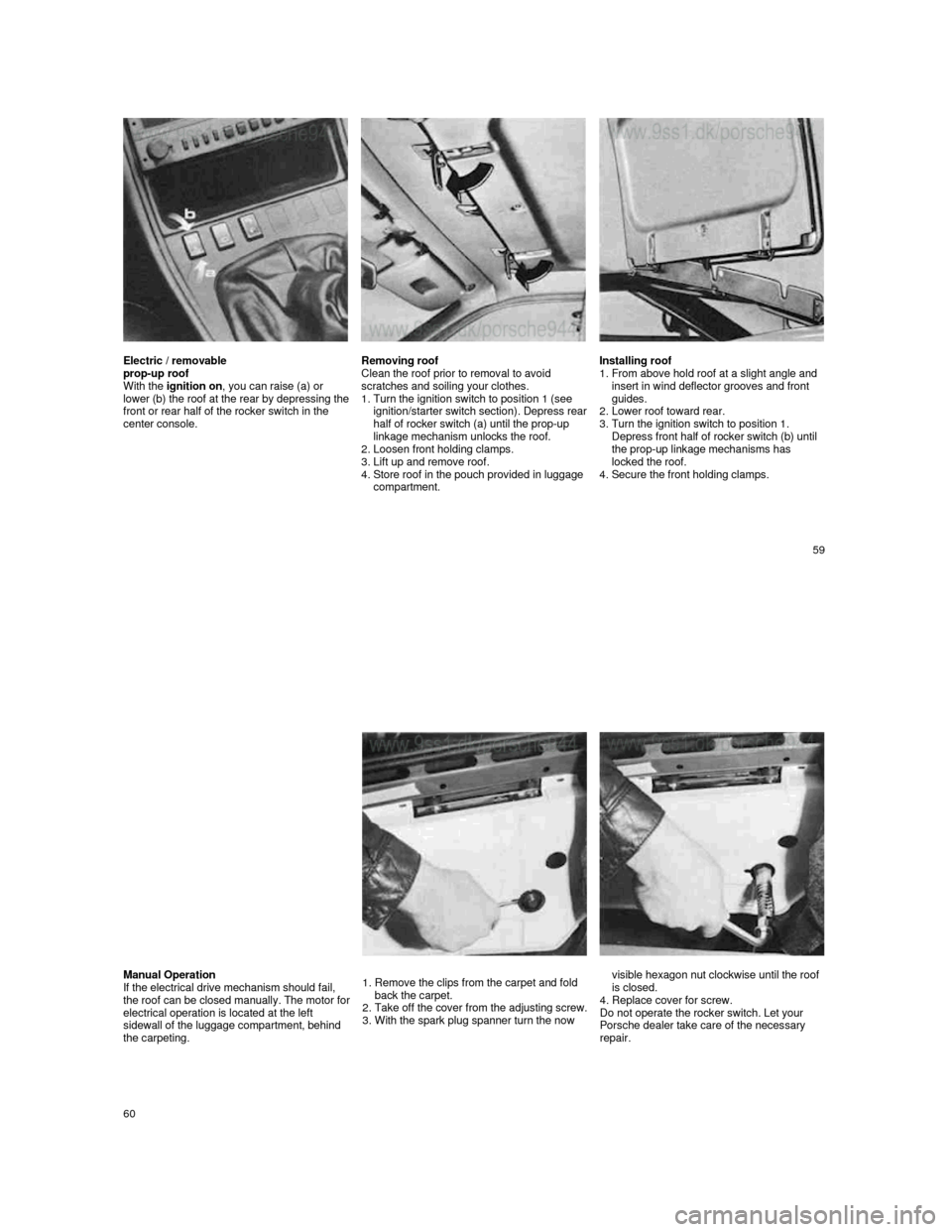
Electric / removable
prop-up roof
With the ignition on , you can raise (a) or
lower (b) the roof at the rear by depressing the front or rear half of the rocker switch in the
center console.
Removing roof
Clean the roof prior to removal to avoid
scratches and soiling your clothes.
1. Turn the ignition switch to position 1 (see
ignition/starter switch section). Depress rear half of rocker switch (a) until the prop-up
linkage mechanism unlocks the roof.
2.
Loosen front holding clamps.
3. Lift up and remove roof.
4. Store roof in the pouch provided in luggage
compartment.
Installing roof
1. From above hold roof at a slight angle and
insert in wind deflector grooves and front
guides.
2.
Lower roof toward rear.
3. Turn the ignition switch to position 1.
Depress front half of rocker switch (b) until
the prop-up linkage mechanisms has
locked the roof.
4.
Secure the front holding clamps.
59
Manual Operation
If the electrical drive mechanism should fail,
the roof can be closed manually. The motor for electrical operation is located at the left
sidewall of the luggage compartment, behind
the carpeting.
1. Remove the clips from the carpet and fold
back the carpet.
2.
Take off the cover from the adjusting screw. 3. With the spark plug spanner turn the now
visible hexagon nut clockwise until the roof
is closed.
4. Replace cover for screw.
Do not operate the rocker switch. Let your
Porsche dealer take care of the necessary
repair.
60
Page 34 of 66

Interior Glass
Use the same cleaning agents as for the
exterior and polish dry with a soft cloth or
paper towel.
Fabric
Use a vacuum cleaner or a soft bristle brush
to remove dust and loose dirt from carpeting,
upholstery, headliner and other trim. Dirt
stains can usually be removed with lukewarm
soap water or an all purpose cleaner solution,
or a dry foam cleaner. For greasy, oily and
other stubborn stains, use a spot remover. Do
not pour the liquid on the fabric. Dampen a
clean cloth and rub carefully, starting at the
edge and working inward.
Safety belts
Keep belts clean. Very dirty belts may not
retract properly. Do not remove belts from the
vehicle to be cleaned. Do not use chemical
cleaning agents, bleach or dyes. They
contain corrosive properties which will
weaken the webbing. Do not allow inertia
reel safety belts to retract before they are
completely dry.
For cleaning, use a mild soap water solution.
Let belts dry out thoroughly and away from
direct sun light.
Plastic, vinyl and leatherette
Use a clean, damp cloth or sponge to keep
this trim free from dust. For other spoilage,
use a lukewarm all purpose cleaning solution
or a mild saddle soap for vinyl and leather
trim. Remove water spots and soap traces
with a clean, damp cloth or sponge. Use a clean, soft cloth to rub dry.
Grease, tar or oil stains can be removed with
a clean cloth or sponge soaked with all
purpose cleaner or with a solvent type vinyl or
leather cleaning agent.
Occasionally apply a colorless vinyl or leather
preservative to retain the material's luster and
pliability.
Leather and leather trim
To keep leather seats and trim beautiful and
soft, they should be cleaned and cared for
regularly. Clean leather with a soft, white
woolen cloth and a mild soapwater solution. Do not use chemical or abrasive cleaning
agents. Do not let moisture seep through
perforated surfaces to safeguard against
corrosion and cracking from underneath. After cleaning, apply a leather preservative re-
commended by Porsche to all dry surfaces with a clean and soft woolen cloth. Let your
Porsche dealer advise you on the use of the
leather preservation product.
Corrosion protection
The engine compartment, as well as all
engine, transmission, front and rear axle
assembly surfaces have been treated with a
wax based coating at the factory for protection against corrosion.
WARNING
Do not apply additional undercoating or
rustproofing on or near the exhaust
manifold, exhaust pipes, catalytic
converter or heat shields. During driving,
the substance used for undercoating could overheat and cause a fire.
Engine Compartment
If it becomes necessary to steam clean or
otherwise wash the engine compartment, the
wax based protective coating is usually lost. It is therefore important to reapply this
protective coating to all engine compart-
65
ment panels, flanges, cavities, seams and
engine assembly surfaces.
When washing the engine compartment,
only use commercially available grease
cutting solvents made especially for this
purpose. Carefully fol
low directions printed on the container by the manufacturer.
Chassis
The lower body shell of your Porsche is
thoroughly protected against corrosion.
However, it is recommended to have the
underbody inspected twice a year. Any
detected damage to the undercoating, due to
road hazards, should be repaired promptly. Oil based protective sprays must not be applied. Only tar or wax based anti corrosion protectors are compatible with the factory applied undercoating. Before application, road dirt and oily substances must be removed.
Whenever the lower body shell, axle,
transmission or engine assemblies are
repaired, the lost anti-corrosion coating of
the affected surfaces should be renewed.
Let your Porsche dealer advise and assist you.
66
Page 51 of 66
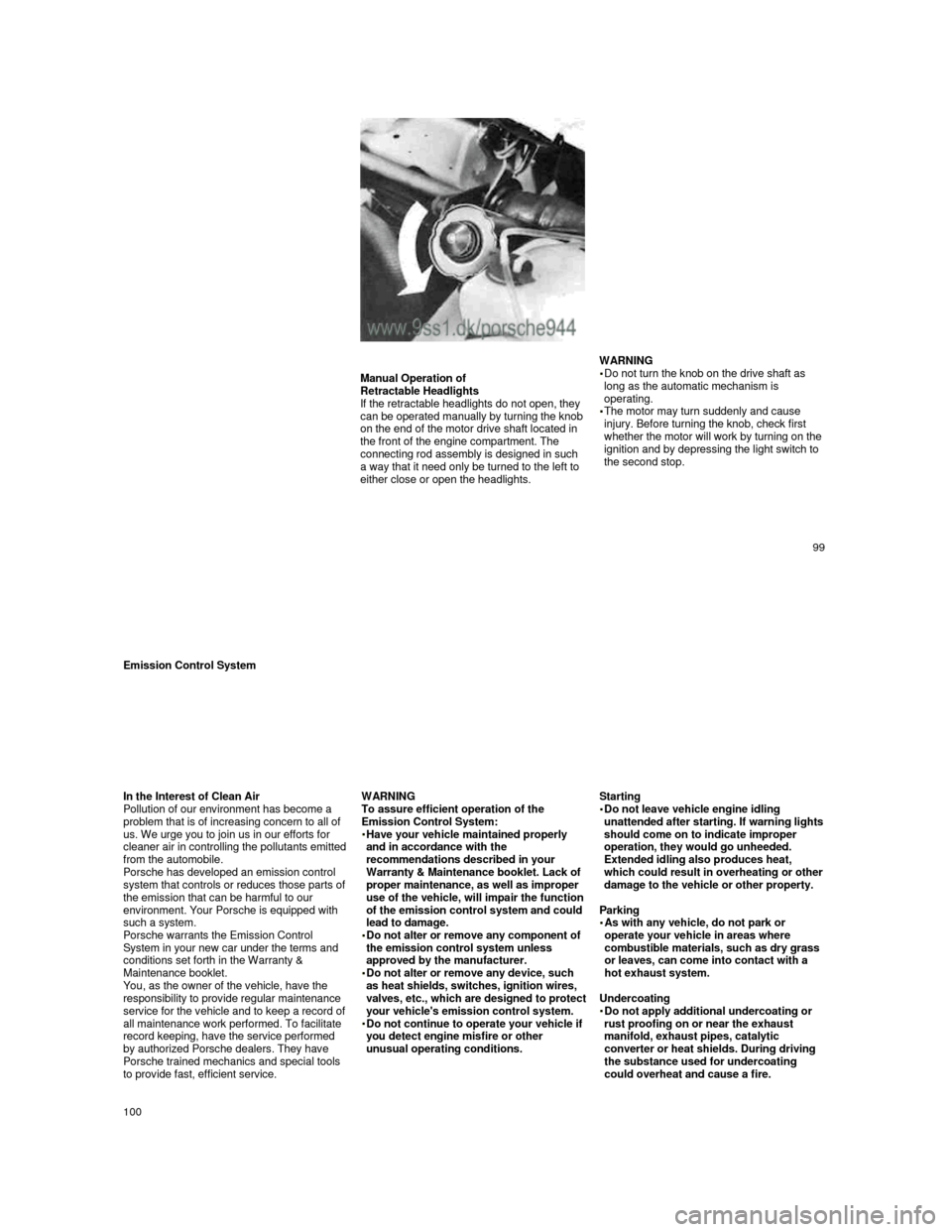
Manual Operation of
Retractable Headlights
If the retractable headlights do not open, they
can be operated manually by turning the knob
on the end of the motor drive shaft located in
the front of the engine compartment. The
connecting rod assembly is designed in such
a way that it need only be turned to the left to
either close or open the headlights.
WARNING
Do not turn the knob on the drive shaft as
long as the automatic mechanism is
operating.
The motor may turn suddenly and cause
injury. Before turning the knob, check first
whether the motor will work by turning on the ignition and by depressing the light switch to
the second stop.
99
Emission Control System
In the Interest of Clean Air
Pollution of our environment has become a
problem that is of increasing concern to all of
us. We urge you to join us in our efforts for
cleaner air in controlling the pollutants emitted from the automobile.
Porsche has developed an emission control
system that controls or reduces those parts of
the emission that can be harmful to our
environment. Your Porsche is equipped with
such a system.
Porsche warrants the Emission Control
System in your new car under the terms and
conditions set forth in the Warranty &
Maintenance booklet.
You, as the owner of the vehicle, have the
responsibility to provide regular maintenance
service for the vehicle and to keep a record of
all maintenance work performed. To facilitate
record keeping, have the service performed
by authorized Porsche dealers. They have
Porsche trained mechanics and special tools
to provide fast, efficient service.
WARNING To assure efficient operation of the
Emission Control System:
Have your vehicle maintained properly and in accordance with the
recommendations described in your
Warranty & Maintenance booklet. Lack of
proper maintenance, as well as improper
use of the vehicle, will impair the function
of the emission control system and could
lead to damage.
Do not alter or remove any component of the emission control system unless
approved by the manufacturer.
Do not alter or remove any device, such as heat shields, switches, ignition wires, valves, etc., which are designed to protect your vehicle's emission control system. Do not continue to operate your vehicle if you detect engine misfire or other
unusual operating conditions.
Starting
Do not leave vehicle engine idling unattended after starting. If warning lights should come on to indicate improper
operation, they would go unheeded.
Extended idling also produces heat,
which could result in overheating or other damage to the vehicle or other property.
Parking
As with any vehicle, do not park or operate your vehicle in areas where
combustible materials, such as dry grass
or leaves, can come into contact with a
hot exhaust system.
Undercoating
Do not apply additional undercoating or rust proofing on or near the exhaust
manifold, exhaust pipes, catalytic
converter or heat shields. During driving
the substance used for undercoating
could overheat and cause a fire.
100
Page 58 of 66

Tires, Rims 944 Turbo
Tires, Rims
(Rim offset 52,3 mm) 205/55 VR 16 on rims 7 J x 16 H2 front and 225/50 V
R 16 on rims 8 J x 16 H2 rear
Snow tires
(Rim offset 52,3 mm) 205/55 R 16 82 Q M+S on rims 7 J x 16 H2 front and
rear
or 205/55 R 16 82 Q M + S on rims 7 J x 16 H2 front and
225/50 R 16 82 Q M + S on rims 8 J x 16 H2 rear
The load rating and identification letter for allow able maximum speed (e.g. 82 Q/VR 16)
represent minimum requirements.
Collapsible spare tire 165-15 8 PR 89 P on rim 51/2 J x 15 H2
Tire pressure always 36 psi (2.5 bar/atm.), front o r rear use. Maximum speed is 50 mph (80 km/h).
Cold tire pressure front and rear 36 psi (2.5 bar)
Snow chains Should snow chains be necessary, they m ust be mounted on the drive wheels only. Maximum
speed is 30 mph (50 km/h). Always use Porsche - app roved snow chains.
Important hint:
For tires with VR quality standard , there are currently no final standards concerning tire strength at speeds above 210 km/h. For this r eason,
only use tire makes and types tested by Porsche.
If you intend to use other than original equipment wheels, be sure that they conform to Porsche specif ications for your model. Check with your
Porsche dealer regarding the correct wheel specific ations for type and model year.
113
Dimensions
Length
Width
Height
Wheel base
Wheel track, front
Wheel track, rear
Ground clearance*
Tuning circle (curb to curb)
Tuning circle (wall to wall)
Overhang angle, front*
Overhang angle, rear*
944 / 944 S
168.90 in. / 4290 mm 68.31 in. / 1735 mm
50.20 in. / 1275 mm
94.49 in. / 2400 mm
58.15 in. / 1477 mm
57.13 in. / 1451 mm
4.72 in. / 120 mm
31.17 ft. / 9.5 m
33.80 ft./ 10.3 m
14°
15°
944 Turbo
168.90 in. / 4290 mm
68.31 in. / 1735 mm
50.20 in. / 1275 mm
94.49 in. / 2400 mm
58.15 in. / 1477 mm
57.13 in. / 1451 mm
4.72 in. / 120 mm
31.17 ft. / 9.5 m
33.80 ft./ 10.3 m
12,5°
15°
Weights
Curb weight
Maximum load capacity
Total permissible weight
Maximum axle load, front**
Maximum axle load, rear**
Permissible rack load**/***
944
2778 Ibs. / 1260kg
661 Ibs. / 300 kg
3439 Ibs. / 1560kg
1587 Ibs. / 720kg
1984 Ibs. / 900kg
165 Ibs. / 75kg 944 S
2866 Ibs. / 1300 kg
661 Ibs. / 300 kg
3527 Ibs. / 1600 kg
1609 Ibs. / 730kg
1984 Ibs. / 900 kg
165 Ibs. / 75kg 944 Turbo 2998 Ibs. / 1360 kg650 Ibs. / 285 kg 3626 Ibs. / 1645 kg1675 Ibs./ 760kg
2028 Ibs. / 920 kg 165 Ibs. / 75kg
* At total permissible weight. ** Do not exceed tot al permissible weight.
*** Applies only if the basic rack of the original Porsche Roof Transport System is used. If old type Porsche ski and luggage racks are used the
permissible roof weight is 35 kg (77 Ibs.).
The vehicle capacity weight (max. load), the Gross Vehicle Weight Rating (GVWR) and the Gross Axle Wei ght Ratings (GAWR) for front and
rear, are listed on the sticker on the left upper s ide member in the engine compartment.
The gross vehicle weight rating includes the weight of the basic vehicle plus full tank, oil and coolant, plus max. load which combines passenger
(150 pounds / 68 kg per designated position) and lu ggage weight. Luggage weight is not increased by th e use of roof, ski or luggage racks,
unless passenger capacity is reducted accordingly.
114