Page 1760 of 1865
POWER DOOR LOCK 1 5
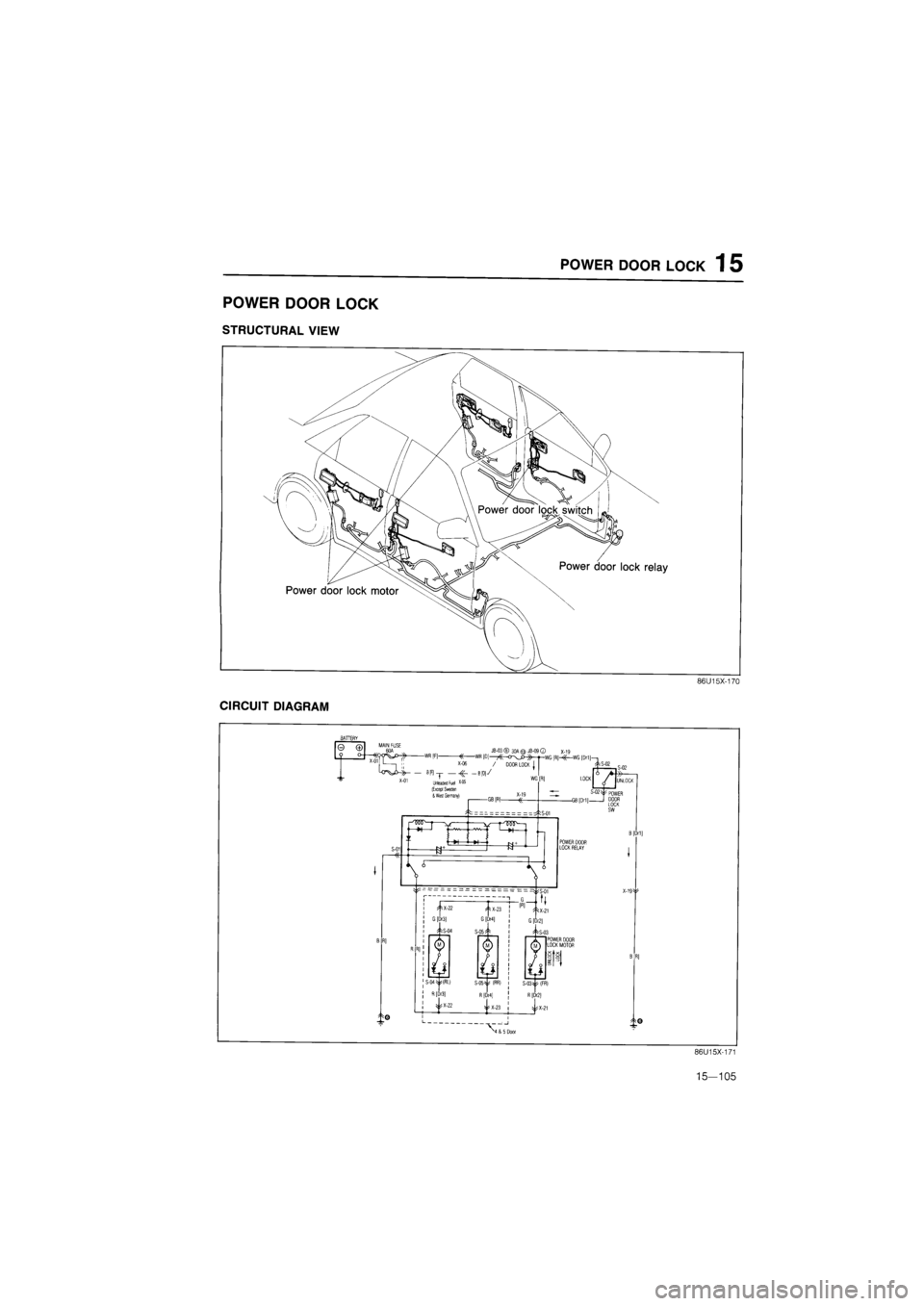
POWER DOOR LOCK
STRUCTURAL VIEW
CIRCUIT DIAGRAM
BATTERY
86U15X-171
15—105
Page 1761 of 1865
1 5 POWER DOOR LOCK
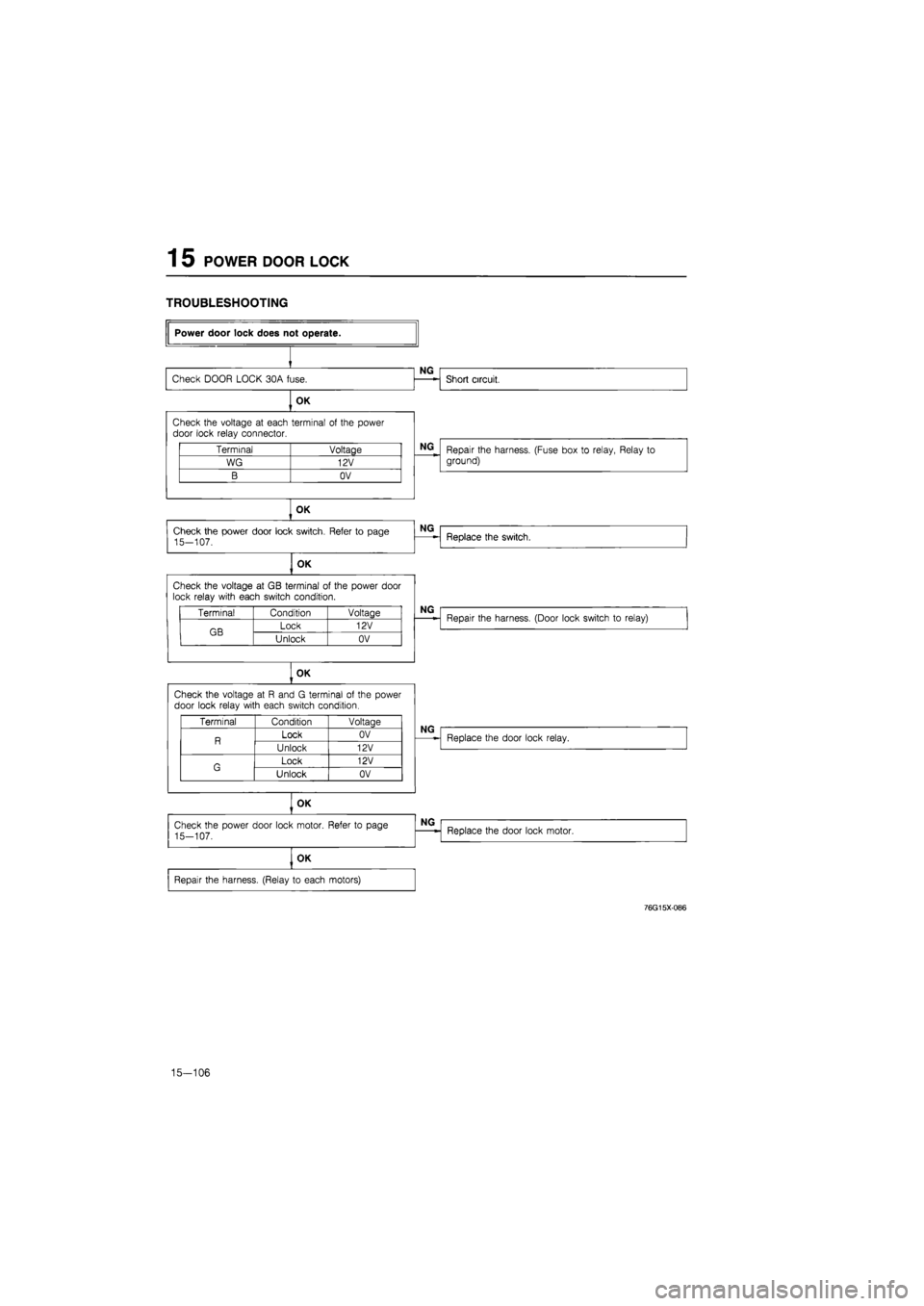
TROUBLESHOOTING
Terminal Voltage
WG 12V
B OV
Check the voltage
at GB
terminal
of
the power door lock relay with each switch condition.
Terminal Condition Voltage
GB Lock 12V GB Unlock OV
OK
Check the voltage
at R
and
G
terminal
of
the power door lock relay with each switch condition.
Terminal Condition Voltaae
R Lock OV R Unlock 12V
G Lock 12V G Unlock OV
Power door lock does not operate.
Check DOOR LOCK 30A fuse.
OK
NG
Short circuit.
Check the voltage
at
each terminal
of
the power door lock relay connector.
NG
Repair the harness. (Fuse box
to
relay, Relay
to
ground)
OK
Check the power door lock switch. Refer
to
page 15-107.
OK
NG
Replace the switch.
NG
Repair the harness. (Door lock switch
to
relay)
NG
Replace the door lock relay.
OK
Check the power door lock motor. Refer
to
page
15-107.
OK
Repair the harness. (Relay
to
each motors)
NG
Replace the door lock motor.
76G15X086
15—106
Page 1762 of 1865
POWER DOOR LOCK 1 5
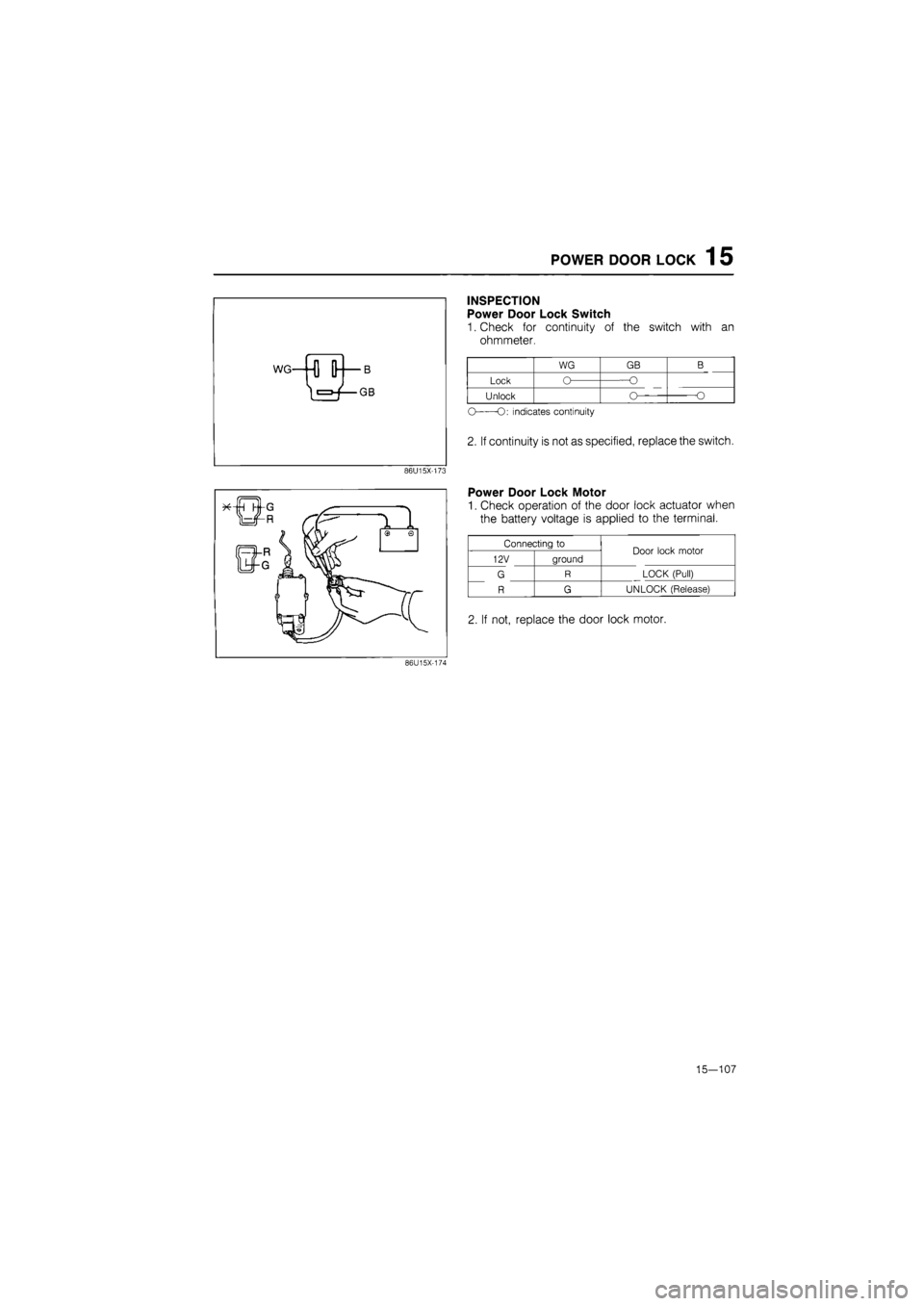
86U15X-173
INSPECTION
Power Door Lock Switch
1. Check for continuity of the switch with an
ohmmeter.
WG GB B
Lock
o O
Unlock
o O
O
O:
indicates continuity
2. If continuity is not as specified, replace the switch.
Power Door Lock Motor
1. Check operation of the door lock actuator when
the battery voltage is applied to the terminal.
Connecting
to
Door lock motor 12V ground Door lock motor
G R LOCK (Pull)
R G UNLOCK (Release)
2. If not, replace the door lock motor.
86U15X-174
15—107
Page 1793 of 1865
16 OUTLINE
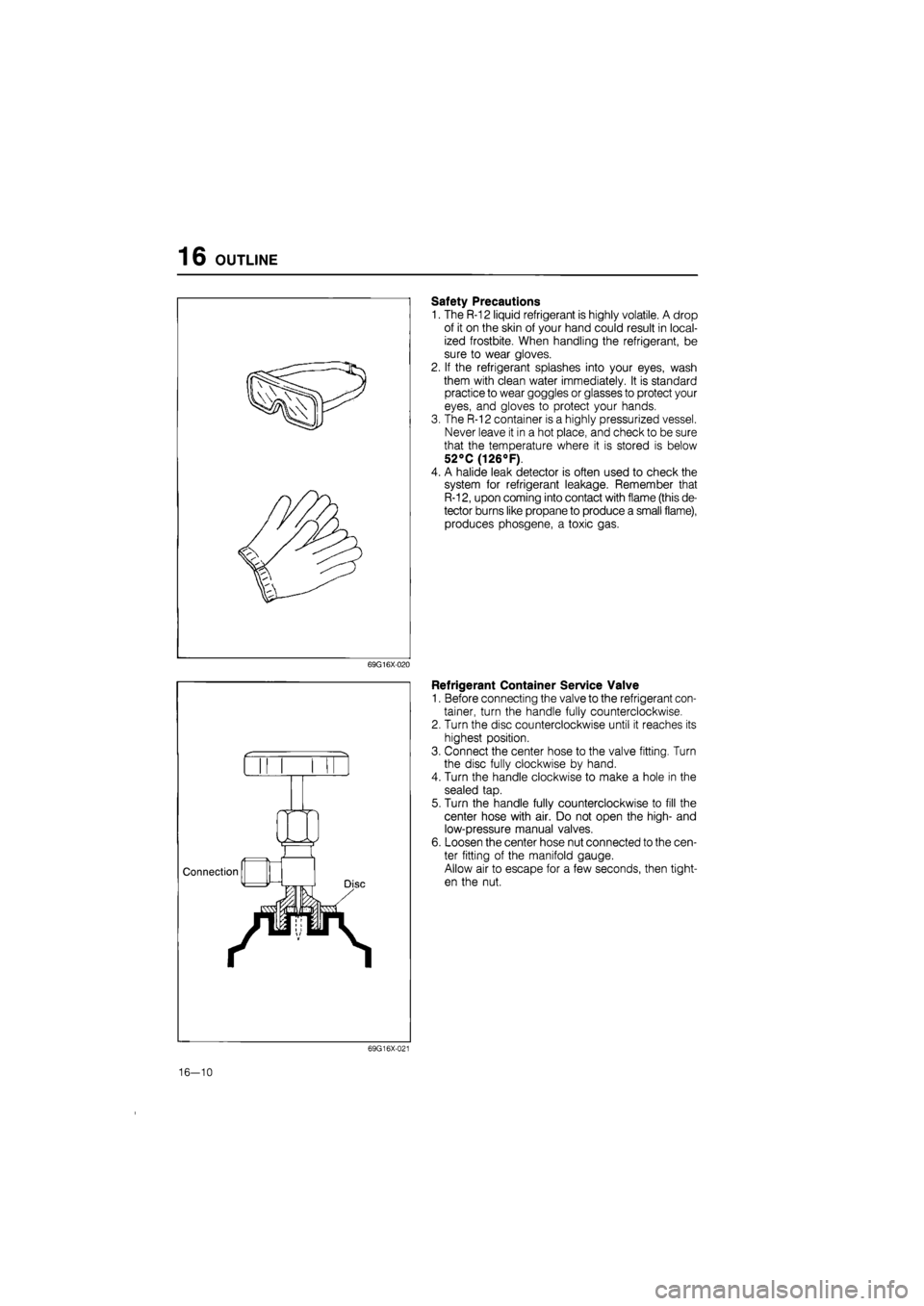
Safety Precautions
1. The R-12 liquid refrigerant is highly volatile. A drop
of it on the skin of your hand could result in local-
ized frostbite. When handling the refrigerant, be
sure to wear gloves.
2. If the refrigerant splashes into your eyes, wash
them with clean water immediately. It is standard
practice to wear goggles or glasses to protect your
eyes, and gloves to protect your hands.
3. The R-12 container is a highly pressurized vessel.
Never leave it in a hot place, and check to be sure
that the temperature where it is stored is below
52°C (126°F).
4. A halide leak detector is often used to check the
system for refrigerant leakage. Remember that
R-12, upon coming into contact with flame (this de-
tector burns like propane to produce a small flame),
produces phosgene, a toxic gas.
69G16X020
V/^V
Connection
LZl
jvmi
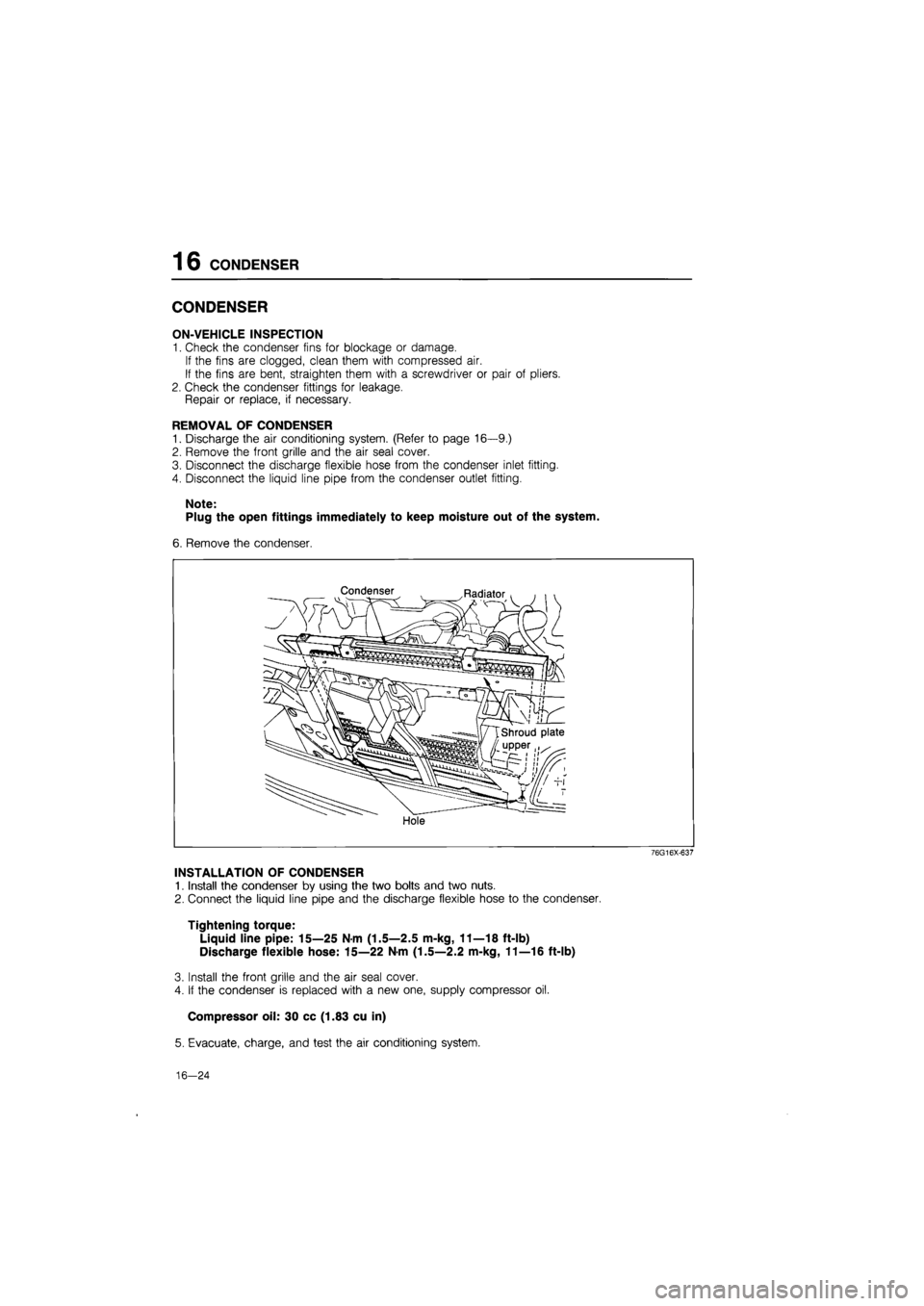
Refrigerant Container Service Valve
1. Before connecting the valve to the refrigerant con-
tainer, turn the handle fully counterclockwise.
2. Turn the disc counterclockwise until it reaches its
highest position.
3. Connect the center hose to the valve fitting. Turn
the disc fully clockwise by hand.
4. Turn the handle clockwise to make a hole in the
sealed tap.
5. Turn the handle fully counterclockwise to fill the
center hose with air. Do not open the high- and
low-pressure manual valves.
6. Loosen the center hose nut connected to the cen-
ter fitting of the manifold gauge.
Allow air to escape for a few seconds, then tight-
en the nut.
69G16X-021
16-10
Page 1807 of 1865
16 CONDENSER
CONDENSER
ON-VEHICLE INSPECTION
1. Check the condenser fins for blockage or damage.
If the fins are clogged, clean them with compressed air.
If the fins are bent, straighten them with a screwdriver or pair of pliers.
2. Check the condenser fittings for leakage.
Repair or replace, if necessary.
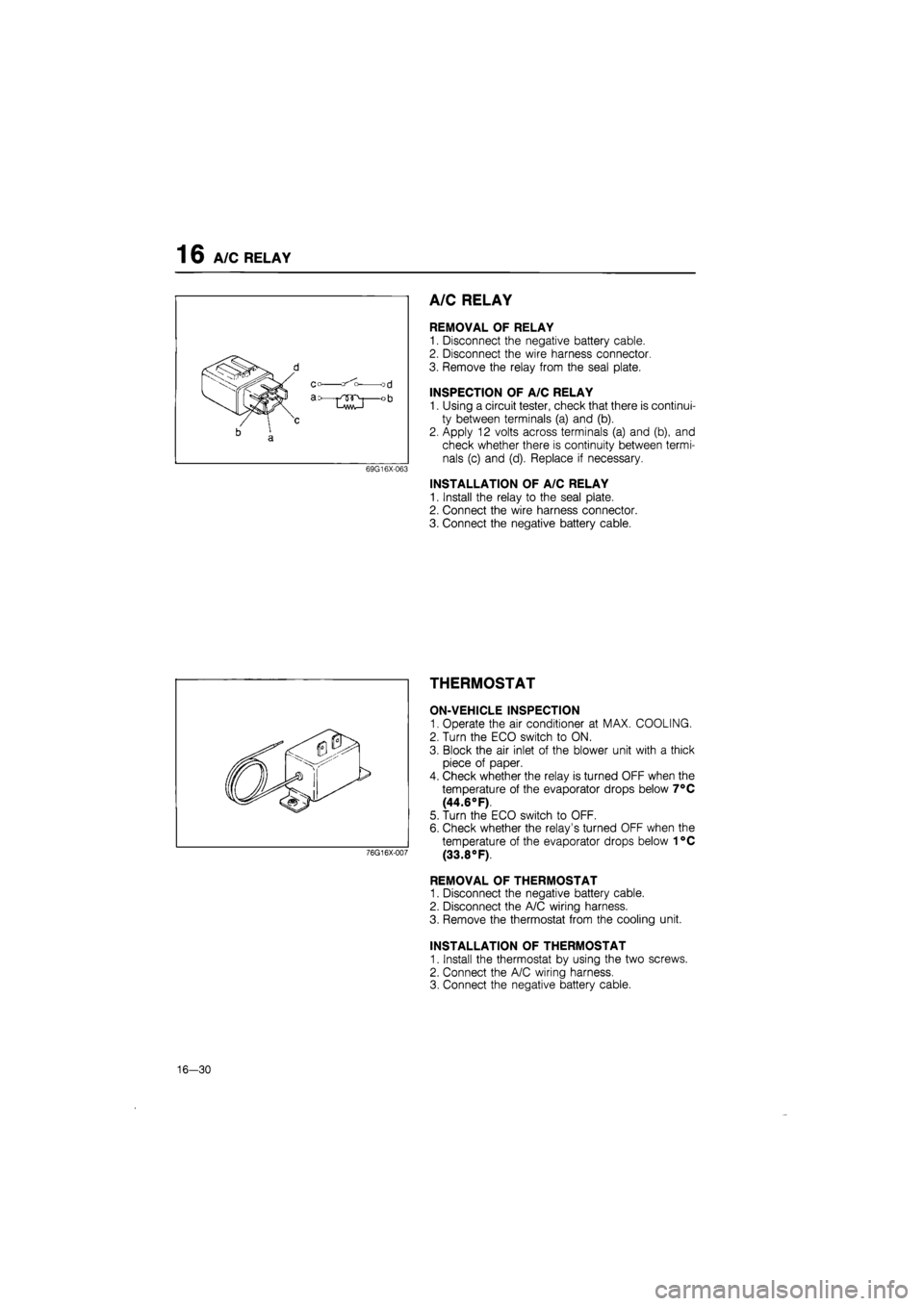
REMOVAL OF CONDENSER
1. Discharge the air conditioning system. (Refer to page 16—9.)
2. Remove the front grille and the air seal cover.
3. Disconnect the discharge flexible hose from the condenser inlet fitting.
4. Disconnect the liquid line pipe from the condenser outlet fitting.
Note:
Plug the open fittings immediately to keep moisture out of the system.
6. Remove the condenser.
Condenser Radiator
Hole
76G16X-637
INSTALLATION OF CONDENSER
1. Install the condenser by using the two bolts and two nuts.
2. Connect the liquid line pipe and the discharge flexible hose to the condenser.
Tightening torque:
Liquid line pipe: 15—25 Nm (1.5—2.5 m-kg, 11—18 ft-lb)
Discharge flexible hose: 15—22 N-m (1.5—2.2 m-kg, 11—16 ft-lb)
3. Install the front grille and the air seal cover.
4. If the condenser is replaced with a new one, supply compressor oil.
Compressor oil: 30 cc (1.83 cu in)
5. Evacuate, charge, and test the air conditioning system.
16—24
Page 1810 of 1865
COOLING UNIT 1 6
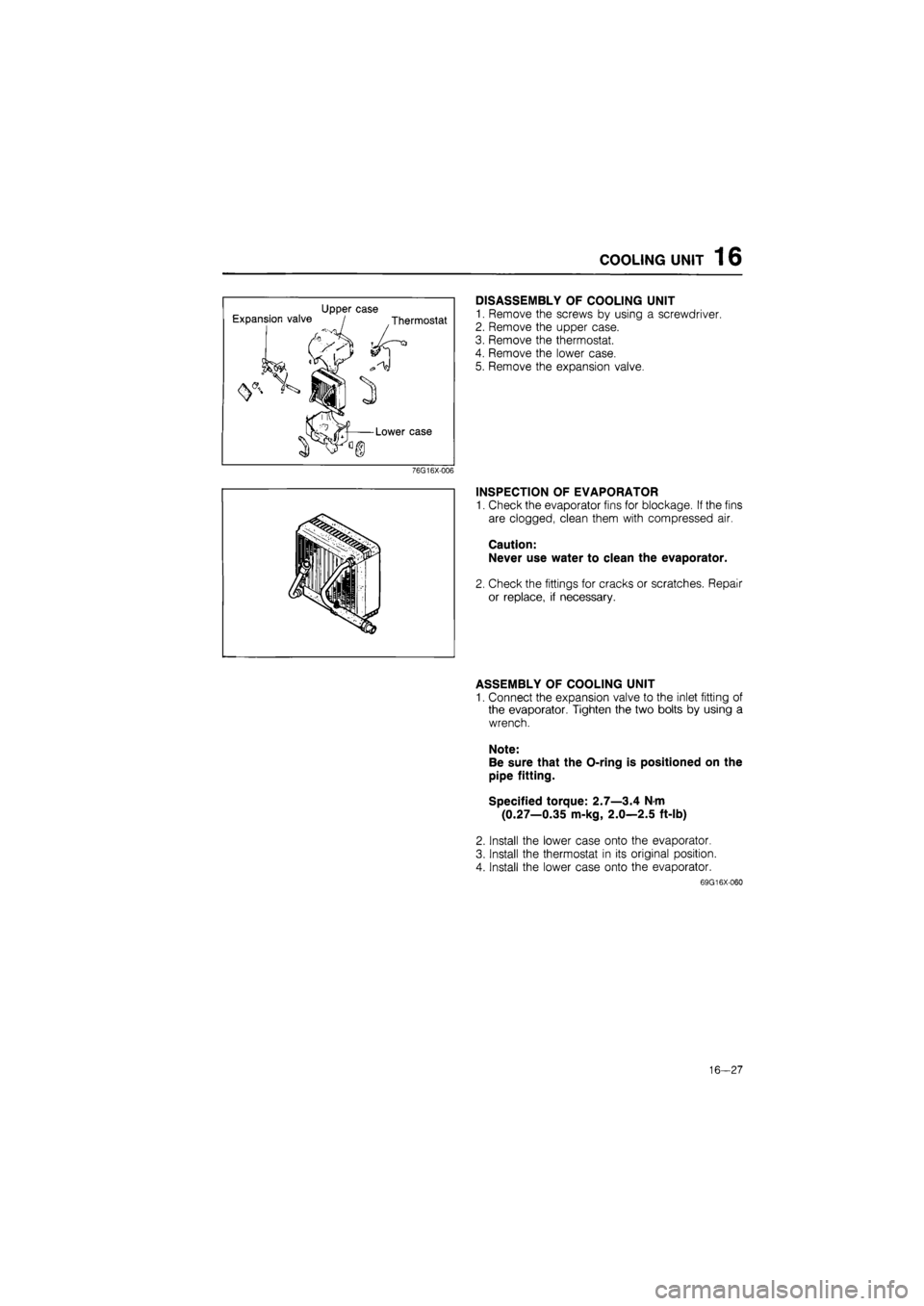
Upper case Expansion valve / Thermostat
Lower case
76G16X-006
DISASSEMBLY OF COOLING UNIT
1. Remove the screws by using a screwdriver.
2. Remove the upper case.
3. Remove the thermostat.
4. Remove the lower case.
5. Remove the expansion valve.
INSPECTION OF EVAPORATOR
1. Check the evaporator fins for blockage. If the fins
are clogged, clean them with compressed air.
Caution:
Never use water to clean the evaporator.
2. Check the fittings for cracks or scratches. Repair
or replace, if necessary.
ASSEMBLY OF COOLING UNIT
1. Connect the expansion valve to the inlet fitting of
the evaporator. Tighten the two bolts by using a
wrench.
Note:
Be sure that the O-ring is positioned on the
pipe fitting.
Specified torque: 2.7—3.4 N-m
(0.27—0.35 m-kg, 2.0—2.5 ft-lb)
2. Install the lower case onto the evaporator.
3. Install the thermostat in its original position.
4. Install the lower case onto the evaporator.
69G16X-060
16—27
Page 1813 of 1865
1 6 A/C RELAY
A/C RELAY
REMOVAL OF RELAY
1. Disconnect the negative battery cable.
2. Disconnect the wire harness connector
3. Remove the relay from the seal plate.
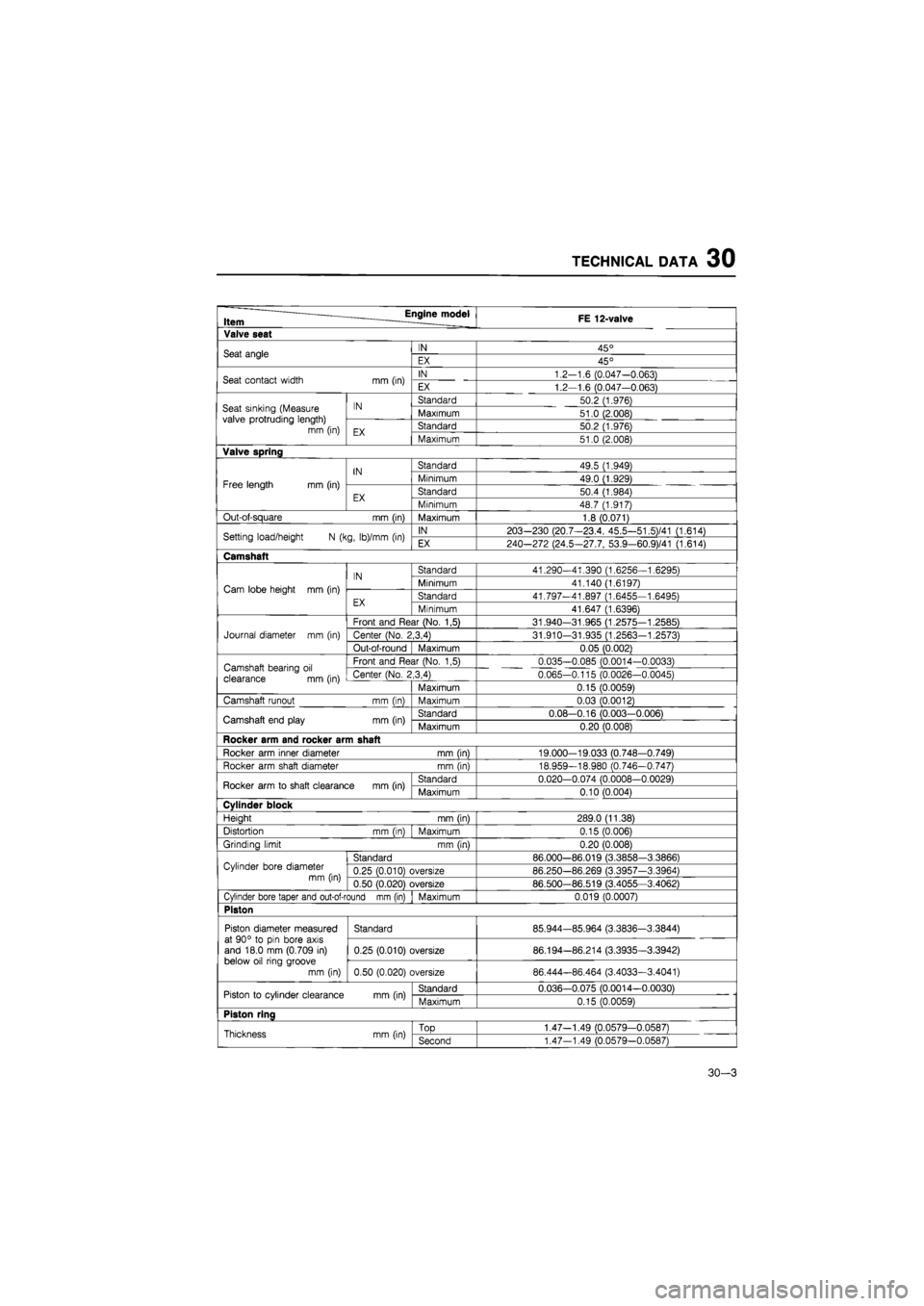
INSPECTION OF A/C RELAY
1. Using a circuit tester, check that there is continui-
ty between terminals (a) and (b).
2. Apply 12 volts across terminals (a) and (b), and
check whether there is continuity between termi-
nals (c) and (d). Replace if necessary.
INSTALLATION OF A/C RELAY
1. Install the relay to the seal plate.
2. Connect the wire harness connector.
3. Connect the negative battery cable.
THERMOSTAT
ON-VEHICLE INSPECTION
1. Operate the air conditioner at MAX. COOLING.
2. Turn the ECO switch to ON.
3. Block the air inlet of the blower unit with a thick
piece of paper.
4. Check whether the relay is turned OFF when the
temperature of the evaporator drops below 7°C
(44.6°F).
5. Turn the ECO switch to OFF.
6. Check whether the relay's turned OFF when the
temperature of the evaporator drops below 1°C
(33.8°F).
REMOVAL OF THERMOSTAT
1. Disconnect the negative battery cable.
2. Disconnect the A/C wiring harness.
3. Remove the thermostat from the cooling unit.
INSTALLATION OF THERMOSTAT
1. Install the thermostat by using the two screws.
2. Connect the A/C wiring harness.
3. Connect the negative battery cable.
76G16X-007
16-30
Page 1817 of 1865
TECHNICAL DATA 30
FE 12-valve Item FE 12-valve
Valve seat
Seat angle IN 45° Seat angle EX 45°
Seat contact width mm (in) IN 1.2-1.6 (0.047-0.063) Seat contact width mm (in) EX 1.2-1.6 (0.047-0.063)
Seat sinking (Measure valve protruding length) mm (in)
IN Standard 50.2 (1.976) Seat sinking (Measure valve protruding length) mm (in)
IN Maximum 51.0 (2.008) Seat sinking (Measure valve protruding length) mm (in) EX Standard 50.2 (1.976)
Seat sinking (Measure valve protruding length) mm (in) EX Maximum 51.0 (2.008)
Valve spring
IN Standard 49.5 (1.949)
Free length
mm
(in)
IN Minimum 49.0 (1.929) Free length
mm
(in)
EX Standard 50.4 (1.984) EX Minimum 48.7 (1.917)
Out-of-square mm (in) Maximum 1.8 (0.071)
Setting load/height
N
(kg, lb)/mm (in) IN 203-230 (20.7-23.4, 45.5-51,5)/41 (1.614) Setting load/height
N
(kg, lb)/mm (in) EX 240-272 (24.5—27.7, 53.9-60.9)/41 (1.614)
Camshaft
IN Standard 41.290-41.390 (1.6256-1.6295)
Cam lobe height
mm
(in)
IN Minimum 41.140 (1.6197) Cam lobe height
mm
(in)
EX Standard 41.797-41.897 (1.6455—1.6495) EX Minimum 41.647 (1.6396)
Front and Rear (No.
1,5)
31.940-31.965 (1.2575-1.2585)
Journal diameter
mm (in)
Center (No. 2,3,4) 31.910-31.935 (1.2563-1.2573)
Out-of-round Maximum 0.05 (0.002)
Camshaft bearing
oil
clearance
mm
(in)
Front and Rear (No.
1,5)
0.035—0.085 (0.0014-0.0033) Camshaft bearing
oil
clearance
mm
(in) Center (No. 2,3,4) 0.065-0.115 (0.0026-0.0045) Camshaft bearing
oil
clearance
mm
(in) Maximum 0.15 (0.0059)
Camshaft runout mm (in) Maximum 0.03 (0.0012)
Camshaft end play mm (in) Standard 0.08-0.16 (0.003—0.0061 Camshaft end play mm (in) Maximum 0.20 (0.008)
Rocker arm and rocker arm shaft
Rocker arm inner diameter mm (in) 19.000—19.033 (0.748—0.749)
Rocker arm shaft diameter mm (in) 18.959-18.980 (0.746-0.747)
Rocker arm
to
shaft clearance mm (in) Standard 0.020-0.074 (0.0008-0.0029) Rocker arm
to
shaft clearance mm (in) Maximum 0.10 (0.004)
Cylinder block
Height mm (in) 289.0 (11.38)
Distortion mm (in) Maximum 0.15 (0.006)
Grinding limit mm (in) 0.20 (0.008)
Cylinder bore diameter
mm (in)
Standard 86.000—86.019 (3.3858-3.3866) Cylinder bore diameter
mm (in) 0.25 (0.010) oversize 86.250-86.269 (3.3957-3.3964) Cylinder bore diameter
mm (in) 0.50 (0.020) oversize 86.500-86.519 (3.4055-3.4062)
Cylinder bore taper and out-of-round mm (in) Maximum 0.019 (0.0007)
Piston
Piston diameter measured at 90°
to
pin bore axis and 18.0 mm (0.709
in)
below oil ring groove
mm (in)
Standard 85.944-85.964 (3.3836-3.3844) Piston diameter measured at 90°
to
pin bore axis and 18.0 mm (0.709
in)
below oil ring groove
mm (in)
0.25 (0.010) oversize 86.194-86.214 (3.3935—3.3942)
Piston diameter measured at 90°
to
pin bore axis and 18.0 mm (0.709
in)
below oil ring groove
mm (in) 0.50 (0.020) oversize 86.444-86.464 (3.4033—3.4041)
Piston
to
cylinder clearance mm (in) Standard 0.036-0.075 (0.0014-0.0030) Piston
to
cylinder clearance mm (in) Maximum 0.15 (0.0059)
Piston ring
Thickness mm (in)
TOD
1.47-1.49 (0.0579—0.05871 Thickness mm (in) Second 1.47-1.49 (0.0579-0.0587)
30-3