Page 284 of 1865
1 C ASSEMBLY (CYLINDER BLOCK)
Clutch Disc and Clutch Cover
Install the clutch disc and clutch cover using the SST.
(Refer to Section 6.)
Tightening torque:
18—26 Nm (1.8—2.7 m-kg, 13—20 ft-lb)
76G01C-169
Timing Belt Pulley
1. Install the timing belt pulley with the semicircular
(woodruff) key.
Tightening torque:
179—193 Nm (18.3—19.7 m-kg,
132—142 ft-lb)
4BG01B-180
2. Release the ring gear brake, turn the flywheel,
move the No.
1
piston to the top position, and then
turn it approximately 45° in the forward direction.
Caution
This is to prevent damage to the pistons and
valves when the cylinder head is installed.
4BG01B-181
1C—72
Page 303 of 1865
INSTALLATION 1C
INSTALLATION
TRANSAXLE ASSEMBLY
Assemble the transaxle to the engine in the sequence shown in the figure referring to the installation note.
37—52 (3.8—5. 27—38
37-52 N m (3.8—5.3 m-kg, 27—38 ft-lb)
(80—110 cm-kg, 69—95 In-lb)
89—117 N-m (9.1—11.9 m-kg, 66—86 ft-lb)
7-52 N-m (3.8—5.3 m-kg, 27—38 ft-lb)
76G01C-217
1. Transaxle
2. Clutch under cover
3. Gusset plate
4. Water pipe
5. Starter
Installation Note
Clutch under cover
Before installation, fill the notches with silicon as
shown in the figure.
76G01C-219
1C—91
Page 308 of 1865
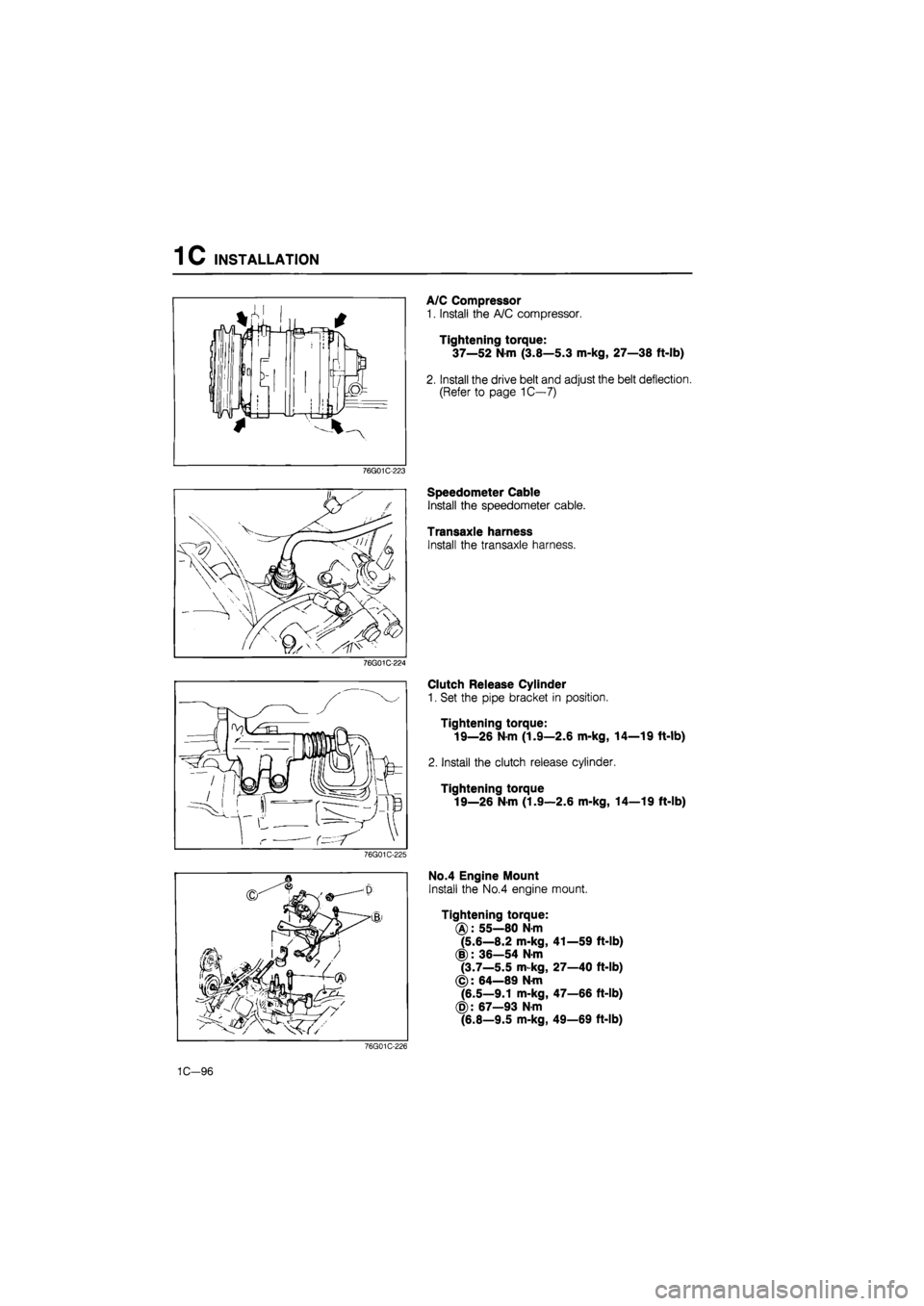
1C INSTALLATION
76G01C-223
76G01C-224
76G01C-225
A/C Compressor
1. Install the A/C compressor.
Tightening torque:
37—52 N-m (3.8—5.3 m-kg, 27—38 ft-lb)
2. Install the drive belt and adjust the belt deflection.
(Refer to page 1C—7)
Speedometer Cable
Install the speedometer cable.
Transaxle harness
Install the transaxle harness.
Clutch Release Cylinder
1. Set the pipe bracket in position.
Tightening torque:
19—26 N-m (1.9—2.6 m-kg, 14—19 ft-lb)
2. Install the clutch release cylinder.
Tightening torque
19—26 N-m (1.9—2.6 m-kg, 14—19 ft-lb)
No.4 Engine Mount
Install the No.4 engine mount.
Tightening torque:
(A): 55—80 N-m
(5.6—8.2 m-kg, 41—59 ft-lb)
(|): 36—54 N-m
(3.7—5.5 m-kg, 27—40 ft-lb)
©: 64—89
N
m
(6.5—9.1 m-kg, 47—66 ft-lb)
67—93 N-m
(6.8—9.5 m-kg, 49—69 ft-lb)
76G01C-226
1C-96
Page 318 of 1865
OIL PAN 2A
OIL PAN
REMOVAL
1. Disconnect the negative battery cable.
2. Drain the engine oil.
3. Remove in the sequence shown in the figure referring to the removal note for specially marked parts.
76G02A-009
5. Sub frame (RH)
6. Oil pan
7. Oil strainer
8. Stiffener (FE 8-valve...only ECE, 12-valve)
Removal Note
Oil pan
(DOHC)
1. Remove the oil pan mounting bolts.
2. Install the bolt ©from the mounting bolt or 10 mm
(0.39 in) bolts in the specified bolt holes ©(both
sides).
3. Screw in the bolts gradually and alternately to re-
move the oil pan.
Caution
Do not pry the oil pan to prevent damaging the
contact surface.
1. Exhaust pipe
2. Gusset plate (SOHC)
3. Clutch housing under cover (SOHC)
4. Performance plate (4WS)
2A-7
Page 333 of 1865
OIL PAN 2B
OIL PAN
REMOVAL
1. Disconnect the negative battery cable.
2. Drain the engine oil and coolant.
3. Remove in the sequence shown in the figure referring to the removal note for specially marked parts.
76G02B-019
1. Sub frame
2. Gusset plate
3. Clutch housing
under cover
4. Water pipe
5. Oil pan
6. Oil strainer
7. Stiffener (RF-CX)
36—54 N-m (3.7-5.5 m-kg, 27—40 ft-lb)"
8—11 Nm (80—110 cm-kg 69—95 In-lb)
N-m (3.6—5.3 m-kg, 27—38 ft-lb)
(80—110 cm-kg, 69—95 in-lb)
76G02B-020
Removal Note
Oil pan
1. Remove the oil pan mounting bolts.
2. Insert a scraper or a suitable tool between the oil
pan and the stiffener to separate them.
3. Remove the oil pan.
4. Remove the oil strainer and stiffener from the
engine.
Caution
Do not bend the oil pan when prying loose.
76G02B-021
2B-9
Page 382 of 1865

TROUBLESHOOTING GUIDE
4A
TROUBLESHOOTING GUIDE
F6 (GENERAL)
The Troubleshooting Guide lists the systems most likely to cause
a
given symptom. After finding the
system(s)
to
check, refer
to
the pages shown
for
detailed guides
for
each system.
\\ POSSIBLE CAUSE
\ PAGE
SYMPTOM
Air
cleaner
(Air
cleaner
element)
intake
air
temperature
control
system
Idle
adjustment
Fuel
system
(Carburetor,
Fuel
pump)
idle-up
control
system
Exhaust
system
Positive
crankcase
ventilation
system
Auto-return
choke
system
\\ POSSIBLE CAUSE
\ PAGE
SYMPTOM 4A—23 4A—60 4A—38 4A—24 4A—68 4A—96 4A—67 4A—40
1 Hard start
or
won't start (Cranks
OK)
1 2
2 Engine stalls During warm
up
3 2 1 4
2 Engine stalls After warm
up
4 2 5 1 3
3 Rough Idle During warm
up
3 2 1 4
3 Rough Idle After warm
up
3 2 5 1 4
4 High idle speed after warm
up
1 3 2
5 Poor acceleration, hesitation, or lack
of
power
1 2 3
6 Runs rough
on
deceleration
1
7 Afterburn
in
exhaust system
1
8 Poor fuel consumption
2 1 4 3
9 Fails emission test
2 1 4 5 3
76G04A-015
The numbers of the list show the priorities
of
inspections from the most possible to that with the lowest
possibility.
These were determined
on
the following basis:
• Ease
of
inspection
•
Most possible system
•
Most Possible point
in
system
TROUBLESHOOTING PROCEDURE:
1st Check the following items:
Electrical system
1) Battery condition
2) Fuses
Ignition system
1) Spark plugs
2) Ignition timing
Fuel system
1) Fuel level
2) Fuel leakage
3) Fuel filter
4) Idle speed
Intake
air
system
1) Vacuum
or air
leakage
2) Vacuum hose routing
3) Accelerator cable
4) Choke cable
2nd Check Fuel and Emission Control Systems
Engine
1) Compression
2) Overheating
Others
1) Clutch slippage
2) Brake dragging
4 A-17
Page 383 of 1865

4A TROUBLESHOOTING GUIDE
F6 (SINGAPORE)
The Troubleshooting Guide lists the systems most likely
to
cause
a
given symptom. After finding
the
system(s)
to
check, refer
to the
pages shown
for
detailed guides
for
each system.
POSSIBLE CAUSE
\ PAGE
SYMPTOM
Air
cleaner
(Air
cleaner
element)
Intake
air
temperature
control
system
Idle
adjustment
Fuel
system
(Carburetor,
Fuel
pump)
Air
injection
system
Deceleration
control
system
Positive
crankcase
ventilation
system
Exhaust
system
Idle-up
control
system
POSSIBLE CAUSE
\ PAGE
SYMPTOM 4A-23 4A-60 4 A—38 4A—24 4A-58 4A-45 4A-67 4A-SW 4A—68
1 Hard start
or
won't start (Cranks
OK)
1 2
2 Engine stalls During warm
up
3 2 1 4
2 Engine stalls After warm
up
3 2 4 1
3 Rough idle During warm
up
3 2 1 4
3 Rough idle After warm
up
3 2 4 1
4 High idle speed after warm
up
1 4 3* 2
5 Poor acceleration, hesitation,
or
lack
of
power
1 2 3
6 Runs rouah
on
deceleration
2 1
7 Afterburn
in
exhaust svstem
2 1
8 Poor fuel consumption
2 1 4 3
9 Fails emission test
6 4 5 3 2 1
Only MTX
76G04A-016
The numbers
of
the list show the priorities
of
inspections from the most possible to that with the lowest
possibility.
These were determined
on the
following basis:
• Ease
of
inspection
•
Most possible system
•
Most possible point
in
system
TROUBLESHOOTING PROCEDURE:
1st Check
the
following items:
Electrical system
1) Battery condition
2) Fuses
Ignition system
1) Spark plugs
2) Ignition timing
Fuel system
1) Fuel level
2) Fuel leakage
3) Fuel filter
4) Idle speed
Intake
air
system
1) Vacuum
or air
leakage
2) Vacuum hose routing
3) Accelerator cable
Engine
1) Compression
2) Overheating
Others
1) Clutch slippage
2) Brake dragging
2nd Check
the
Fuel
and
Emission Control Systems
4A—18
Page 384 of 1865

TROUBLESHOOTING GUIDE
4A
FE
12
VALVE and
F8
(EXCEPT MIDDLE EAST and GENERAL)
The Troubleshooting Guide lists the systems most likely to cause
a
given symptom. After finding
the
system(s)
to
check, refer
to
the pages shown
for
detailed guides
for
each system.
POSSIBLE CAUSE
\ PAGE
SYMPTOM
Air
cleaner
(Air
cleaner
element)
Intake
air
temperature
control
system
Idle
adjustment
Fuel
system
(Carburetor,
Fuel
pump)
PTC
heater
system
Air
injection
system
Positive
crankcase
ventilation
system
Deceleration
control
system
Idle-up
control
system
Ignition
control
system
POSSIBLE CAUSE
\ PAGE
SYMPTOM
4A-23 4A-60 4A-38 4A-24 4A-42 4A-58 4A-67 4A—45 4A—68 4 A—80
1 Hard start
or
won't start
(Cranks
OK)
1 2
2 Engine stalls During warm
up
5 4 1 6 2 3
2 Engine stalls After warm
up
3 2 4 1
3 Rough idle During warm
up
5 4 1 6 2 3
3 Rough idle After warm
up
3 2 4 1
4 High idle speed after warm
up
1 4 3 2
5 Poor acceleration, hesitation, or lack
of
power
1 4 2 3
6 Runs rough
on
deceleration
2 1
7 Afterburn
in
exhaust system
2 1
8 Poor fuel consumption
3 1 4 2
4
9 Fails emission test
6 2 5 3 1 4
76G04A-017
The numbers of the list show the priorities
of
inspections from the most possible to that with the lowest
possibility.
These were determined
on the
following basis:
• Ease
of
inspection
•
Most possible system
•
Most possible point
in
system
TROUBLESHOOTING PROCEDURE:
1st Check the following items:
Electrical system
1) Battery condition
2) Fuses
Ignition system
1) Spark plugs
2) Ignition timing
Fuel system
1) Fuel level
2) Fuel leakage
3) Fuel filter
4) Idle speed
Intake
air
system
1) Vacuum
or air
leakage
2) Vacuum hose routing
3) Accelerator cable
Engine
1) Compression
2) Overheating
Others
1) Clutch slippage
2) Brake dragging
2nd Check the Fuel
and
Emission Control Systems
4A—19