1984 FORD SIERRA spark
[x] Cancel search: sparkPage 3 of 26

Buying spare parts
Spare parts are available from many
sources, including maker’s appointed
garages, accessory shops, and motor factors.
To be sure of obtaining the correct parts, it
will sometimes be necessary to quote the
vehicle identification number. If possible, it
can also be useful to take the old parts along
for positive identification. Items such as
starter motors and alternators may be
available under a service exchange scheme -
any parts returned should always be clean.
Our advice regarding spare part sources is
as follows.
Officially-appointed garages
This is the best source of parts which are
peculiar to your car, and which are not
otherwise generally available (eg badges,
interior trim, certain body panels, etc). It is
also the only place at which you should buy
parts if the vehicle is still under warranty.
Accessory shops
These are very good places to buy
materials and components needed for themaintenance of your car (oil, air and fuel
filters, spark plugs, light bulbs, drivebelts, oils
and greases, brake pads, touch-up paint, etc).
Components of this nature sold by a
reputable shop are of the same standard as
those used by the car manufacturer.
Besides components, these shops also sell
tools and general accessories, usually have
convenient opening hours, charge lower
prices, and can often be found not far from
home. Some accessory shops have parts
counters where the components needed for
almost any repair job can be purchased or
ordered.
Motor factors
Good factors will stock all the more
important components which wear out
comparatively quickly, and can sometimes
supply individual components needed for the
overhaul of a larger assembly (eg brake seals
and hydraulic parts, bearing shells, pistons,
valves, alternator brushes). They may also
handle work such as cylinder block reboring,
crankshaft regrinding and balancing, etc.
Tyre and exhaust specialists
These outlets may be independent, or
members of a local or national chain. They
frequently offer competitive prices when
compared with a main dealer or local garage,
but it will pay to obtain several quotes before
making a decision. When researching prices,
also ask what “extras” may be added - for
instance, fitting a new valve and balancing the
wheel are both commonly charged on top of
the price of a new tyre.
Other sources
Beware of parts or materials obtained from
market stalls, car boot sales or similar outlets.
Such items are not invariably sub-standard,
but there is little chance of compensation if
they do prove unsatisfactory. In the case of
safety-critical components such as brake
pads, there is the risk not only of financial loss
but also of an accident causing injury or death.
Second-hand components or assemblies
obtained from a car breaker can be a good
buy in some circumstances, but this sort of
purchase is best made by the experienced
DIY mechanic.
Vehicle identification numbers
Modifications are a continuing and
unpublicised process in vehicle manufacture,
quite apart from major model changes. Spareparts lists are compiled upon a numerical
basis, the individual vehicle identification
numbers being essential to correct
identification of the component concerned.
When ordering spare parts, always give as
much information as possible. Quote the car
model, year of manufacture, body and engine
numbers, as appropriate.
The Vehicle Identification Number (VIN)
plate is mounted on the right-hand side of the
body front panel, and may be seen once the
bonnet is open (see illustration).Besides the
VIN it also carries information on vehicle
equipment and permissible loads.
The engine numberis situated on the
cylinder block. On SOHC engines, the number
is located on the right-hand side of thecylinder block in front of the engine mounting
bracket. On 1.8 litre (R2A) CVH engines, the
number is located on the front upper
right-hand side of the cylinder block. On 1.6
and 1.8 litre (R6A) CVH engines, the engine
number is stamped on the front lower face of
the cylinder block, on the alternator side of
the timing cover. On DOHC engines, the
engine number is stamped on the front face of
the cylinder block, below the upper timing
chain cover (see illustrations)..
Other identification numbers or codes are
stamped on major items such as the gearbox,
final drive housing, distributor etc. These
numbers are unlikely to be needed by the
home mechanic.
Buying spare parts REF•3
Engine code (A) and engine number (B)
locations - SOHC engines
Engine number location -
1.8 litre (R2A) CVH engineEngine number code sticker and engine
number location (A) - DOHC engineEngine number location -
1.6 litre CVH engine
A Engine code B Engine number
REF
Vehicle identification numbers
Page 5 of 26

Introduction
A selection of good tools is a fundamental
requirement for anyone contemplating the
maintenance and repair of a motor vehicle.
For the owner who does not possess any,
their purchase will prove a considerable
expense, offsetting some of the savings made
by doing-it-yourself. However, provided that
the tools purchased meet the relevant national
safety standards and are of good quality, they
will last for many years and prove an
extremely worthwhile investment.
To help the average owner to decide which
tools are needed to carry out the various tasks
detailed in this manual, we have compiled
three lists of tools under the following
headings: Maintenance and minor repair,
Repair and overhaul, and Special. Newcomers
to practical mechanics should start off with
the Maintenance and minor repairtool kit, and
confine themselves to the simpler jobs around
the vehicle. Then, as confidence and
experience grow, more difficult tasks can be
undertaken, with extra tools being purchased
as, and when, they are needed. In this way, a
Maintenance and minor repairtool kit can be
built up into a Repair and overhaultool kit over
a considerable period of time, without any
major cash outlays. The experienced do-it-
yourselfer will have a tool kit good enough for
most repair and overhaul procedures, and will
add tools from the Specialcategory when it is
felt that the expense is justified by the amount
of use to which these tools will be put.
Maintenance and minor repair
tool kit
The tools given in this list should be
considered as a minimum requirement if
routine maintenance, servicing and minor
repair operations are to be undertaken. We
recommend the purchase of combination
spanners (ring one end, open-ended the
other); although more expensive than open-
ended ones, they do give the advantages of
both types of spanner.
MCombination spanners:
Metric - 8, 9, 10, 11, 12, 13, 14, 15, 17 &
19 mm
MAdjustable spanner - 35 mm jaw (approx.)
MSpark plug spanner (with rubber insert)
MSpark plug gap adjustment tool
MSet of feeler blades
MBrake bleed nipple spanner
MScrewdrivers:
Flat blade - 100 mm long x 6 mm dia
Cross blade - 100 mm long x 6 mm dia
MCombination pliers
MHacksaw (junior)
MTyre pump
MTyre pressure gauge
MOil can
MOil filter removal tool
MFine emery cloth
MWire brush (small)
MFunnel (medium size)
Repair and overhaul tool kit
These tools are virtually essential for
anyone undertaking any major repairs to amotor vehicle, and are additional to those
given in the Maintenance and minor repairlist.
Included in this list is a comprehensive set of
sockets. Although these are expensive, they
will be found invaluable as they are so
versatile - particularly if various drives are
included in the set. We recommend the half-
inch square-drive type, as this can be used
with most proprietary torque wrenches. If you
cannot afford a socket set, even bought
piecemeal, then inexpensive tubular box
spanners are a useful alternative.
The tools in this list will occasionally need to
be supplemented by tools from the Special
list.
MSockets (or box spanners) to cover range in
previous list (including Torx sockets)
MReversible ratchet drive (for use with
sockets)
MExtension piece, 250 mm (for use with
sockets)
MUniversal joint (for use with sockets)
MTorque wrench (for use with sockets)
MSelf-locking grips
MBall pein hammer
MSoft-faced mallet (plastic/aluminium or
rubber)
MScrewdrivers:
Flat blade - long & sturdy, short (chubby),
and narrow (electricians) types
Cross blade - Long & sturdy, and short
(chubby) types
MPliers:
Long-nosed
Side cutters (electricians)
Circlip (internal and external)
MCold chisel - 25 mm
MScriber
MScraper
MCentre punch
MPin punch
MHacksaw
MBrake hose clamp
MBrake/clutch bleeding kit
MSelection of twist drills
MSteel rule/straight-edge
MAllen keys (inc. splined/Torx type)
MSelection of files
MWire brush
MAxle-stands
MJack (strong trolley or hydraulic type)
MLight with extension lead
Tools and working facilities REF•5
Sockets and reversible ratchet driveSpline bit set
Spline key setValve spring compressorTwo- and three legged bearing pullerREF
Page 11 of 26

The vehicle owner who does his or her own maintenance according
to the recommended service schedules should not have to use this
section of the manual very often. Modern component reliability is such
that, provided those items subject to wear or deterioration are
inspected or renewed at the specified intervals, sudden failure is
comparatively rare. Faults do not usually just happen as a result of
sudden failure, but develop over a period of time. Major mechanical
failures in particular are usually preceded by characteristic symptoms
over hundreds or even thousands of miles. Those components which
do occasionally fail without warning are often small and easily carried
in the vehicle.
With any fault-finding, the first step is to decide where to begin
investigations. Sometimes this is obvious, but on other occasions, alittle detective work will be necessary. The owner who makes half a
dozen haphazard adjustments or replacements may be successful in
curing a fault (or its symptoms), but will be none the wiser if the fault
recurs, and ultimately may have spent more time and money than was
necessary. A calm and logical approach will be found to be more
satisfactory in the long run. Always take into account any warning
signs or abnormalities that may have been noticed in the period
preceding the fault - power loss, high or low gauge readings, unusual
smells, etc - and remember that failure of components such as fuses or
spark plugs may only be pointers to some underlying fault.
The pages which follow provide an easy-reference guide to the more
common problems which may occur during the operation of the
vehicle. These problems and their possible causes are grouped under
Fault diagnosisREF•11
REF
Engine
MEngine fails to rotate when attempting to start
MStarter motor turns engine slowly
MEngine rotates, but will not start
MEngine difficult to start when cold
MEngine difficult to start when hot
MStarter motor noisy or excessively-rough in engagement
MEngine starts, but stops immediately
MEngine idles erratically
MEngine misfires at idle speed
MEngine misfires throughout the driving speed range
MEngine hesitates on acceleration
MEngine stalls
MEngine lacks power
MEngine backfires
MOil pressure warning light illuminated with engine running
MEngine runs-on after switching off
MEngine noises
Cooling system
MOverheating
MOvercooling
MExternal coolant leakage
MInternal coolant leakage
MCorrosion
Fuel and exhaust systems
MExcessive fuel consumption
MFuel leakage and/or fuel odour
MExcessive noise or fumes from exhaust system
Clutch
MPedal travels to floor - no pressure or very little resistance
MClutch fails to disengage (unable to select gears)
MClutch slips (engine speed increases; no increase in vehicle speed)
MJudder as clutch is engaged
MNoise when depressing or releasing clutch pedal
Manual gearbox
MNoisy in neutral with engine running
MNoisy in one particular gear
MDifficulty engaging gears
MJumps out of gear
MVibration
MLubricant leaks
Automatic transmission
MFluid leakage
MTransmission fluid brown, or has burned smellMGeneral gear selection problems
MTransmission will not downshift (kickdown) with acceleration
MEngine will not start in any gear, or starts in gears other than Park
or Neutral
MTransmission slips, shifts roughly, is noisy, or has no drive in forward
or reverse gears
Propeller shaft
MClunking or knocking noise when taking up drive
MVibration when accelerating or decelerating
Final drive and driveshafts
MExcessive final drive noise
MOil leakage from final drive
MGrating, knocking or vibration from driveshafts
Braking system
MVehicle pulls to one side under braking
MNoise (grinding or high-pitched squeal) when brakes applied
MExcessive brake pedal travel
MBrake pedal feels spongy when depressed
MExcessive brake pedal effort required to stop vehicle
MJudder felt through brake pedal or steering wheel when braking
MPedal pulsates when braking hard
MBrakes binding
MRear wheels locking under normal braking
Suspension and steering systems
MVehicle pulls to one side
MWheel wobble and vibration
MExcessive pitching and/or rolling around corners, or during braking
MWandering or general instability
MExcessively-stiff steering
MExcessive play in steering
MLack of power assistance
MTyre wear excessive
Electrical system
MBattery will not hold a charge for more than a few days
MIgnition/no-charge warning light remains on with engine running
MIgnition/no-charge warning light fails to come on
MLights inoperative
MInstrument readings inaccurate or erratic
MHorn inoperative, or unsatisfactory in operation
MWindscreen/tailgate wipers inoperative, or unsatisfactory in operation
MWindscreen/tailgate washers inoperative, or unsatisfactory in
operation
MElectric windows inoperative, or unsatisfactory in operation
MCentral locking system inoperative, or unsatisfactory in operation
Introduction
Page 12 of 26

headings denoting various components or systems, such as Engine,
Cooling system, etc. The Chapter and/or Section which deals with the
problem is also shown in brackets. Whatever the fault, certain basic
principles apply. These are as follows:
Verify the fault. This is simply a matter of being sure that you know
what the symptoms are before starting work. This is particularly
important if you are investigating a fault for someone else, who may
not have described it very accurately.
Don’t overlook the obvious. For example, if the vehicle won’t start, is
there fuel in the tank? (Don’t take anyone else’s word on this particular
point, and don’t trust the fuel gauge either!) If an electrical fault is
indicated, look for loose or broken wires before digging out the test
gear.Cure the disease, not the symptom. Substituting a flat battery with a
fully-charged one will get you off the hard shoulder, but if the
underlying cause is not attended to, the new battery will go the same
way. Similarly, changing oil-fouled spark plugs for a new set will get
you moving again, but remember that the reason for the fouling (if it
wasn’t simply an incorrect grade of plug) will have to be established
and corrected.
Don’t take anything for granted. Particularly, don’t forget that a
“new” component may itself be defective (especially if it’s been rattling
around in the boot for months), and don’t leave components out of a
fault diagnosis sequence just because they are new or recently-fitted.
When you do finally diagnose a difficult fault, you’ll probably realise
that all the evidence was there from the start.
Engine fails to rotate when attempting to start
MBattery terminal connections loose or corroded (Chapter 1).
MBattery discharged or faulty (Chapter 5).
MBroken, loose or disconnected wiring in the starting circuit (Chapter 5).
MDefective starter solenoid or switch (Chapter 5).
MDefective starter motor (Chapter 5).
MStarter pinion or flywheel/driveplate ring gear teeth loose or broken
(Chapters 2 or 5).
MEngine earth strap broken or disconnected.
Starter motor turns engine slowly
MPartially-discharged battery (recharge, use jump leads, or push start)
(Chapter 5).
MBattery terminals loose or corroded (Chapter 1).
MBattery earth to body defective (Chapter 5).
MEngine earth strap loose.
MStarter motor (or solenoid) wiring loose (Chapter 5).
MStarter motor internal fault (Chapter 5).
Engine rotates, but will not start
MFuel pump inertia switch tripped (electric pump) (Chapter 4).
MFuel tank empty.
MBattery discharged (engine rotates slowly) (Chapter 5).
MBattery terminal connections loose or corroded (Chapter 1).
MIgnition components damp or damaged (Chapters 1 and 5).
MBroken, loose or disconnected wiring in the ignition circuit (Chapters 1
and 5).
MWorn, faulty or incorrectly-gapped spark plugs (Chapter 1).
MFuel injection system fault (Chapter 4).
MMajor mechanical failure (eg broken timing chain) (Chapter 2).
Engine difficult to start when cold
MBattery discharged (Chapter 5).
MBattery terminal connections loose or corroded (Chapter 1).
MWorn, faulty or incorrectly-gapped spark plugs (Chapter 1).
MFuel injection system fault (Chapter 4).
MOther ignition system fault (Chapters 1 and 5).
MLow cylinder compressions (Chapter 2).
Engine difficult to start when hot
MAir filter element dirty or clogged (Chapter 1).
MFuel injection system fault (Chapter 4).
MLow cylinder compressions (Chapter 2).
Starter motor noisy or excessively-rough in
engagement
MStarter pinion or flywheel/driveplate ring gear teeth loose or broken
(Chapters 2 or 5).
MStarter motor mounting bolts loose or missing (Chapter 5).
MStarter motor internal components worn or damaged (Chapter 5).
Engine starts, but stops immediately
MLoose or faulty electrical connections in the ignition circuit
(Chapters 1 and 5).
MVacuum leak at the throttle body or inlet manifold (Chapter 4).
MFuel injection system fault (Chapter 4).
Engine idles erratically
MIncorrectly-adjusted idle speed (Chapter 4).
MAir filter element clogged (Chapter 1).
MVacuum leak at the throttle body, inlet manifold or associated
hoses (Chapter 4).
MWorn, faulty or incorrectly-gapped spark plugs (Chapter 1).
MUneven or low cylinder compressions (Chapter 2).
MCamshaft lobes worn (Chapter 2).
MFuel injection system fault (Chapter 4).
Engine misfires at idle speed
MWorn, faulty or incorrectly-gapped spark plugs (Chapter 1).
MFaulty spark plug HT leads (Chapter 5).
MVacuum leak at the throttle body, inlet manifold or associated
hoses (Chapter 4).
MFuel injection system fault (Chapter 4).
MDistributor cap cracked or tracking internally, where applicable
(Chapter 5).
MUneven or low cylinder compressions (Chapter 2).
MDisconnected, leaking, or perished crankcase ventilation hoses
(Chapter 4).
Engine misfires throughout the driving speed range
MFuel filter choked (Chapter 1).
MFuel pump faulty, or delivery pressure low (Chapter 4).
MFuel tank vent blocked, or fuel pipes restricted (Chapter 4).
MVacuum leak at the throttle body, inlet manifold or associated
hoses (Chapter 4).
MWorn, faulty or incorrectly-gapped spark plugs (Chapter 1).
MFaulty spark plug HT leads (Chapter 5).
MDistributor cap cracked or tracking internally, where applicable
(Chapter 5).
MFaulty ignition coil (Chapter 5).
MUneven or low cylinder compressions (Chapter 2).
MFuel injection system fault (Chapter 4).
Engine hesitates on acceleration
MWorn, faulty or incorrectly-gapped spark plugs (Chapter 1).
MVacuum leak at the throttle body, inlet manifold or associated
hoses (Chapter 4).
MFuel injection system fault (Chapter 4).
Engine stalls
MVacuum leak at the throttle body, inlet manifold or associated
hoses (Chapter 4).
REF•12Fault diagnosis
Engine
Page 13 of 26

MFuel filter choked (Chapter 1).
MFuel pump faulty, or delivery pressure low (Chapter 4).
MFuel tank vent blocked, or fuel pipes restricted (Chapter 4).
MFuel injection system fault (Chapter 4).
Engine lacks power
MFuel filter choked (Chapter 1).
MFuel pump faulty, or delivery pressure low (Chapter 4).
MUneven or low cylinder compressions (Chapter 2).
MWorn, faulty or incorrectly-gapped spark plugs (Chapter 1).
MVacuum leak at the throttle body, inlet manifold or associated
hoses (Chapter 4).
MFuel injection system fault (Chapter 4).
MBrakes binding (Chapters 1 and 10).
MClutch slipping (Chapter 6).
Engine backfires
MVacuum leak at the throttle body, inlet manifold or associated
hoses (Chapter 4).
MFuel injection system fault (Chapter 4).
Oil pressure warning light illuminated with engine
running
MLow oil level, or incorrect oil grade (Chapter 1).
MFaulty oil pressure sensor (Chapter 2).
MWorn engine bearings and/or oil pump (Chapter 2).
MExcessively high engine operating temperature (Chapter 3).
MOil pressure relief valve defective (Chapter 2).
MOil pick-up strainer clogged (Chapter 2).
Note:Low oil pressure in a high-mileage engine at tickover is not
necessarily a cause for concern. Sudden pressure loss at speed is far
more significant. In any event, check the gauge or warning light sender
before condemning the engine.
Engine runs-on after switching off
MExcessive carbon build-up in engine (Chapter 2).
MExcessively high engine operating temperature (Chapter 3).
Engine noises
Pre-ignition (pinking) or knocking during acceleration or
under load
MIgnition timing incorrect/ignition system fault (Chapters 1 and 5).
MIncorrect grade of spark plug (Chapter 1).
MIncorrect grade of fuel (Chapter 1).
MVacuum leak at throttle body, inlet manifold or associated hoses
(Chapter 4).
MExcessive carbon build-up in engine (Chapter 2).
MFuel injection system fault (Chapter 4).
Whistling or wheezing noises
MLeaking inlet manifold or throttle body gasket (Chapter 4).
MLeaking exhaust manifold gasket (Chapter 4).
MLeaking vacuum hose (Chapters 4 and 10).
MBlowing cylinder head gasket (Chapter 2).
Tapping or rattling noises
MWorn valve gear, timing chain, camshaft or hydraulic tappets
(Chapter 2).
MAncillary component fault (water pump, alternator, etc) (Chapters 3, 5)
Knocking or thumping noises
MWorn big-end bearings (regular heavy knocking, perhaps less
under load) (Chapter 2).
MWorn main bearings (rumbling and knocking, perhaps worsening
under load) (Chapter 2).
MPiston slap (most noticeable when cold) (Chapter 2).
MAncillary component fault (water pump, alternator, etc) (Chapters 3, 5)
Overheating
MAuxiliary drivebelt broken or incorrectly adjusted (Chapter 1).
MInsufficient coolant in system (Chapter 1).
MThermostat faulty (Chapter 3).
MRadiator core blocked, or grille restricted (Chapter 3).
MElectric cooling fan or thermostatic switch faulty (Chapter 3).
MViscous-coupled fan faulty (Chapter 3).
MIgnition timing incorrect, or ignition system fault (Chapters 1 and 5).
MInaccurate temperature gauge sender unit (Chapter 3).
MAirlock in cooling system (Chapter 3).
Overcooling
MThermostat faulty (Chapter 3).
MInaccurate temperature gauge sender unit (Chapter 3).
External coolant leakage
MDeteriorated or damaged hoses or hose clips (Chapter 1).
MRadiator core or heater matrix leaking (Chapter 3).
MPressure cap faulty (Chapter 3).
MWater pump internal seal leaking (Chapter 3).
MWater pump-to-block seal leaking (Chapter 3).
MBoiling due to overheating (Chapter 3).
MCore plug leaking (Chapter 2).
Internal coolant leakage
MLeaking cylinder head gasket (Chapter 2).
MCracked cylinder head or cylinder block (Chapter 2).
Corrosion
MInfrequent draining and flushing (Chapter 1).
MIncorrect coolant mixture or inappropriate coolant type (Chapter 1).
Fault diagnosisREF•13
REF
Cooling system
Excessive fuel consumption
MAir filter element dirty or clogged (Chapter 1).
MFuel injection system fault (Chapter 4).
MIgnition timing incorrect or ignition system fault (Chapters 1 and 5).
MBrakes binding (Chapter 10).
MTyres under-inflated (Chapter 1).
Fuel leakage and/or fuel odour
MDamaged fuel tank, pipes or connections (Chapters 1 and 4).
Excessive noise or fumes from exhaust system
MLeaking exhaust system or manifold joints (Chapters 1 and 4).
MLeaking, corroded or damaged silencers or pipe (Chapters 1 and 4).
MBroken mountings causing body or suspension contact (Chapter 4).
Fuel and exhaust systems
Page 19 of 26

Glossary of Technical termsREF•19
REF
CamshaftA rotating shaft on which a series
of cam lobes operate the valve mechanisms.
The camshaft may be driven by gears, by
sprockets and chain or by sprockets and a
belt.
CanisterA container in an evaporative
emission control system; contains activated
charcoal granules to trap vapours from the
fuel system.
CarburettorA device which mixes fuel with
air in the proper proportions to provide a
desired power output from a spark ignition
internal combustion engine.
CastellatedResembling the parapets along
the top of a castle wall. For example, a
castellated balljoint stud nut.
CastorIn wheel alignment, the backward or
forward tilt of the steering axis. Castor is
positive when the steering axis is inclined
rearward at the top.Catalytic converterA silencer-like device in
the exhaust system which converts certain
pollutants in the exhaust gases into less
harmful substances.
CirclipA ring-shaped clip used to prevent
endwise movement of cylindrical parts and
shafts. An internal circlip is installed in a
groove in a housing; an external circlip fits into
a groove on the outside of a cylindrical piece
such as a shaft.
ClearanceThe amount of space between
two parts. For example, between a piston and
a cylinder, between a bearing and a journal,
etc.
Coil springA spiral of elastic steel found in
various sizes throughout a vehicle, for
example as a springing medium in the
suspension and in the valve train.
CompressionReduction in volume, and
increase in pressure and temperature, of a
gas, caused by squeezing it into a smaller
space.
Compression ratioThe relationship between
cylinder volume when the piston is at top
dead centre and cylinder volume when the
piston is at bottom dead centre.
Constant velocity (CV) jointA type of
universal joint that cancels out vibrations
caused by driving power being transmitted
through an angle.
Core plugA disc or cup-shaped metal device
inserted in a hole in a casting through which
core was removed when the casting was
formed. Also known as a freeze plug or
expansion plug.
CrankcaseThe lower part of the engine
block in which the crankshaft rotates.
CrankshaftThe main rotating member, or
shaft, running the length of the crankcase,
with offset “throws” to which the connecting
rods are attached.Crocodile clipSee Alligator clip
DDiagnostic codeCode numbers obtained by
accessing the diagnostic mode of an engine
management computer. This code can be
used to determine the area in the system
where a malfunction may be located.
Disc brakeA brake design incorporating a
rotating disc onto which brake pads are
squeezed. The resulting friction converts the
energy of a moving vehicle into heat.
Double-overhead cam (DOHC)An engine
that uses two overhead camshafts, usually
one for the intake valves and one for the
exhaust valves.
Drivebelt(s)The belt(s) used to drive
accessories such as the alternator, water
pump, power steering pump, air conditioning
compressor, etc. off the crankshaft pulley.
DriveshaftAny shaft used to transmit
motion. Commonly used when referring to the
axleshafts on a front wheel drive vehicle.
Drum brakeA type of brake using a drum-
shaped metal cylinder attached to the inner
surface of the wheel. When the brake pedal is
pressed, curved brake shoes with friction
linings press against the inside of the drum to
slow or stop the vehicle.
Castellated nut
Catalytic converter
Crankshaft assembly
Carburettor
Canister
Drum brake assembly
Accessory drivebelts
Driveshaft
Page 20 of 26

REF•20Glossary of Technical terms
EEGR valveA valve used to introduce exhaust
gases into the intake air stream.
Electronic control unit (ECU)A computer
which controls (for instance) ignition and fuel
injection systems, or an anti-lock braking
system. For more information refer to the
Haynes Automotive Electrical and Electronic
Systems Manual.
Electronic Fuel Injection (EFI)A computer
controlled fuel system that distributes fuel
through an injector located in each intake port
of the engine.
Emergency brakeA braking system,
independent of the main hydraulic system,
that can be used to slow or stop the vehicle if
the primary brakes fail, or to hold the vehicle
stationary even though the brake pedal isn’t
depressed. It usually consists of a hand lever
that actuates either front or rear brakes
mechanically through a series of cables and
linkages. Also known as a handbrake or
parking brake.
EndfloatThe amount of lengthwise
movement between two parts. As applied to a
crankshaft, the distance that the crankshaft
can move forward and back in the cylinder
block.
Engine management system (EMS)A
computer controlled system which manages
the fuel injection and the ignition systems in
an integrated fashion.
Exhaust manifoldA part with several
passages through which exhaust gases leave
the engine combustion chambers and enter
the exhaust pipe.
FFan clutchA viscous (fluid) drive coupling
device which permits variable engine fan
speeds in relation to engine speeds.Feeler bladeA thin strip or blade of hardened
steel, ground to an exact thickness, used to
check or measure clearances between parts.
Firing orderThe order in which the engine
cylinders fire, or deliver their power strokes,
beginning with the number one cylinder.
Flywheel A heavy spinning wheel in which
energy is absorbed and stored by means of
momentum. On cars, the flywheel is attached
to the crankshaft to smooth out firing
impulses.
Free playThe amount of travel before any
action takes place. The “looseness” in a
linkage, or an assembly of parts, between the
initial application of force and actual
movement. For example, the distance the
brake pedal moves before the pistons in the
master cylinder are actuated.
FuseAn electrical device which protects a
circuit against accidental overload. The typical
fuse contains a soft piece of metal which is
calibrated to melt at a predetermined current
flow (expressed as amps) and break the
circuit.
Fusible linkA circuit protection device
consisting of a conductor surrounded by
heat-resistant insulation. The conductor is
smaller than the wire it protects, so it acts as
the weakest link in the circuit. Unlike a blown
fuse, a failed fusible link must frequently be
cut from the wire for replacement.
GGapThe distance the spark must travel in
jumping from the centre electrode to the sideelectrode in a spark plug. Also refers to the
spacing between the points in a contact
breaker assembly in a conventional points-
type ignition, or to the distance between the
reluctor or rotor and the pickup coil in an
electronic ignition.
GasketAny thin, soft material - usually cork,
cardboard, asbestos or soft metal - installed
between two metal surfaces to ensure a good
seal. For instance, the cylinder head gasket
seals the joint between the block and the
cylinder head.
GaugeAn instrument panel display used to
monitor engine conditions. A gauge with a
movable pointer on a dial or a fixed scale is an
analogue gauge. A gauge with a numerical
readout is called a digital gauge.
HHalfshaftA rotating shaft that transmits
power from the final drive unit to a drive
wheel, usually when referring to a live rear
axle.
Harmonic balancerA device designed to
reduce torsion or twisting vibration in the
crankshaft. May be incorporated in the
crankshaft pulley. Also known as a vibration
damper.
HoneAn abrasive tool for correcting small
irregularities or differences in diameter in an
engine cylinder, brake cylinder, etc.
Hydraulic tappetA tappet that utilises
hydraulic pressure from the engine’s
lubrication system to maintain zero clearance
(constant contact with both camshaft and
valve stem). Automatically adjusts to variation
in valve stem length. Hydraulic tappets also
reduce valve noise.
IIgnition timingThe moment at which the
spark plug fires, usually expressed in the
number of crankshaft degrees before the
piston reaches the top of its stroke.
Inlet manifoldA tube or housing with
passages through which flows the air-fuel
mixture (carburettor vehicles and vehicles with
throttle body injection) or air only (port fuel-
injected vehicles) to the port openings in the
cylinder head.
Exhaust manifold
Feeler blade
Adjusting spark plug gap
Gasket
EGR valve
Page 21 of 26
Glossary of Technical termsREF•21
REF
JJump startStarting the engine of a vehicle
with a discharged or weak battery by
attaching jump leads from the weak battery to
a charged or helper battery.
LLoad Sensing Proportioning Valve (LSPV)A
brake hydraulic system control valve that
works like a proportioning valve, but also
takes into consideration the amount of weight
carried by the rear axle.
LocknutA nut used to lock an adjustment
nut, or other threaded component, in place.
For example, a locknut is employed to keep
the adjusting nut on the rocker arm in
position.
LockwasherA form of washer designed to
prevent an attaching nut from working loose.
MMacPherson strutA type of front
suspension system devised by Earle
MacPherson at Ford of England. In its original
form, a simple lateral link with the anti-roll bar
creates the lower control arm. A long strut - an
integral coil spring and shock absorber - is
mounted between the body and the steering
knuckle. Many modern so-called MacPherson
strut systems use a conventional lower A-arm
and don’t rely on the anti-roll bar for location.
MultimeterAn electrical test instrument with
the capability to measure voltage, current and
resistance.
NNOxOxides of Nitrogen. A common toxic
pollutant emitted by petrol and diesel engines
at higher temperatures.
OOhmThe unit of electrical resistance. One
volt applied to a resistance of one ohm will
produce a current of one amp.
OhmmeterAn instrument for measuring
electrical resistance.
O-ringA type of sealing ring made of a
special rubber-like material; in use, the O-ring
is compressed into a groove to provide the
sealing action.Overhead cam (ohc) engineAn engine with
the camshaft(s) located on top of the cylinder
head(s).
Overhead valve (ohv) engineAn engine with
the valves located in the cylinder head, but
with the camshaft located in the engine block.
Oxygen sensorA device installed in the
engine exhaust manifold, which senses the
oxygen content in the exhaust and converts
this information into an electric current. Also
called a Lambda sensor.
PPhillips screwA type of screw head having a
cross instead of a slot for a corresponding
type of screwdriver.
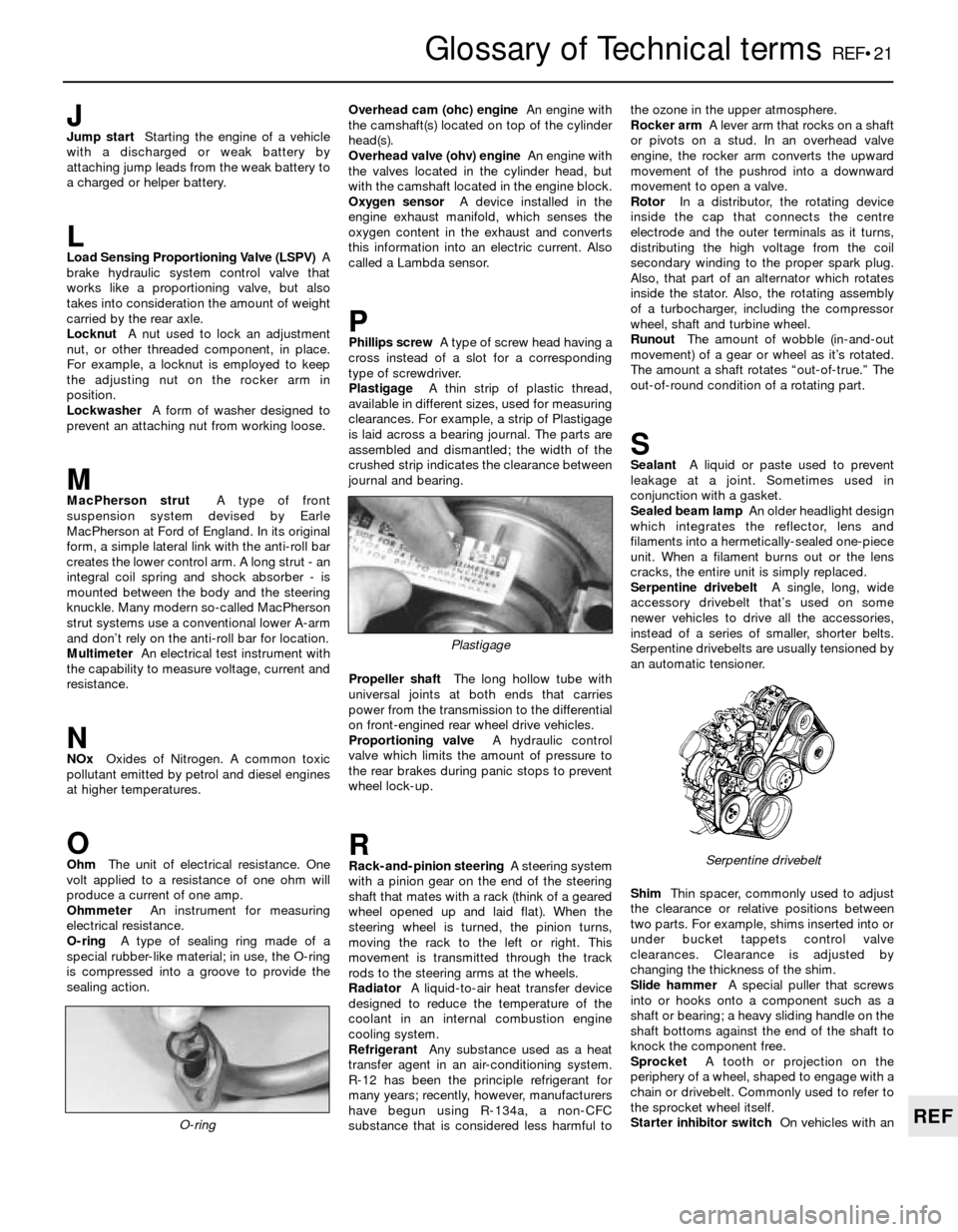
PlastigageA thin strip of plastic thread,
available in different sizes, used for measuring
clearances. For example, a strip of Plastigage
is laid across a bearing journal. The parts are
assembled and dismantled; the width of the
crushed strip indicates the clearance between
journal and bearing.
Propeller shaftThe long hollow tube with
universal joints at both ends that carries
power from the transmission to the differential
on front-engined rear wheel drive vehicles.
Proportioning valveA hydraulic control
valve which limits the amount of pressure to
the rear brakes during panic stops to prevent
wheel lock-up.
RRack-and-pinion steeringA steering system
with a pinion gear on the end of the steering
shaft that mates with a rack (think of a geared
wheel opened up and laid flat). When the
steering wheel is turned, the pinion turns,
moving the rack to the left or right. This
movement is transmitted through the track
rods to the steering arms at the wheels.
RadiatorA liquid-to-air heat transfer device
designed to reduce the temperature of the
coolant in an internal combustion engine
cooling system.
RefrigerantAny substance used as a heat
transfer agent in an air-conditioning system.
R-12 has been the principle refrigerant for
many years; recently, however, manufacturers
have begun using R-134a, a non-CFC
substance that is considered less harmful tothe ozone in the upper atmosphere.
Rocker armA lever arm that rocks on a shaft
or pivots on a stud. In an overhead valve
engine, the rocker arm converts the upward
movement of the pushrod into a downward
movement to open a valve.
RotorIn a distributor, the rotating device
inside the cap that connects the centre
electrode and the outer terminals as it turns,
distributing the high voltage from the coil
secondary winding to the proper spark plug.
Also, that part of an alternator which rotates
inside the stator. Also, the rotating assembly
of a turbocharger, including the compressor
wheel, shaft and turbine wheel.
RunoutThe amount of wobble (in-and-out
movement) of a gear or wheel as it’s rotated.
The amount a shaft rotates “out-of-true.” The
out-of-round condition of a rotating part.
SSealantA liquid or paste used to prevent
leakage at a joint. Sometimes used in
conjunction with a gasket.
Sealed beam lampAn older headlight design
which integrates the reflector, lens and
filaments into a hermetically-sealed one-piece
unit. When a filament burns out or the lens
cracks, the entire unit is simply replaced.
Serpentine drivebeltA single, long, wide
accessory drivebelt that’s used on some
newer vehicles to drive all the accessories,
instead of a series of smaller, shorter belts.
Serpentine drivebelts are usually tensioned by
an automatic tensioner.
ShimThin spacer, commonly used to adjust
the clearance or relative positions between
two parts. For example, shims inserted into or
under bucket tappets control valve
clearances. Clearance is adjusted by
changing the thickness of the shim.
Slide hammerA special puller that screws
into or hooks onto a component such as a
shaft or bearing; a heavy sliding handle on the
shaft bottoms against the end of the shaft to
knock the component free.
SprocketA tooth or projection on the
periphery of a wheel, shaped to engage with a
chain or drivebelt. Commonly used to refer to
the sprocket wheel itself.
Starter inhibitor switchOn vehicles with an
O-ring
Serpentine drivebelt
Plastigage