1983 Citroen CX bleed screw
[x] Cancel search: bleed screwPage 177 of 394

Downloaded from www.Manualslib.com manuals search engine OPERATION NJ MA. 230.00 : 1 i !O,Oi ,V,iC,i< c “ii<, ‘/QC < iOi ,< “,,i!< 0, ii’<
Op. MA. 230.00 7
COOLING SYSTEM
2 4 litre engine fuel injection (Thermostat and heater unit open)
Hat coolant
Cold coolant
Partial view F
1 Rodiotor
2 Electric fon (5)
3 De-aerating pipe
4 Header tank
5 De-aeration chamber
6 Thermostat
7 Heater unit
6 Drain top
9 Thermal switch for fan
0 Bleed screws
Thermast.t open
Page 178 of 394

Downloaded from www.Manualslib.com manuals search engine OPERATION No MA. 230.0 : M k
08 ,ri,y r,i, //I<’ roo/i,ip c, s,w,,.
Op. MA. 230.0 1 FILLING THE WATER SYSTEM
IMPORTANT
: Core must be token to protect alternator from water whenever working on cooling systems fitted close to this unit.
Two operations are involved
- Complete filling i roolir~g c~s~<,v, nvd bvolvr ,,ail ,
- Partial filling I roolir,p ~J~S/IW, oul~* 1
NOTES
Draining the radiator and the engine unit does not involve draining the heater unit.
- De-aeration of the system is only operative when the thermostat is open 1 v,rgiur wnnu J.
I. COMPLETE REFILLING 1. Remove
spare wheel
.
2. Open heater control to fullest extent ( inside
vehicle 1.
3. Unscrew the two bleed screws ( 1 ) and ( 2 ).
Place a tronsporent tube
200 mm in length
over each screw in order to ovoid the escape
of the liquid.
4. Disconnect the heater outlet hose and pour in
approximately 0.6 litre of cooling liquid.
Reconnect tube ( 4).
5. Fill remainder of circuit slowly through the
header tank and close bleed screws I 1) and
( 2) after releasing air
6. Remove transparent tubes ( 3) and close header
tank.
NOTE : To induce primitzg o/pum~,~~~sseri;irrp
o/ circuit I I bar 1 f 14. 5 psi ) may b+ r~i/vrtd:
(11 through overflow orifice ( 5)
I Vehicles -2/ 1976 ).
Page 179 of 394

Downloaded from www.Manualslib.com manuals search engine 2 OPERATION No MA. 230-O : II .h’ 0, fug Ol, I/7‘, rodir,p sys/w1.
b) by replacing the header tank cap with a
flexible rocker-cover union
I V~~/7id<~S 2/ IU7h - ,
7. Run engine at approximately 2000 rpm until
electric fan (5) cut (5) in.
Then let the engine idle for about 10 mins.
Never open header tank cap while electric fan (5)
ore/is in operation.
Do not open bleed-screws ( 1 ) and (2) while engine
is running.
8. After releasing the air. water level should
stabilize in header tank. Level should be checked
when the engine is cold.
9. Fit the rubber covers cm the bleed-screws.
Replace spare wheel.
II. PARTIAL FILLING
Same operations as for total filling except that
the heater unit is not filled by outlet tube ( 3)
to the radiator.
111. FILLING AND DE-AERATING THE AUXILIARY
HEATER UNIT ON CX AMBULANCE VEHICLES
Before connecting the auxiliary heater unit water
system to the main system. the following must
be carried out :
- Fill up the auxiliary heater unit and its hoses
( with heater control open I with 1.6 litres
( 2.8 pts 1 of coolant liquid of the some type
as that used in the main
system.
- Connect all hoses. and tiqhten 011 hose clips.
-Stat engine. and wait for electric fan (5) to
to cut-in ( De-aeration time 1.’
- Check the operation of the auxilioly heater unit.
- WHEN THE ENGINE IS COLD, check the level,
and top up if necessary.
Page 227 of 394
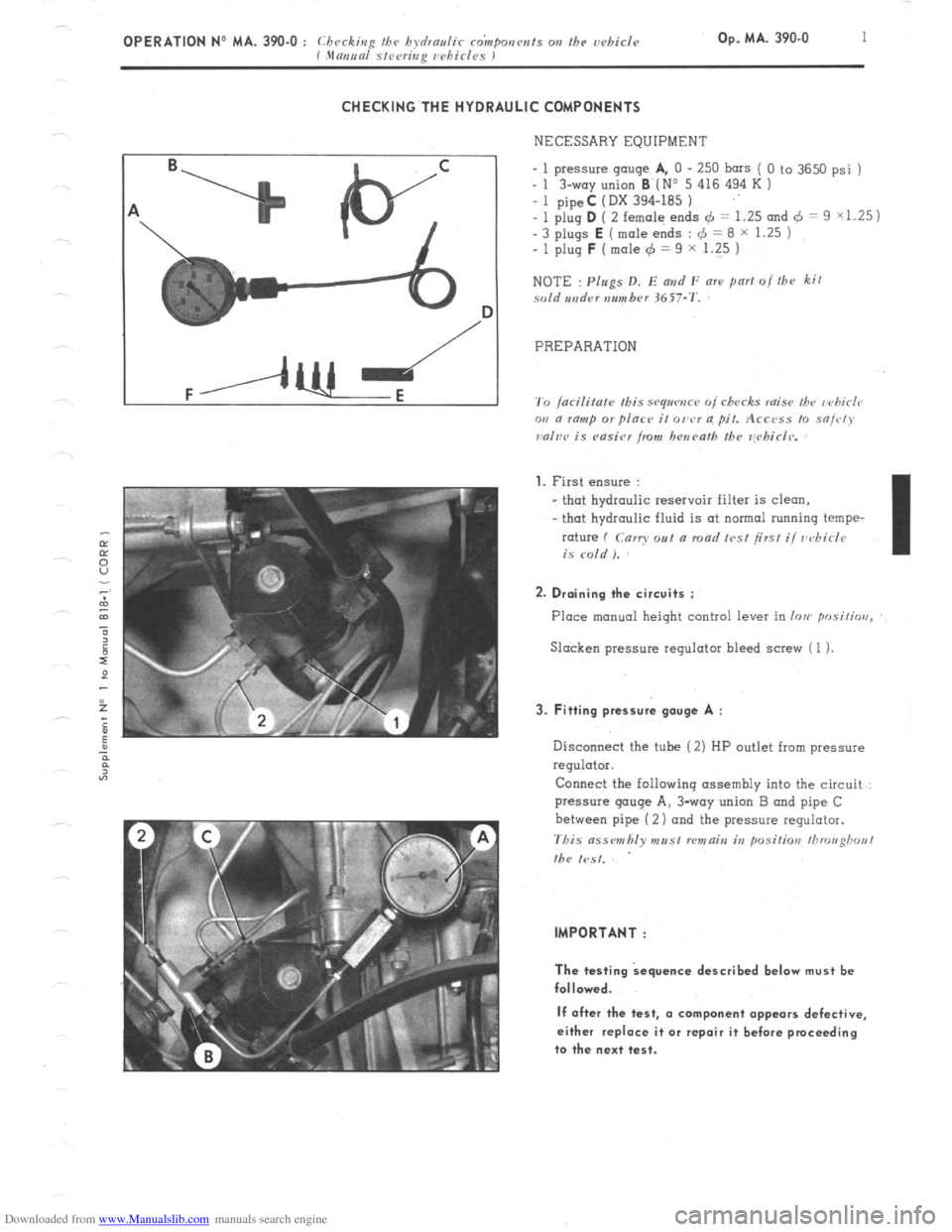
Downloaded from www.Manualslib.com manuals search engine OPERATION No MA. 390-O : ChrckinR thr bydraalir co’mponcnts on the u&i& f Manual stcprine r~ebidos t Op. MA. 390.0 1
CHECKING’THE HYDRAULIC COMPONENTS
NECESSARY EQUIPMENT
- 1 pressure gauge A,
0 - 250 bars ( 0 to 3650 psi )
_ 1 3-way union B (No 5 416 494 K 1
- 1 pipeC (DX 394-185 ) ..
- 1 plug D ( 2 female ends 4 1.25 and 6 9 X1.25) = =
- 3 plugs E (mole ends : r$ 8 X 1.25 ) =
- 1 plug F (
mole 4 = 9 x 1.25 1
NOTE
: Plugs D, E md F are part 01 fhe kit
sold snder number 3657-T.
PREPARATION 1.
First ensure :
- that hydraulic reservoir filter is clean.
- that hydraulic fluid is ot normal running tempe-
rature ( Carry 0~1 a road lent first i/ vt4icie
is
mid ). 8 2. Draining the circuits :
Place manual height control lever in ion, posirios,
Slacken pressure regulator bleed screw ( 1 ). 3. Fitting pressure gouge A :
Disconnect the tube (2) HP outlet from pressure
regulator.
Connect the following assembly into the circuit :
pressure gaoge A, 3way union B and pipe C
between pipe ( 2) and the pressure regulator.
This ass~nzhly mrtst remain in positioa /brougbo~~l
the test. IMPORTANT :
The testing kquance described below must be
followed.
If after the test, a component appears defective,
either replace it or repair it before proceeding
to the next test.
Page 228 of 394

Downloaded from www.Manualslib.com manuals search engine 2 OPERATION No MA. 390-O : Checking the hydra&c conponmts on the.uehicle
f Mnnual sirrrin~ uehicles J CHECKS
4. Checking the main accumulator : a) Disconnect HP inlet pipe ( 1) from safety
valve.
b) Plug HP inlet pipe fusing p[u~s D
and E ). : c ) Tighten pressure regulator bleed screw.
Disconnect contact breaker lead from coil.
Operate storter,watching the pressure g”“ge :
the pressure should rise steadily and then
appear to stobilize.
Note this reading, which is the inflation
pressure of acc”mulator.
This preksure must equal 62 ‘, To
bars
(899 IE,psi) Corned lead of contact breaker
5. Checking cut-out :
a) Checking cut-out ~TPSSU~~~ : Start engine.
With pressure regulator bleed screw tightened,
examine the pressure gauge.
When pressure stops rising, reading indicates
maximum cut-out pressure.
This pressure m”st be equal to
170 t’5 bars
(2466 ?,73 p:i ). When the c”t-o”t pressure is obtained allow
the engine to nrn for a few minutes in order
to stabilize pressure.
Stop engine.
Examine the pressure gauge and note the fall
in pressure for the next 3
minutes. If the fall in’pressure exceeds
10 bark 4 145psi) check seai of plug D and repeat, the test sequence.
If the result of test is the some, the pressure
regulator is defective,
Replace it 01 repair it.
When cutout takes place, slightly slacken
pressure regulator bleed screw.
The pressure should fall gently then rise (IS~.
soon (IS the HP pump begins to operate.
The minimum reading indicated on tbe pressure
gauge corresponds to the cut-in pressure.
This pressure must be 145 +,5 bars
(2103 ?,73
psi ). If these cut-in and cot-out pressures do
not lie within the given tolerances, check the
pressure regulator.
c) Slacken the pressure regulator bleed screw.
d) Remove plug D and connect HP inlet pipe ( 1)
to safety valve.
Page 229 of 394

Downloaded from www.Manualslib.com manuals search engine OPERATION No MA. 390-O : Checkin
P the hydraulic componm~s on the ucbicle Op. MA. 390-O 3
f Mama sleeting wbi&s I
6. Checking the safety valve :
=I
bl
Cl
dl
Remove safety v&e fixing screw ( 1 ).
Remove from safety valve :
supply pipe for front suspension (2 ),
- supply pipe for rem suspension (3):
Plug openings of safety valve ( pIugs E J.
Tighten pressure regulator bleed screw
and
start engine.
Disconnect rubher overflow return pipe and
watch aperture ~a>> of safety valve.
- I/ Iherr is a slight c7moa,,t 0, sHymge thr
sa/cty ~dve is s in good ordrv n.
el
-If thrr~ is a discharge of fluid the sniw
dw must be rqlacrd..
f ) Slacken pressure regulator bleed screw-
Conned overflow return pipe to safety valve.
Secure safety valve ( screw (( 1 a) 1.
7. Checking the safety valve slidevolve :
a) Remove plug from rem suspension outlet on
safety v&e at G b >a.
b ) Disconnect contact breaker lead on coil and
turn engine using stmter : fluid should start
to run through the opening a d N when pressure
reaches
1lLl +o 130 bars ( 1585 to 1885 psi )
c) Slacken pressure regulator bleed screw.
Connect contact breaker lead.
d ) Plug safety valve opening u b )) (plug E ).
8. Checking the hydraulic brake contml :
m ) Tighten pressure regulator bleed screw.
b) Start up engine.
When cut-out takes place wait a fen: seconds
for the pressure to stobilize.
Stop engine%
Watch pressure gauge and note the pressure
drop in the next 3
minutes. If pressure drop
exceeds 10 bors*( 145 psi ) repeat the test.
If the re< is the same. the broke control
valve is defective : change it.
Page 230 of 394

Downloaded from www.Manualslib.com manuals search engine 9. Checking pressure switch (1) : Test procedure is the sctme as for checking
broke control.
Turn engine to obtain cut-out pressure.
Stop engine.
Operate brake pedal until the hydraulic pressure
warning lamp remains on.
Attbat point, read off pressure on pressure gauge.
This should be between 75
and 95 bars ( 1088 ta.
1378 psi 1, inclusive.
If not, change the pressure switch.
10. Checking the Front suspension : Slacken.pressure regulator bleed screw.
Remove plug E and connect front suspension
supply pipe (2 ) to safety valve.
Tighten pressure regulator bleed screw.
Start engine.
Put manual height control in
rronnaf rtmni>rp positim. Wait until the front end of vehicle rises and cut-
out takes place.
Allow pressure to stabilize.
Stop engine.
Examine pressure gauge and note pressure drop
during wperiod of 3
minutes. If it exceeds 10 bars
( 145 psi 1, check once more.
If the result is confirmed check the following
c?mponenG to determine which one is leaking :
either the front corrector
or the suspension cylinders (one or both ).
Testing the 3 components should be carried out by
eliminating each one in turn.
(I) Testing the front height cmwclor : Loosen pressure regulator bleed saew.
Put manual control in
loin position. Disconnect supply pipe (3 ) for front cylinders
from 3-way union (4 ).
Plug tube (3 ) using plug D ( female 1.
Tighten pressure regulator bleed scwe.
Place manual height control in normal running
posiGon:Start engine.
Allow pressure to stabilize.
Stop engine.
Read off pressure drop on pressure qtruqe.
If this drop in pressure is greater than
10 bars (
145 psi ) during a period of 3 minutes, repeat
test. If the result is confirmed, the front height
corrector is defective : change it.
Remove plug and connect pipe (3 ) to 3roy
union
(4 ).
Page 231 of 394

Downloaded from www.Manualslib.com manuals search engine Slacken pressure regulator bleed screw.
Put manual height control in /VII. position
Disconnect front left-hand cylinder supply
pipe ( 1 ) from 3~woy union (2 ).
Plug 3-way union opening using plug E.
Repeat test as described in preceding parograpb.
If the front left suspension cylinder is defective
replace 01 repair it.
Remove plug E.
Fit supply pipe ( 1 ).
If after testing the front height corrector and the
left-hand front suspension cvlinder, the drop in
pressure persists, the front right-hand cylinder
is defective.
Replace or repair it. Il.
Checking the rear suspension :
Slacken pressure regulator bleed screw.
Put manual height control in IOU pnsi!ios,
Remove plug E.
Connect rear suspension supply pipe (?) to
safety valve.
Disconnect rear brake supply pipe (4) from
brake valve.
Plug oriilce of pipe using plug D.
Tighten pressure regulator bleed screw
Place manual height control in aorwnl rrruniug
posilio,,.
Proceed as for test of front suspension.
12. Slacken pressure regulator bleed screw.
Disconnect 3-way union B together with pressure
gauge A and pipe C.
Fit connecting pipe of safety valve to pressure
regulator.
Tighten pressure regulator bleed screw.