1974 CHEVROLET CAMARO heater
[x] Cancel search: heaterPage 26 of 85
Downloaded from www.Manualslib.com manuals search engine INSTRUMENTS AND CONTROLS
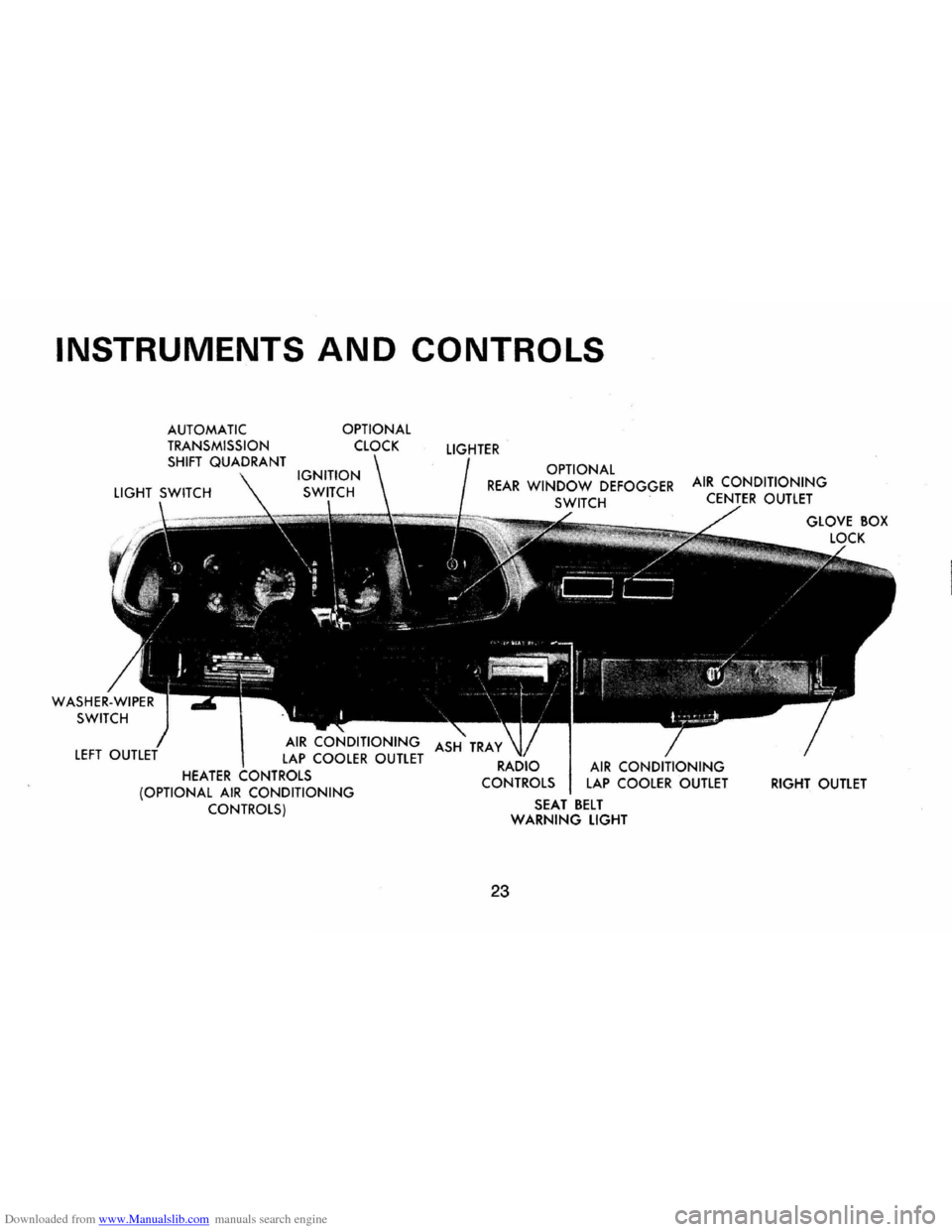
AUTOMATIC TRANSMISSION
SHIFT QUADRANT
HEATER ,-,.., ... ,T,,,,",'
OPTIONAL
CLOCK
(OPTIONAL
AIR CONDITIONING CONTROLS)
LIGHTER
OPTIONAL REAR WINDOW DEFOGGER AIR CONDITIONING SWITCH CENTER OUTLET
ASH TRAY
RADIO
CONTROLS
23
SEAT BELT WARNING LIGHT
GLOVE BOX
RIGHT
OUTLET
Page 33 of 85
Downloaded from www.Manualslib.com manuals search engine Heater
The windshield defrosting and
defogging system assists in provid
ing good visibility through desig
nated areas of the windshield under
most inclement weather conditions.
For immediate operation of the
vehicle, the windshield should be
scraped clear.
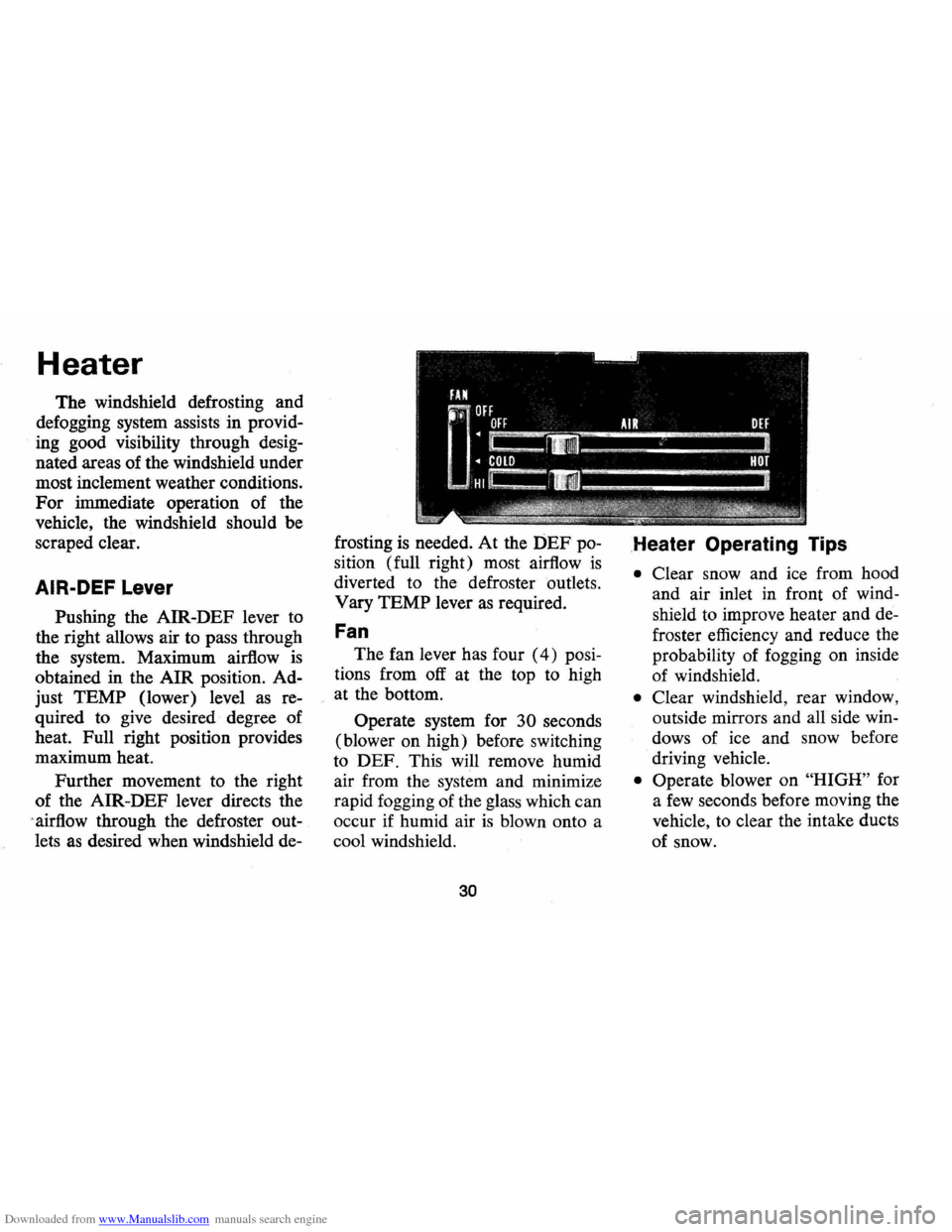
AIR-DEF Lever
Pushing the AIR-DEF lever to
the right allows air to pass through
the system. Maximum airflow
is
obtained in the AIR position. Ad
just
TEMP (lower) level as re
quired to give desired degree of
heat. Full right position provides
maximum heat.
Further movement to the right
of the AIR-DEF lever directs the
'airflow through the defroster out
lets as desired when windshield de-frosting
is needed. At the DEF po
sition (full right) most airflow
is
diverted to the defroster outlets.
Vary
TEMP lever as required.
Fan
The fan lever has four (4) posi
tions from off at the top to high
at the bottom.
Operate system for 30 seconds
(blower on high) before switching
to DEF. This will remove humid
air from the system and minimize
rapid fogging of the glass which can
occur if humid air
is blown onto a
cool windshield.
30
.Heater Operating Tips
• Clear snow and ice from hood
and air inlet in front of wind
shield to improve heater and de
froster efficiency and reduce the
probability of fogging on inside
of windshield.
• Clear windshield, rear window,
outside mirrors and all side win
dows of ice and snow before
driving vehicle.
• Operate blower on "HIGH" for
a
few seconds before moving the
vehicle, to clear the intake ducts
of snow.
Page 34 of 85
Downloaded from www.Manualslib.com manuals search engine • Keep all windows and vents
closed to reduce dust, road and
wind noise and uncomfortable
drafts .
• For most satisfactory heater op
eration and air circulation, oper
ate fan on low or medium speeds
for normal operation and high
speed for quick warm-up and
during extremely low tempera
tures.
• For adequate rear seat heating,
the area beneath the front seat
must not be blocked by carpet
ing, rags, paper
or other mate
rial and fan should operate on
.high blower.
• For additional summer ventila
tion move the
AIR lever to mid
position and the
DEFROSTER
lever to DEE If greater air
flow is desired, move the FAN
lever down to operate the three
speed blower.
Rear Window Defroster
To insure clear vision through
the rear window during
incH:ment
weather, the Rear Window De
froster has become established
as a
popular accessory . This unit draws in
air from the passenger compart
ment and direct s it against the back
window to remove frost or mois
ture. Its blower has a two-speed
control switch on the instrument
panel.
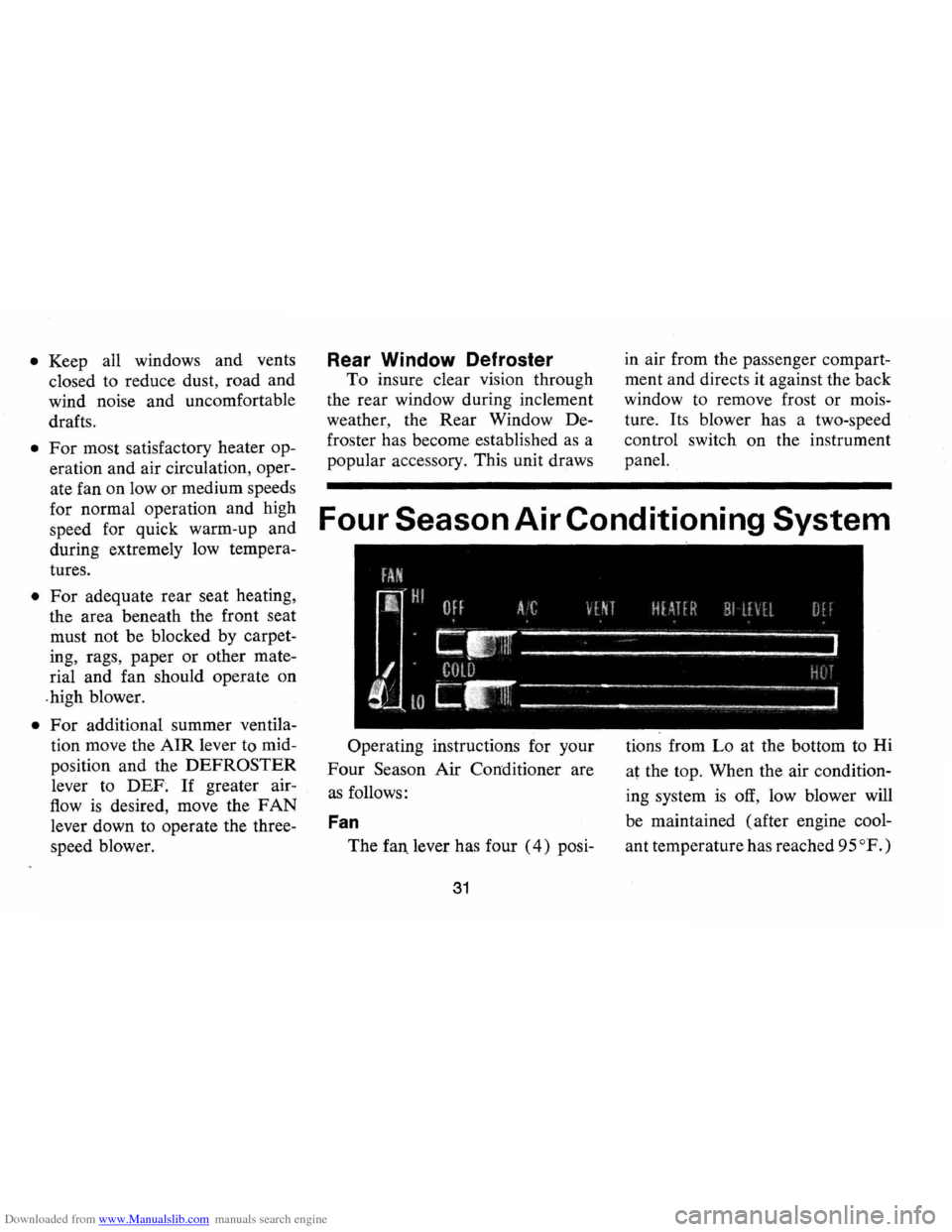
Four Season Air Conditioning System
Operating instructions for your
Four Season Air Conditioner are
as follows:
Fan
The fan. lever has four (4) posi-
31
tions from Lo at the bottom to Hi
at the top. When the air condition
ing system
is off, low blower will
be maintained (after engine cool
ant temperature has reached
95 of.)
Page 35 of 85
Downloaded from www.Manualslib.com manuals search engine no matter which position the fan
switch
is in.
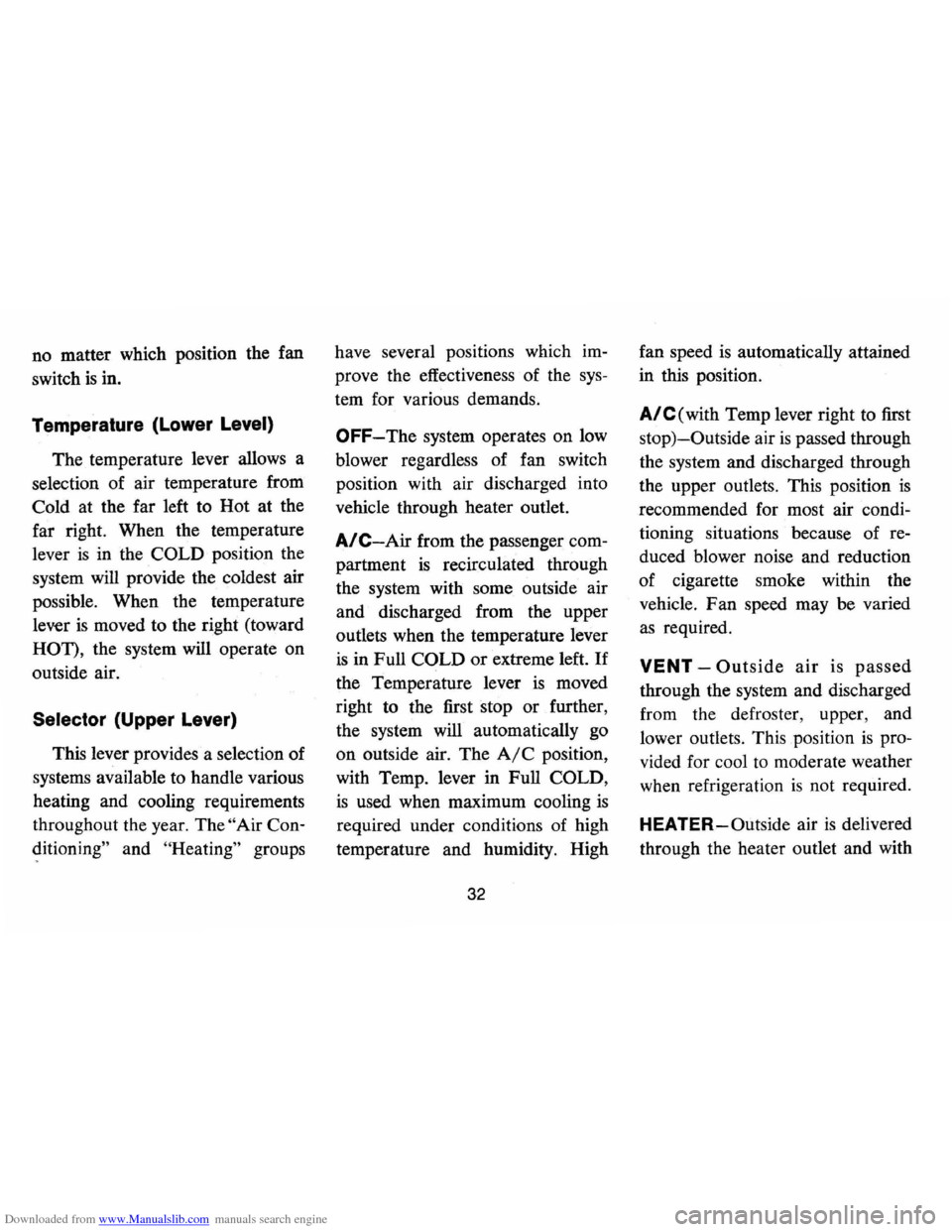
Temperature (Lower Level)
The temperature lever allows a
selection of air temperature from
Cold at the far left to Hot at the
far right. When the temperature
lever
is in the COLD position the
system will provide the coldest air
possible. When the temperature
lever
is moved to the right (toward
HOT), the system will operate on
outside air.
Selector (Upper Lever)
This lever provides a selection of
systems available to handle various
heating and cooling requirements
throughout the year . The
"Air Con
ditioning" and "Heating" groups have
several
posItIons which im
prove the effectiveness of the
sys
tem for various demands.
OFF-The system operates on low
blower regardless of fan switch
position with air discharged into
vehicle through heater outlet.
A/C-Air from the passenger com
partment
is recirculated through
the system with some outside air
and discharged from the upper
outlets when the temperature lever
is in Full COLD or extreme left. If
the Temperature lever is moved
right to the first stop or further,
the system will automatically go
on outside air. The
AIC position,
with Temp. lever in Full
COLD ,
is used when maximum cooling is
required under conditions of high
temperature and humidity. High
32
fan speed is automatically attained
in this position.
AI C (with Temp lever right to first
stop)-Outside air
is passed through
the system and discharged through
the upper outlets. This position
is
recommended for most air condi
tioning situations because of re
duced blower noise and reduction
of cigarette smoke within the
vehicle.
Fan speed may be varied
as required.
VENT -Outside air is passed
through the system and discharged
from the defroster, upper, and
lower outlets. This position
is pro
vided for cool
to moderate weather
when refrigeration
is not required.
HEATER-Outside air is delivered
through the heater outlet and with
Page 36 of 85
Downloaded from www.Manualslib.com manuals search engine some air through defroster outlets.
Temperature may be adjusted
as
required. This position is recom
mended for most winter driving.
BI-LEVEL-Outside air is delivered
from the heater lower outlet and
the defroster duct and upper out
lets to provide comfort and keep
the windshield and side glass clear
under low fogging conditions.
DEF -Outside air is delivered
mainly through the defroster out
lets. Temperature and blower
speeds may be adjusted as required.
This position
is recommended for
conditions of severe fogging and
icing only.
Operating tip: When driving in
,snow , if defrost or defog is not re
quired to keep the windshield from
fogging, it
is recommended that the
"Heater" position be used. This keeps
the windshield cold so that
snow will not stick and melt and
will provide a cleaner view.
Four Season System
Air Outlets
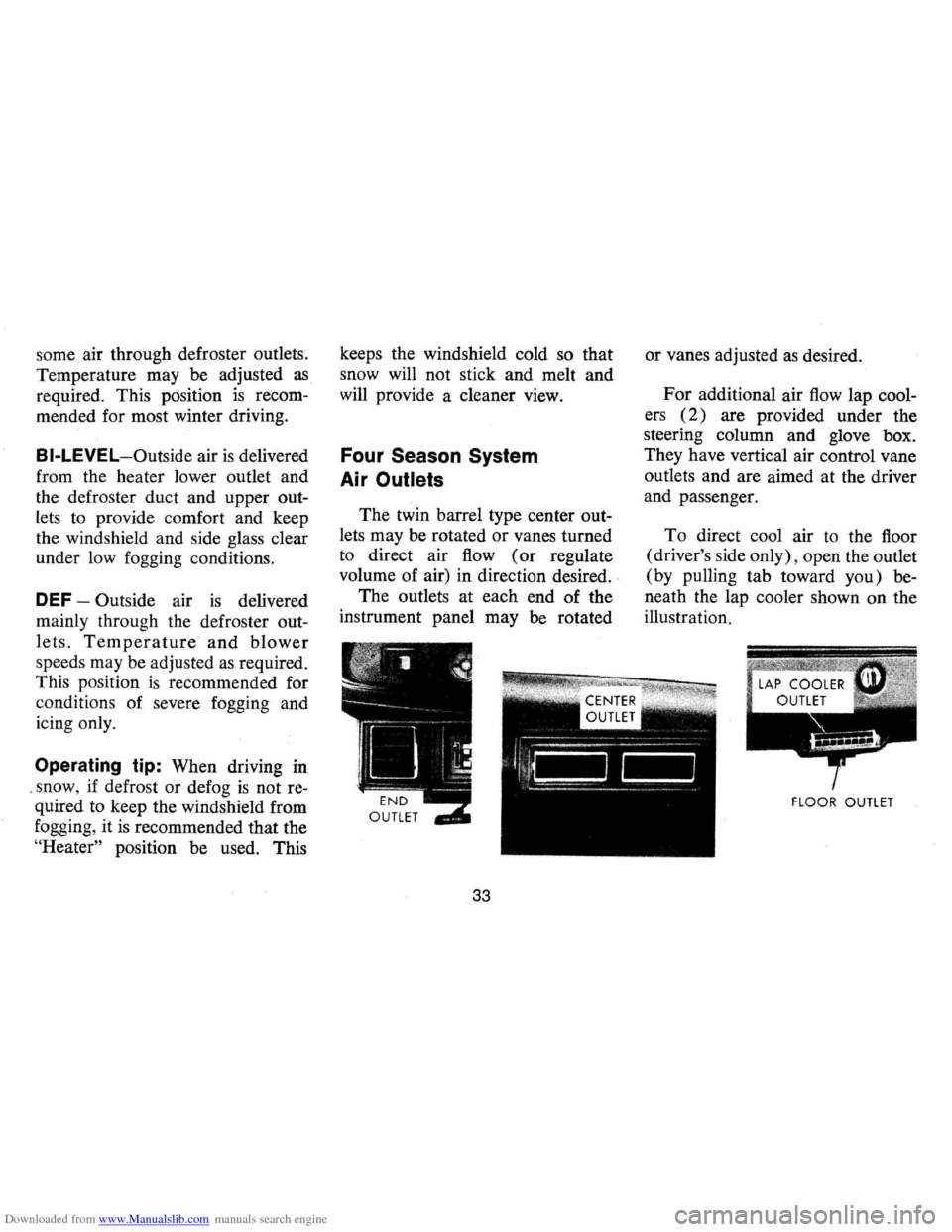
The twin barrel type center out
lets may be rotated or vanes turned
to direct air flow ( or regulate
volume of air) in direction desired.
The outlets at each end of the
instrument panel may be rotated
33
or vanes adjusted as desired.
For additional air flow lap cool
ers
(2) are provided under the
steering column and glove box.
They have vertical air control vane
outlets and are aimed at the driver
and passenger.
To direct cool air to the floor
(driver's side only), open the outlet
(by pulling tab toward you) be
neath the lap cooler shown on the
illustration.
FLOOR OUTLET
Page 41 of 85
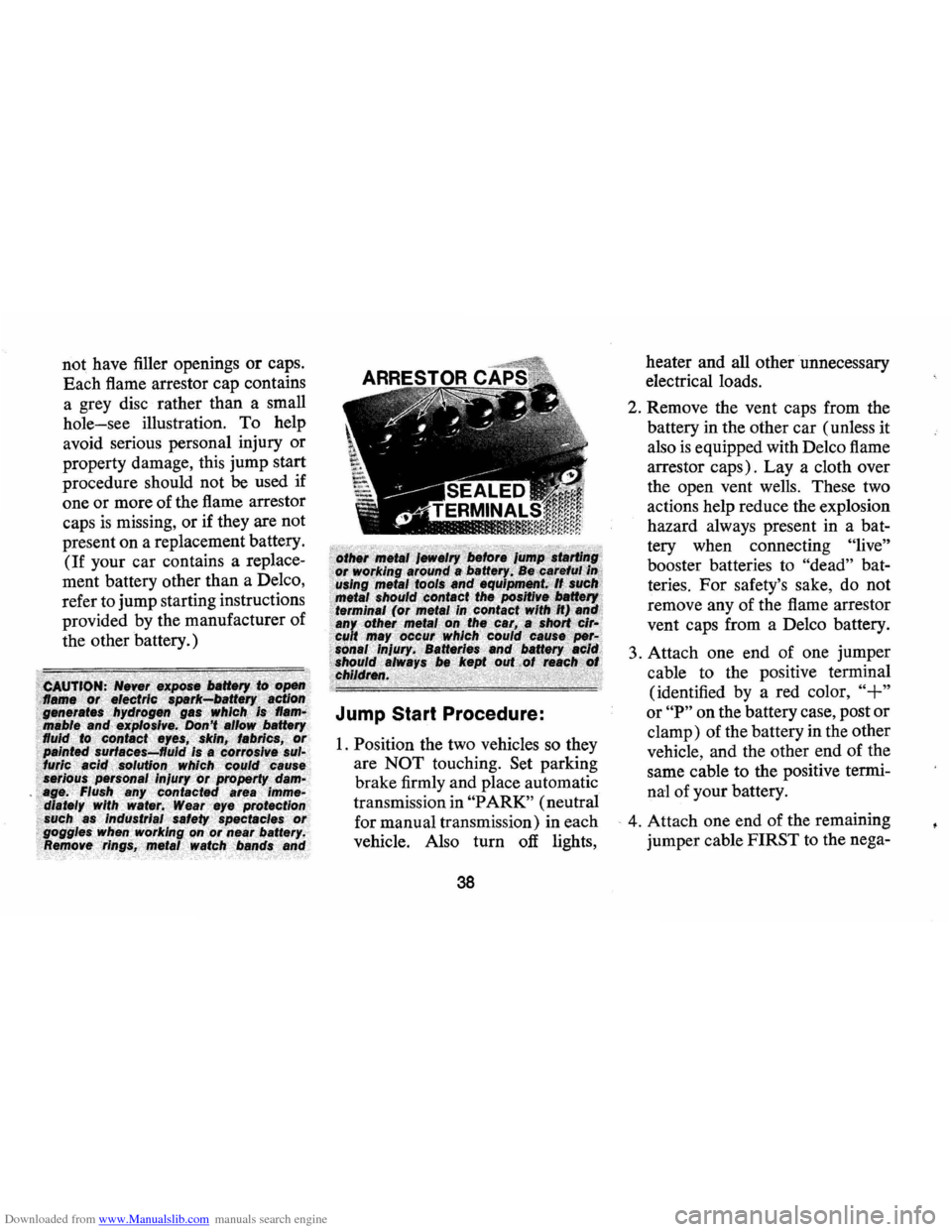
Downloaded from www.Manualslib.com manuals search engine not have filler openings or caps.
Each flame arrestor cap contains
a grey disc rather than a small
hole-see illustration. To help
avoid serious personal injury or
property damage, this jump start
procedure should not
be used if
one or more of the flame arrestor
caps
is missing, or if they are not
present on a replacement battery.
(If your car contains a replace
ment battery other than a Delco,
refer to jump starting instructions
provided by the manufacturer of
the other battery.)
Jump Start Procedure:
1. Position the two vehicles so they
are
NOT touching. Set parking
brake firmly and place automatic
transmission in
"PARK" (neutral
for manual transmission) in each
vehicle. Also turn
off lights,
38
heater and all other unnecessary
electrical loads.
2. Remove the vent caps from the
battery in the other car (unless it
also
is equipped with Delco flame
arrestor caps). Lay a cloth over
the open vent wells. These two
actions help reduce the explosion
hazard always present in a bat
tery when connecting
"live"
booster batteries to "dead" bat
teries.
For safety's sake, do not
remove any of the flame arrestor
vent caps from a Delco battery.
3. Attach one end of one jumper
cable to the positive terminal
(identified by a red color,
"+"
or "P" on the battery case, post or
clamp) of the battery in the other
vehicle, and the other end of the
same cable to the positive termi
nal of your battery.
- 4. Attach one end of the remaining
jumper cable FIRST to the nega-
Page 65 of 85
Downloaded from www.Manualslib.com manuals search engine Inflation Instructions with
Canister
(Inflator)
1. Install deflated Space Saver Spare
on car with valve stem at the bot
tom and tighten all
five lug nuts.
2. Remove valve cap and make sure
valve core
is screwed tight in
valve stem.
3. Remove plastic cap from can
ister.
*
4. Place canister over valve stem
and push squarely onto stem
until gas entering tire can be
heard.
*If temperature is below 20°F,
Canister should be warmed on left hand
defroster outlet for
10 min
utes to provide adequate tire in
flation. Heater should be on de
frost and fan on high.
S. To ensure complete draining of
fluid, hold the canister in posi
tion for one minute after sound
stops. Then remove canister for
disposal in proper receptacle.
6. Replace valve cap.
NOTE: Inflation pressure should
be checked and adjusted to the rec
ommended pressure shown on tire
placard
as soon as possible after
installing tire on car.
Inflation Instructions at a
Service Station
1. Mount wheel on car, or place on
center-post tire changer with
lock-down mechanism engaged.
62
2. If beads have become unseated,
lubricate wheel and beads with
soapy water
or tire mO,unting lub
ricant before inflation .
3.
To seat beads, inflate tire to a
maximum of 35 psi.
4. Adjust inflation to recommended
pressure shown on tire placard.
5.
On assemblies so equipped,
check that dust cover is pressed
firmly into un threaded relief stem
before road use.
Deflation Instructions
Remove valve core using slotted
end of valve cap.
Flatten tire and replace core and
cap. Store tire in trunk compart
ment.
Page 76 of 85
Downloaded from www.Manualslib.com manuals search engine FUSES AND CIRCUIT BREAKER:
The head lamp circuit s are protected by a circuit breaker in the light switch.
An electrical overload on the breaker will cause the lamps to go on and off, or
in some cases to remain off. If this condition develops, have your wiring circuits checked immediately.
Fuses, located in the Junction Block beneath the dash on the driver's side are:
Radio, T.S.C. Sol. Rear Defogger Glove Box Lamp, Hydra·Matic Downshift ...
Wiper ..
.10 Amp.
... 25 Amp.
Stop and Hazard Warning Lamps. . . . . . ... . ........ 20 Amp.
Dir. Sig., B/U Lamps........... ............. ... .. . ... 20 Amp.
Heater, A /C .... . .25 Amp.
Inst. Lamps, Anti-Diesel Relay............. ....... . .. 4 Amp.
Gauges, Warning Lamps ......................... 10 Amp.
Clock, Lighter, Courtesy, Dome and Luggage Lamps. . .20 Amp.
Taii, License, Sidemarker and Parking Lamps ... ..... 20 Amp.
An Air Conditioning high blower speed fuse, 30 amp. is located in an
In-line fuse holder running from junction block to Air Conditioning relay.
Do not use fuses of higher amperage rating than those recommended above.
Fusible Links are incorporated into the wiring system. These are wires of such a gauge that they will fuse (or melt) before damage occurs to an entire
wiring harness in the event of an electrical overload. See your Chevrolet Dealer if fusible link replacement becomes necessary.
73
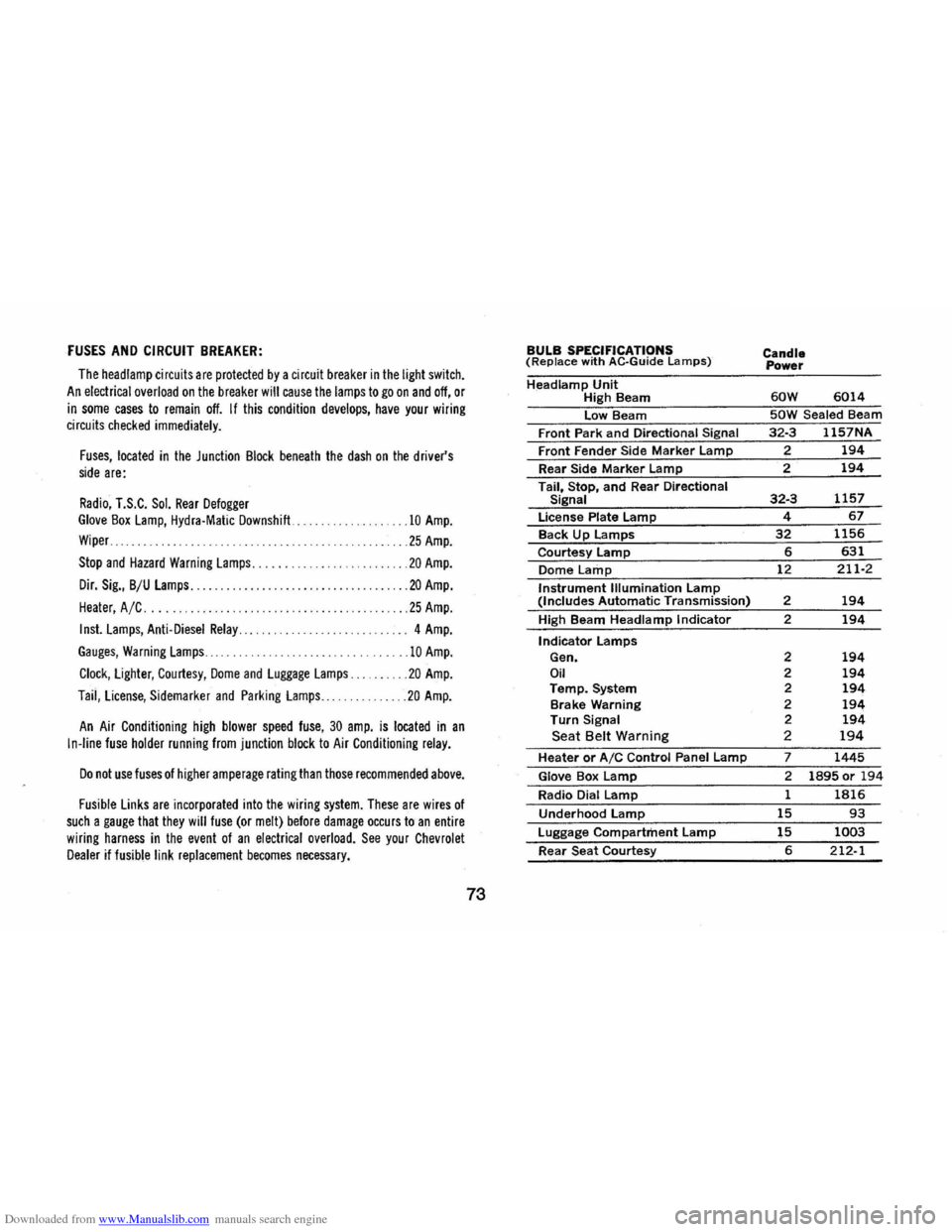
BULB SPECIFICATIONS (Replace with AC·Guide Lamps)
Headlamp Unit High Beam
low Beam
Front Park
and Directional Signal
Front Fender Side Marker lamp
Rear Side Marker lamp
Tail, Stop, and Rear Directional Signal
license Plate lamp
Back Up lamps
Courtesy lamp
Dome Lamp
Instrument Illumination lamp (Includes Automatic Transmission)
High Beam
Headlamp Indicator
Indicator lamps Gen. Oil Temp. System
Brake Warning
Turn Signal Seat Belt Warning
Heater or AIC Control Panel lamp
Glove Box lamp
Radio Dial lamp
Underhood lamp
luggage Compartment lamp
Rear Seat Courtesy
Candle
Power
60W 6014
50W Sealed Beam
32·3 1157NA
? 194
2 194
32·3 1157
4 67
32 1156
6 631
12 211·2
2 194
2 194
2 194 2 194 2 194 2 194 2 194 2 194
7 1445
2 1895 or 194
1 1816
15 93
15 1003
6 212-1