1973 CHEVROLET MONTE CARLO heating
[x] Cancel search: heatingPage 16 of 86
Downloaded from www.Manualslib.com manuals search engine STARTING AND OPERATING
Engine Exhaust Gas Caution (Carbon Monoxide)
Allold inhaling exhaust gases because
they contain carbon monoxide, which by
Itsell is colorless and odorless. Carbon
monoxide is a dangerous gas that can cause unconsciousness and is potentially
lethal.
II at any time you suspect that exhaust fumes are entering the passenger compartment, have the cause determined and corrected as soon as possible. II you must
drive under these conditions, drive only
with
all windows fully open.
The best protection against carbon
monoxide entry into the car body is a properly
maintained exhaust system, car body and body ventilation system. It is recommended that the exhaust system and body
be inspected by a competent mechanic:
• Each time the IIehicie is raised for oil change. > •
Wheneller a change
is noticed In the
sound of the exhaust system.
• Wheneller the exhaust system, under
body or rear of the vehicle is damaged.
See your Maintenance Schedule folder
for inspection procedure.
To allow proper operation of the car's
IIentilation system, keep front ventilation
inlet
grille clear of snow, leaves or other obstruction at all times.
SITTING IN A PARKED CAR WITH
ENGINE RUNNING FOR AN EXTENDED PERIOD IS NOT RECOMMENDED.
Do
not run engine in confined areas such as garages any more than needed to mOlle IIehicle In or out of area. When IIehlcle is stopped In an UNCONFINED area with the engine running for any more than a short period, adJust heating or cooling system to force outside air Into car as follows:
14
1. On cars not equipped with air condi
tioning, set fan to medium or high
speed and upper control leller to any
position except OFF.
2. On cars equipped with manual air conditioning, set fan to medium or high speed, upper control lever to any
position except OFF, and lower control lever to any position except extreme left COLD.
The trunk lid should be closed while
drilling to help prellent inadllertently drawIng exhaust gases Into the car. If Is unwise to drive at high speeds for long durations
with the trunk lid open. Howeller, If lor some reason the trunk must remain open lor a period while mOiling, or electrical wiring or other cable connections to a trailer must pass through the seal between
trunk lid and body, the lol/owlng precau
tions should be observed:
• Close all windows.
• Ad/ust heating or cooling system to
force outside air into car as described In items 1 and 2 abolle but with Ian set at high speed.
• On cars equipped with outside aIr IIents In or under Instrument panel, open IIents lully.
Page 24 of 86
Downloaded from www.Manualslib.com manuals search engine your foot from the accelerator.
If control button is not fully de
pressed, when changing speed
setting,
. the car will resume your
previously selected speed.
To disengage system, lightly de
press brake pedal or fully de
press the control button.
Horn
The hom on your Monte Carlo
is actuated · by firmly pressing on
the pad in the center of the steering
wheel. As a good motorist, use of the
horn should be kept at a minimum.
However, acquaint yourself
as soon
as possible with this function of
your car, should it ever become
necessary to give a warning to a
pedestrian
or another motorist.
Holding Car on an Upgrade
When stopped on an upgrade,
maintain your position by apply
ing the brakes. Never hold the
car in place by accelerating en-gine
with transmission in gear.
This could cause damage by over
heating the transmission (auto
matic)
or clutch (manual).
Parking Your Car
Always engage the parking
brake and place the automatic
transmission selector lever in
"Park" position when leaving your
car unattended. Also with auto
matic transmissions, never park
for prolonged periods with engine
idling and transmission in gear,
especially if your car
is equipped
with air conditioning. This prac
tice
is detrimental to the trans
mission, due to overheating.
NOTE: For operation of hazard flasher, see page 41, in Section "In Case of Emergency."
22
Page 29 of 86
Downloaded from www.Manualslib.com manuals search engine Generator Indicator Light
This light provides a quick
check on the generating system
of your car. The red light will
go on when the ignition key
is
in the "on" position, but before
the engine
is started. After the
engine starts, the light should go
out and remain out.
If the light
remains on when engine
is run
ning , have your Authorized Chev
rolet Dealer locate and correct
the trouble
as soon as possible.
Engine Temperature
Indicator Light
This indicator light is provided
in the
instrument cluster to
quickly warn of an overheated
engine. With the ignition switch
in the
START position, the red
TEMP indicator will light to let
you know that it
is operating
properly. When the engine
is started, the red
light will go out immediately.
It will light up at no other time
unless for some reason the engine
reaches a dangerously high oper
ating temperature.
If the red light
should come on, the engine must
be stopped until the cause of the
overheating
is corrected. Glance
at instrument cluster frequently
as
you drive to see if this light is on.
Brake System Warning Light
The service brake system is
designed so that half of the brake
system will provide some braking
action in the event of a hydraulic
leak in the other half of the
sys
tem. If the warning light located
below the fuel gauge glows con
tinuously when the ignition
is on
and after the brakes have been
firmly applied, it may indicate that
there
is a malfunction in one half
of the brake hydraulic system.
27
• As a check on bulb condition
the light should glow with the
parking brake applied and the
ignition on. (Light
is also a
reminder to release parking
brake) .
• Have system repaired if light
does not come on during check.
• This warning light is not a sub
stitute for the visual check of
brake fluid level required
as
part of normal maintenance.
If the light glows red:
• The parking brake control is not
fully released or,
• The service brake system is
partially inoperative
What to do:
1. Check that the parking brake
is released. If it is ...
2. Pull off the road and stop,
carefully- remembering that:
Page 35 of 86
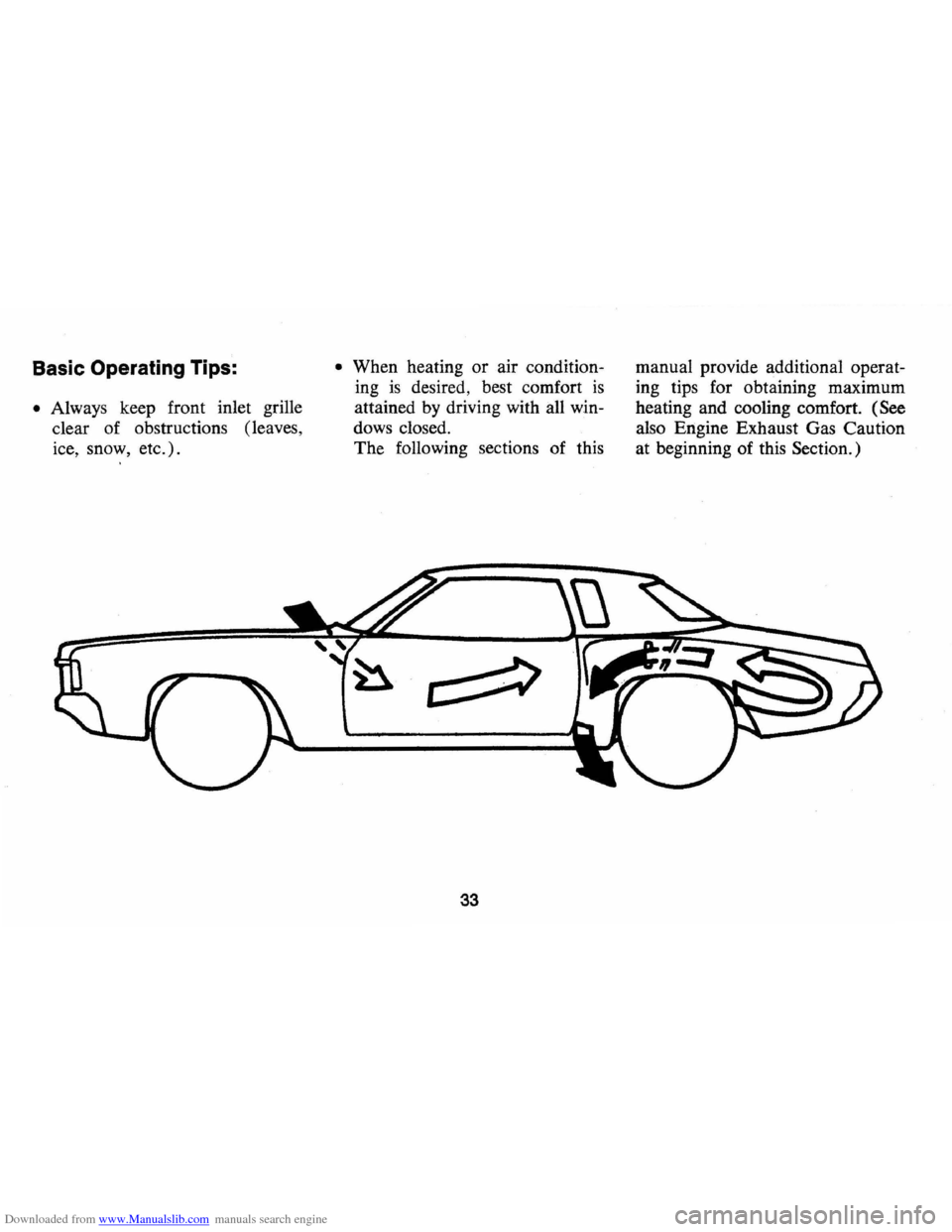
Downloaded from www.Manualslib.com manuals search engine Basic Operating Tips:
• Always keep front inlet grille
clear of obstructions (leaves,
ice, snow, etc.).
• When heating or air condition
ing
is desired, best comfort is
attained by driving with all win
dows closed.
The following sections of this
33
manual provide additional operat
ing tips for obtaining maximum
heating and cooling comfort.
(See
also Engine Exhaust Gas Caution
at beginning of this
Section.)
Page 37 of 86
Downloaded from www.Manualslib.com manuals search engine • Operate blower on "HIGH" for
a
few seconds before moving the
vehicle, to clear the intake ducts
of snow.
• Keep all windows and vents
closed to reduce dust, road and
wind noise and uncomfortable
drafts.
• For most satisfactory heater op
eration and air circulation, op
erate fan on low
or medium
speeds for normal operation and
high speed for quick warm-up
and during extremely low temp
eratures.
• For adequate rear seat heating,
the area beneath the front seat
must not be blocked
by carpet
ing, rags, paper or other ma
terial and fan should operate on
high blower.
Rear Window Defroster
To ensure clear vision through
the rear window during inclement weather,
the Rear Window De
froster
is optionally available. This
unit draws
in air from the pas
senger compartment and directs it against
the back window to remove
frost or moisture. Its blower has a
two-speed control switch on the
instrument panel.
Four Season Air Conditioning System
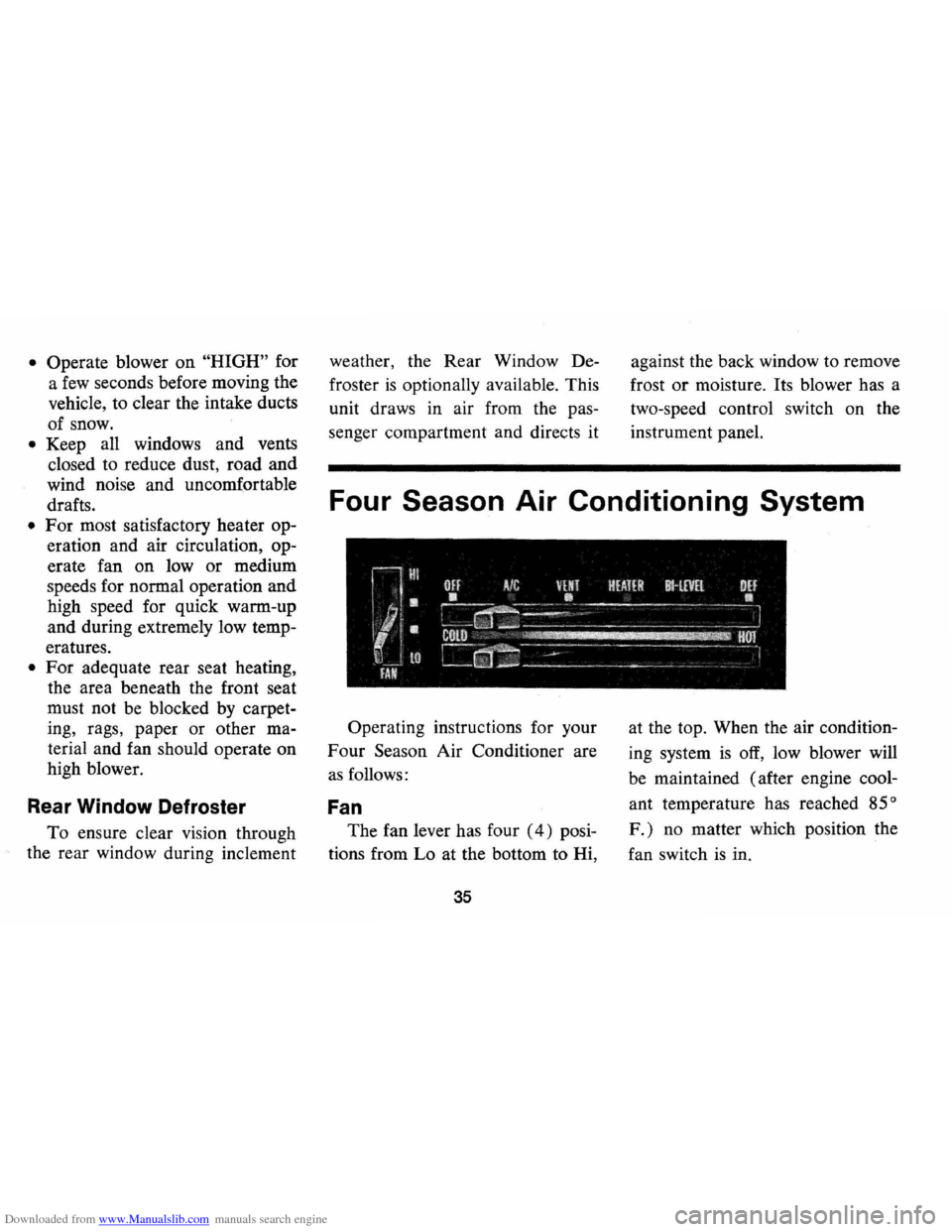
Operating instructions for your
Four Season Air Conditioner are
as follows:
Fan
The fan lever has four (4) posi
tions from Lo at the bottom to Hi,
35
at the top. When the air condition
ing system
is off, low blower will
be maintained (after engine cool
ant temperature has reached
85°
F.) no matter which position the
fan switch
is in.
Page 38 of 86
Downloaded from www.Manualslib.com manuals search engine Temperature (Lower Lever)
The temperature lever allows a
selection of air temperature from
Cold at the far left to Hot
at the far
right. When the temperature lever
is in the COLD position the system
will provide the coldest air possible.
When the temperature lever
is
moved to the right (toward HOT) ,
the system will operate on outside
air.
Selector (Upper Lever)
This lever provides a selection of
systems available to handle various
heating and cooling requirements
throughout the year. The Selector
lever has four
(4) major opera
tional
positions-"Off," "Air Condi
tioning," "Vent" and "Heating."
The "Air Conditioning" and "Heat
ing"
groups have several positions
which improve the effectiveness of the
system for various demands.
OFF-The system operates on low
blower regardless of fan switch po
sition with air discharged into
ve
hicle through heater outlet.
A/C-Air from the passenger com
partment
is recirculated through
the system with some outside air
and discharged from the upper out
lets when the temperature lever
is
in Full COLD or extreme left. If
the Temperature lever is moved
right to the first stop or further, the
system will automatically go on
outside air. The
AIC position, with
Temp. lever in Full
COLD, is used
when maximum cooling
is required
under conditions of high tempera
ture and humidity. High fan speed
is automatically attained in this
position .
36
A/C (with Temp lever right to first
stop) -Outside air
is passed
through the system and discharged
through the upper outlets. This po
sition
is recommended for most air
conditioning situations because of
reduced blower noise and reduction
of cigarette smdke within the
ve
hicle. Fan speed may be varied as
required.
VENT -Outside air is passed
through the system and discharged
from the upper and lower outlets.
This position
is provided for cool
to moderate weather when refrig
eration
is not required.
HEATER-Outside air
is delivered
through the heater outlet and with
some air through the defroster out
lets. Temperature may be adjusted
as required. This position is recom-
Page 62 of 86

Downloaded from www.Manualslib.com manuals search engine • Maintain cooling system freeze
protection at
.;...200 F or below
to ensure protection against
corrosion and loss of coolant
from boiling , even though freez
ing temperatures are not
ex
pected.
• Add ethylene glycol base cool
ant that meets GM Specification
1899-M when coolant additions
are required because of coolant
loss or to provide additional
protection against freezing at
temperatures lower than
_200 F
(_320 F in Canada).
NOTE: Alcohol or methanol base
coolants or plain water are not
recommended for your Monte
Carlo at any time.
Radiator Pressure Cap
The radiator cap, a 15 lb. pres
sure type, must be installed tightly,
otherwise coolant may be lost and
damage to engine may result from
overheating. Radiator pressure caps
should be checked periodically for
proper operation.
If replacement is
required specify AC.
Thermostat
The cooling system is protected
and controlled by a thermostat in
stalled in the engine coolant outlet
to maintain a satisfactory operating
temperature of the engine. This
thermostat
is designed for continu
ous use through both winter and
summer and need not be changed
seasonally . When replacement
is
necessary, Delco parts are recom
mended.
60
Tires
The factory installed tires on
your car
as shown on the following
Tire Usage chart are designed to
provide the best all around per
formance for normal vehicle op
eration. When inflated
as recom
mended on the tire pressure plac
ard, located on the left door of
your vehicle, they have the load
carrying capacity to operate satis
factorily at all normal highway
speeds.
Tire Care
Tires should be checked regu
larly for proper inflation pressure,
wear, and damage. The following
information will assist you in prop
erly caring for your tires:
Page 73 of 86
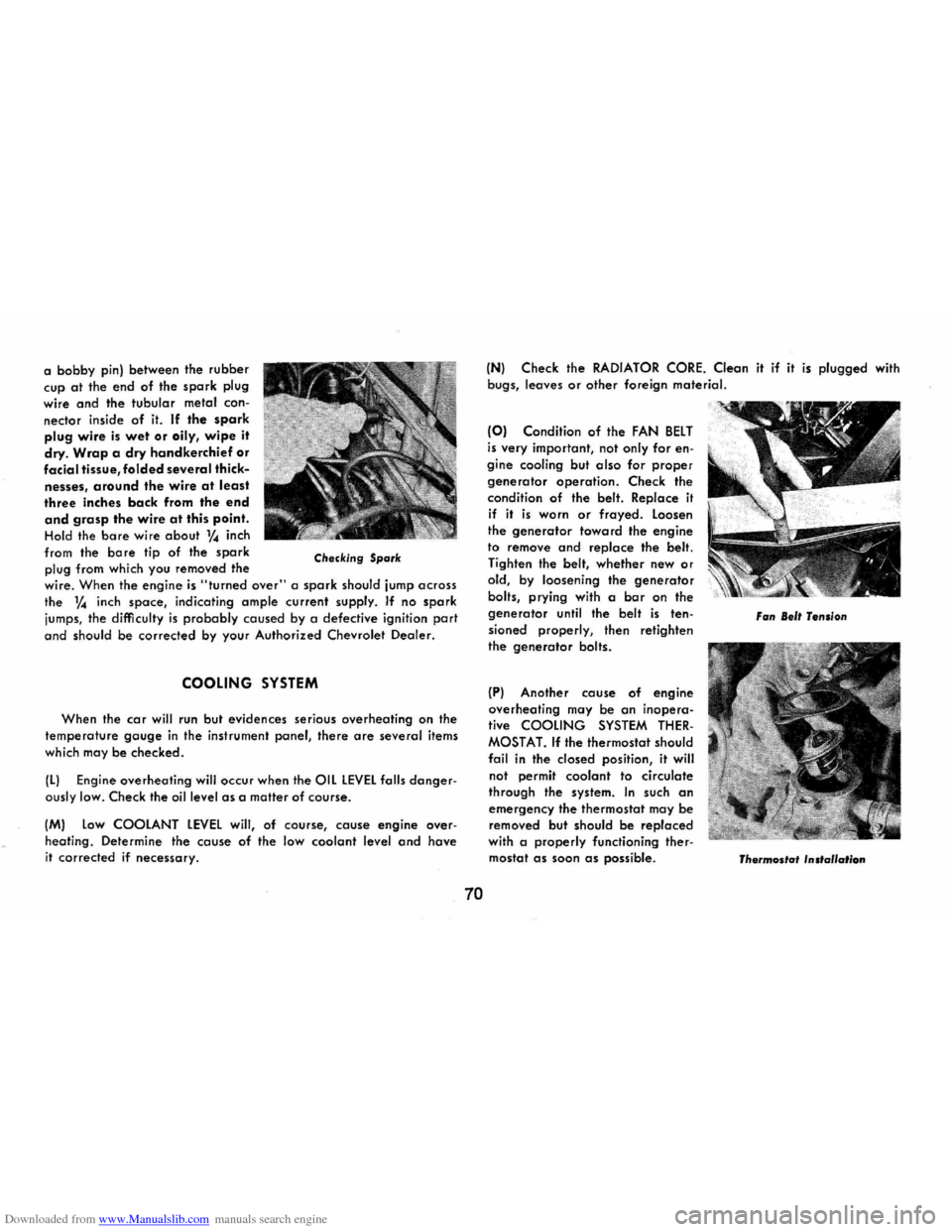
Downloaded from www.Manualslib.com manuals search engine a bobby pin) between the rubber
cup
at the end of the spark plug
wire
and the tubular metal con
nector inside
of it. If the spark plug wire is wet or oily, wipe it
dry.
Wrap a dry handkerchief or
facial tissue, folded several thick
nesses,
around the wire at least
three inches back from the end and grasp the wire at this point.
Hold the bare wire about V4 inch
from the
bore tip of the spark plug from which you removed the Checking Spark
wire. When the engine is "turned over" a spark should jump across
the 1,4 inch space, indicating ample current supply. If no spark
jumps, the difficulty is probably caused by a defective ignition part
and should be corrected by your Authorized Chevrolet Dealer.
COOLING SYSTEM
When the car will run but evidences serious overheating on the
temperature gauge in the instrument panel, there are several items
which may
be checked.
IL) Engine overheating will occur when the OIL LEVEL falls danger
ously low. Check the oil level as a mailer of course.
1M) Low COOLANT LEVEL will, of course, cause engine over
heating . Determine the
cause of the low coolant level and have it corrected if necessary.
70
IN) Check the RADIATOR CORE. Clean it if it is plugged with
bugs, leaves or other foreign material.
(0) Condition of the FAN BELT
is very important, not only for en
gine cooling but
also for proper
generator operation. Check the
condition of the belt. Replace it
if it is worn or frayed. Loosen
the generator toward the engine
to remove
and replace the belt.
Tighten the belt, whether new or
old, by loosening the generator
bolts, prying with a bar on the
generator until the belt is ten
sioned properly , then retighten
the
generator bolts.
(P) Another couse of engine
overheating may be
an inopera
tive
COOLING SYSTEM THER
MOSTAT. If the thermostat should
foil in the dosed position, it will
not permit
coolant to circulate
through the system. In such an
emergency the thermostat may be
removed but should be
replaced with a properly functioning ther
mostat as soon as possible.
Fan Belt Tension
Thermostat
'ns'alla"on