1973 CHEVROLET MONTE CARLO checking oil
[x] Cancel search: checking oilPage 54 of 86
Downloaded from www.Manualslib.com manuals search engine SE oils and quality oil filters. Oil
change intervals longer than those
listed above will seriously reduce
engine life and may affect Chevro
let's obligation under the provisions
of the New Vehicle Warranty.
A high quality
SE oil was in
stalled in your engine at the factory.
It is not necessary to change this
facory-installed oil prior
to the rec
ommended normal change period.
However, check the oil level more
NOTE: Non-detergent and other
low quality oils are specifically not
recommended.
Only the use of SE
engine oils and proper oil and filter
change intervals assure you of con
tinued proper lubrication of your
Chevrolet engine.
frequently during the break-in pe
riod since higher oil consumption
is normal until the piston rings be
come seated.
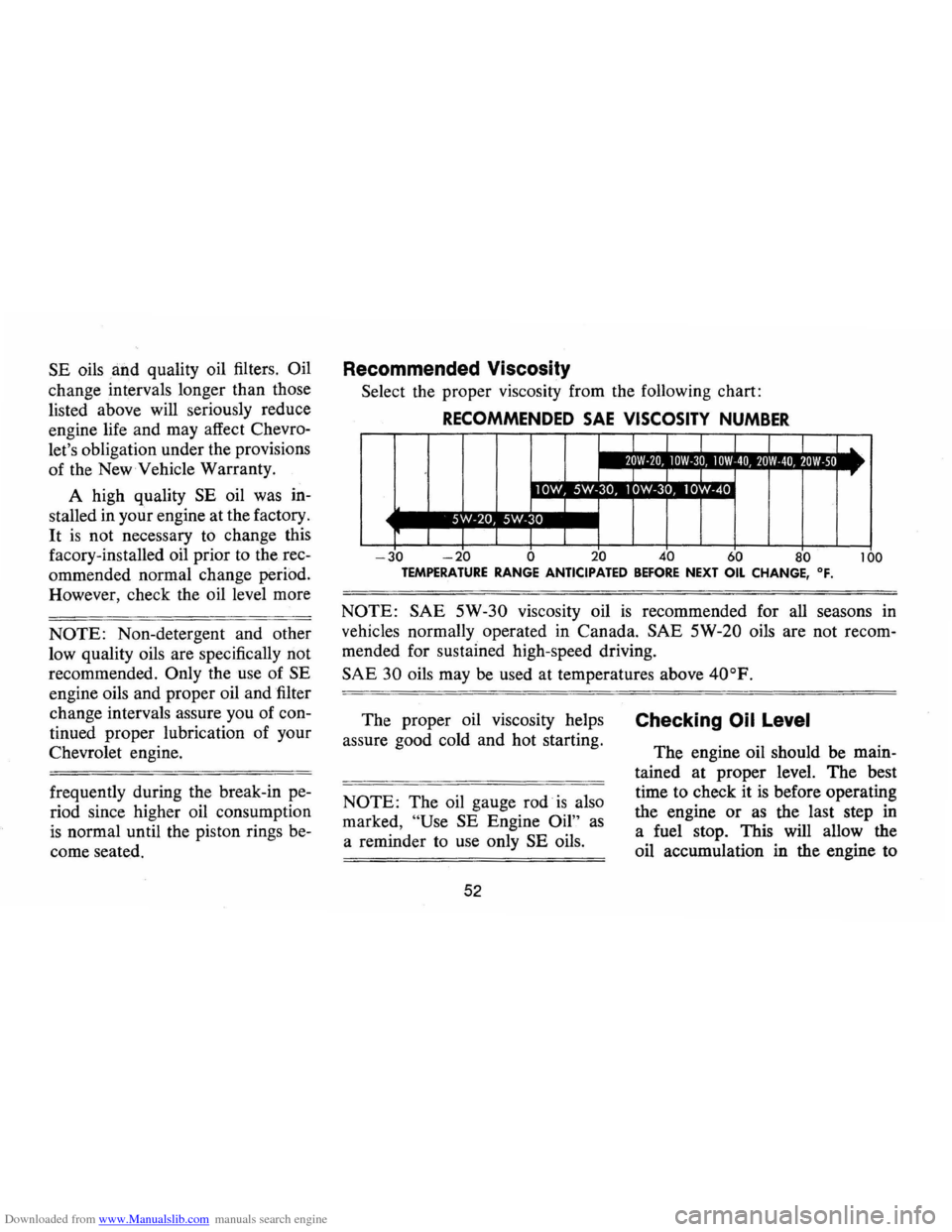
Recommended Viscosity
Select the proper viscosity from the following chart:
RECOMMENDED SAE VISCOSITY NUMBER
I ,.
.... ~.-."'). ... .II ••• :.; I
-30 -20 0 20 40 60 80 100 TEMPERATURE RANGE ANTICIPATED BEFORE NEXT OIL CHANGE, OF.
NOTE: SAE 5W-30 viscosity oil is recommended for all seasons in
vehicles normally operated in Canada.
SAE 5W-20 oils are not recom
mended for sustained high-speed driving.
SAE 30 oils may be used at temperatures above 40oP.
The proper oil viscosity helps
assure good cold and hot starting.
NOTE: The oil gauge rod is also
marked,
"Use SE Engine Oil" as
a reminder to use only SE oils.
52
Checking Oil Level
The engine oil should be main
tained at proper level. The best
time to check it
is before operating
the engine or
as the last step in
a fuel stop. This will allow the
oil accumulation in the engine to
Page 71 of 86
Downloaded from www.Manualslib.com manuals search engine The chart on the previous page, and the information on the pages which follow, contains information designed to aid the average driver to discover, and possibly correct, conditions resulting in minor
mechanical difficulties in his cor. The chart, designed to point out
possible solutions to several of the most common automotive malfunctions and point out a logical checking sequence, will lead step by step to the most likely causes and corrective procedures. If, after making the checks and adjustments suggested,' the source of the
trouble has not been found and corrected, it is strongly recommended that an Authorized Chevrolet Dealer inspect the vehicle and make whatever repairs or adjustments are necessary.
FUEL SYSTEM AND ENGINE
If the ignition switch will cause the engine to "turn over" or "crank" but the cor will not start,
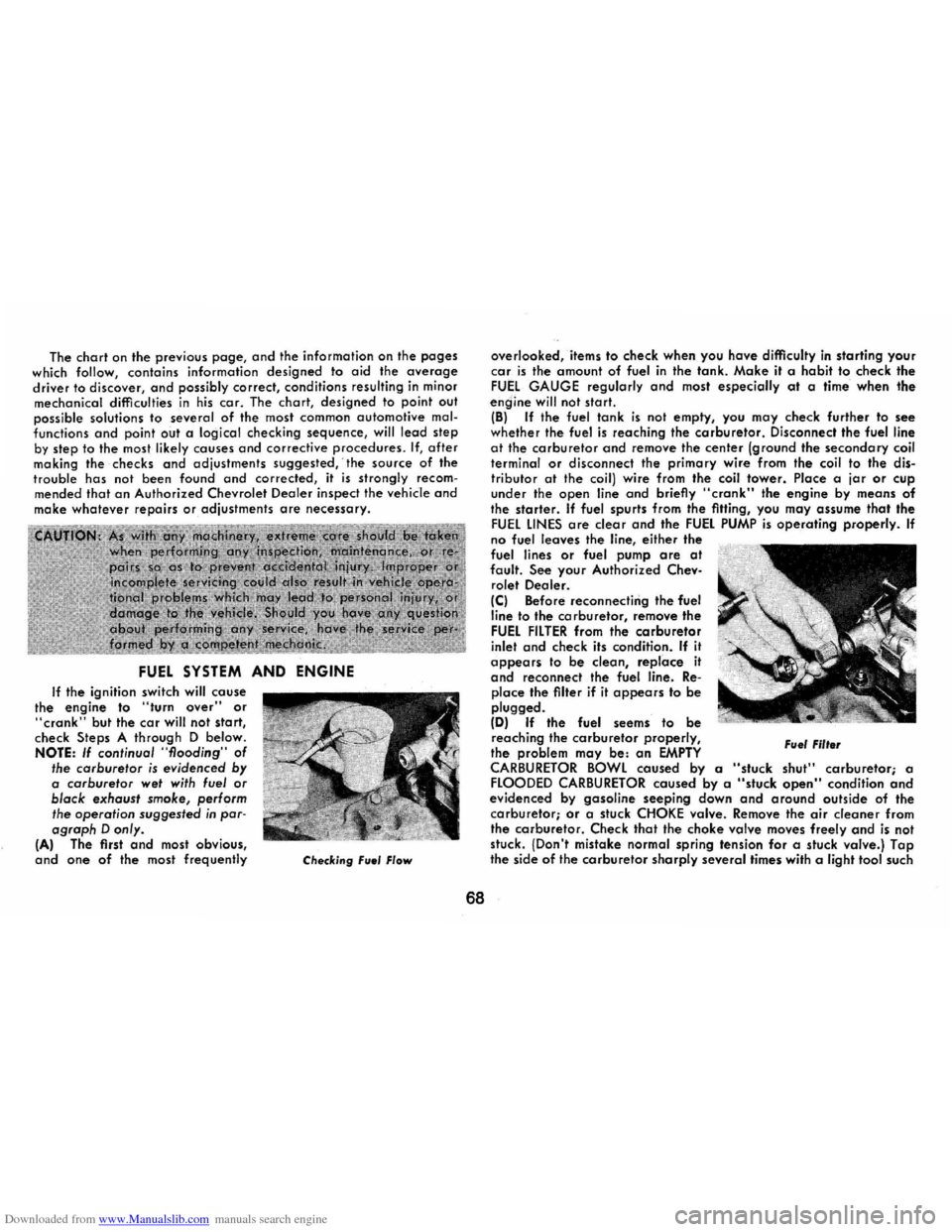
check Steps A through D below. NOTE: If continual "f1ooding" of the carburetor is evidenced by a carburetor wet with fuel or black exhaust smoke, perform the operation suggested in paragraph 0 only. (A) The first and most obvious, and one of the most frequently Checlcing Fuel Flow
68
overlooked, items to check when you have difficulty in starting your car is the amount of fuel in the tank. Make it a habit to check the FUEL GAUGE regularly and most especially at a time' when the engine will not start. (B) If the fuel tank is not empty, you may check further to see whether the fuel is reaching the carburetor_ Disconnect the fuel line at the carburetor and remove the center (ground the secondary coil
terminal or disconnect the primary wire from the coil to the distributor at the coil) wire from the coil tower. Place a jar or cup under the open line and briefly "crank" the engine by means of the starter. If fuel spurts from the fitting, you may assume that the FUEL LINES are clear and the FUEL PUMP is operating properly. If no fuel leaves the line, either the
fuel lines or fuel pump are at fault. See your Authorized Chevrolet Dealer. (C) Before reconnecting the fuel
line to the carburetor, remove the FUEL FILTER from the carburetor inlet and check its condition. If it appears to be clean, replace it and reconnect the fuel line. Replace the filter if it appears to be plugged. (0) If the fuel seems to be reaching the carburetor properly, the problem may be: an EMPTY Fuel Filter
CARBURETOR BOWL caused by a "stuck shut" carburetor; a flOODED CARBURETOR caused by a "stuck open" condition and evidenced by gasoline seeping down and around outside of the carburetor; or a stuck CHOKE valve. Remove the air cleaner from
the carburetor. Check that the choke valve moves freely and is not
stuck. (Don't mistake normal spring tension for a stuck valve.) Tap the side of the carburetor sharply several times with a light tool such
Page 73 of 86
Downloaded from www.Manualslib.com manuals search engine a bobby pin) between the rubber
cup
at the end of the spark plug
wire
and the tubular metal con
nector inside
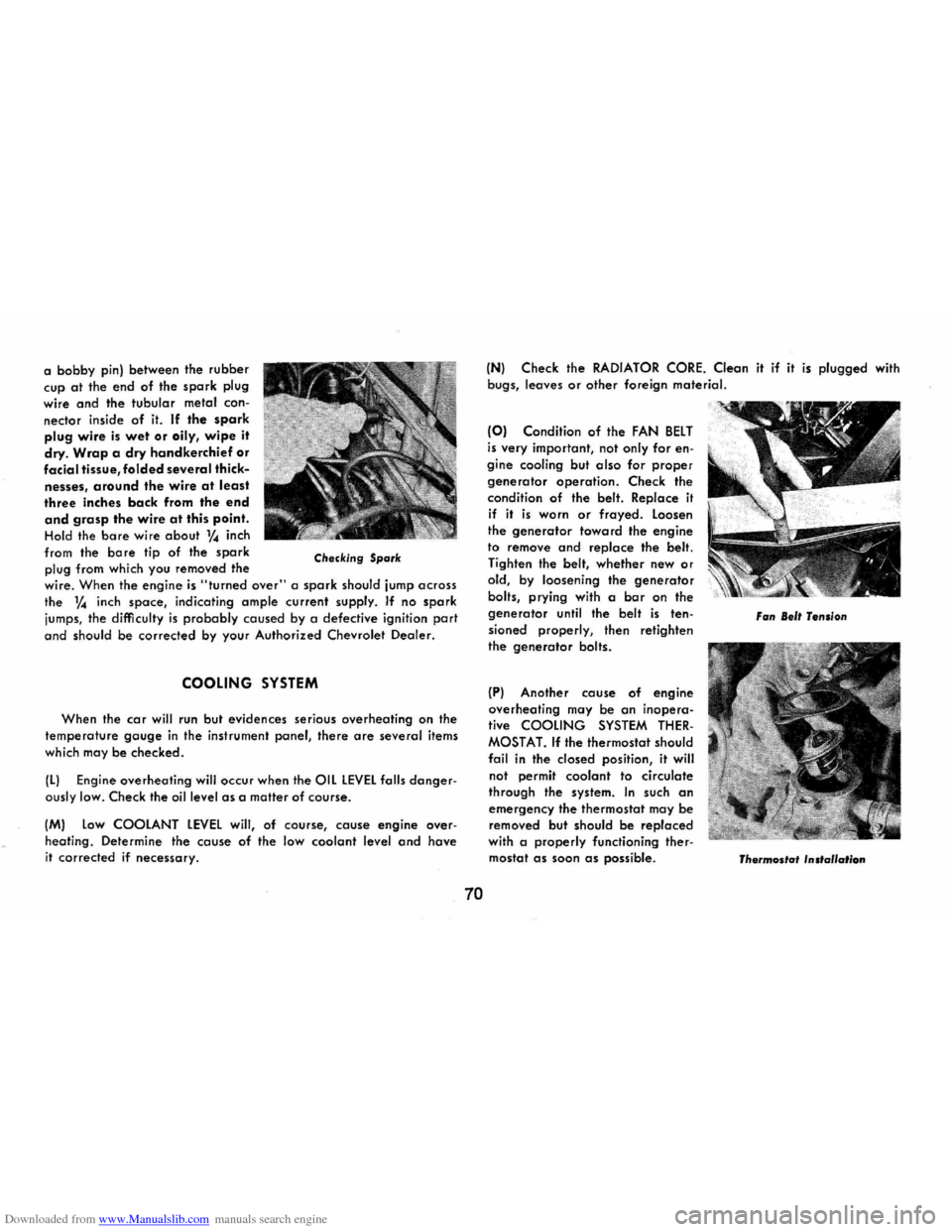
of it. If the spark plug wire is wet or oily, wipe it
dry.
Wrap a dry handkerchief or
facial tissue, folded several thick
nesses,
around the wire at least
three inches back from the end and grasp the wire at this point.
Hold the bare wire about V4 inch
from the
bore tip of the spark plug from which you removed the Checking Spark
wire. When the engine is "turned over" a spark should jump across
the 1,4 inch space, indicating ample current supply. If no spark
jumps, the difficulty is probably caused by a defective ignition part
and should be corrected by your Authorized Chevrolet Dealer.
COOLING SYSTEM
When the car will run but evidences serious overheating on the
temperature gauge in the instrument panel, there are several items
which may
be checked.
IL) Engine overheating will occur when the OIL LEVEL falls danger
ously low. Check the oil level as a mailer of course.
1M) Low COOLANT LEVEL will, of course, cause engine over
heating . Determine the
cause of the low coolant level and have it corrected if necessary.
70
IN) Check the RADIATOR CORE. Clean it if it is plugged with
bugs, leaves or other foreign material.
(0) Condition of the FAN BELT
is very important, not only for en
gine cooling but
also for proper
generator operation. Check the
condition of the belt. Replace it
if it is worn or frayed. Loosen
the generator toward the engine
to remove
and replace the belt.
Tighten the belt, whether new or
old, by loosening the generator
bolts, prying with a bar on the
generator until the belt is ten
sioned properly , then retighten
the
generator bolts.
(P) Another couse of engine
overheating may be
an inopera
tive
COOLING SYSTEM THER
MOSTAT. If the thermostat should
foil in the dosed position, it will
not permit
coolant to circulate
through the system. In such an
emergency the thermostat may be
removed but should be
replaced with a properly functioning ther
mostat as soon as possible.
Fan Belt Tension
Thermostat
'ns'alla"on
Page 84 of 86
Downloaded from www.Manualslib.com manuals search engine Mirrors, Rear View Inside, Adjustment Up or Down.. .. .. 6 Inside, Day/Night. . :. . . . . . . . . . . . . . . . 6 Mountainous Terrain
Driving Down Grades ....... ........ 19 Transmission Fluid Change Interval. .. 54 "Neutral" (N) Transmission Range ..... 18 New Car Break-In. . . . . . . . . . . . . . . . . . . . 2 Oil Additives ........................ .'. 51 Change Interval, Engine ............. 51 Checking Engine Oil Level. .... .. , . .. 52 Engine ............................ 51 Filter .............................. 51 Pressure Indicator Light/Gauge. . . . . .. 29 Recommendations . . . . . . . . . . . . . . . . .. 51 Transmissions . . . . . . . . . . . . . . . . . . . . .. 54 Viscosity ........................... 51 Operation in Foreign Countries ......... 13 Other Controls and Features. . . . . . . . . .. 40 Outside
Air Vents ....................... ... 32 Overheated Engine
Indicator Light. . . . . . . . . . . . . . . . . . . .. 27 What To Do. . . . . . . . . . . . . . . . . . . . . .. 27 Overseas Operation. . . . . . . . . . . . . . . . . .. 13 Owner Assistance. . . . . . . . . . . . . . . . . . . .. 73 Paint Care .............................. 49 Touch Up ......................... 49 Parking Brake ............................. 23 Lights ............................. 28 "Park" (P) Transmission Position ..... 18 Precautions ...................... " 18 Polishing And Waxing ................. 48 Positive Traction Differential. .......... 40
Power Brakes ............. , .............. 23 Seats.. . . . . . . . . . . . . . . . . . . . . . . .. . . .. 5 Steering .. . . . . . . . . . . . . . . . . . . . . . . . .. 21 Windows........................ .. 5 Pressure, Tire Inflation. . . . • . . . . . . . . . .. 60 Preventive Maintenance ............. " 60 Pushing To Start. .......... .... ...... 41 Radiator Coolant ........................... 57 Coolant Level Inspection. . . . . . . . . . .. 57 Overheating ........................ 42 Pressure Cap. . . . . . . . . . . . . . . . . ... 42, 60 Radio AM/FM ...................... ..... 38 Antenna ........................... 38 Stereo ............................. 38 Tape System. . . . . . . . . . . . . . . . . . . . . .. 39 Raising Car With Jack.. . . . . . . . . . . . . .. 44
Rear Axle
.............................. 53 Speaker ........................... 38 Window Defogger. . . . . . . . . . . . . . . . .. 34 Rearview Mirrors, Inside. . . . . . . . . . . . . . 6 Registration, Vehicle Engine Number ............... , .... 71 . Vehicle Identification Number. ....... 71 Replacement Tires. . . . . . . . . . . . . . . . . . .. 64 Replacement Wheels. . . . . . . . . . . . . . . . .. 64 Release , Hood .......... Inside Back Cover
Restarting. . . . . . . . . . . . . . . . . . . . . . . . . .. 16 Restraints
Child .............................. 10 Head.............................. 6 Lap Belts.......................... 6
Methods Of Restraining Children .. • .. 10 Shoulder Belts. .. . . . . . . . . . . . . . . . . . . . 8
Rests, Head (See Head Restraints)
81
Retractors, Lap Belt. . . . . . . . . . . . . . . . .. 7 "Reverse" (R) Transmission Range 18 Roof Care, Vinyl. . . . . . . . . . . . . . . . . . . .. 49
Rotation, Tire.. . . . . . . . . . . . . . . . . . . . . .. 62 Safety Belts (Seat Belts). . . . . . . . . . . . . . . . . . . . 6 Carrier, Infant. .. . . . . . . . . . . . . . . . . . .. 10 Seat, Child.. . . . . . . . . . . . . . . . . . . . . . .. 10 Schedule Break-In... ...... .. ...... .... .. .... 2 Maintenance. . . . . . . . . . . . . . . . . . . . . .. 50 Seat Adjustment, Manual. . . . . . . . . . . . . . .. 4
Adjustment, Power.... .. .... .. .... .. 5 Back Latch, Folding Front. . . . . . . . . .. 4 Child Safety.. .. .. . .. . . . . . . . .. .. . ... 10 Head Restraints. . . . . . . . . . . . . . . . . . . . 6 Seat Belts
Child Restraint. . . . . . . . . . . . . . . . . . . .. 10 Inspection and Care ......... ....... , 9
Lap ... , .................... ....... 6 Retractors. . . . . . . . . . . . . . . . . . . . . . . .. 7 Shoulder........................... 8
Self-Adjusting Brakes. . . . . . . . . . . . . . . .. 24 Service and Maintenance . . . . . . . . . . . . .. 50 Shift Linkage Maintenance ............... 55 Operation (See Transmission)
Shoulder Belts Adjustment. . . . . . . . . . . . . 8 Side Marker Lights .................. . Signals, Turn ......................... 20 Solvents, Recommended Cleaning. . • . . .. 46 Sound Systems (See Radio) Spare Tire
Jacking Instructions ... , ............. 46 Spark Knock (See Fuel
Recommendations)
Speaker, Rear ........................ 38