1960 CHEVROLET CORVAIR tire type
[x] Cancel search: tire typePage 18 of 38

It is recommended that all bright metal parts of your
Corvair, after being thoroughly cleaned, be given a
coating of wax and rubbed to a high polish. This will
serve to keep corrosive agents away from these surfaces,
and should be repeated as often as required.
CLEANING WHITE SIDEWALL TIRES
Use soap, warm water or a tire cleaner such as
G. M. Whitewall Tire Cleaner and a stiff brush to remove
road grime and dirt from white sidewall tires. A fine
grade of steel wool will remove severe curb scrapes.
Do
not use gasoline, kerosene or any oil product which
would discolor or deteriorate the rubber.
CAUTION: Some white sidewall cleaners will cause
serious damage to aluminum trim. Use caution
when cleaning tires with this type of cleaner.
G. M. Whitewall Tire Cleaner is safe to use
around aluminum trim.
15
INTERIOR APPEARANCE
DUST AND DIRT
Clean the interior of your car frequently, using a
broom or vacuum cleaner. A damp cloth will wipe dust
from hard surfaces. G. M. leather Cleaner is available
from your Authorized Chevrolet Dealer to clean any
imitation leather, vinyl or coated trim fabric on seats
or door panels.
SPOTS AND STAINS
Remove upholstery stains as soon as possible or
they may become "set" and difficult or impossible to
remove. First determine the type and age of the stain
and the kind of upholstery material. Kar Kleen Uphol
stery Cleaner or Kar Kleen Upholstery Spot Cleaner,
available from your Authorized Chevrolet Dealer, will
remove most stains. For oil, grease and road grime stains
not removed by these cleaners the use of a volatile type
cleaner such as G. M.Upholstery Spot Remover is recom
mended. Do not use alkaline cleaners ·for they may
damage the color or finish of the materials. Other solu
tions such as hot or cold water, ammonia water, soap,
ink eradicator, etc., will probably discolor and disturb
the material.
Page 20 of 38
ure up to U. S. standards, it is desirable to' obtain
detailed information as to availability of fuels in a given
area and service and adjustments n~cessary to adapt
your car to the fuels available. Such information may be
obtained by writing:
General Motors Overseas Operations
Service Department, Room 9-164
General Motors Building
Detroit 2, Michigan
Include with your request the area to which you
plan to take your car and the vehicle type and serial
number.
COOLING SYSTEM CARE
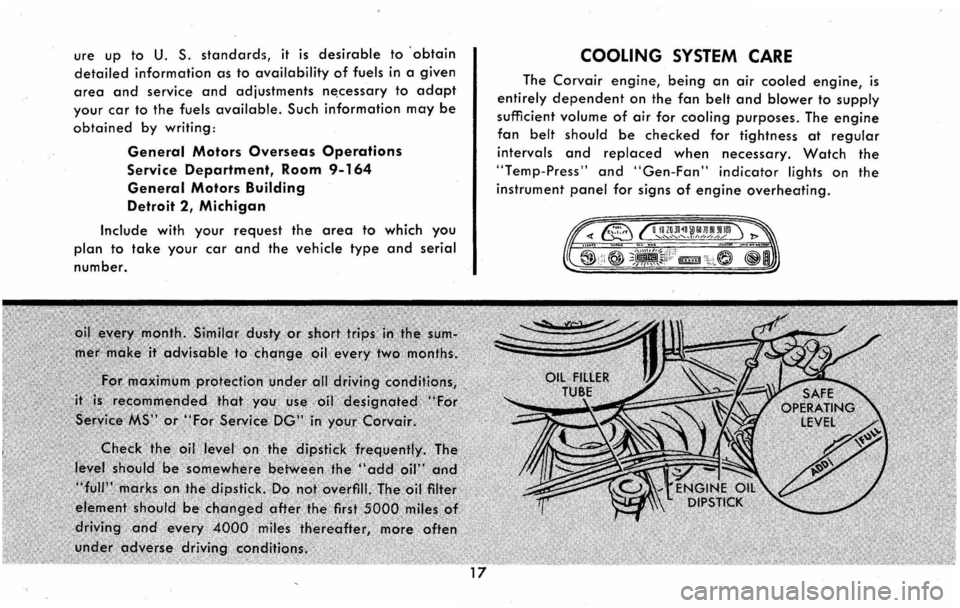
The Corvair engine, being an air cooled engine, is
entirely dependent on the fan belt and blower to supply
sufficient volume of air for cooling purposes. The engine
fan belt should be checked for tightness at regular
intervals and replaced when necessary. Watch the
"Temp-Press" and "Gen-Fan" indicator lights on the
instrument panel for signs of engine overheating.
OIiIOJl~ll!I[olrolin! ...... ~'-~ ............ ,'.,./ .. / ... A/
Page 21 of 38

TIRE CARE
Your new Chevrolet Corvair is designed to operate
most efficiently with the inflation pressure shown in the
following table. Nothing will be gained by exceeding
pressure shown, whereas, excessive pressures can ad
versely affect riding comfort and quietness. Under infla
tion affects vehicle handling and tire life. Over-steer
problems may also be encountered with incorrect pres
sures. Maintain the recommended inflation pressures at
all times.
All four wheels of your Corvair have been static-balanced for best performance and tire life. Wheels should be rebalanced after tire service or replacement.
FRONT AND REAR PRESSURE DIFFERENCE IS IMPORTANT
TO VEHICLE HANDLING.
18
Inspection and Repair
Inspect every 1000 miles for puncturing objects in
the tires. If any are found, do not attempt removal until
you are in a position to change the tire or have it
repaired. Also, check regularly that the wheel rim has
sustained
no damage which could affect the air seal.
Jacking the Car
The scissors type jack, its adapter and ratchet han
dle are stowed under the spare tire. One end of the
ad~pter is a wrench which fits over the wheel nuts and
the hex connection on the jack. The other end fits into
the non-adjustable ratchet wrench. One side of the wrench
faces the car for raising the car or tightening the wheel
nuts. Turn the wrench over so that the opposite side faces
JACK
WRENCH SPARE TIRE AND JACK STOWAGE
Page 26 of 38
ammonia or soda solution and flush with clear
water. Check state of charge regularly, espe
cially in freezing weather, for an undercharged
battery may freeze and break.
16. FUEL FILTER
Every 15,000 miles-Replace filters, located in each
carburetor inlet. If flooding occurs, replace more
often.
17. BRAKE MASTER CYLINDER
Check frequently and maintain fluid level at mark
inside reservoir below filler opening, using G. M.
Hydraulic Brake Fluid, Super No. 11. If addition
of fluid is required more often than ·every 1000
miles the entire system should be checked for
leaks.
18. PARKING BRAKE & CLUTCH PULLEYS
AND CABLES
Every 10,000 miles-Lubric.ate pulleys under dash.
Remove the
tunnel cover under vehicle and lubri
cate pulleys and cable bearing points with lub
riplate. lubricate gearshift lever ball and socket
and shift rod universal joint at transmission con
nection with lubriplate.
BODY LUBRICATION POINTS
Most body lube points do not need frequent, heavy
23
lubrication as does the chassis. However, periodic checks
of certain points on the Corvair body, and lubrication
when needed will eliminate annoying squeaks and
noises . Be careful not to over-lubricate. Wipe off all
surplus lubricant.
The following items should be lubricated periodically:
1. DQQr Hinges-Wipe off dirt and apply Lubriplate.
2 . Door Lock
Striker-Wipe off dirt and apply stick type lubricant.
3. Door Bottom Drain Hole Sealing Strip-Apply silicone rub-
ber lubricant.
4. Door Jamb Switch-Apply Lubriplate.
5 .
Rear Door Weatherstrip-Apply silicone rubber, lubricant.
6 . Front
and Rear Compartment Lid Lock-Apply Lubriplate.
7. Front Compartment Lid Torque Rods-Apply dripless oil to bearing points.
8. Gas Tank Filler Door Hinge-Apply dripless oil. 9. Glove Box Door Hinge-Apply dripless oil. 10. Rear Folding Seat Back Support Link Assembly & Filler Panel Hinge-Apply dripless Qil to bearing points.
The following items moy be lubricated whenever
access to the item is availoble:
11. Door Outsi.de Handle Lock Cylinder Shaft-Apply Lubri-
plate. 12. Door Window Regulator and Cams-Apply Lubriplate .
13. Door Lock Parts-Apply Lubriplate . 14. Door Locking Mechanism-Apply Lubriplate .
15. Front and Rear Compartment Hinges-Apply Lubriplate.
Page 31 of 38

SPECIFICATIONS
SERIAL AND UNIT NUMBERS
Serial Number . Stamped on plate attached to left center body pillar. Body Number .. Stamped on a plate attached to the left rear wheel well, within the engine compartment.
Engine Number. Stamped on the engine block behind and to
left of the fuel pump.
DIMENSIONS
Overall length ............................. 180.0 in.
Height
(loaded) .......... ................. 51.3 in.
Width
............... . . . . . . . . . . . . . . . . . . .. 66.4 in.
Wheelbase ...........•................... 108.0 in.
Turning
diameter ................. ............ 39 ft.
CAPACITIES
Gasoline Tank .........................•.... 11 gal.
Crankcase Refill ............................... 4 qt.
Add for Filter .......... , ... : ............... 1 pt.
Transmission
3-Speed .................................. 2 pt.
Powerglide
(Refill) ...... 4% to 8 pts . (depending on drain period) Differential .................. ............ 3 pt.
Air Cleaner ..................... . Polyurethane Element
Cooling System ...
.................. Air Cooled Engine
28
TIRE INFORMATION
Type .................................... Tubeless
Size .............................. 6.50 x 13-4 ply
Inflation COLD HOT
Front ............................ 15 18
Rear ......................•..... 26 30
Spare Tire-Inflate to 26 Ibs. Deflate to 15 Ibs. when using as front wheel.
ENGINE SPECIFICATIONS
Horsepower .•..............................
Compression Ratio ........................... 8.0:1
Displacement ....... ....................• 140 cu. in.
Bore
................... ' ............ ' ....... 3.375
Stroke ...................................... 2.60
Firing Order .............. .............. 1-4-5-2-3-6
Spark Plugs .............•. AC-4.4FF (Gap: .033-.038")
Idle Speed
3-Speed .................. 450-500 RPM (in Neutral)
Powerglide
................ .. 475-500 RPM (In Drive)
Ignition Timing .......................... 40 B.T.D.C.
Axle Ratio
(Std.) ......... ................... 3.55:1
(Opl.) ............................ 3.89:1