1953 JEEP CJ torque
[x] Cancel search: torquePage 303 of 376
'Jeep*
UNIVERSAL
SERIES SERVICE
MANUAL
N
scribed
in
Pars.
N-ll through N-l9 for standard
axles, with the exception of the following torque
recommendations. Torque the differential case
bearing
cap screws 70 to 90 lb-ft. [9,7 a 12,4 kg-m.]
and
the cover screws 15 to 25 lb-ft. [2,1 a 3,4
kg-m.].
The ring gear screws on axles with Powr-
Lok
differentials should be torqued as follows:
Model
30 and 44 axles 35 to 55 lb-ft. [4,84 a 7,60 kg-m.].
N-24. TRAC-LOK DIFFERENTIAL
As
optional equipment
Trac-Lok
Model 44 differen
tial
is available on all Jeep Universal vehicles equipped with semi-float flanged axle shafts.
A
conventional differential transmits all of the
ring
gear torque through the differential gears to the axle shafts. Torque is at all
times
equal on the axle shafts, and if one wheel slips, the other wheel
can
only put out as much torque as the slipping
wheel.
The
Trac-Lok
differential is similar,
except
that
part
of the torque from the ring gear is trans mitted through clutch packs
between
the side gears
and
differential case. The multiple disc clutches
with
radial
grooves
on the plates and concentric
grooves
on the discs are
engaged
by a preload
from
Belleville springs, plus separating forces from
the side gears as torque is applied through the
ring
gear.
The
Trac-Lok
construction permits differential action when required for turning corners and transmits equal torque to both
wheels
when driving
straight
ahead. However, when one wheel tries to spin due to leaving the ground, a patch of ice,
etc., the clutch packs automatically provide more
torque to the wheel which is not trying to spin.
It
can be
seen
then that the
Trac-Lok
differential
resists wheel spin on bumpy roads and provides
more pulling power when one wheel tries to slip.
In
many cases of differences in traction, pulling
power
will
be automatically provided until both
wheels
start to slip.
In
diagnosis of vehicle operators' complaints, it
is important to recognize two things:
a.
If, with unequal traction, both
wheels
slip, the
Trac-Lok
has
done
all it can possibly do.
b.
In extreme cases of differences in traction, the
wheel with least traction may spin after the
Trac-
Lok
has transferred as much torque as possible
to the non-slipping wheel.
N-25.
Lubrication
The
Trac-Lok
differential requires a special
lubri
cant
and ordinary multipurpose gear lubricants
MUST
NOT be used. Use only 'Jeep* Differential
Oil,
Part
No. 94557.
Trac-Lok
differential may be cleaned only by disassembling the unit and wiping with clean rags. Do not flush the
Trac-Lok
unit.
Note:
The
Trac-Lok
differential is serviced at the
same time intervals as the standard differential.
N-26.
Trouble
Symptoms
If
noises
or roughness, such as chatter, are present
in
turning corners, the probable cause is incorrect
or
contaminated lubricant.
Before any differential is removed and disassem
bled for chatter complaints, the correctness of
lubri
cant
can and should be determined.
A
complete
lubricant
drain,
and
refill
with specified
Limited
Slip Differential lubricant
will
usually
correct
chatter.
The
following procedure is recommended to ensure
complete
removal of old lubricant.
a.
Warm
the lubricant by vehicle road operation,
or
5 minutes of operation in gear at 30 mph with
both
wheels
off the ground on a hoist.
Caution:
Never place the transmission in gear with
the
engine
running when only one wheel of a
Limited
Slip Differential equipped vehicle is raised.
The
vehicle might drive itself off the
jack
and produce damage or
injury.
b.
Drain
lubricant while
warm.
Remove
drain
plug
or
cover to
drain
completely. If cover is removed,
it
may be necessary to replace gasket at this time.
c.
Refill
axle with specified
Limited
Slip Differen
tial
lubricant.
d.
Operate the vehicle for approximately ten miles
[16,09
km.], making at least ten figure 8 turns
to flush the old lubricant out of the clutch packs.
e.
Repeat
steps
b, c, and d, making sure to replace
the cover gasket if required in
step
c.
f. It is possible that slight chatter, requiring ad
ditional
vehicle operation, may remain after
step
e. If chatter persists after 100 miles
[160,9
km.]
of vehicle operation, or remains severe after
step
e above, disassembly and repair
will
be necessary.
N-27.
Unit
Inoperative
Proper
performance and capabilities of
Limited
Slip
Differentials are
often
misunderstood. No
precise
methods
of measuring
Limited
Slip Dif
ferential
performance are generally available in the field. A functioning unit can be determined by
relatively
simple vehicle operational
tests,
as
follows:
a.
Place one wheel on
good
dry pavement, and the
other on ice, mud, grease, etc.
b.
Gradually
increase
engine
rpm to obtain maxi
mum
traction
prior
to "break-a-way." The ability
to
move
the vehicle
effectively
will
demonstrate
proper
performance.
c.
If extremely slick surfaces, such as ice or grease,
are
used
some
question may exist as to proper per
formance at
step
b. In
these
extreme cases a prop
erly
performing
Limited
Slip Differential
will
pro
vide greater "pulling" power by lightly applying
the parking brake.
N-23.
Trac-Lok
Differential Disassembly
and
Reassembly
It
is recommended that the
complete
axle assembly
be removed from the vehicle, when it
becomes
necessary to remove the
Trac-Lok
from the hous
ing.
Refer to Par. N-3 and N-12 for removal of axle shafts and differential case from axle housing. 303
Page 306 of 376
N
REAR
AXLE
FIG.
N-49—REMOVING
PINION
MATE
WASHERS
m.
Thread
forcing screw so that it becomes cen
tered into the
step
plate. Torque forcing screw
tight.
This
will
move the side gears away from
the pinion mate gears, and relieve the load between
the gears, allowing only the pinion mate gears to
be
loose.
n.
Remove both pinion mate spherical washers. Use
a
shim stock of .030" [0,762 mm.] thickness or an
equivalent tool to push out the spherical washers.
Relieve
the tension of the Belleville spring by
loose
ning
the forcing screw. Refer to Fig. N-49.
o.
Retighten forcing screw until a very slight move ment of the pinion mate gears is detected.
FIG.
N-50—-REMOVING
PINION
MATE
GEARS
p.
Insert the pawl rotating tool between one of
the side gear
teeth
as shown.
Pull
on handle so
the top side gear
will
rotate and also allow the
pinion mate gears to rotate. Also continue pulling
on tool until the gear hits the handle,
q.
Remove pawl from between the gear
teeth
and
repeat the above until the pinion mate gears can
be removed through the large opening of the case.
Note:
When attempting to rotate the side gear, it
will
probably be necessary to adjust the forcing
screw
by very slightly tightening or loosening until the required load is applied to the Belleville springs
to allow the side gear and pinion mate gears to
rotate. Refer to Fig. N-50.
r.
Retain the top side gear and clutch pack in
the case by holding hand on the bottom of the
rotating tool while removing forcing screw. Remove
rotating tool, top side gear, and clutch pack.
FIG.
N-51—-TRAC-LOK
UNIT
DISASSEMBLY
s. Remove the differential case from the axle shaft.
Turn
case with the flange or ring gear side up
and
allow the
step
plate tool side gear and clutch
pack
to be removed from the case. Remove the
retainer
clips from both clutch packs to allow
separation of the plates and discs. Refer to Fig.
N-51.
N-30.
Inspection
a.
Plates and discs —
If
any one member of either
stack
shows evidence of excessive wear or scoring,
then the complete stack is to be replaced on both
sides.
b.
Side gears and pinion mate gears —
The
gear
teeth
of
these
parts should be checked for extreme
wear
or possible
cracks.
The external
teeth
of the side gear which holds the clutch pack should also
be checked for wear or
cracks.
If replacement of one gear is required due to wear, etc., then both
side gears, pinion mate gears, and washers are to
be replaced.
c.
Cross
pin
— If excessive wear is evident, then
the cross pin should be replaced.
d.
Clutch
retainer clips — If wear is evident on
any
one of the retainer clips, it is
suggested
that
all
four clips be replaced.
e. Differential case — If scoring, wear, or metal
pick-up
is evident on the machined surfaces, then replacement of the case is necessary.
I.
Example of
radial
groove plate (A) and the con
centric
groove disc (B) shown in Fig. N-52.
N-31.
Reassembly
a.
Assemble plates and discs in exactly the same position as they were removed, regardless of
whether they are new parts or the original parts. 306
Page 309 of 376
'Jeep'
UNIVERSAL
SERIES
SERVICE
MANUAL
N
m.
Pull
on tool until the handle hits the gear.
Remove pawl from
between
the
gear
teeth, reposi
tion handle and pawl. Repeat the same operation
until
the
holes
of both pinion mate gears are lined
up exactly with
those
of the case,
n.
Prelubricate both sides of the pinion mate
spherical
washers with the specified lubricant,
o.
Apply torque to the forcing screw to allow
clearance
to assemble the spherical washers,
p.
Assemble washers into case. Use a very small
screw
driver to push washers into place, as shown
in
Fig. N-61.
Caution:
Be sure the
holes
of the washers and gears
are
lined up exactly with
those
of the case.
q.
Remove forcing screw, rotating tool, and
step
plate.
FIG.
N-62—INSTALLING
CROSS
PIN
r.
Prelubricate the cross pin with the specified
lubricant.
Assemble cross pin into case. Use a
hammer
as shown. Be sure the snap ring
grooves
of the cross pin are
exposed
to allow assembly of
the snap rings. Refer to Fig. N-62. s. Assemble snap rings.
FIG.
N-63—TORQUING
RING
GEAR
SCREWS
t.
Remove case from axle shaft. Assemble ring gear
to case.
u.
Line
up the ring gear screw
holes
with
those
of the case. Assemble ring gear screws finger tight,
v.
Reposition differential case
onto
axle shaft as shown.
Draw
screws up evenly.
Note:
Use new ring gear screws and torque to 45-
50 ft. lbs.
w.
This
completes
the service procedure for the
Trac-Lok
assembly.
Install
Trac-Lok
differential case assembly into axle housing. Follow the service
procedure given in Par. N-8 and
N-l
7 through
N-l9,
to complete the differential and axle assembly
servicing.
N-32.
Complete
Trac-Lok
Assembly Replacement
a.
If inspection reveals that the replacement of the
Trac-Lok
as a unit is required, the following
steps
should be followed.
b.
Remove both differential bearing
cones
and
shims.
Mark
or tag each side bearing
cone
and
shim
pack as it is removed to indicate from which
side of the case they were removed.
c.
To remove ring gear from case, follow the
same
steps
as illustrated in Fig. N-42.
d.
Assemble ring gear to new
Trac-Lok
case.
Fol
low the same
steps
as illustrated in
Fig.
N-63.
Make
sure
the gear flange on the differential case is free
of nicks,
burrs,
etc.
e. Inspect shims and bearings which were removed
from
the old case. If shims on bearings show exces
sive wear or damage, they should be replaced.
Make
sure they are used on exactly the same sides
of the new case as they were removed from the
old case. Assemble shims and differential bearing cones. Use
step
plate on
bottom
bearing to protect
the bearing from becoming damaged during as sembly of the top bearing. To completely seat
the bearings use the proper bearing driver tool.
f. Prelubricate differential bearing
cones
with the
specified lubricant, and assemble case into axle
housing. Follow the service procedure given in
Par.
N-8 and N-l7 through N-19 to complete the
differential
and axle assembly servicing.
N-33.
INSTALLING
REAR
AXLE
All
service replacement axle assemblies are shipped
from
the factory without lubricant in the differ
ential.
Lubricant
must be added to the differential
before the axles are installed in vehicles. Use the grade and quantity of lubricant specified in the
Lubrication
Chart.
When
adding differential lubricant, suspend the axle with the axle shafts horizontal and the yoke
end of the pinion housing hanging down, then
turn
the pinion shaft several times to assure that the
lubricant
gets
into the pinion shaft bearings.
Procedure
for installing the
rear
axle on Jeep
Universal
Series vehicles is as follows:
a.
Position the axle assembly under the vehicle.
b.
Position springs to axle pads, and install spring
clips
and nuts. 309
Page 310 of 376
m
REAR AXLE
c. Attach the brake line
hose
at tee fitting on top
of housing.
d.
Attach parking brake cables at rear of brake
backing plate. DJ
models
only.
e. Connect the shock absorbers at the axle mount
ing pads.
f. Connect the propeller shaft at the rear universal
joint.
g. Adjust and bleed brakes. (See Section P).
h.
Install
wheels
and lower vehicle to floor.
i.
Check parking brake as described in Section P.
j.
Fill
the axle housing with the proper lubricant.
For
correct lubricant refer to the
Lubrication
Chart.
N-34.
TROUBLE
SHOOTING
The
following problems can be present with either the conventional differential,
Powr-Lok
or
Trac-
Lok
differential.
N-35. Backlash
Excessive
backlash in the vehicle drive line may be the results of
excessive
backlash in the trans
mission, propeller shaft spline, universal joint, ring gear and pinion, the axle shaft spline, or the dif
ferential.
Excessive
backlash in the differential may be meas
ured
as follows:
a.
Jack
up one rear wheel.
b. Put the transmission in gear.
c. Measure the travel of the jacked-up wheel on
a
10"
[25,40
cm.] radius from the wheel center.
This
total
movement
should not
exceed
IVi" [3,17 cm.] in a new unit. In order to restrict the
backlash
to the axles only, make sure that the
yoke of the propeller shaft
does
not
move
during
the check.
d.
If all causes of backlash mentioned
above
have
been
eliminated with the exception of the differen
tial
and that still
exceeds
the maximum allowable
movement, overhaul the differential.
N-36.
Rear
Wheel
Noise
Looseness of the rear axle shaft nut on semifloat- ing tapered rear axles may produce a clicking or
creaking
noise.
This
noise
can usually be
stopped
by torquing the wheel hub nut 150 to 175 lb-ft. [20,7 a 24,2 kg-m.]. If the condition has continued
for
some
time, slight wear may have resulted allow
ing the
noise
to persist. In this case, coat the hub,
key, and keyway on tapered axle shafts with white
lead and torque the nut as specified. If the
noise
persists after this treatment, replace the worn parts.
N-37.
SERVICE DIAGNOSIS
SYMPTOMS
Axle
Noisy on Pull and
Coast
Excessive
Back
Lash
Bevel
Gear
and Pinion. . . . . Adjust
End
Play Pinion Shaft Adjust
Worn
Pinion Shaft Bearing Adjust
Pinion
Set too Deep in Bevel
Gear
too Tight..... Adjust
Wrong
Lubricant
Being Used
(Powr-Lok
or
Trac-Lok
Differential) . Replace
Axle
Noisy on
Pull
Pinion
and Bevel
Gear
Improperly Adjusted Adjust
Pinion
Bearings Rough....................... Adjust
Pinion
Bearings Loose Adjust
Axle
Noisy on Coast
Excessive
Back
Lash
in Bevel
Gear
and Pinion. . . Adjust
End
Play in Pinion Shaft. . Adjust
Improper
Tooth Contact.
....................
Adjust
Rough Bearings Replace
Back
Lash
Worn
Differential Pinion
Gear
Washers Adjust
Excessive
Back
Lash
in Bevel
Gear
and Pinion. . . Adjust
Worn
Universal Joints Replace
PROBABLE REMEDY
310
Page 314 of 376
STEERING
SYSTEM
O-L
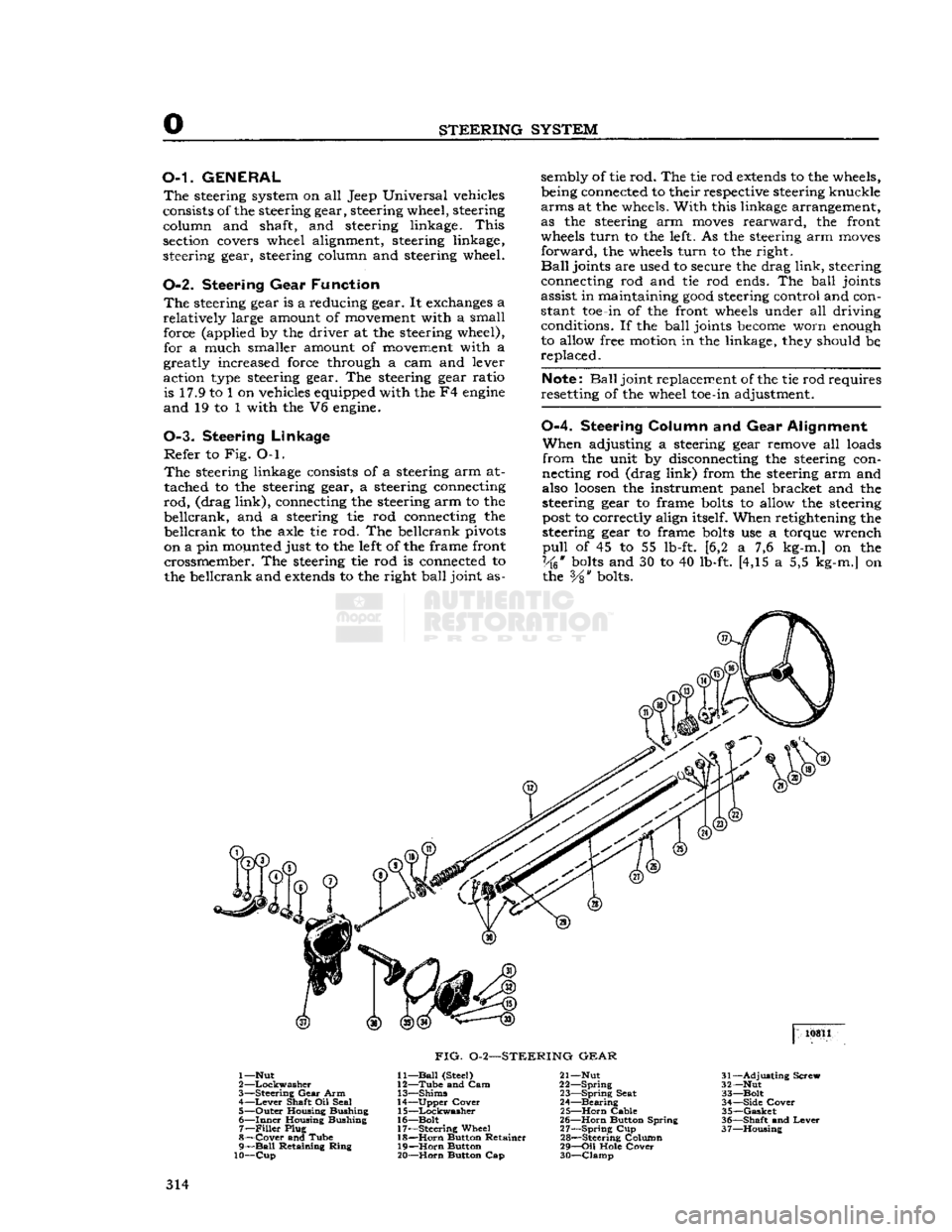
GENERAL
The
steering system on all Jeep Universal vehicles
consists of the steering gear, steering wheel, steering column and shaft, and steering linkage.
This
section covers wheel alignment, steering linkage,
steering gear, steering column and steering wheel.
0-2. Steering
Gear
Function
The
steering gear is a reducing gear. It exchanges a
relatively
large amount of movement with a small force (applied by the driver at the steering wheel), for a much smaller amount of movement with a
greatly increased force through a cam and lever
action type steering gear. The steering gear ratio is 17.9 to 1 on vehicles equipped with the F4
engine
and
19 to 1 with the V6 engine.
0-3. Steering
Linkage
Refer
to Fig. O-l.
The
steering linkage consists of a steering arm at
tached to the steering gear, a steering connecting
rod,
(drag
link),
connecting the steering arm to the
beilcrank,
and a steering tie rod connecting the
beilcrank
to the axle tie rod. The beilcrank pivots
on a pin mounted just to the left of the frame front crossmember. The steering tie rod is connected to
the beilcrank and
extends
to the right
ball
joint as sembly of tie rod. The tie rod
extends
to the wheels,
being connected to their respective steering knuckle
arms
at the wheels.
With
this linkage arrangement,
as the steering arm
moves
rearward,
the front
wheels
turn
to the left. As the steering arm
moves
forward,
the wheels
turn
to the right.
Ball
joints are used to secure the drag
link,
steering
connecting rod and tie rod ends. The
ball
joints
assist in maintaining
good
steering control and con
stant toe-in of the front wheels under all driving conditions. If the
ball
joints
become
worn enough
to allow free motion in the linkage, they should be,
replaced.
Note:
Ball
joint replacement of the tie rod requires
resetting of the wheel toe-in adjustment.
0-4.
Steering
Column
and Gear
Alignment
When
adjusting a steering gear remove all loads
from
the unit by disconnecting the steering con
necting rod (drag
link)
from the steering arm and
also
loosen
the instrument panel bracket and the
steering gear to frame
bolts
to allow the steering
post
to correctly align itself. When retightening the
steering gear to frame
bolts
use a torque wrench
pull
of 45 to 55 lb-ft. [6,2 a 7,6 kg-m.] on the
Vk*
bolts
and 30 to 40 lb-ft. [4,15 a 5,5 kg-m.] on the
Vs"
bolts. 10811
FIG.
0-2—STEERING
GEAR
1—Nut
2
—Lockwasher
3—
Steering
Gear
Arm 4—
Lever
Shaft Oil Seal
5—
Outer
Housing Bushing
6—
Inner
Housing Bushing 7—
Filler
Plug
8—
Cover
and Tube
9—
Ball
Retaining
Ring
10—Cup
11—
Ball
(Steel)
12—
Tube
and Cam
13—
Shims
14—
Upper
Cover
15—
Lockwasher
16—
Bolt
17—
Steering
Wheel 18—
Horn
Button Retainer
19—
Horn
Button
20—
Horn
Button Cap 21— Nut
22—
Spring
23—
Spring
Seat
24—
Bearing
25—
Horn
Cable
26—
Horn
Button Spring
27—
Spring
Cup
28—
Steering Column
29—
Oil
Hole
Cover
30—
Clamp
31—
Adjusting
Screw
32— Nut
33—
Bolt
34—
Side
Cover
35—
Gasket
36—
Shaft
and
Lever
37—
Housing
314
Page 315 of 376
'Jeep'
UNIVERSAL
SERIES SERVICE
MANUAL
O Note:
If the steering-gear-to-frame
bolts
are not
properly
torqued, they
will
eventually
loosen
dur
ing operation of the vehicle. Loose
bolts
will
result
in
elongated
bolt
holes
making maintenance of bolt torque difficult, and may allow position of the
steering columns to be misaligned. Therefore,
proper
torquing is extremely important.
Do not tighten the steering gear to dampen out
steering trouble. Adjust the steering gear only to
remove lost motion or play within the unit.
0-5. Steering
Gear
Adjustment
The
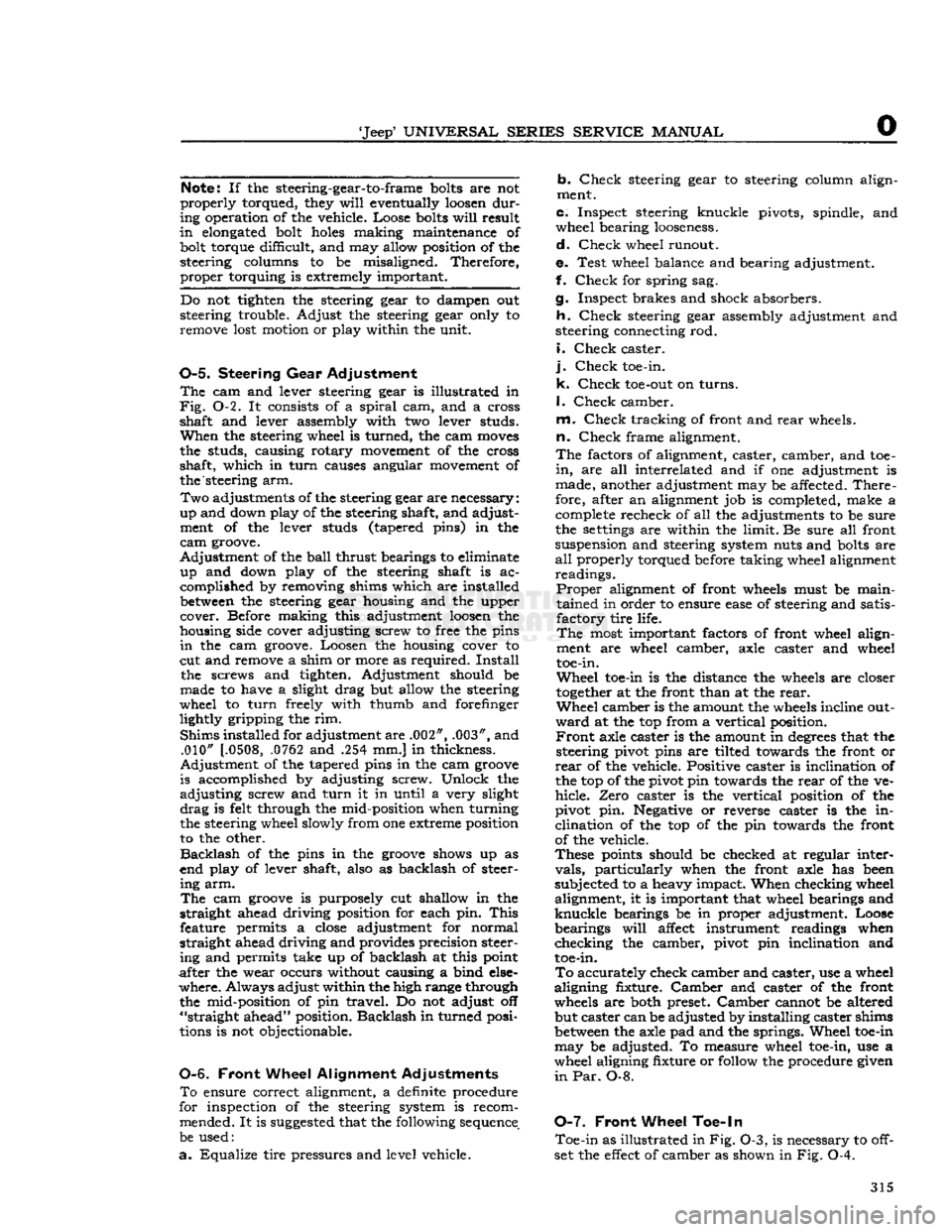
cam and lever steering gear is illustrated in
Fig.
0-2. It consists of a
spiral
cam, and a cross shaft and lever assembly with two lever studs.
When
the steering wheel is turned, the cam
moves
the studs, causing rotary movement of the cross
shaft, which in
turn
causes angular movement of
the*steering arm.
Two
adjustments of the steering gear are necessary:
up and down play of the steering shaft, and adjustment of the lever studs (tapered pins) in the
cam
groove.
Adjustment
of the
ball
thrust bearings to eliminate up and down play of the steering shaft is ac
complished by removing shims which are installed
between
the steering gear housing and the upper
cover. Before making this adjustment
loosen
the
housing side cover adjusting screw to free the pins
in
the cam groove. Loosen the housing cover to
cut and remove a shim or more as required.
Install
the screws and tighten. Adjustment should be
made to have a slight drag but allow the steering
wheel to
turn
freely with thumb and forefinger
lightly gripping the rim.
Shims
installed for adjustment are .002*, .003", and .010"
[.0508,
.0762
and .254 mm.] in thickness.
Adjustment
of the tapered pins in the cam
groove
is accomplished by adjusting screw. Unlock the
adjusting
screw and
turn
it in until a very slight
drag
is felt through the mid-position when turning
the steering wheel slowly from one extreme position
to the other.
Backlash
of the pins in the
groove
shows up as
end play of lever shaft, also as backlash of steer ing arm.
The
cam
groove
is purposely cut shallow in the
straight
ahead driving position for each pin.
This
feature permits a
close
adjustment for normal
straight
ahead driving and provides precision steer ing and permits take up of backlash at this point
after the wear occurs without causing a bind else
where.
Always
adjust within the high range through
the mid-position of pin travel. Do not adjust off
"straight
ahead" position.
Backlash
in turned posi
tions is not objectionable.
0-6.
Front
Wheel Alignment Adjustments
To
ensure correct alignment, a definite procedure
for inspection of the steering system is recom mended. It is
suggested
that the following sequence
be used:
a.
Equalize
tire pressures and level vehicle.
b.
Check
steering gear to steering column align
ment.
c.
Inspect steering knuckle pivots, spindle, and
wheel bearing
looseness.
d.
Check
wheel runout.
e.
Test wheel balance and bearing adjustment.
f.
Check
for spring sag.
g.
Inspect brakes and shock absorbers.
h.
Check
steering gear assembly adjustment and
steering connecting rod.
i.
Check
caster,
j.
Check
toe-in.
k.
Check
toe-out
on turns.
I.
Check
camber.
m.
Check
tracking of front and
rear
wheels,
n.
Check
frame alignment.
The
factors of alignment, caster, camber, and toe-
in,
are all interrelated and if one adjustment is
made, another adjustment may be affected.
There
fore, after an alignment job is completed, make a
complete recheck of all the adjustments to be sure
the
settings
are within the limit. Be sure all front
suspension and steering system nuts and
bolts
are
all
properly torqued before taking wheel alignment readings.
Proper
alignment of front wheels must be main
tained in order to ensure
ease
of steering and satisfactory tire life.
The
most important factors of front wheel alignment are wheel camber, axle caster and wheel
toe-in.
Wheel
toe-in is the distance the wheels are closer
together
at the front than at the
rear.
Wheel
camber is the amount the wheels incline out
ward
at the top from a vertical position.
Front
axle caster is the amount in
degrees
that the
steering pivot pins are tilted towards the front or
rear
of the vehicle. Positive caster is inclination of
the top of the pivot pin towards the
rear
of the ve
hicle.
Zero caster is the vertical position of the
pivot pin. Negative or reverse caster is the in
clination
of the top of the pin towards the front
of the vehicle.
These
points should be checked at regular inter
vals,
particularly when the front axle has been
subjected to a heavy impact. When checking wheel alignment, it is important that wheel bearings and
knuckle
bearings be in proper adjustment. Loose bearings
will
affect instrument readings when
checking
the camber, pivot pin inclination and
toe-in.
To
accurately check camber and caster, use a wheel
aligning fixture.
Camber
and caster of the front
wheels are both preset.
Camber
cannot be altered
but caster can be adjusted by installing caster shims
between
the axle pad and the springs. Wheel toe-in
may
be adjusted. To measure wheel toe-in, use a
wheel aligning fixture or follow the procedure given
in Par.
0-8.
0-7.
Front Wheel Toe-in
Toe-in
as illustrated in
Fig.
0-3, is necessary to
off
set the
effect
of camber as shown in Fig. Q-4. 315
Page 319 of 376
'Jeep*
UNIVERSAL
SERIES SERVICE
MANUAL
D
©—P3
10789
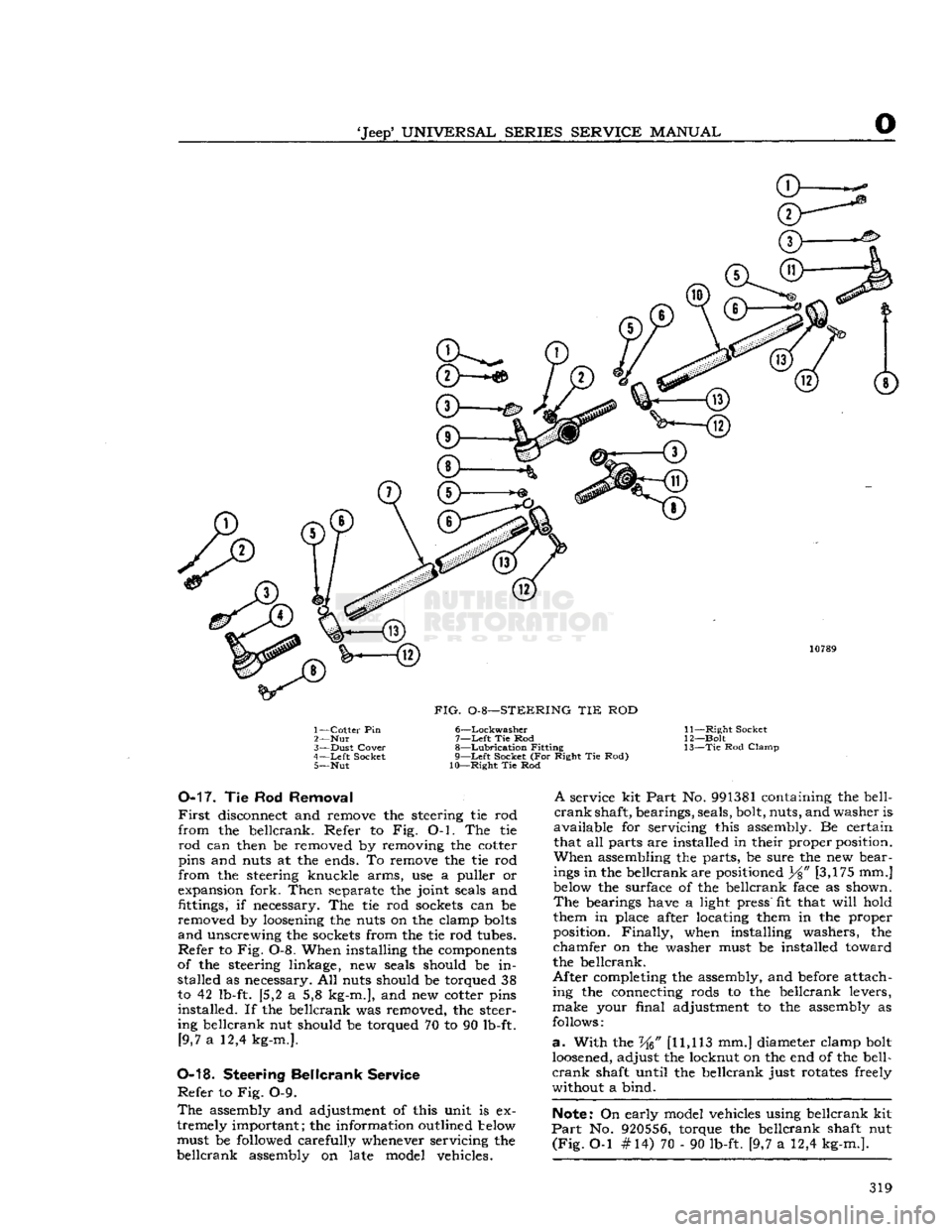
FIG.
0-8—STEERING TIE ROD
1—
Cotter
Pin 6—Lockwasher
2—
Nut 7—Left Tie Rod
3—
Dust
Cover
8—Lubrication
Fitting
4—
Left
Socket 9—Left Socket (For Right Tie Rod) 5— Nut 10—Right Tie Rod 11—
Right
Socket
12—
Bolt
13— Tie
Rod
Clamp
0-17.
Tie Rod
Removal
First
disconnect and remove the steering tie rod
from
the bellcrank. Refer to Fig. O-l. The tie
rod
can then be removed by removing the cotter
pins and
nuts
at the
ends.
To remove the tie rod
from
the steering knuckle arms, use a puller or
expansion
fork.
Then
separate
the
joint
seals
and
fittings,
if
necessary.
The tie rod
sockets
can be
removed by loosening the
nuts
on the clamp bolts
and unscrewing the
sockets
from
the tie rod
tubes.
Refer to Fig. 0-8. When installing the
components
of
the steering linkage, new
seals
should be in stalled as
necessary.
All
nuts
should be torqued 38
to 42
lb-ft.
{5,2 a 5,8
kg-m.],
and new cotter pins
installed.
If the bellcrank was removed, the
steer
ing
bellcrank nut should be torqued 70 to 90
lb-ft.
[9,7
a 12,4
kg-m.].
0-18.
Steering
Bellcrank
Service
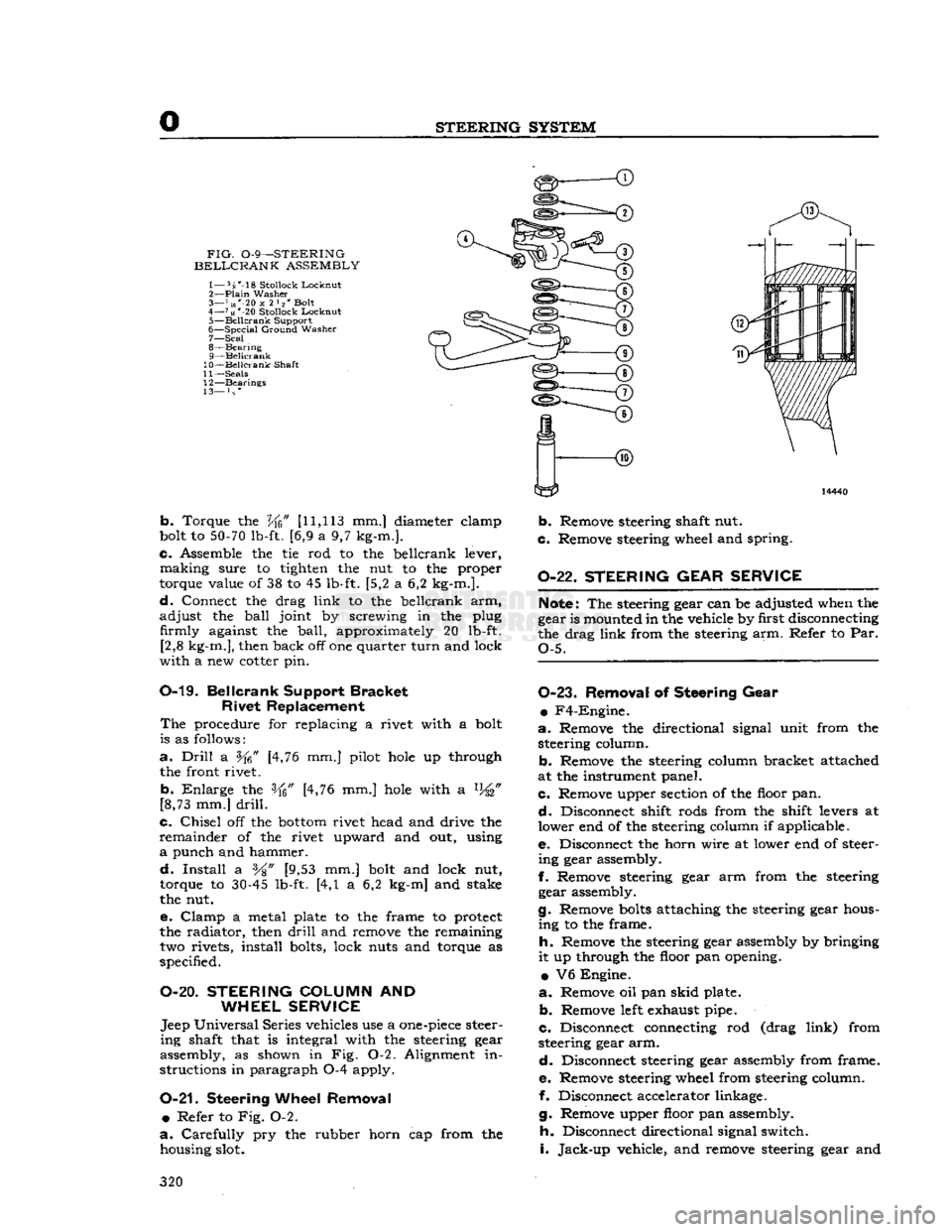
Refer to Fig. 0-9.
The
assembly
and adjustment of this unit is ex
tremely important; the information outlined below must be
followed
carefully whenever servicing the
bellcrank
assembly
on late model vehicles.
A
service kit
Part
No. 991381 containing the
bell
crank shaft, bearings,
seals,
bolt, nuts, and
washer
is
available for servicing this
assembly.
Be certain that all
parts
are installed in their proper position.
When assembling the parts, be
sure
the new
bear
ings in the bellcrank are positioned
Y%"
[3,175 mm.]
below the
surface
of the bellcrank
face
as shown. The
bearings
have
a
light
press"
fit that
will
hold
them in
place
after locating them in the proper
position.
Finally, when installing
washers,
the
chamfer on the
washer
must be installed toward
the bellcrank.
After
completing the
assembly,
and before attach
ing
the connecting
rods
to the bellcrank levers,
make
your
final
adjustment to the
assembly
as
follows:
a.
With
the W [11,113 mm.] diameter clamp bolt
loosened, adjust the locknut on the end of the
bell
crank shaft
until
the bellcrank just
rotates
freely
without
a bind.
Note:
On early model vehicles using bellcrank kit
Part
No. 920556, torque the bellcrank shaft nut
(Fig.
O-l #14) 70 - 90
lb-ft.
[9,7 a 12,4
kg-m.].
319
Page 320 of 376
STEERING
SYSTEM
FIG.
0-9—STEERING
BELLCRANK
ASSEMBLY
1— 5s'-18
Stollock
Lockout
2—
Plain
Washer
3— 7 us"-20
x
2 l2' Bolt
4—
71«
*-20
Stollock
Locknut
5—
Beilcrank
Support
6—
Special
Ground
Washer
7— Seal
8—
Bearing
9— Beilcrank
10— Beilcrank
Shaft
11—
Seals
12—
Bearings
13— } s *
b.
Torque the
Vfc"
[11,113
mm.] diameter elamp
bolt to
50-70
lb-ft. [6,9 a 9,7 kg-m.].
c.
Assemble the tie rod to the beilcrank lever,
making
sure to tighten the nut to the proper
torque value of 38 to 45 lb-ft. [5,2 a 6,2 kg-m.].
d.
Connect the drag
link
to the beilcrank arm,
adjust
the
ball
joint by screwing in the plug firmly against the
ball,
approximately 20 lb-ft. [2,8 kg-m.], then back off one quarter
turn
and lock
with
a new cotter pin.
0-19.
Beilcrank
Support
Bracket
Rivet
Replacement
The
procedure for replacing a rivet with a bolt
is as follows:
a.
Drill
a [4,76 mm.] pilot
hole
up through
the front rivet.
b.
Enlarge
the [4,76 mm.]
hole
with a %"
[8,73 mm.]
drill.
c.
Chisel
off the
bottom
rivet head and drive the
remainder
of the rivet upward and out, using
a
punch and hammer.
d.
Install
a %" [9,53 mm.] bolt and lock nut,
torque to
30-45
lb-ft. [4,1 a 6,2 kg-m] and stake
the nut.
e.
Clamp
a metal plate to the frame to protect
the radiator, then
drill
and remove the remaining two rivets, install bolts, lock nuts and torque as
specified.
O-20.
STEERING
COLUMN
AND
WHEEL SERVICE
Jeep
Universal
Series vehicles use a
one-piece
steer
ing
shaft that is integral with the steering gear
assembly, as shown in Fig. 0-2. Alignment in
structions in paragraph 0-4 apply.
0-21.
Steering
Wheel Removal •
Refer to Fig. 0-2.
a.
Carefully
pry the rubber horn cap from the housing slot.
b.
Remove steering shaft nut.
c.
Remove steering wheel and spring.
0-22.
STEERING GEAR SERVICE
Note:
The steering gear can be adjusted when the
gear is mounted in the vehicle by first disconnecting
the drag
link
from the steering arm. Refer to Par.
Q-5.
0-23.
Removal
of
Steering Gear
•
F4-Engine.
a.
Remove the directional signal unit from the steering column.
b.
Remove the steering column bracket attached
at the instrument panel.
c.
Remove upper section of the floor pan.
d.
Disconnect shift rods from the shift levers at
lower end of the steering column if applicable.
e.
Disconnect the horn wire at lower end of steer
ing
gear assembly.
f.
Remove steering gear arm from the steering gear assembly.
g.
Remove
bolts
attaching the steering gear hous
ing
to the frame.
h.
Remove the steering gear assembly by bringing
it
up through the floor pan opening.
•
V6 Engine.
a.
Remove oil pan
skid
plate.
b.
Remove
left
exhaust pipe.
c.
Disconnect connecting rod (drag
link)
from
steering gear arm.
d.
Disconnect steering gear assembly from frame.
e.
Remove steering wheel from steering column.
f. Disconnect accelerator linkage.
g.
Remove upper floor pan assembly.
h.
Disconnect directional signal switch.
i.
Jack-up
vehicle, and remove steering gear and
320