1953 JEEP CJ clutch
[x] Cancel search: clutchPage 306 of 376
N
REAR
AXLE
FIG.
N-49—REMOVING
PINION
MATE
WASHERS
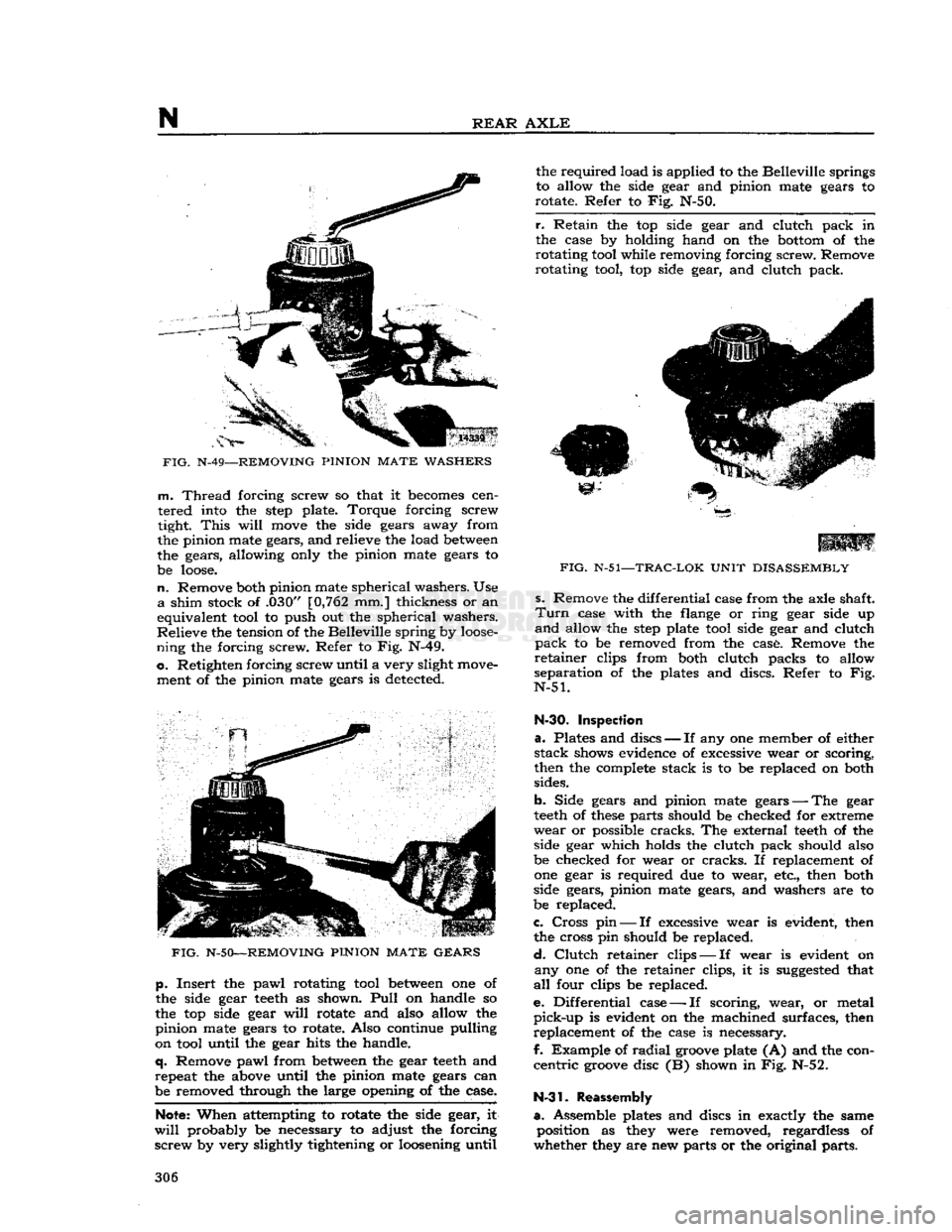
m.
Thread
forcing screw so that it becomes cen
tered into the
step
plate. Torque forcing screw
tight.
This
will
move the side gears away from
the pinion mate gears, and relieve the load between
the gears, allowing only the pinion mate gears to
be
loose.
n.
Remove both pinion mate spherical washers. Use
a
shim stock of .030" [0,762 mm.] thickness or an
equivalent tool to push out the spherical washers.
Relieve
the tension of the Belleville spring by
loose
ning
the forcing screw. Refer to Fig. N-49.
o.
Retighten forcing screw until a very slight move ment of the pinion mate gears is detected.
FIG.
N-50—-REMOVING
PINION
MATE
GEARS
p.
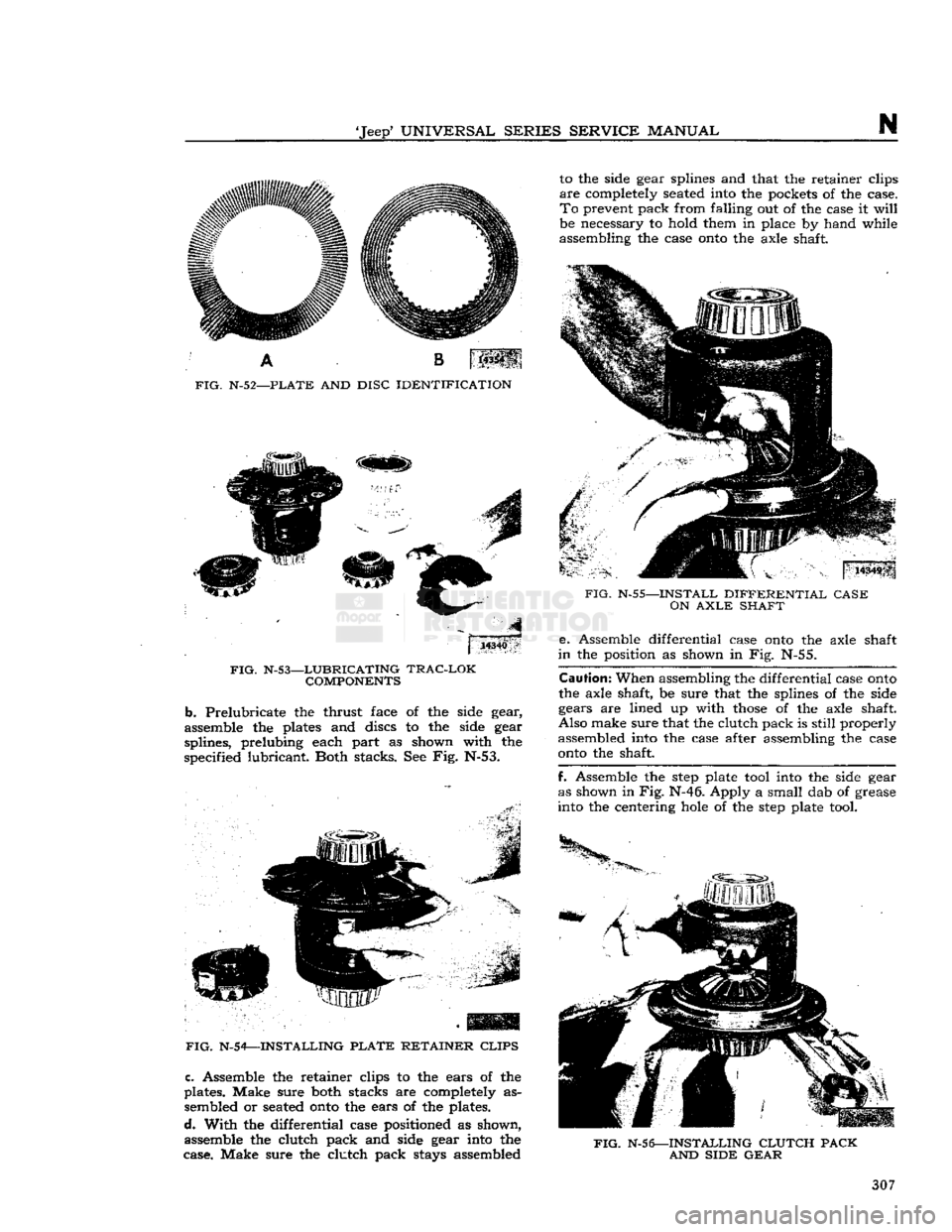
Insert the pawl rotating tool between one of
the side gear
teeth
as shown.
Pull
on handle so
the top side gear
will
rotate and also allow the
pinion mate gears to rotate. Also continue pulling
on tool until the gear hits the handle,
q.
Remove pawl from between the gear
teeth
and
repeat the above until the pinion mate gears can
be removed through the large opening of the case.
Note:
When attempting to rotate the side gear, it
will
probably be necessary to adjust the forcing
screw
by very slightly tightening or loosening until the required load is applied to the Belleville springs
to allow the side gear and pinion mate gears to
rotate. Refer to Fig. N-50.
r.
Retain the top side gear and clutch pack in
the case by holding hand on the bottom of the
rotating tool while removing forcing screw. Remove
rotating tool, top side gear, and clutch pack.
FIG.
N-51—-TRAC-LOK
UNIT
DISASSEMBLY
s. Remove the differential case from the axle shaft.
Turn
case with the flange or ring gear side up
and
allow the
step
plate tool side gear and clutch
pack
to be removed from the case. Remove the
retainer
clips from both clutch packs to allow
separation of the plates and discs. Refer to Fig.
N-51.
N-30.
Inspection
a.
Plates and discs —
If
any one member of either
stack
shows evidence of excessive wear or scoring,
then the complete stack is to be replaced on both
sides.
b.
Side gears and pinion mate gears —
The
gear
teeth
of
these
parts should be checked for extreme
wear
or possible
cracks.
The external
teeth
of the side gear which holds the clutch pack should also
be checked for wear or
cracks.
If replacement of one gear is required due to wear, etc., then both
side gears, pinion mate gears, and washers are to
be replaced.
c.
Cross
pin
— If excessive wear is evident, then
the cross pin should be replaced.
d.
Clutch
retainer clips — If wear is evident on
any
one of the retainer clips, it is
suggested
that
all
four clips be replaced.
e. Differential case — If scoring, wear, or metal
pick-up
is evident on the machined surfaces, then replacement of the case is necessary.
I.
Example of
radial
groove plate (A) and the con
centric
groove disc (B) shown in Fig. N-52.
N-31.
Reassembly
a.
Assemble plates and discs in exactly the same position as they were removed, regardless of
whether they are new parts or the original parts. 306
Page 307 of 376
'Jeep'
UNIVERSAL
SERIES
SERVICE
MANUAL
N
FIG.
N-52—PLATE
AND
DISC
IDENTIFICATION
I 14340
FIG.
N-S3—LUBRICATING
TRAC-LOK
COMPONENTS
b.
Prelubricate the thrust face of the side
gear,
assemble
the plates and discs to the side
gear
splines, prelubing each part as shown
with
the
specified
lubricant.
Both
stacks. See Fig. N-53.
FIG.
N-54—INSTALLING
PLATE
RETAINER
CLIPS
c. Assemble the retainer clips to the
ears
of the
plates. Make
sure
both
stacks
are completely as sembled or
seated
onto the
ears
of the plates.
d.
With
the
differential
case
positioned as shown,
assemble
the
clutch
pack and side
gear
into
the
case.
Make
sure
the
clutch
pack
stays
assembled
to
the side
gear
splines and that the retainer clips
are completely
seated
into
the pockets of the
case.
To
prevent pack
from
falling
out of the
case
it
will
be
necessary
to
hold
them in place by hand
while
assembling the
case
onto the axle shaft.
FIG.
N-55—INSTALL
DIFFERENTIAL
CASE
ON
AXLE
SHAFT
e. Assemble
differential
case
onto the axle shaft
in
the position as shown in Fig. N-55.
Caution:
When assembling the
differential
case
onto
the axle shaft, be
sure
that the splines of the side
gears
are
lined
up
with
those
of the axle shaft.
Also
make
sure
that the
clutch
pack is
still
properly
assembled
into
the
case
after assembling the
case
onto the shaft.
f. Assemble the
step
plate
tool
into
the side
gear
as shown in Fig. N-4 6.
Apply
a small dab of
grease
into
the centering hole of the
step
plate
tool.
FIG.
N-56—INSTALLING
CLUTCH
PACK
AND
SIDE
GEAR
307
Page 308 of 376
N
REAR
AXLE
FIG.
N-57—POSITIONING GEAR ROTATING TOOL
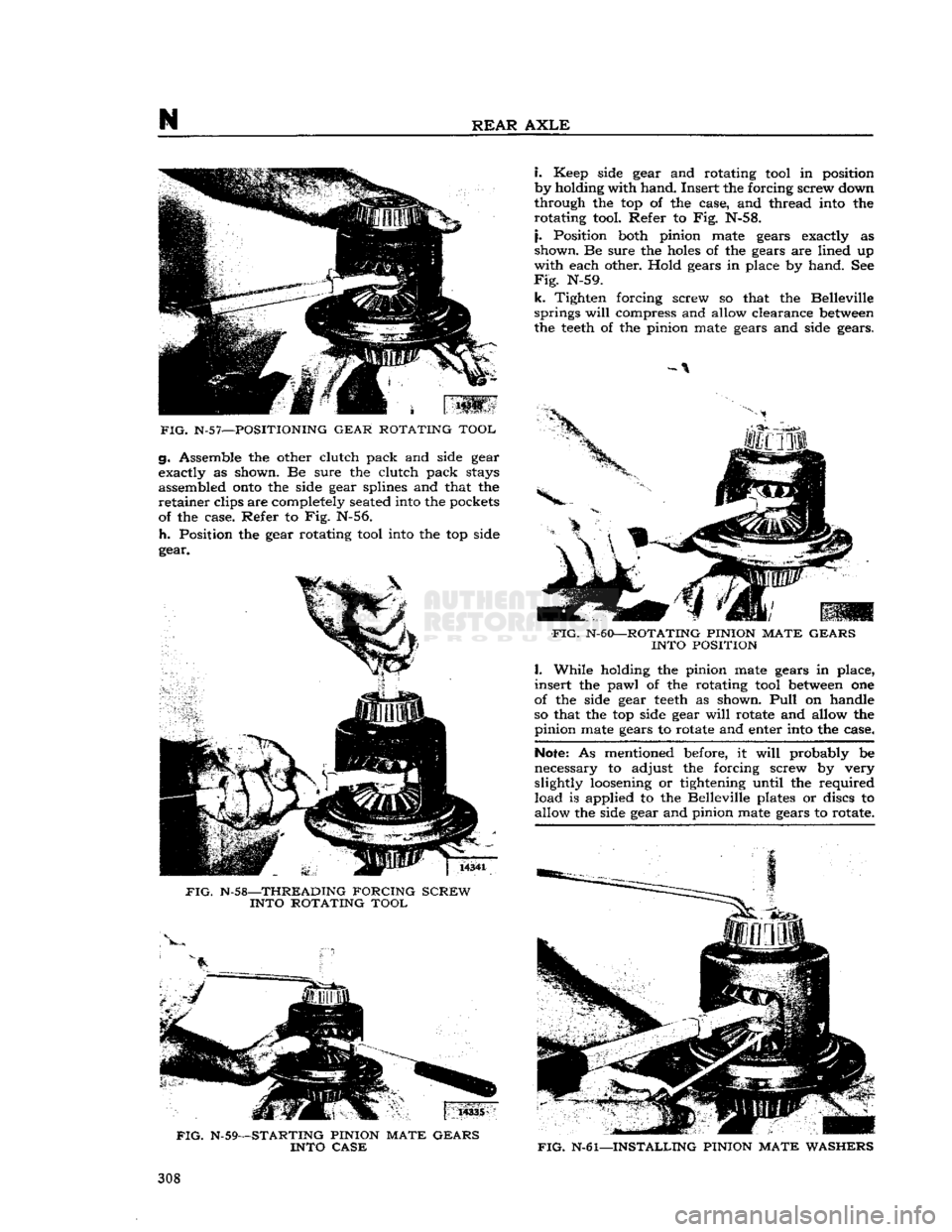
g. Assemble the other clutch pack and side gear
exactly as shown. Be sure the clutch pack stays
assembled
onto
the side gear splines and that the
retainer
clips are completely seated into the pockets
of the case. Refer to Fig. N-56.
h.
Position the gear rotating tool into the top side
gear.
FIG.
N-58—THREADING FORCING SCREW
INTO ROTATING TOOL
FIG.
N-59—STARTING PINION MATE GEARS INTO CASE
i.
Keep side gear and rotating tool in position
by holding with hand. Insert the forcing screw down
through the top of the case, and thread into the
rotating tool. Refer to Fig. N-58.
j.
Position both pinion mate gears exactly as
shown. Be sure the holes of the gears are lined up
with
each other. Hold gears in place by hand. See
Fig.
N-59.
k.
Tighten forcing screw so that the Belleville
springs
will
compress and allow clearance between
the
teeth
of the pinion mate gears and side gears.
FIG.
N-60—ROTATING PINION MATE GEARS
INTO POSITION
I.
While holding the pinion mate gears in place,
insert
the pawl of the rotating tool between one
of the side gear
teeth
as shown.
Pull
on handle
so that the top side gear
will
rotate and allow the pinion mate gears to rotate and enter into the case.
Note:
As mentioned before, it
will
probably be
necessary to adjust the forcing screw by very
slightly loosening or tightening until the required load is applied to the Belleville plates or discs to allow the side gear and pinion mate gears to rotate.
FIG.
N-61—INSTALLING PINION MATE WASHERS
308
Page 327 of 376
'Jeep'
UNIVERSAL
SERIES SERVICE
MANUAL
P
lengthening of the brake master cylinder eye bolt.
This
is
done
so the primary cup
will
clear the by
pass port when the piston is in the off position,
otherwise the compensating action of the master
cylinder
for expansion and contraction of the fluid
in
the system, due to temperature changes,
will
be destroyed and cause the brakes to drag.
Note:
Some older 'Jeep' vehicles may
develop
side
movement
of the clutch and brake pedals resulting
from wear of the pedals, shafts, and bushings. One
way to
compensate
for this wear is to install a pedal
slack
adjuster kit,
Part
No.
921936.
FIG.
P-6—HAND
BRAKE
ADJUSTMENT
P-10.
Hand Brake
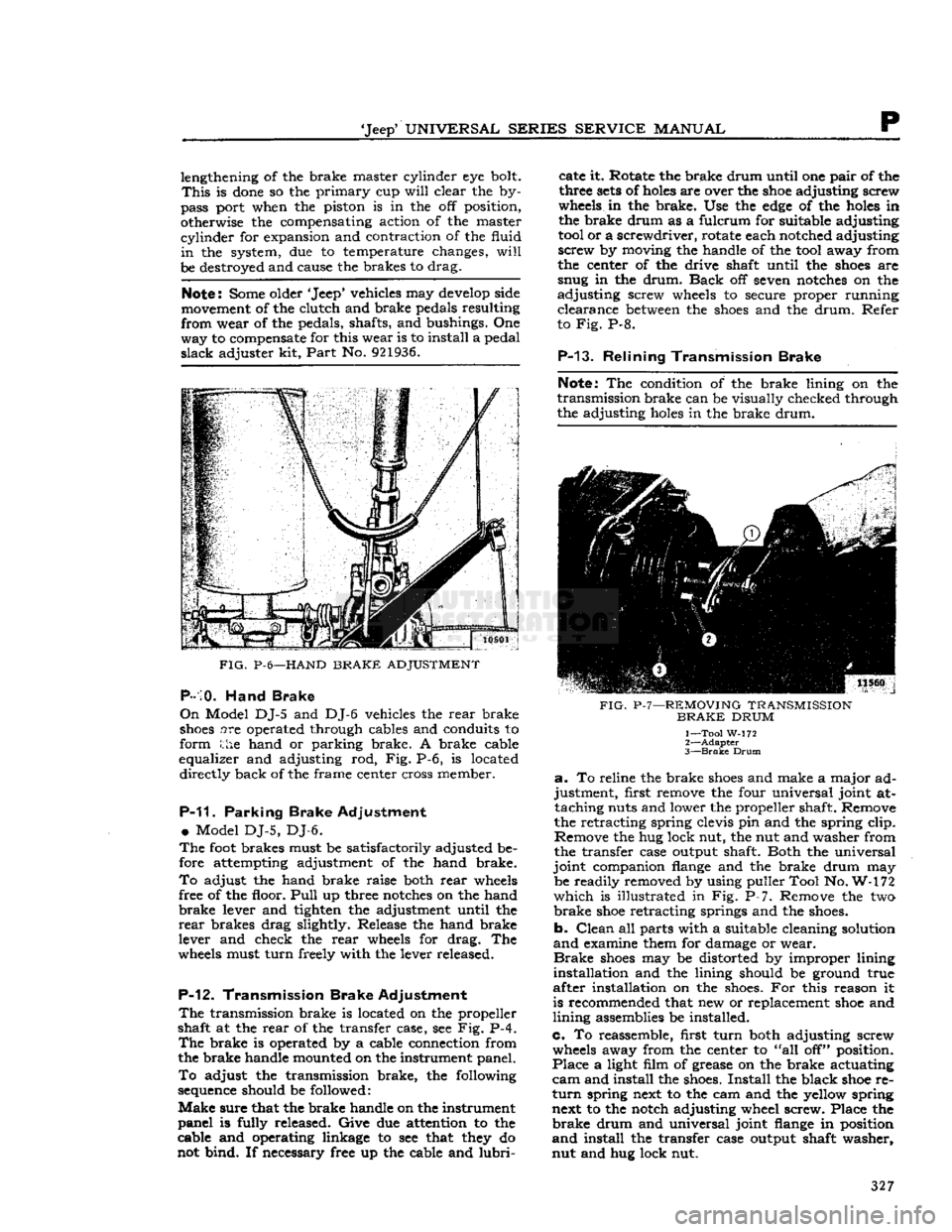
On
Model DJ-5 and DJ-6 vehicles the rear brake
shoes
are operated through cables and conduits to
form the hand or parking brake. A brake cable
equalizer and adjusting rod, Fig. P-6, is located directly back of the frame center cross member.
P-11.
Parking Brake Adjustment
•
Model DJ-5, DJ-6.
The
foot
brakes must be satisfactorily adjusted be
fore attempting adjustment of the hand brake.
To
adjust the hand brake raise both rear
wheels
free of the floor.
Pull
up three
notches
on the hand
brake
lever and tighten the adjustment until the
rear
brakes drag slightly. Release the hand brake
lever and check the rear
wheels
for drag. The
wheels
must turn freely with the lever released.
P-12.
Transmission Brake Adjustment
The
transmission brake is located on the propeller
shaft at the rear of the transfer case, see Fig. P-4.
The
brake is operated by a cable connection from
the brake handle mounted on the instrument panel.
To
adjust the transmission brake, the following
sequence
should be followed:
Make
sure that the brake handle on the instrument
panel is fully released. Give due attention to the
cable and operating linkage to see that
they
do
not bind. If necessary free up the cable and
lubri
cate it. Rotate the brake drum until one pair of the
three
sets
of
holes
are over the
shoe
adjusting screw
wheels
in the brake. Use the
edge
of the
holes
in
the brake drum as a fulcrum for suitable adjusting
tool
or a screwdriver, rotate each notched adjusting
screw by moving the handle of the
tool
away from
the center of the drive shaft until the
shoes
are
snug in the drum.
Back
off seven
notches
on the
adjusting screw
wheels
to secure proper running clearance
between
the
shoes
and the drum. Refer
to Fig. P-8.
P-13.
Relining Transmission Brake
Note:
The condition of the brake lining on the
transmission brake can be visually checked through
the adjusting
holes
in the brake drum.
FIG.
P-7—REMOVING
TRANSMISSION
BRAKE
DRUM
1— Tool W-172
2—
Adapter
3—
Brake
Drum
a.
To reline the brake
shoes
and make a major ad
justment, first remove the four universal joint at taching nuts and lower the propeller shaft. Remove
the retracting spring clevis pin and the spring clip.
Remove the hug lock nut, the nut and washer from
the transfer case output shaft. Both the universal
joint companion
flange
and the brake drum may be readily removed by using puller Tool No. W-172
which
is illustrated in Fig. P-7. Remove the two
brake
shoe
retracting springs and the
shoes.
b. Clean all parts with a suitable cleaning solution
and
examine them for damage or wear.
Brake
shoes
may be distorted by improper lining
installation and the lining should be ground true
after installation on the
shoes.
For this reason it
is recommended that new or replacement
shoe
and
lining assemblies be installed.
c. To reassemble, first turn both adjusting screw
wheels
away from the center to "all off" position.
Place a light film of grease on the brake actuating
cam
and install the
shoes.
Install the black
shoe
re
turn
spring next to the cam and the yellow spring next to the notch adjusting wheel screw. Place the
brake
drum and universal joint
flange
in position
and
install the transfer case output shaft washer,
nut and hug lock nut. 327
Page 351 of 376
'Jeep'
UNIVERSAL
SERIES
SERVICE
MANUAL
T
BODY
Contents
SUBJECT
PAR.
Brake
and
Clutch
Pedal Pads T-7
Canvas
Tops T-5
Care
of
Fabric
Tops. : T-6
Front
Seat Adjustment. . . T-8
Passenger Seat Safety
Catch
. .T-9
Windshield
T-2, T-3
Windshield
Glass and Weatherstrip T-4
T-1.
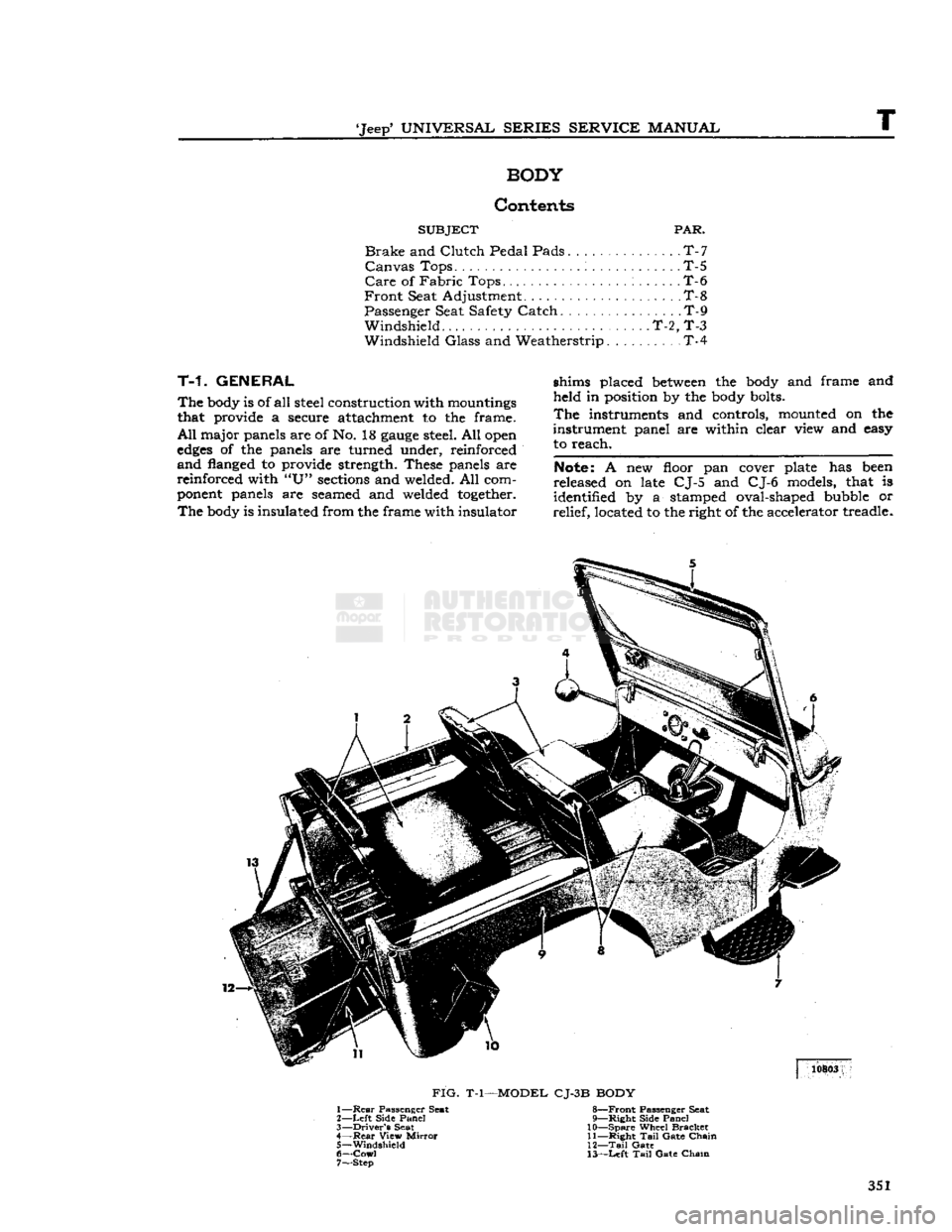
GENERAL
The
body
is of
all
steel construction with mountings
that provide a secure attachment to the frame.
All
major panels are of No. 18
gauge
steel. All
open
edges
of the panels are turned under, reinforced
and
flanged to provide strength. These panels are reinforced with
"U"
sections
and welded. All com
ponent
panels are seamed and welded
together.
The
body
is insulated from the frame with insulator shims placed
between
the
body
and frame and
held in position by the
body
bolts.
The
instruments and controls, mounted on the
instrument panel are within clear view and easy
to reach.
Note:
A new floor pan cover plate has
been
released on late CJ-5 and CJ-6 models, that is
identified by a stamped oval-shaped bubble or
relief, located to the right of the accelerator treadle.
FIG.
T-l—MODEL CJ-3B BODY
1—
Rear
Passenger Seat 8—Front Passenger Seat
2—
Left
Side
Panel
9—Right Side
Panel
3—
Driver's
Seat 10—Spare Wheel
Bracket
4—
Rear
View
Mirror
11—Right
Tail
Gate
Chain
5—
Windshield
12—Tail
Gate
6—
Cowl
13—Left
Tail
Gate
Chain
7— Step
351
Page 354 of 376
T
BODY
from the windshield wiper vacuum fitting. On
late
models
disconnect electrical wires from wiper
motor. Unlatch the two windshield clamps on each
side
of the windshield.
Fold
the windshield forward
until
the
slot
in the windshield
hinges
aligns with the flat
side
of the pin in the
body
hinges.
Slip wind
shield off the pins and remove from
body.
T-4.
Windshield Glass
The
windshield
glass
is mounted in a rubber
weatherstrip which in turn
mounts
in the frame. A
rubber
locking strip, which
holds
the
glass
firmly in
the frame, is inserted in a moulded
groove
around
the rear
face
of the weatherstrip as shown in Fig.
T-2.
To remove the
glass
it is necessary to first
remove the locking strip which may be pried out
with a screwdriver or similar
tool.
Installation is,
obvious.
T-5.
Canvas Tops
Canvas
tops
are available in
Half
Tops and
Full
Tops.
Installation instructions are provided with
each canvas top kit for each model vehicle.
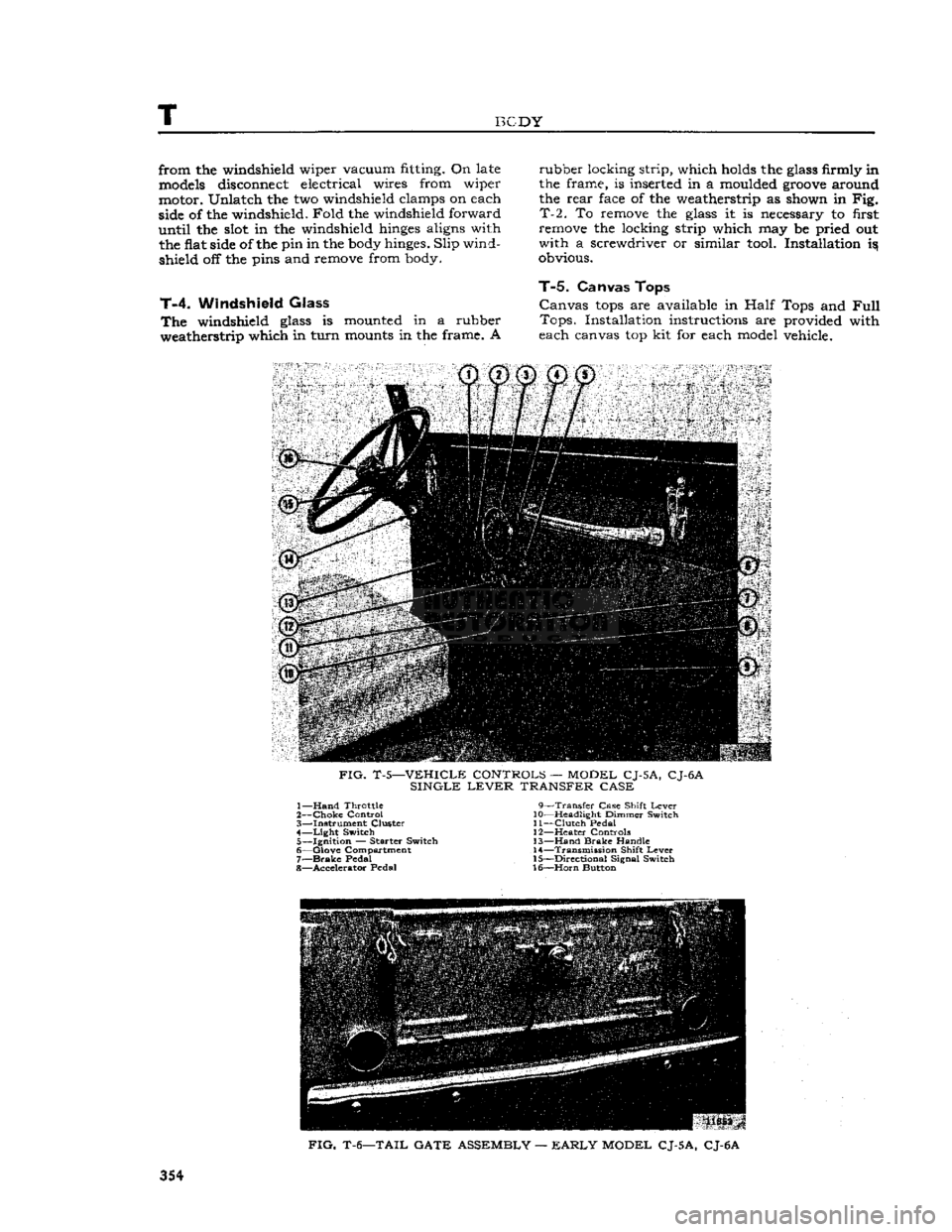
FIG.
T-5—VEHICLE CONTROLS — MODEL CJ-5A, CJ-6A
SINGLE
LEVER
TRANSFER CASE 1—
Hand
Throttle 9—Transfer Case Shift
Lever
2—
Choke
Control 10—Headlight Dimmer Switch
3— Instrument Cluster 11—Clutch Pedal 4—
Light
Switch 12—Heater Controls 5— Ignition — Starter Switch 13—Hand
Brake
Handle
6— Glove Compartment 14—Transmission Shift
Lever
7—
Brake
Pedal 15—Directional Signal Switch
8— Accelerator Pedal 16—Horn Button
FIG.
T-6—TAIL GATE ASSEMBLY —
EARLY
MODEL CJ-5A, CJ-6A
354
Page 355 of 376
'Jeep'
UNIVERSAL
SERIES
SERVICE
MANUAL
T
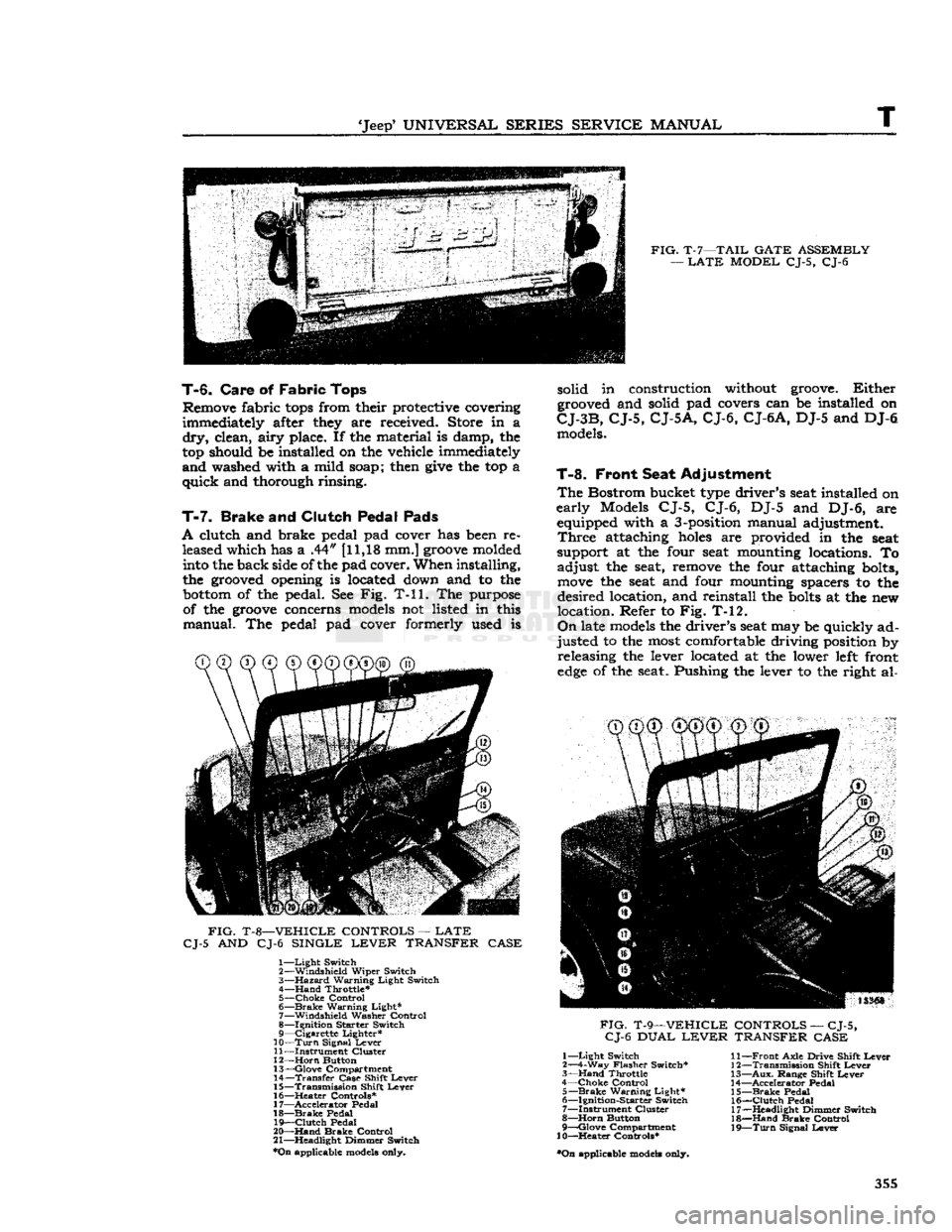
FIG.
T-7—TAIL
GATE
ASSEMBLY
—
LATE
MODEL
CJ-5, CJ-6
T-6.
Care
of
Fabric
Tops
Remove fabric
tops
from their protective covering
immediately after they are received. Store in a
dry,
clean,
airy
place. If the material is damp, the
top should be installed on the vehicle immediately
and
washed with a mild soap; then
give
the top a
quick
and thorough rinsing.
T-7.
Brake
and
Clutch Pedal Pads
A
clutch and brake pedal pad cover has been re leased which has a .44" [11,18 mm.]
groove
molded into the back side of the pad cover. When installing,
the grooved opening is located down and to the
bottom
of the pedal. See Fig. T-ll. The purpose of the
groove
concerns models not listed in this
manual.
The pedal pad cover formerly used is
FIG.
T-8—VEHICLE
CONTROLS
—
LATE
CJ-5
AND CJ-6
SINGLE
LEVER
TRANSFER
CASE
1—
Light
Switch
2—
Windshield
Wiper
Switch
3—
Hazard
Warning
Light
Switch
4—
Hand
Throttle*
5—
Choke
Control
6—
Brake
Warning
Light*
7—
Windshield
Washer
Control
8—
Ignition
Starter
Switch
9—
Cigarette
Lighter*
10—
Turn
Signal
Lever
11—
Instrument
Cluster
12—
Horn
Button
13—
Glove
Compartment
14—
Transfer
Case
Shift
Lever
15—
Transmission
Shift
Lever
16—
^Heater
Controls*
17—
Accelerator
Pedal
18—
Brake
Pedal
19—
Clutch
Pedal
20—
Hand
Brake
Control
21—
Headlight
Dimmer
Switch
*On
applicable models only. solid in construction without groove.
Either
grooved and solid pad covers can be installed on
CJ-3B,
CJ-5,
CJ-5A,
CJ-6,
CJ-6A,
DJ-5 and DJ-6 models.
T-8.
Front Seat Adjustment
The
Bostrom bucket type driver's seat installed on
early
Models CJ-5, CJ-6, DJ-5 and DJ-6, are equipped with a 3-position manual adjustment.
Three
attaching
holes
are provided in the seat
support at the four seat mounting locations. To
adjust
the seat, remove the four attaching bolts,
move
the seat and four mounting spacers to the
desired
location, and reinstall the
bolts
at the new
location. Refer to Fig. T-12.
On
late models the driver's seat may be quickly ad
justed
to the most comfortable driving position by releasing the lever located at the lower left front
edge
of the seat. Pushing the lever to the right al-
CD CD®
®@©"®^
FIG.
T-9—VEHICLE
CONTROLS
—
CJ-5,
CJ-6
DUAL
LEVER
TRANSFER
CASE
1—
Light
Switch
2—4-Way
Flasher
Switch*
3—
Hand
Throttle
4—
Choke
Control
5—
Brake
Warning
Light*
6—
Ignition-Starter
Switch
7—
Instrument
Cluster
8—
Horn
Button
9—
Qlove
Compartment
10—Heater
Controls*
•On
applicable models only.
11—
Front
Axle
Drive
Shift
Lever
12—
Transmission
Shift
Lever
13—
Aux.
Range
Shift
Lever
14—
Accelerator
Pedal
15—
Brake
Pedal
16—
Clutch
Pedal
17—
Headlight
Dimmer
Switch
18—
Hand
Brake
Control
19—
Turn
Signal
Lever
355
Page 356 of 376
T
BODY
lows
the seat to be
moved forward
or
rearward.
Re
positioning
the
lever
to the
left
will
lock
the seat
in
the
desired position.
T-9.
Passenger
Seat
Safety
Catch
Thejfront
passenger seat on
late model vehicles
is
provided
with
a
safety
catch, located
at the
left
rear
base of the seat. To
tilt
the seat
forward,
first
release
the
catch
by
pulling
upwards
on the
catch lever. 11213
.
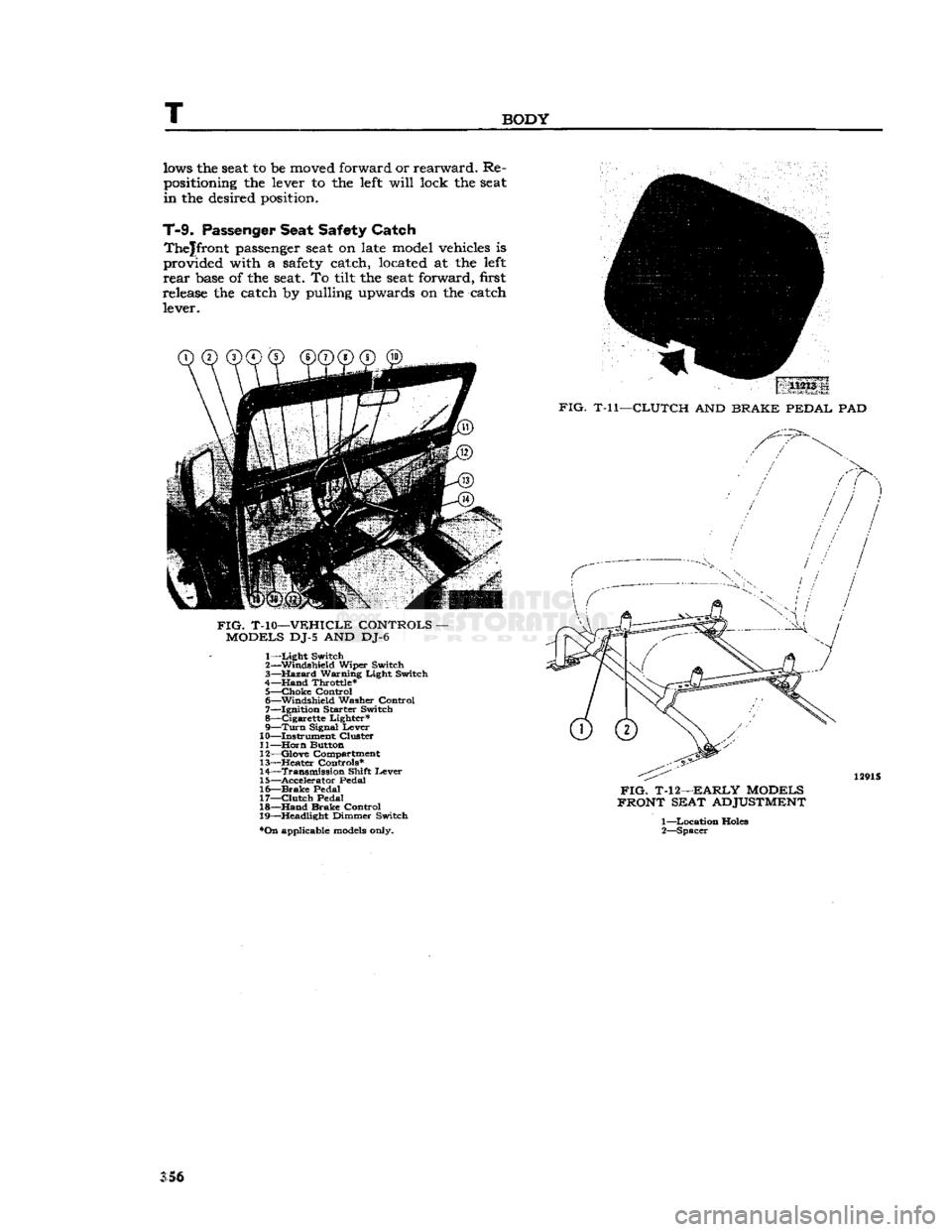
FIG.
T-ll—CLUTCH
AND
BRAKE PEDAL
PAD
FIG.
T-10—VEHICLE CONTROLS
-
MODELS
DJ-5 AND DJ-6 1—
Light
Switch
2— Windshield Wiper Switch
3—
Hazard
Warning Light Switch
4—Hand Throttle*
5—
choke
Control
6— Windshield
Washer
Control
7— Ignition
Starter
Switch
8— Cigarette Lighter* 9—
Turn
Signal Lever
10— Instrument Cluster
11—
Horn
Button
12— Glove Compartment
13—
Heater
Controls*
14— Transmission Shift Lever
15— Accelerator
Pedal
16—
Brake
Pedal
17—
Clutch
Pedal
18—
Hand
Brake Control
19— Headlight Dimmer Switch
*On
applicable
models
only.
FIG.
T-12—EARLY MODELS
FRONT SEAT
ADJUSTMENT
1—
Location Holes
2— Spacer
S5§