1953 JEEP CJ air condition
[x] Cancel search: air conditionPage 327 of 376
'Jeep'
UNIVERSAL
SERIES SERVICE
MANUAL
P
lengthening of the brake master cylinder eye bolt.
This
is
done
so the primary cup
will
clear the by
pass port when the piston is in the off position,
otherwise the compensating action of the master
cylinder
for expansion and contraction of the fluid
in
the system, due to temperature changes,
will
be destroyed and cause the brakes to drag.
Note:
Some older 'Jeep' vehicles may
develop
side
movement
of the clutch and brake pedals resulting
from wear of the pedals, shafts, and bushings. One
way to
compensate
for this wear is to install a pedal
slack
adjuster kit,
Part
No.
921936.
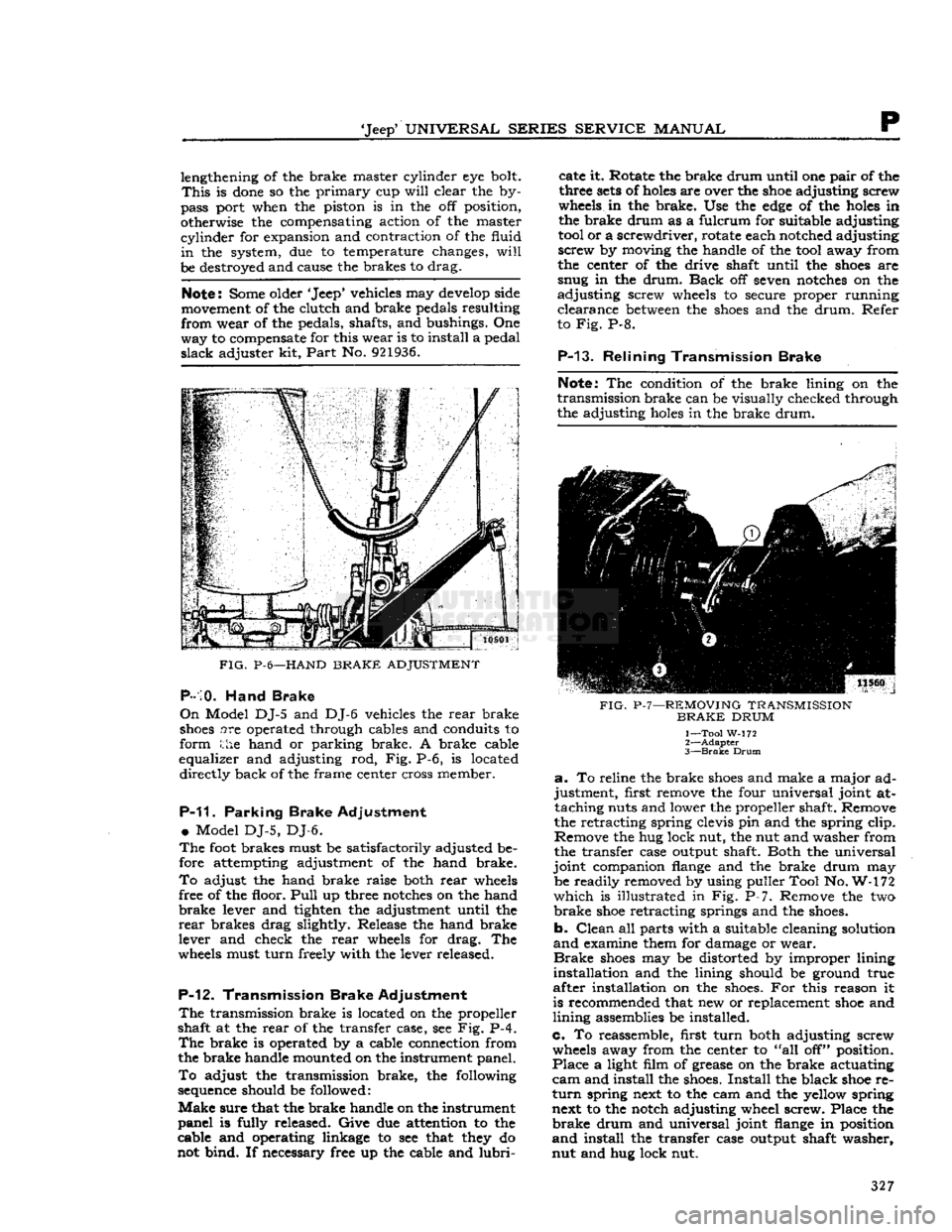
FIG.
P-6—HAND
BRAKE
ADJUSTMENT
P-10.
Hand Brake
On
Model DJ-5 and DJ-6 vehicles the rear brake
shoes
are operated through cables and conduits to
form the hand or parking brake. A brake cable
equalizer and adjusting rod, Fig. P-6, is located directly back of the frame center cross member.
P-11.
Parking Brake Adjustment
•
Model DJ-5, DJ-6.
The
foot
brakes must be satisfactorily adjusted be
fore attempting adjustment of the hand brake.
To
adjust the hand brake raise both rear
wheels
free of the floor.
Pull
up three
notches
on the hand
brake
lever and tighten the adjustment until the
rear
brakes drag slightly. Release the hand brake
lever and check the rear
wheels
for drag. The
wheels
must turn freely with the lever released.
P-12.
Transmission Brake Adjustment
The
transmission brake is located on the propeller
shaft at the rear of the transfer case, see Fig. P-4.
The
brake is operated by a cable connection from
the brake handle mounted on the instrument panel.
To
adjust the transmission brake, the following
sequence
should be followed:
Make
sure that the brake handle on the instrument
panel is fully released. Give due attention to the
cable and operating linkage to see that
they
do
not bind. If necessary free up the cable and
lubri
cate it. Rotate the brake drum until one pair of the
three
sets
of
holes
are over the
shoe
adjusting screw
wheels
in the brake. Use the
edge
of the
holes
in
the brake drum as a fulcrum for suitable adjusting
tool
or a screwdriver, rotate each notched adjusting
screw by moving the handle of the
tool
away from
the center of the drive shaft until the
shoes
are
snug in the drum.
Back
off seven
notches
on the
adjusting screw
wheels
to secure proper running clearance
between
the
shoes
and the drum. Refer
to Fig. P-8.
P-13.
Relining Transmission Brake
Note:
The condition of the brake lining on the
transmission brake can be visually checked through
the adjusting
holes
in the brake drum.
FIG.
P-7—REMOVING
TRANSMISSION
BRAKE
DRUM
1— Tool W-172
2—
Adapter
3—
Brake
Drum
a.
To reline the brake
shoes
and make a major ad
justment, first remove the four universal joint at taching nuts and lower the propeller shaft. Remove
the retracting spring clevis pin and the spring clip.
Remove the hug lock nut, the nut and washer from
the transfer case output shaft. Both the universal
joint companion
flange
and the brake drum may be readily removed by using puller Tool No. W-172
which
is illustrated in Fig. P-7. Remove the two
brake
shoe
retracting springs and the
shoes.
b. Clean all parts with a suitable cleaning solution
and
examine them for damage or wear.
Brake
shoes
may be distorted by improper lining
installation and the lining should be ground true
after installation on the
shoes.
For this reason it
is recommended that new or replacement
shoe
and
lining assemblies be installed.
c. To reassemble, first turn both adjusting screw
wheels
away from the center to "all off" position.
Place a light film of grease on the brake actuating
cam
and install the
shoes.
Install the black
shoe
re
turn
spring next to the cam and the yellow spring next to the notch adjusting wheel screw. Place the
brake
drum and universal joint
flange
in position
and
install the transfer case output shaft washer,
nut and hug lock nut. 327
Page 331 of 376
'Jeep*
UNIVERSAL SERIES SERVICE
MANUAL
P
f. On vehicles without a transmission brake hold
the brake
shoes
in their relative position and
engage
the parking brake cable
into
the parking
brake
lever.
g. On vehicles without a transmission brake in
stall
the parking brake strut and spring
between
the parking brake lever and the primary
shoe.
h.
Place the brake
shoes
on the backing plate and
install
the retainer pins, springs and retainers.
i.
Install the anchor pin plate.
j.
Install the lever and
sleeve
on the primary
shoe
then install the secondary return spring, then the
primary
return spring.
Important:
A
"L"
or "R" is located on the hex
agon
side of the lever crank for identification. The
lever crank marked "R" applies to the primary
shoe
on the
left
rear brake assembly. The lever
crank
marked
"L"
applies to the primary
shoe
on
the right rear brake assembly.
k. Place the upper linkage rod in the
groove
of the
anchor pin and
engage
the hook of the link rod
into
the adjusting lever.
I.
Install the brake drum. Install the wheel and
tire
assembly.
m. Adjust the brakes as described
below.
P-19.
Brake
Shoe
Initial
Adjustment —
a.
Should wheel brake units have
been
disassem bled for any reason, an initial adjustment
MUST
be made
before
drum installation.
b.
When the brake parts have
been
installed in
their correct position, initially adjust the adjusting
screw assemblies to a point where approximately Y% [9,53 mm.] of threads are
exposed
between
the
star
wheel and star wheel nut.
Note:
Following the initial adjustment and final
assembly, check brake pedal height to ensure
brake
operation. Then drive the car in reverse and
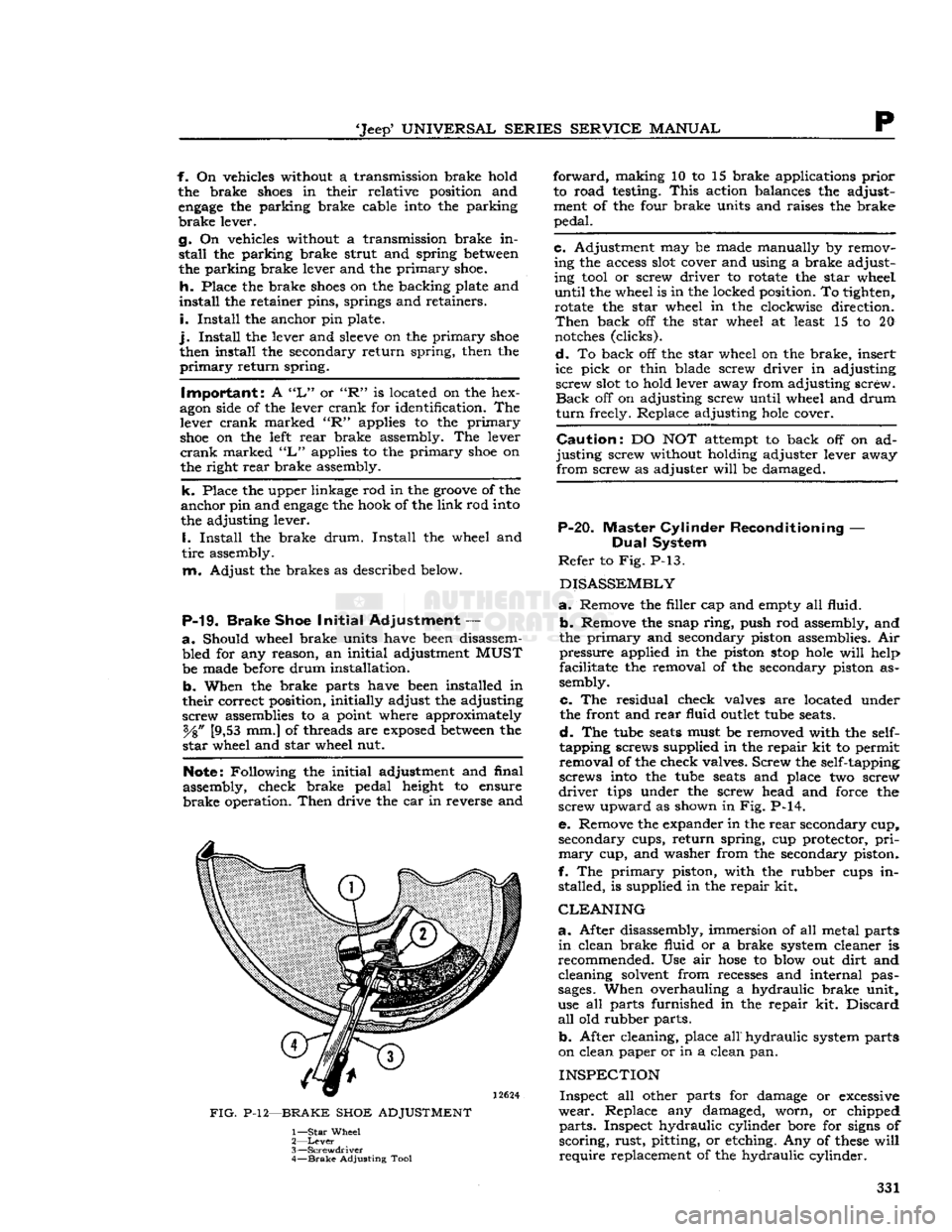
FIG.
P-12—BRAKE SHOE ADJUSTMENT
1—
Star
Wheel
2—
Lever
3—
Screwdriver
4—
Brake
Adjusting Tool
forward,
making 10 to 15 brake applications prior
to road testing.
This
action balances the adjust
ment of the four brake units and raises the brake
pedal.
c. Adjustment may be made manually by removing the access
slot
cover and using a brake adjust
ing
tool
or screw driver to rotate the star wheel
until
the wheel is in the locked position. To tighten, rotate the star wheel in the clockwise direction.
Then
back off the star wheel at least 15 to 20
notches
(clicks).
d.
To back off the star wheel on the brake, insert
ice pick or thin blade screw driver in adjusting screw
slot
to hold lever away from adjusting screw.
Back
off on adjusting screw until wheel and drum
turn
freely. Replace adjusting
hole
cover.
Caution:
DO NOT attempt to back off on ad
justing screw without holding adjuster lever away from screw as adjuster
will
be damaged.
P-20. Master Cylinder Reconditioning —
Dual
System
Refer
to Fig. P-13.
DISASSEMBLY
a.
Remove the filler cap and empty all fluid.
b.
Remove the snap ring, push rod assembly, and
the primary and secondary piston assemblies. Air pressure applied in the piston
stop
hole
will
help
facilitate the removal of the secondary piston as
sembly.
c. The residual check valves are located under
the front and rear fluid
outlet
tube
seats.
d.
The
tube
seats
must be removed with the
self-
tapping screws supplied in the repair kit to permit removal of the check valves. Screw the self-tapping
screws
into
the
tube
seats
and place two screw
driver
tips under the screw head and force the
screw upward as shown in Fig. P-14.
e. Remove the expander in the rear secondary cup, secondary cups, return spring, cup protector,
pri
mary
cup, and washer from the secondary piston.
f. The primary piston, with the rubber cups in stalled, is supplied in the repair kit.
CLEANING
a.
After disassembly, immersion of all metal parts
in
clean brake fluid or a brake system cleaner is
recommended. Use air
hose
to blow out dirt and cleaning solvent from recesses and internal pas
sages.
When overhauling a hydraulic brake unit,
use all parts furnished in the repair kit. Discard
all
old rubber parts.
b.
After cleaning, place
all"
hydraulic
system parts
on clean paper or in a clean pan.
INSPECTION
Inspect all other parts for damage or
excessive
wear.
Replace any damaged, worn, or chipped
parts.
Inspect hydraulic cylinder bore for
signs
of
scoring, rust, pitting, or etching. Any of
these
will
require
replacement of the hydraulic cylinder. 331
Page 333 of 376
'Jeep'
UNIVERSAL
SERIES SERVICE
MANUAL
P h.
Install
the tube seats, flat side toward the check
valve,
and press in with tube nuts or the master
cylinder
brake pipe tube nuts.
BLEEDING
a.
Before the master cylinder is installed on the
car,
the unit must be bled.
b.
Support the cylinder assembly in a vise and
fill
both fluid reservoirs with approved brake fluid,
e.
Loosely install a plug in each
outlet
of the
cylinder.
Depress the push rod several times until
air
bubbles cease to appear in the brake fluid.
d.
Tighten the plugs and attempt to depress the piston. The piston travel should be restricted after
all
air is expelled.
e.
Install
the master cylinder on the car and bleed
the hydraulic lines at the wheel cylinder. Refer to
Par.
P-7.
P-21.
Wheel
Cylinder
Reconditioning
•
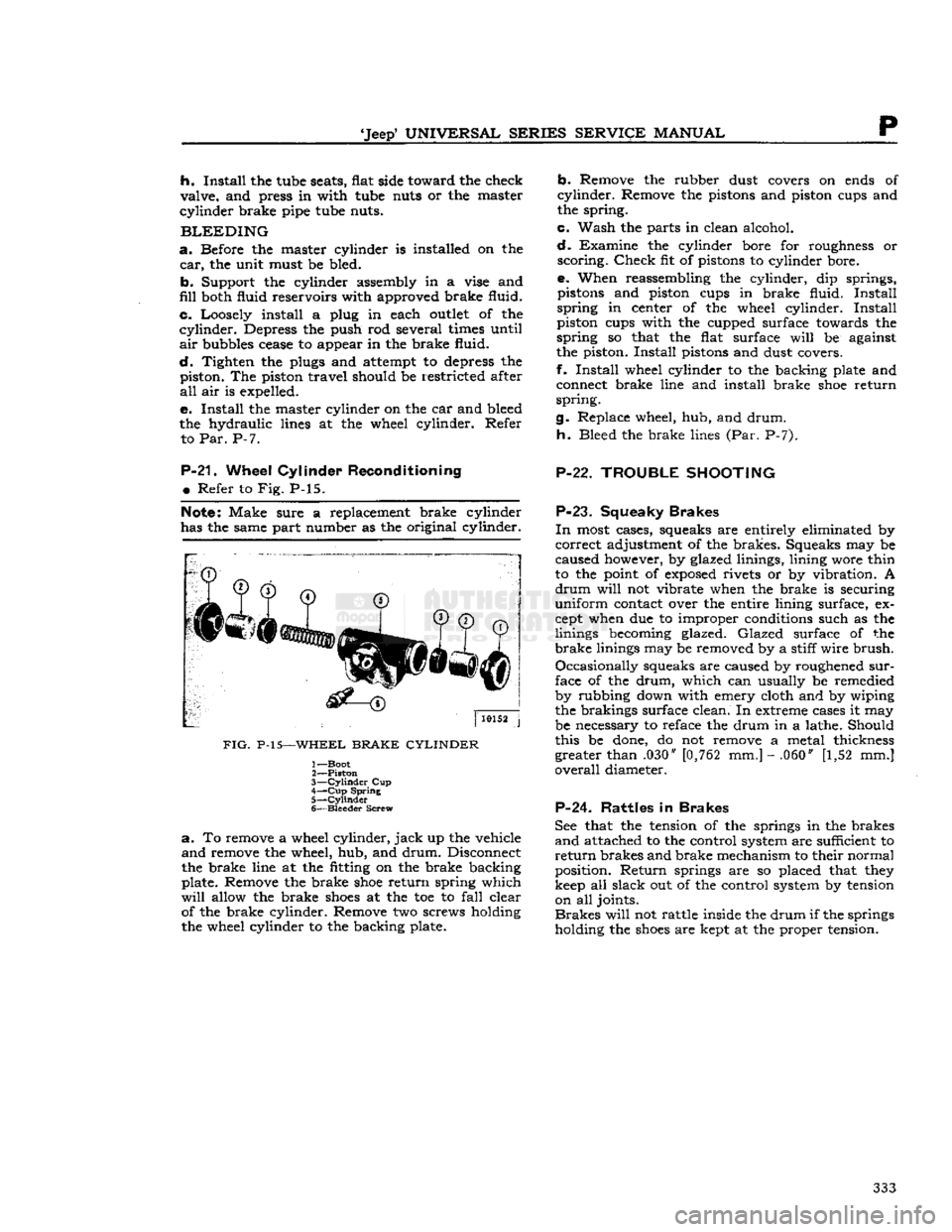
Refer to Fig. P-15.
Note:
Make sure a replacement brake cylinder
has the same part number as the original cylinder.
FIG.
P-15—WHEEL
BRAKE CYLINDER
1— Boot
2—
Piston
3—
Cylinder
Cup
4—
Cup
Spring
5—
Cylinder
6—
Bleeder
Screw
a.
To remove a wheel cylinder,
jack
up the vehicle
and
remove the wheel, hub, and
drum.
Disconnect
the brake line at the fitting on the brake backing
plate. Remove the brake
shoe
return spring which
will
allow the brake
shoes
at the toe to
fall
clear of the brake cylinder. Remove two screws holding
the wheel cylinder to the backing plate.
b.
Remove the rubber dust covers on ends of
cylinder.
Remove the pistons and piston cups and
the spring.
c.
Wash the parts in clean alcohol.
d.
Examine the cylinder bore for roughness or
scoring.
Check
fit of pistons to cylinder bore.
e. When reassembling the cylinder, dip springs, pistons and piston cups in brake fluid.
Install
spring
in center of the wheel cylinder.
Install
piston cups with the cupped surface towards the
spring
so that the flat surface
will
be against
the piston.
Install
pistons and dust covers.
f.
Install
wheel cylinder to the backing plate and connect brake line and install brake
shoe
return
spring.
g. Replace wheel, hub, and
drum.
h.
Bleed the brake lines (Par. P-7).
P-22. TROUBLE
SHOOTING
P-23.
Squeaky
Brakes
In
most cases, squeaks are entirely eliminated by
correct
adjustment of the brakes. Squeaks may be
caused however, by glazed linings, lining wore thin
to the point of
exposed
rivets or by vibration. A
drum
will
not vibrate when the brake is securing
uniform
contact over the entire lining surface, ex
cept when due to improper conditions such as the
linings becoming glazed.
Glazed
surface of the
brake
linings may be removed by a stiff
wire
brush.
Occasionally
squeaks are caused by roughened
sur
face of the
drum,
which can usually be remedied
by rubbing down with emery cloth and by wiping
the brakings surface clean. In extreme cases it may
be necessary to reface the drum in a lathe. Should
this be done, do not remove a metal thickness greater than .030" [0,762 mm.] - .060" [1,52 mm.]
overall
diameter.
P-24. Rattles
in
Brakes
See that the tension of the springs in the brakes
and
attached to the control system are sufficient to
return
brakes and brake mechanism to their normal
position.
Return
springs are so placed that they
keep all slack out of the control system by tension on all joints.
Brakes
will
not rattle inside the
drum
if the springs
holding the
shoes
are kept at the proper tension. 333
Page 339 of 376
'Jeep'
UNIVERSAL
SERIES
SERVICE
MANUAL
Q
ice, provide maximum safety over all
types
of
terrain,
and furnish the medium on which the
vehicle can be maneuvered with ease. Although
there are other
elements
of tire service, inflation maintenance is the most important and in many
instances the most neglected. The tire pressure should be maintained for safe operation. An under- inflated tire is dangerous as too much flexing can
cause breakage of the casing. Overinflation in time
may
cause a blowout.
Upon
careful inspection of tires, it may be found
that improper wheel alignment, balance, grabbing
brakes,
poor driving habits, fast cornering or other
conditions are the cause of wear. Such conditions
should be corrected.
a.
UNDERINFLATION
Underinflation
distorts the normal contour of the
tire
body and the tire
bulges
or "bellies out" with
an
extreme flexing action.
This
wears the tread at the
edges
more than the center and generates
excessive internal heat, weakening the cords and
resulting
in bruises, broken cords or ply separation.
Underinflation
also leads to rim bruises as in sufficient resistance is provided to prevent the tire
from
being jammed against the rim and crushed
or
cut when the tire strikes a
curb,
rock, or rut.
b.
OVERINFLATION
When
a tire is
overinf
lated,
increased tension caused by excessive pressure prevents proper deflection of
the sidewalls.
This
results in wear in the center of the tread and the tire also
loses
its ability to absorb
road
shocks. Under this increased
strain,
cords in the tread area eventually snap under impact, causing a casing break.
c.
MISALIGNMENT
WEAR
Excessive
wheel camber causes the tires to run at an angle to the road when camber is incorrect
it
will
cause excessive wear on one side of the
tire
tread.
Front
wheels should be straight ahead or toe-in slightly. When there is excessive toe-in or
toe-out,
tires
will
revolve with a side motion and scrape
the tread rubber off.
Front
tires
will
show wear on the outside with too great a toe-in condition
and
on the inside with a
toe-out
condition.
d.
BALANCE
Cupping
and bald spotting of tires is associated
with
wear on a vehicle driven mostly at high-way
speeds
without the recommended tire rotation and
with
unbalance conditions.
Q-12.
Tire
Care
Note;
For satisfactory 4-wheel drive operation, a
4-wheel drive vehicle
MUST
be equipped with the same size tires of equal circumference on all
four wheels. The tires must then be inflated to
proper
factory recommended pressures at all times.
Tire
pressure, tire rotation, wheel balance, and wheel alignment are the four vital factors that in
fluence the
extent
of tire life and the
ease
and safety of vehicle control.
Four
of the most common
tire
troubles are:
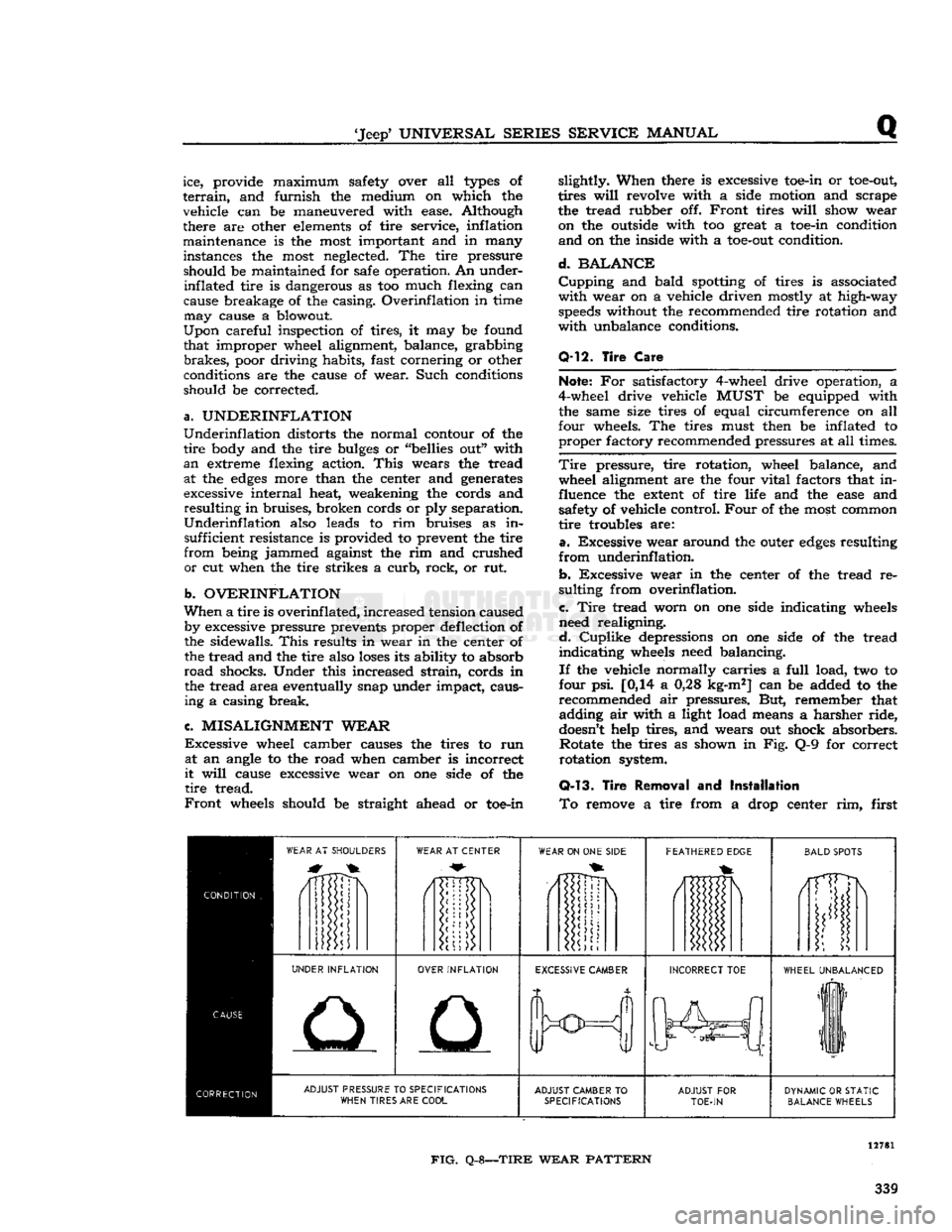
a.
Excessive wear around the outer
edges
resulting
from
underinflation.
b.
Excessive wear in the center of the tread re
sulting from overinflation.
c.
Tire
tread worn on one side indicating wheels
need realigning.
d.
Cuplike
depressions on one side of the tread
indicating
wheels need balancing.
If
the vehicle normally carries a
full
load, two to
four psi. [0,14 a 0,28 kg-m2] can be added to the
recommended air pressures. But, remember that adding air with a light load means a harsher ride,
doesn't
help tires, and wears out shock absorbers. Rotate the tires as shown in Fig. Q-9 for correct
rotation system.
Q-13.
Tire
Removal
and
Installation
To
remove a tire from a drop center rim, first
WEAR
AT SHOULDERS
WEAR
AT CENTER
WEAR
ON ONE
SIDE
FEATHERED
EDGE
BALD
SPOTS
/1TTDN
i
UNDER
INFLATION
OVER
INFLATION
EXCESSIVE
CAMBER
INCORRECT
TOE
WHEEL
UNBALANCED
liF
11
ADJUST
PRESSURE TO
SPECIFICATIONS
WHEN
TIRES ARE
COOL
ADJUST
CAMBER
TO
SPECIFICATIONS
ADJUST
FOR
TOE-IN
DYNAMIC
OR
STATIC
BALANCE
WHEELS
FIG.
Q-8—TIRE
WEAR
PATTERN
339