1953 JEEP CJ ECO mode
[x] Cancel search: ECO modePage 230 of 376

CLUTCH
is deeply scored or grooved, the part should be
replaced.
b. Inspect driven plate for wear or damage to fac
ings,
loose
rivets, broken or
loose
torsion springs,
and
flattened cushion springs. If facings are worn
near
rivets or are oily, replace the plate assembly.
A
slight amount of oil on clutch facings
will
cause
clutch
grab and chatter; excessive oil on facings
will
cause slippage. It is not practical to remove
oil
with solvents or by buffing since oil
will
con
tinue to bleed from facing material when hot. If
oil
is found on driven plate facings, examine trans
mission drainback hole, pilot bushing,
engine
rear
main
bearing and other points of possible oil leakage. Test the fit of driven plate hub on trans
mission main drive gear for an easy sliding fit.
c. Inspect clutch release bearing for scoring or ex cessive wear on front contact face. Test for rough
ness
of balls and races by pressing and turning
front race slowly. Inspect main drive gear pilot
bushing in crankshaft. Replace bushing if it is rough or worn. Regardless of whether the old plate
or
a new plate is to be installed, check the plate
for runout. Slide the driven plate, front side first,
over the transmission main drive gear shaft so that
it
is tight on the spline. Index a
dial
indicator to the plate facing as shown in
Fig.
1-9. While holding
firmly
against front end of main drive gear, to take up play in main drive gear bearing, slowly
rotate driven plate and observe the amount of
run
out shown by indicator. If runout of front facing
exceeds
.025" [0,635 mm.], replace the plate. It
is not practical to correct excessive runout by bending. 12769
FIG.
1-9—RUNOUT
CHECK
—
CLUTCH
PLATE
1—
Front
Facing
(Flywheel
Side)
2—
Dial
Indicator
Set
d.
Check
clutch pilot bushing for excessive wear
or
damage. Replace pilot bushing, if necessary, with
special
removal and installation
tools.
(See
Figs.
1-6 and 1-7). 1-13.
SERVICING
CLUTCH
PRESSURE
PLATE
AND
DISC
—
BORG
&
BECK
V6
(Late
Models)
The
Borg & Beck clutch is a single plate, dry disk
type. It provides smooth
engagement
of
engine
power to the wheels. The clutch consists of a pres
sure
plate assembly with pressure springs and
release levers, and driven plate assembly. The
driven
plate assembly
uses
spring center vibration
neutralizes and two flexible facings.
The
clutch driven plate is spring cushioned with a facing riveted to both sides. The coil springs around
the hub absorb the power shocks and cushion the
driving
mechanism. The clutch throw-out bearing is of the
ball
type, packed at time of manufacture,
and
requires no further lubrication.
No adjustment for wear is provided in the clutch itself. An individual adjustment is built into the
clutch
cover to adjust the height of the release
levers.
This
adjusting nut is locked in position
and
should never be disturbed unless the clutch assembly has been disassembled for the replace
ment of worn parts or to correct the height of the release levers.
When
the clutch pedal is depressed (disengaged),
the release bearing is moved toward the flywheel
and
contacts the inner ends of the release levers.
Each
lever is pivoted on a floating pin which re
mains stationary in the lever and rolls across a short flat portion of the enlarged
hole
in the eye-
bolt. The outer ends of the
eyebolts
extend
through
holes
in the stamped cover and are fitted
with
adjusting nuts to secure the levers in the
correct
position. The outer ends of the release levers
engage
the pressure plate lugs by means of ful-
crums,
which provide knife-edge contact
between
the outer ends of the levers and the lugs as shown
in
Fig.
I-10. 12190
FIG.
MO—CLUTCH
LEVER
POSITIONS
A—Clutch
Engaged
B—Clutch
Disengaged 1-14.
Clutch
Pressure Plate Adjustment
The
clutch pressure plate adjustment must be
checked before installing a new or reconditioned
clutch.
The proper spacer thickness and
gage
length for a particular clutch is listed in Par. 1-30.
Use
Clutch
Adjusting
Fixture
W-296. If the W-296
fixture is not available one can be fabricated as
described in Par. 1-26. 230
Page 239 of 376

'Jeep'
UNIVERSAL
SERIES
SERVICE
MANUAL
J
THREE-SPEED
TRANSMISSION
Contents
SUBJECT
PAR.
GENERAL
J-l
TRANSMISSION
SHIFTING
CONTROL.
. J-2
TRANSMISSION
REMOTE
CONTROL
ADJUSTMENT
J-3
REMOTE
CONTROL
DISASSEMBLY
J-4
REMOTE
CONTROL
REASSEMBLY.
. . . . J-5
TRANSMISSION
REMOVAL
J-6
SEPARATING
TRANSMISSION
AND
TRANSFER
CASE
J-7
SUBJECT
PAR.
DISASSEMBLY
OF
CANE
SHIFT
TRANSMISSION
J-8, J-12, J-16
Transmission
Cleaning and
Inspection J-10, J-18
Transmission
Interlocking Sleeve Inspection J-9
REASSEMBLY
OF
CANE
SHIFT
TRANSMISSION
J-ll,
J-14, J-19
SERVICE
DIAGNOSIS
J-20
TRANSMISSION
SPECIFICATIONS
J-21
J-1.
GENERAL
A
three speed synchromesh transmission is standard
equipment on all 'Jeep' Universal vehicles.
The
models T90 and T96 transmissions are used
with
the
Hurricane
F4 engine, and models
T86AA
and
T14A transmissions are used with the Daunt
less
V-6 engine. All model transmissions are similar
in
design with exception of the T14A which is a
fully
synchronized (all forward gears) transmission
with
helical drive gears throughout.
The
transmission assembly is attached to the
rear
face of the flywheel bell housing and is supported on a rubber insulator at the frame center cross member which forms the
rear
engine
support.
All
4-wheel-drive vehicles are equipped with a
transfer
case attached to the
rear
of the transmission.
Transfer
case service and repair procedures
are
described in Section
K.
Models
CJ-5A,
and
CJ-6A
are equipped with the
same transmission, but with a remote control shift.
Models DJ-5 and DJ-6 are equipped with a similar
transmission,
however, the construction is
some
what different because it is not designed to receive a transfer case for four-wheel drive.
For
DJ-5 and DJ-6 2WD vehicles, the trans mission repair procedures begin with Par. J-12.
J-2.
TRANSMISSION SHIFTING CONTROL
The
shift of the three-speed transmission is smooth
and
positive. The cane control lever shifts the trans
mission gears direct from the shift control housing
mounted to the top side of the transmission housing.
The
remote control lever shifts the transmission
gears through remote control rods attached to the
adjusting
levers of the shift shafts protruding from the left side of the transmission housing. Poppet
balls and springs retain the transmission gears in mesh and an interlocking mechanism prevents
shifting into two gears at the same time.
J-3.
Transmission Remote Control Adjustment
•
Early
CJ-5A,
CJ-6A
First
disconnect the transmission shift rods from the remote control levers.
Check
for binding of
the remote control shaft on the steering column
and
make the necessary corrections to eliminate any binding condition.
If
the shift is not smooth and positive, first make
sure
the gears are in neutral position then remove
the shift rods at the transmission by removing
clevis pins, Fig. J-l No. 17, and slip a short piece
of snug fitting 34" [6,35 mm.] aligning rod, through
the gearshift levers and housing as shown in insert
drawing.
This
places the clutch and shift lever assemblies
in
the neutral position. Adjust the shift rod yokes
at the transmission end, so clevis pins can be in stalled freely without moving the shift levers on the
transmission after which remove alignment pin.
If
shifting from first to second is difficult or trans
mission hangs in first gear, shorten the low and
reverse shift rod one
turn
at a time until the con
dition is corrected. Usually three turns are re
quired.
Should
the fault continue after completing the above adjustment, check further as outlined below.
First
remove the lubricating fitting. Use a narrow
feeler
gauge
which
will
enter the opening for the
lubricator
and check the clearance
between
the
faces of the shifting clutches.
This
clearance should
be .015" to .031", [W to W]
[0,397-0,794
mm.]. If
this clearance is greater the assembly must be removed for adjustment. The shift dog, which
engages
the clutch slots, should not have more than .009" [0,229 mm.] clearance in the slots. If the clear
ance
between
the clutch
grooves
and cross pins is
too great,
these
parts must be replaced.
J-4.
Removal
of
Remote Control
m
Early
CJ-5A,
CJ-6A
•
Refer to Fig. J-l
To
remove the remote control the following pro cedure is
suggested:
a.
Remove shifting rods from the transmission
and
also from the steering remote control clutch levers. 239
Page 241 of 376
'Jeep'
UNIVERSAL
SERIES
SERVICE
MANUAL
J
10489
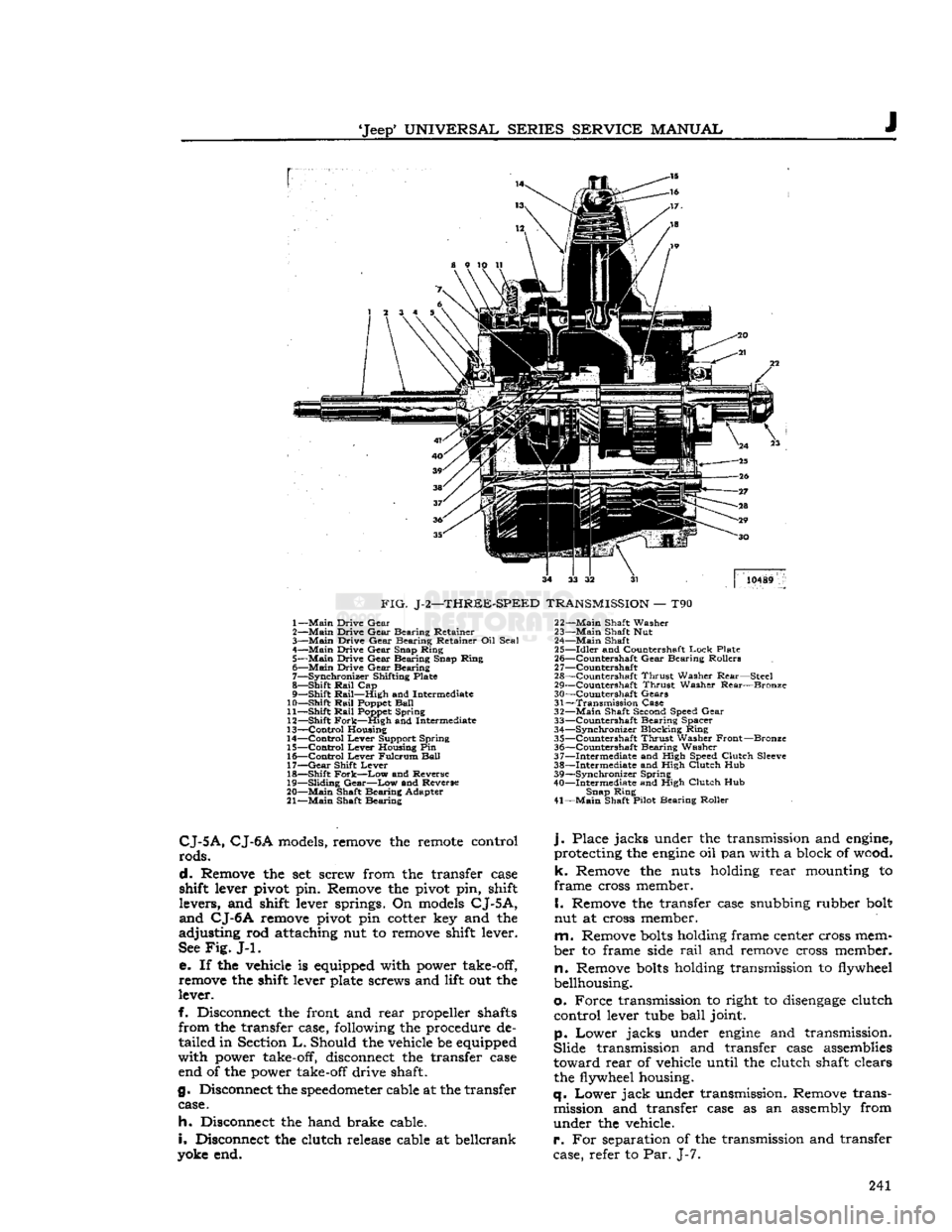
FIG.
J-2—THREE-SPEED
TRANSMISSION
— T90 1—
Main
Drive
Gear
2—
Main
Drive
Gear
Bearing
Retainer
3—
Main
Drive
Gear
Bearing
Retainer Oil
Seal
4—
Main
Drive
Gear
Snap
Ring
5—
Main
Drive
Gear
Bearing
Snap
Ring
6—
Main
Drive
Gear
Bearing
7—
Synchronizer
Shifting Plate
8—
Shift
Rail
Cap
9—
Shift
Rail—High
and Intermediate
10—
Shift
Rail
Poppet
Ball
11—
Shift
Rail
Poppet
Spring
12—
Shift
Fork—High
and Intermediate
13—
Control
Housing
14—
Control
Lever
Support
Spring
15—
Control
Lever
Housing Pin
16—
Control
Lever
Fulcrum
Ball
17—
Gear
Shift
Lever
18—
Shift
Fork—Low
and Reverse
19—
Sliding
Gear—Low
and Reverse
20—
Main
Shaft
Bearing
Adapter
21—
Main
Shaft
Bearing
22—
Main
Shaft
Washer
23—
Main
Shaft Nut
24—
Main
Shaft
25—
Idler
and Countershaft
Lock
Plate
26—
^Countershaft
Gear
Bearing
Rollers
2
7—Countershaft
28—
Countershaft
Thrust
Washer
Rear—Steel
29—
Countershaft
Thrust
Washer
Rear—Bronze
30—
Countershaft
Gears
31—
Transmission
Case
32—
Main
Shaft Second Speed
Gear
33—
Countershaft
Bearing
Spacer
34—
Synchronizer
Blocking
Ring
35—
Countershaft
Thrust
Washer
Front—Bronze
36—
Countershaft
Bearing
Washer
37—
Intermediate
and High Speed
Clutch
Sleeve
38—
Intermediate
and High
Clutch
Hub
39—
Synchronizer
Spring
40—
Intermediate
and High
Clutch
Hub
Snap
Ring
41—
Main
Shaft Pilot
Bearing
Roller
CJ-5A,
CJ-6A
models, remove the remote control
rods.
d.
Remove the set screw from the transfer case
shift lever pivot pin. Remove the pivot pin, shift
levers,
and shift lever springs. On models
CJ-5A,
and
CJ-6A
remove pivot pin cotter key and the
adjusting
rod attaching nut to remove shift lever.
See
Fig.
J-l.
e. If the vehicle is equipped with power take-off,
remove the shift lever plate screws and lift out the
lever.
f. Disconnect the front and
rear
propeller shafts
from
the transfer case, following the procedure de
tailed
in Section
L.
Should the vehicle be equipped
with
power take-off, disconnect the transfer case end of the power take-off drive shaft.
g. Disconnect the
speedometer
cable at the transfer case.
h.
Disconnect the hand brake cable.
i.
Disconnect the clutch release cable at beilcrank
yoke end.
j.
Place
jacks
under the transmission and engine,
protecting the
engine
oil pan with a block of wood,
k.
Remove the nuts holding
rear
mounting to
frame
cross member.
I.
Remove the transfer case snubbing rubber bolt
nut at cross member.
m.
Remove
bolts
holding frame center cross mem
ber
to frame side
rail
and remove cross member,
n.
Remove
bolts
holding transmission to flywheel
bellhousing.
o.
Force
transmission to right to
disengage
clutch
control
lever tube
ball
joint.
p.
Lower
jacks
under
engine
and transmission.
Slide
transmission and transfer case assemblies
toward
rear
of vehicle until the clutch shaft clears the flywheel housing.
q.
Lower
jack
under transmission. Remove trans mission and transfer case as an assembly from
under
the vehicle.
r.
For separation of the transmission and transfer
case, refer to Par. J-7. 241
Page 245 of 376
'Jeep*
UNIVERSAL
SERIES'
SERVICE
MANUAL
lightly
on the end of the
mainshaft
to
loosen
the
gear
and
separate
the two
units.
J-8.
Disassembly
—
T90,
T86AA
®
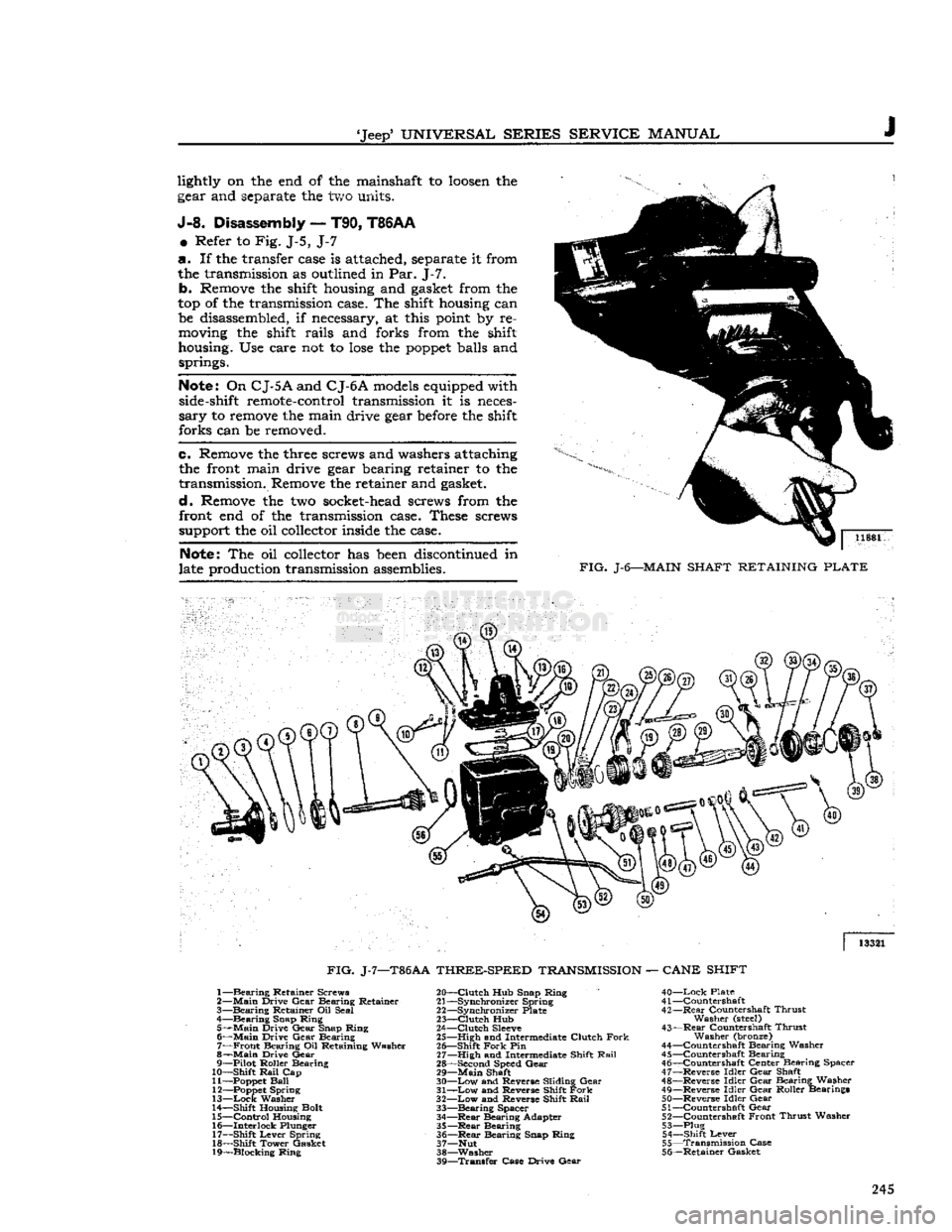
Refer to Fig. J-5, J-7
a. If the transfer
case
is
attached,
separate
it from
the
transmission
as
outlined
in Par. J-7. b.
Remove
the
shift
housing
and
gasket
from the
top of the
transmission
case.
The
shift
housing
can
be
disassembled,
if
necessary,
at
this
point
by re
moving
the
shift
rails and forks from the
shift
housing.
Use care not to
lose
the
poppet
balls
and
springs.
Note;
On
CJ-5
A
and
C
J-6A
models
equipped
with
side-shift
remote-control
transmission
it is
neces
sary to
remove
the main drive
gear
before
the
shift
forks can be
removed.
e.
Remove
the
three
screws
and
washers
attaching
the
front
main drive
gear
bearing
retainer to the
transmission.
Remove
the retainer and
gasket,
d.
Remove
the two
socket-head
screws
from the
front
end of the
transmission
case.
These
screws
support
the oil
collector
inside
the
case.
Note:
The oil
collector
has
been
discontinued
in
late
production
transmission
assemblies.
11881
FIG.
J-6—MAIN
SHAFT
RETAINING
PLATE
13321
FIG.
J-7—T86AA
THREE-SPEED
TRANSMISSION
—
CANE
SHIFT
1—
Bearing
Retainer Screws
2—
Main
Drive Gear Bearing Retainer
3—
Bearing
Retainer Oil Seal
,
4—Bearing Snap Ring
5—
Main
Drive Gear Snap Ring 6—
Main
Drive Gear Bearing 7—
Front
Bearing Oil Retaining Washer
8—
Main
Drive Gear
9— Pilot Roller Bearing
10— Shift
Rail
Cap
11—
Poppet
Ball
12—
Poppet
Spring
13—
Lock
Washer
14— Shift Housing Bolt
15—
Control
Housing 16— Interlock Plunger
17— Shift Lever Spring
18— Shift Tower Gasket
19— Blocking Ring 20—
Clutch
Hub Snap Ring
21— Synchronizer Spring
22— Synchronizer Plate
23—
Clutch
Hub
24—
Clutch
Sleeve
25— High and Intermediate Clutch
Fork
26— Shift
Fork
Pin
27— High and Intermediate Shift
Rail
28— Second Speed Gear 29—
Main
Shaft
30—
Low
and Reverse Sliding Gear
31—
Low
and Reverse Shift
Fork
32—
Low
and Reverse Shift
Rail
33—
Bearing
Spacer
34—
—Rear
Bearing Adapter
35—Rear
Bearing 36—
Rear
Bearing Snap Ring
37— Nut
38—Washer 39—
Transfer
Case Drive Gear
40—Lock
Plate
41 —Countershaft
42—
Rear
Countershaft Thrust Washer
(steel)
43—
Rear
Countershaft Thrust Washer (bronze)
44— Countershaft Bearing Washer
45— Countershaft Bearing 46— Countershaft Center Bearing Spacer
47— Reverse Idler Gear Shaft
48— Reverse Idler Gear Bearing Washer
49— Reverse Idler Gear Roller Bearings 50— Reverse Idler Gear
51— Countershaft Gear 52— Countershaft Front Thrust Washer
53— Plug 54— Shift Lever
55—
Transmission
Case
56— Retainer Gasket 245
Page 246 of 376
J
THREE-SPEED
TRANSMISSION
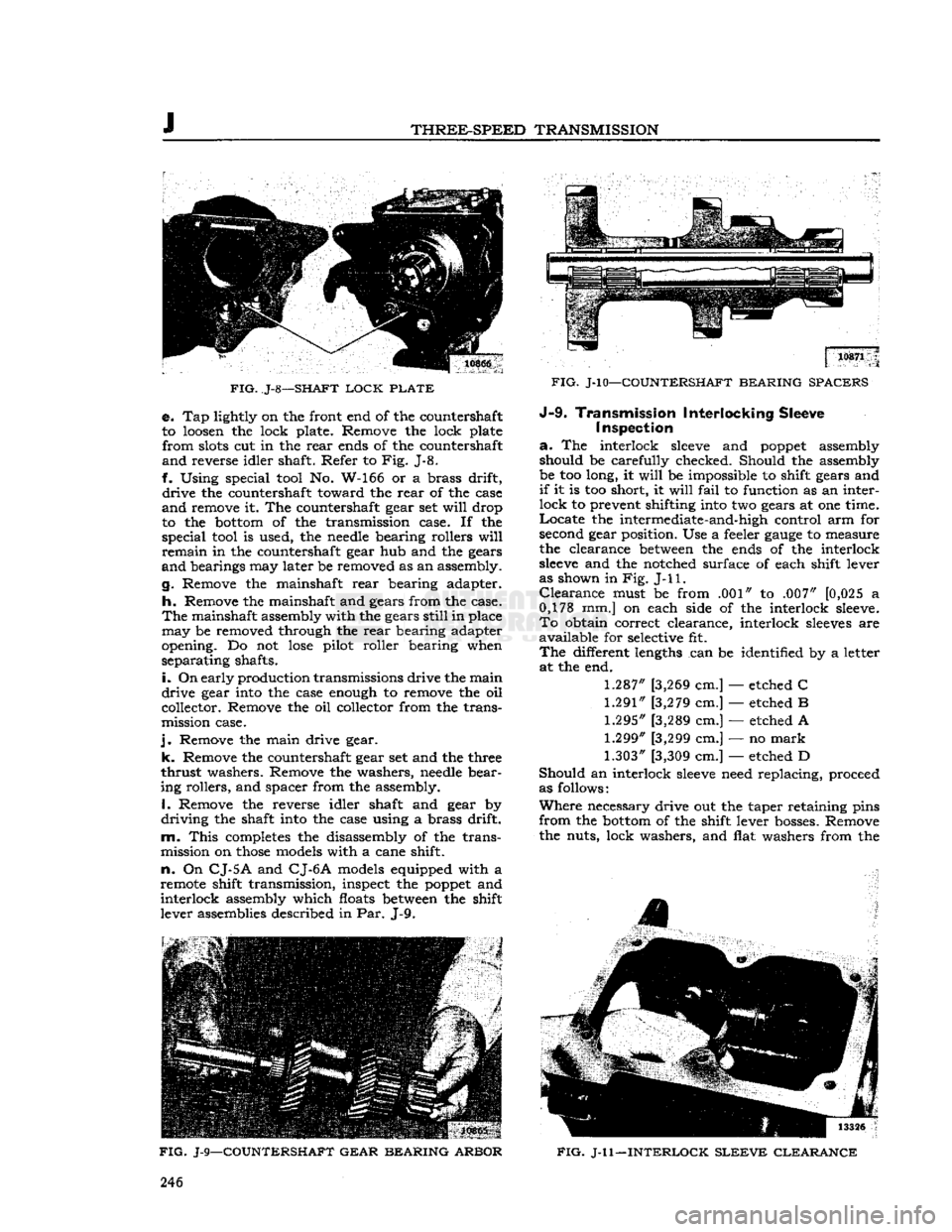
FIG.
J-8—SHAFT
LOCK
PLATE
e. Tap lightly on the front end of the countershaft
to loosen the lock plate. Remove the lock plate
from
slots cut in the
rear
ends of the countershaft
and
reverse idler shaft. Refer to Fig. J-8.
f. Using special tool No. W-166 or a brass drift,
drive
the countershaft toward the
rear
of the case
and
remove it. The countershaft gear set
will
drop
to the bottom of the transmission case. If the
special
tool is used, the needle bearing rollers
will
remain
in the countershaft gear hub and the gears
and
bearings may later be removed as an assembly.
g. Remove the mainshaft
rear
bearing adapter.
h.
Remove the mainshaft and gears from the case.
The
mainshaft assembly with the gears
still
in place
may
be removed through the
rear
bearing adapter
opening. Do not
lose
pilot roller bearing when
separating
shafts.
i.
On
early production transmissions drive the main
drive
gear into the case enough to remove the oil
collector. Remove the oil collector from the trans
mission case.
j.
Remove the main drive gear,
k.
Remove the countershaft gear set and the three
thrust
washers. Remove the washers, needle bear
ing rollers, and spacer from the assembly. 1, Remove the reverse idler shaft and gear by
driving
the shaft into the case using a brass drift,
m.
This
completes the disassembly of the trans
mission on
those
models with a cane shift,
n.
On
CJ-5
A
and
CJ-6 A
models equipped with a
remote shift transmission, inspect the poppet and
interlock
assembly which floats between the shift
lever assemblies described in Par. J-9.
FIG.
J-9—COUNTERSHAFT GEAR BEARING ARBOR
FIG.
J-l0—COUNTERSHAFT BEARING SPACERS J-9-
Transmission Interlocking Sleeve
I
inspection
a.
The interlock
sleeve
and poppet assembly should be carefully checked. Should the assembly
be too long, it
will
be impossible to shift gears and
if
it is too short, it
will
fail
to function as an inter
lock
to prevent shifting into two gears at one time.
Locate
the intermediate-and-high control arm for
second gear position. Use a feeler
gauge
to measure
the clearance between the ends of the interlock
sleeve
and the notched surface of each shift lever
as shown in Fig.
J-l
1.
Clearance
must be from .001" to .007" [0,025 a
0,178 mm.] on each side of the interlock sleeve.
To
obtain correct clearance, interlock
sleeves
are
available
for selective fit.
The
different lengths can be identified by a letter at the end.
1.287"
[3,269 cm.] — etched C
1.291"
[3,279 cm.] — etched B
1.295"
[3,289 cm.] — etched A
1.299"
[3,299 cm.] — no
mark
1.303"
[3,309 cm.] — etched D
Should
an interlock
sleeve
need replacing, proceed
as follows:
Where
necessary drive out the taper retaining pins
from
the bottom of the shift lever bosses. Remove
the nuts, lock washers, and flat washers from the
4
FIG.
J-l 1—INTERLOCK
SLEEVE
CLEARANCE
246
Page 257 of 376
'Jeep*
UNIVERSAL
SERIES
SERVICE
MANUAL
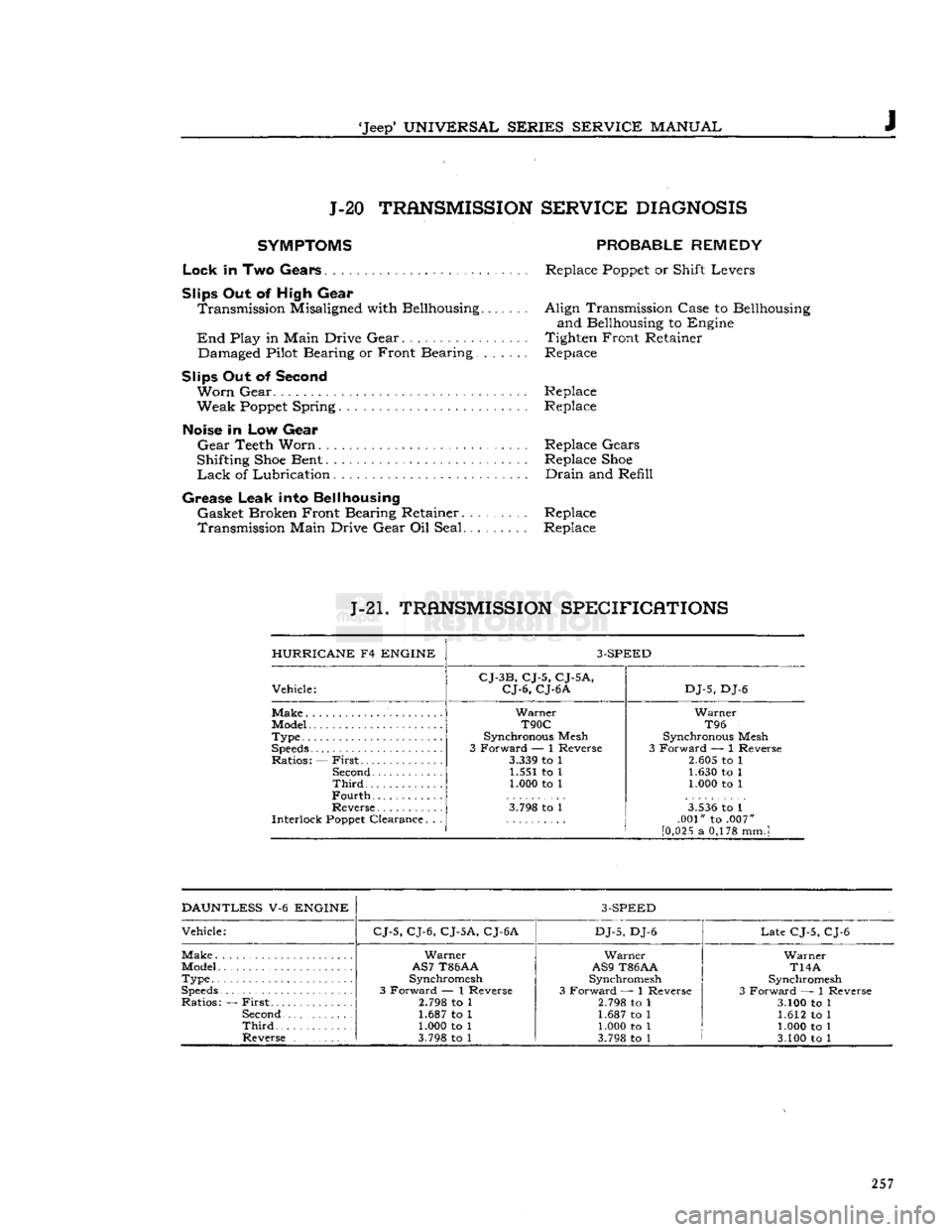
J J-20
TRANSMISSION
SERVICE
DIAGNOSIS
SYMPTOMS
PROBABLE
REMEDY
Lock
in Two
Gears
Replace
Poppet
or Shift Levers
Slips
Out of High Gear Transmission Misaligned with Bellhousing
End
Play in Main Drive Gear Damaged Pilot Bearing or Front Bearing.
Slips
Out of Second
Worn
Gear Replace
Weak
Poppet
Spring Replace
Noise
in Low Gear
Gear
Teeth Worn Replace Gears
Shifting
Shoe
Bent Replace
Shoe
Lack
of Lubrication Drain and Refill
Grease
Leak into Bellhousing Gasket Broken Front Bearing Retainer Replace
Transmission Main Drive Gear Oil Seal Replace Align Transmission Case to Bellhousing
and Bellhousing to Engine
Tighten Front Retainer
Replace
J-21.
TRANSMISSION
SPECIFICATIONS
HURRICANE
F4
ENGINE
3-SPEED
Vehicle:
CJ-3B,
CJ-5,
CJ-5A,
CJ-6,
CJ-6A
DJ-5,
DJ-6
Make
Type
Speeds
Ratios: —
First
Second
Third
Fourth
Warner
T90C
Synchronous Mesh
3 Forward — 1 Reverse
3.339
to 1 1.551 to 1 1.000 to 1
Warner
T96
Synchronous Mesh
3 Forward — 1 Reverse
2.605
to 1 1.630 to 1
1.000 to 1
Reverse
Interlock
Poppet
Clearance. . .
3.798
to 1
3.536
to 1
.001" to .007"
[0,025
a 0,178 mmJ
DAUNTLESS
V-6
ENGINE
3-SPEED
Vehicle:
CJ-5,
CJ-6,
CJ-5A,
CJ-6A
DJ-5,
DJ-6
Late
CJ-5, CJ-6
Make
Warner
Warner Warner
Model
AS7
T86AA
AS9
T86AA
T14A
Type..
Synchromesh
Synchromesh Synchromesh
Speeds
3 Forward — 1 Reverse 3 Forward — 1 Reverse 3 Forward — 1 Reverse
Ratios: —
First
2.798
to 1
2.798
to 1
3.100 to 1
Second
1.687 to 1 1.687 to 1 1.612 to 1
Third
1.000 to 1
1.000 to 1 1.000 to 1
Reverse
3.798
to 1
3.798
to 1 3.100 to 1 257
Page 260 of 376
Jl
FOUR-SPEED
TRANSMISSION
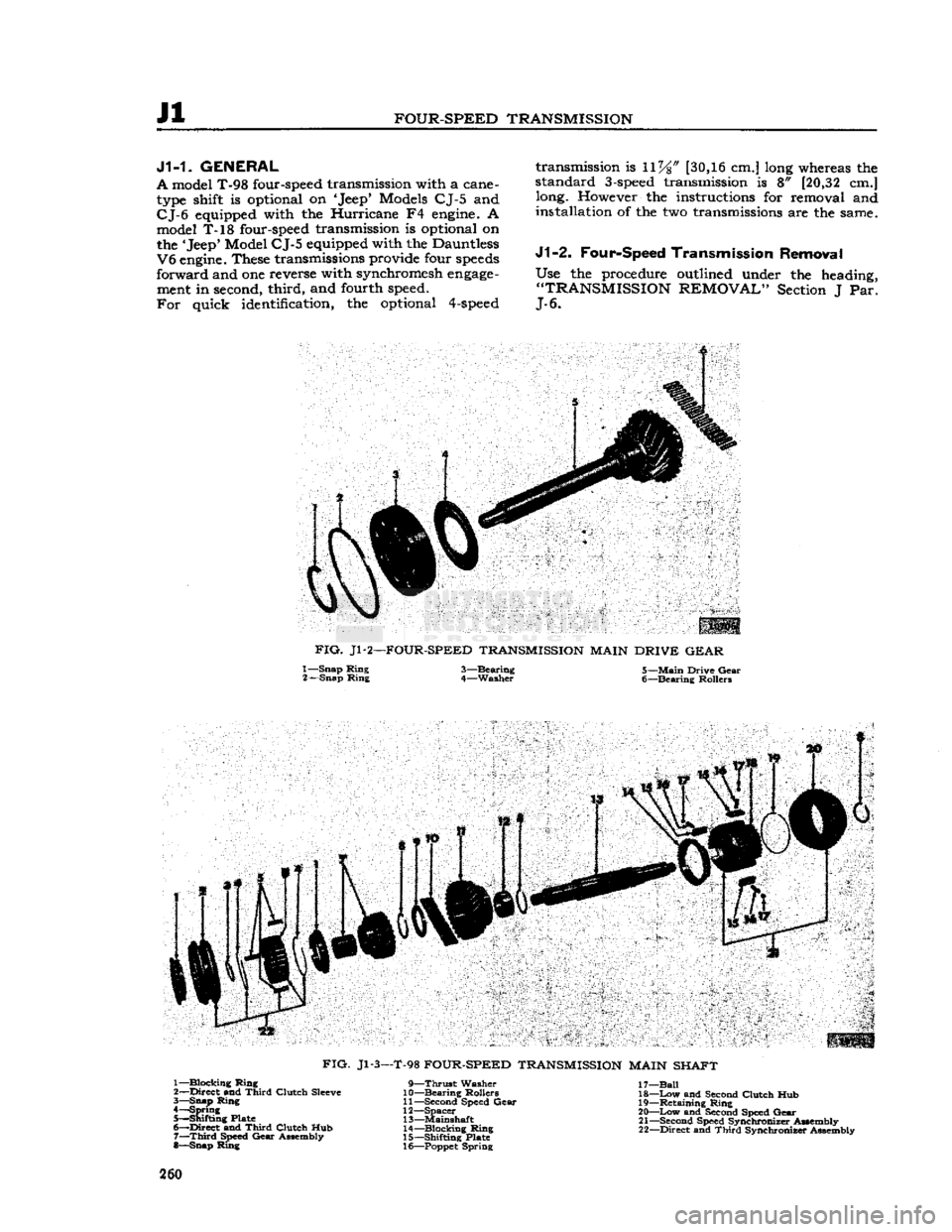
J1-1.
GENERAL
A
model T-98 four-speed transmission with a cane- type shift is optional on 'Jeep* Models CJ-5 and
CJ-6
equipped with the Hurricane F4
engine.
A model T-18 four-speed transmission is optional on
the 'Jeep* Model
CJ-5
equipped with the Dauntless
V6
engine.
These transmissions provide four
speeds
forward
and one reverse with synchromesh
engage
ment in second,
third,
and fourth speed.
For
quick identification, the optional
4-speed
transmission is 11%"
[30,16
cm.] long whereas the
standard
3-speed
transmission is 8"
[20,32
cm.] long. However the instructions for removal and
installation of the two transmissions are the same.
J1-2.
Four-Speed
Transmission Removal Use the procedure outlined under the heading,
"TRANSMISSION
REMOVAL"
Section J Par.
J-6.
FIG.
Jl-2—FOUR-SPEED TRANSMISSION MAIN DRIVE
GEAR
1—
Snap
Ring
3—Bearing 5—Main
Drive
Gear
2—
Snap
Ring
4—Washer 6—Bearing Rollers
FIG.
Jl-3—T-98
FOUR-SPEED TRANSMISSION MAIN SHAFT 1—
Blocking
Ring
2—
Direct
and
Third
Clutch
Sleeve
3—
Snap
Ring
4—
Spring
5—
Shifting
Plate
6—
Direct
and
Third
Clutch
Hub 7—
Third
Speed
Gear
Assembly
8—
Snap
Ring
9—Thrust
Washer
10—
Bearing
Rollers
11—
Second Speed
Gear
12—
Spacer
13—
Mainshaft
14—
Blocking
Ring
15—
Shifting
Plate
16— Poppet
Spring
17—
Ball
18—
Low
and Second
Clutch
Hub 19—
Retaining
Ring
20—
Low
and Second Speed
Gear
21—
Second Speed
Synchronizer
Assembly
22—
Direct
and
Third
Synchroniser Assembly 260
Page 261 of 376
'Jeep*
UNIVERSAL
SERIES SERVICE
MANUAL
Jl
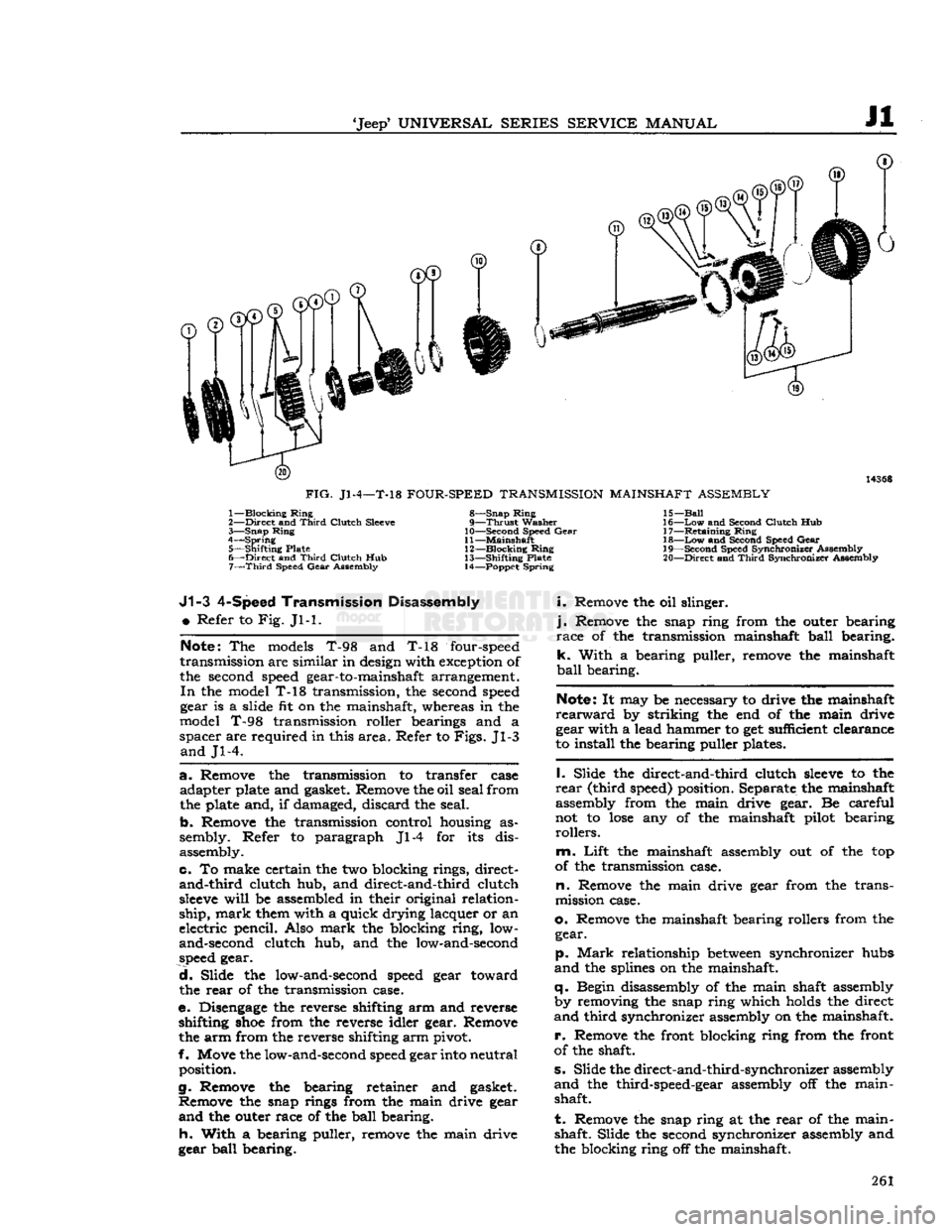
1—
Blocking
Rir
2—
Direct
and 1
3—
Snap
Ring
4—
Spring
5—
Shifting
Plat
6—
Direct
and 1 7—
Third
Speed
J1-3
4-Speed Transmission Disassembly
•
Refer to Fig. Jl-1.
Note;
The
models
T-98 and T-18 four-speed
transmission are similar in design with exception of
the second
speed
gear-to-mainshaft arrangement.
In
the model T-18 transmission, the second
speed
gear is a slide fit on the mainshaft, whereas in the
model T-98 transmission roller bearings and a
spacer are required in this area. Refer to Figs. Jl-3
and
Jl-4.
a.
Remove the transmission to transfer case adapter plate and gasket. Remove the oil seal from
the plate and, if damaged, discard the seal.
b. Remove the transmission control housing as
sembly. Refer to paragraph Jl-4 for its dis
assembly.
c. To make certain the two blocking rings, direct-
and-third
clutch hub, and direct-and-third clutch
sleeve
will
be assembled in their original relation
ship,
mark them with a quick drying lacquer or an
electric pencil. Also mark the blocking ring, low-
and-second clutch hub, and the low-and-second
speed
gear.
d.
Slide the low-and-second
speed
gear toward the rear of the transmission case.
e.
Disengage
the reverse shifting arm and reverse shifting
shoe
from the reverse idler gear. Remove
the arm from the reverse shifting arm pivot.
f. Move the low-and-second
speed
gear
into
neutral position.
g. Remove the bearing retainer and gasket.
Remove the snap rings from the main drive gear
and
the outer race of the ball bearing.
h.
With a bearing puller, remove the main drive
gear ball bearing. 1436S
i
Hub
Gear
izer
Assembly
ironizer
Assembly
i.
Remove the oil slinger.
j.
Remove the snap ring from the outer bearing
race
of the transmission mainshaft ball bearing.
k. With a bearing puller, remove the mainshaft
ball
bearing.
Note:
It may be necessary to drive the mainshaft
rearward
by striking the end of the main drive gear with a lead hammer to get sufficient clearance
to install the bearing puller plates.
I.
Slide the direct-and-third clutch
sleeve
to the
rear
(third
speed)
position. Separate the mainshaft
assembly from the main drive gear. Be careful
not to
lose
any of the mainshaft pilot bearing
rollers.
m.
Lift
the mainshaft assembly out of the top
of the transmission case.
n.
Remove the main drive gear from the trans
mission case.
o. Remove the mainshaft bearing rollers from the gear.
p.
Mark
relationship
between
synchronizer hubs
and
the splines on the mainshaft.
q. Begin disassembly of the main shaft assembly by removing the snap ring which holds the direct
and
third synchronizer assembly on the mainshaft,
r.
Remove the front blocking ring from the front
of the shaft.
s. Slide the direct-and-third-synchronizer assembly
and
the third-speed-gear assembly off the main-shaft.
t. Remove the snap ring at the rear of the main-
shaft. Slide the second synchronizer assembly and the blocking ring off the mainshaft.
FIG.
Jl-4—T-18
FOUR-SPEED TRANSMISSION MAINSHAFT ASSEMBLY
ng 8—Snap
Ring
15—Ball
third
Clutch
Sleeve
9—Thrust
Washer 16—Low and Second
Clutch
10—
Second
Speed
Gear
17—Retaining
Ring
11—
Mainshaft
18—Low and Second Speed
te 12—Blocking
Ring
19—Second Speed
Synchroni
rhird
Clutch
Hub 13—Shifting Plate 20—Direct and
Third
Synch
Gear
Assembly 14—Poppet
Spring
261